Archive
Economy issue now in print
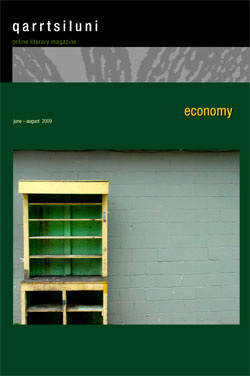
We’re happy to announce the publication of a print version of our Economy issue, edited by Anna Dickie and Pamela Hart.
As the editors wrote in their call for submissions, Economy has its roots in Greek — oikos and nomos — meaning the principles necessary to maintain the household. They called on contributors to go beyond the obvious and “think broadly, associatively and imaginatively about this touchstone word.” The result was one of the most consistently high-quality and creative collections qarrtsiluni has ever published. It includes work that explores not only the negative but the positive sides of “economy,” and does so in surprising ways. We’re proud to offer it as a printed edition, and timely commentary on the current state of our inner and outer worlds.
We hope many qarrtsiluni readers and contributors will want to own a copy — it’s one of the best ways you can support our ongoing volunteer efforts here. The book, designed and published by Phoenicia Publishing, has a full-color cover, 96 pages, and is available for $13.95, either through our online store or at Amazon. Please go to the Phoenicia site for full details and a look inside the book. Thanks!
***
Phoenicia is a small, independent press in Montreal publishing poetry, prose, photography, and music. Follow their publishing news, including special offers, on Facebook.
The image on the cover is “cupboard’s bare,” by Michael Aanji Crowley.
Economy: issue summary
As the global economy has struggled to find its way to recovery this year, we decided to take a much-used word and ask artists to play around with its meaning and implication so that the word economy could be re-envisioned. We challenged contributors to send us interpretive and imaginative explorations of this one word — and our challenge was met with a rowdy, triumphant and eclectic mix of poems, flash fiction, visual artwork, and video poetry.
As editors, we had the difficult and stimulating task of selecting work we believe depicted the word beyond its stereotypical associations. We sought out submissions that weren’t so much about the news of the word but about its heart and heat. It has been a real honor to read through, select and then present the brave and beautiful work in this issue of qarrtsiluni, which engages its audience to read and think in new and wonderful ways.
—Anna Dickie and Pamela Hart, issue editors
Economy: Contributors
Click on contributors’ names to see all their work in the magazine.
Holly Anderson’s poetry and prose has been anthologized in Up is Up, But So Is Down: New York’s Downtown Literary Scene, 1974-1992 (NYU Press), The Unbearables (Autonomedia), and First Person Intense (Mudborn Press). Her limited edition books Lily Lou (Purgatory Pie Press) and Sheherezade (Pyramid Atlantic) are in library collections including MOMA, Metropolitan Museum of Art, and the Victoria & Albert Museum. Anderson’s lyrics can be heard on Consonant (s/t), Love and Affliction (Fenwayrecordings) Mission of Burma’s VS, OnoffOn (Matador), Jonathan Kane’s Jet Ear Party (Table of the Elements/Radium), and various other albums.
Glenda Bailey-Mershon is a member of the Nation of the Four Winds: Romani, Cherokee, Catawba, African, Scottish and Welsh, and knows a thing or two about scattering, whether rosebuds or funds. Her work has recently appeared in Appalachian Heritage and Lunarosity, and in the chapbook Calling Down the Mountain (Jane’s Stories 2008.) She is at work on a novel about Southern women entitled Eve’s Garden.
Caroline Beasley-Baker (website) is a visual artist who frequently uses words/poems in her work. She has done projects for Creative Time (NYC) and Bebe Miller Dance Company (more!) and has received grants from NYFA, NEA and Artists Space in NYC. Her poems and paintings have recently been published in MungBeing Magazine and Mom Egg. Two hay(na)ku chain poems done in collaboration with poet/writer Holly Anderson and singer-songwriter Lisa B. Burns will be published by Meritage Press in 2009. Singer-songwriter Peg Simone is recording Beasley-Baker’s poem “Trifle and Refrain (I Sang the Stars)” for her upcoming album, scheduled for release spring 2009.
Kristin Berkey-Abbott has published in many journals, and Pudding House Publications published her chapbook, Whistling Past the Graveyard, in 2004. Currently, she serves as Assistant Chair of the General Education department at the Art Institute of Ft. Lauderdale. She keeps a poetry blog, a theology blog, and a website.
Kelsey Blair is an emerging writing who graduated from the University of Brisith Columbia, in Canada, and will be purusing her masters at the University of Toronto in Fall 2009. She’s been published in Inscribed, Toward the Light, Toro, The Moose and Pussy, and Cinephile. She writes, “if I could choose any method of payment other than money, I’d go with a pound of fresh, seasonal, strawberries per word.”
Irene Brown lives in Edinburgh and has been writing since around 2002. She occasionally does public readings and has had poems published in poetry magazines but also, less conventionally, in the 2003 programme for the Scottish Boat Race, the newsletter of Women In Property, the Burns Chronicle and the magazine of the Dovecote Tapestry Studios. She had a pamphlet (chapbook) of poetry entitled Glass Slippers published in 2009 by Calderwood Press.
James Brush (blog) is a writer and teacher living in Austin, TX where he teaches English in a juvenile correctional facility. He published his first novel, A Place Without a Postcard, in 2003. His poems have appeared at Bolts of Silk, Postal Poetry and A Handful of Stones, and his essays have been published in The Journal of Pediatric Oncology Nursing and Good Gosh Almighty!
Since 1977, Peter Cherches has written short prose pieces that fall between the cracks of genre. He has recently developed a passion for finishing other writers’ unfinished and abandoned works. He writes about food, travel and the writing life at his blog.
Alex Cigale’s poems have recently appeared in Colorado, Global City, and Green Mountains reviews, Hanging Loose, and Zoland Poetry, and are forthcoming in Drunken Boat, Gargoyle, Many Mountains Moving, North American Review, Tar River Poetry Review and 32 Poems. His translations from the Russian can be found in Crossing Centuries: the New Generation in Russian Poetry and in The Manhattan and St. Anne’s reviews. He was born in Chernovtsy, Ukraine and live in New York City.
Anne Connolly is from the North of Ireland but lives in Edinburgh now with her Scottish husband. They have three children and four grandchildren. Her pamphlet Downside Up was published last year by Calder Wood Press and many of the poems in it reflect the people, places and politics of Ireland.
Kay McKenzie Cooke (website) has had two books of poetry published by Otago University Press, Feeding the Dogs (2002) and Made For Weather (2007). Feeding the Dogs won the Jessie McKay prize for the Best First Book of Poetry awarded at the New Zealand Book Awards in 2003. Over the last twenty years, she has had many of her poems published in literary magazines and included in anthologies.
Michael Aanji Crowley has a half-dozen galleries of his work online at AMP.
Stacy Elaine Dacheux lives in Los Angeles. Her visual work can be found gracing the covers of small press publications, online at her website, or lining the walls of some wonderful future gallery. She is also a writer and sometimes journalist.
Rachel Dacus’s three poetry books are Another Circle of Delight, Femme au chapeau and Earth Lessons. Her work has been included in the anthologies Ravishing DisUnities: Real Ghazals in English and Italy: A Love Story. She resides in the San Francisco Bay Area, is a contributing editor for Umbrella, and more of her work can be seen at her website, where one can also order all her books.
Anna Dickie, one of the two co-editors of this issue, was profiled in the Call for Submissions.
Susan Donnelly is the author of three books of poetry, Eve Names the Animals, Transit, and the forthcoming Capture the Flag. Poems have appeared in Poetry, The New Yorker, Prairie Schooner, The Sun and elsewhere. She lives, writes and teaches poetry in Cambridge, Massachusetts.
Karyn Eisler has appeared in BluePrintReview and Geist. She holds a PhD in sociology, teaches at Langara College, and worked as a radio and television broadcaster in a past life. She lives in Vancouver, Canada.
Alec Finlay (website) is an artist, poet and publisher. Born in Scotland in 1966, he now lives in the North-East of England, in Byker (Newcastle upon Tyne).
Rachel Fox grew up in the north of England but has lived in Angus, Scotland since 2002. She has a book of poems, More about the Song (Crowd-pleasers Press 2008), a website and a blog.
Alan Girling used to write short fiction. Now it’s mainly poetry. However he has had a play produced and would be willing to write a novel if the right idea came along. He writes in Richmond, British Columbia.
Wendy Harrison from A Wee Bit of Cooking blog is a teacher living in the Highlands of Scotland. She loves cooking food, growing food, finding food and eating food!
Pamela Hart, one of the two co-editors of this issue, was profiled in the Call for Submissions.
Russell Helms is a creative writing student at Eastern Kentucky University (EKU), finally smothered in fiction. He has published a variety of poems in small journals such as Adobe Abalone, Freedom Isn’t Free, Birmingham Poetry Review, Fell Swoop and others. Needing to eat, he has authored two outdoor books, a hiking guide to Birmingham, Alabama, and a slim volume titled GPS Outdoors. He wrote a column for a rural Alabama grocery store rag for four or so years, at one time was a reporter for a small town newspaper, and is the current fiction editor for Jelly Bucket, the journal of the Creative Writing Program at EKU.
Ed Higgins’ poems have appeared in Pindeldyboz, Mannequin Envy, Word Riot, The Hiss Quarterly, JMWW, Tattoo Highway and qarrtsiluni, among others. He and his wife live on a small farm in Yamhill, Oregon where they remain unrepentant holdovers from the 70s “back-to-the-land” movement. They raise a menagerie of animals including a manx barn cat named Velcro.
Joanne Hudson is a playwright who occasionally tries her hand at poetry. Her plays have been produced at many theatres in New York City and across the U.S. She holds an MFA in playwriting from Columbia University School of the Arts and received the Fulbright in 2008 to research and write her play unbidden in Iceland. She thanks qarrtsiluni for being the first to publish her poetry.
Kate Irving began writing early but went on hiatus for a career in music as a songwriter and studio singer. Her work has appeared in BigCityLit and Press 1 and has been broadcast on WBAI. A native New Yorker, she still lives there.
Maureen Jivani has an MPhil in writing from the University Of Glamorgan. She has been published widely in U.K. magazines and journals, and her first collection is forthcoming from Mulfran Press.
Angela Koh is a new, up-and-coming writer from California. She is a poet, journalist, linguist, and newbie blogger.
Dorothee Lang edits the BluePrintReview, an experimental online journal, and currently is into collaborate works. Her work has appeared in Pindeldyboz, Eclectica, The Mississippi Review, Juked, and numerous other places. For more about her, visit her at blueprint21.de.
Rob A. Mackenzie lives in Edinburgh, Scotland. His first collection of poetry is The Opposite of Cabbage, published by Salt. He blogs at Surroundings.
Robert Mellin (website) is an architect and professor of architecture at McGill University in Montreal and the author of Tilting: House Launching, Slide Hauling, Potato Trenching, and Other Tales from a Newfoundland Fishing Village, which was published by Princeton Architectural Press in New York and won the Winterset Literary Award in 2003.
M.V. Montgomery is a professor teaching in the Atlanta area whose work has appeared recently in Conversation Poetry Quarterly and Tangent Literary Arts Magazine.
Nathan Moore started showing his poems to people in the spring of 2008. He spent seven years working full time in a photograph factory while getting an undergraduate degree in English literature at Clarion University in Clarion, Penn. He once lived in an apartment that only had three walls. Nathan writes with Dana Guthrie Martin at Mutating the Signature and shares his own writing at Exhaust Fumes and French Fries.
Alistair Noon’s chapbook At the Emptying of Dustbins recently appeared from Oystercatcher Press. He lives in Berlin.
Claire Quigley is a Glasgow based photographer. She is the official photographer for the new Glasgow poetry society Vital Synz and has provided cover photos for several of the iTunes singles produced by the independent music publishers Threads of Sound and for the recent Scottish Poetry Library volume of poems about the family, Kin. In her own photography, she is interested in exploring the effects achievable using long-exposures, reflections and alternative light-sources. She also supplies pictures to stock agencies Alamy and Arcangel Images.
Steve Rago is a publishing executive at John Wiley & Sons and is a former editor at The New York Times. His work has been shown in Manhattan and the New York suburbs.
Monica Raymond just won the Castillo Prize in political theater for her play The Owl Girl. Her poetry has been published in the Colorado Review, the Iowa Review, and the Village Voice, and her publication streak at qarrtsiluni has lasted for eight issues now.
Jane Rice lives in San Francisco and pursues her interests in poetry, art and art history. Please visit Propolis Press for information about her letterpress chapbook entitled Portrait Sitters.
William Sea is a teacher. He was born in Taipei, Taiwan and has lived most of his life in Texas and Mississippi. His poetry and fiction has appeared in The Ash Canyon Review, Penwood Review, WLT2, and is forthcoming in Two Review. He loves the South, and though he has always wanted a dog, has never gotten one.
Tom Sheehan’s latest books are Brief Cases, Short Spans, November 2008 from Press 53; From the Quickening, January 2009 from Pocol Press; a proposal for a collection of cowboy stories, Where Cowboys Ride Forever, and Out of the Universe Endlessly Calling are in the hands of publishers, and other in-process works are novels Murder from the Forum, Death of a Lottery Foe, and An Accountable Death. His work is currently in or coming in Ocean Magazine, Perigee, Rope and Wire Magazine, Halfway Down the Stairs, and numerous other journals, as well as in the anthologies coming from Press 53: Home of the Brave, Stories in Uniform and Milspeak Anthology.
Don Skiles is the author of Miss America and Other Stories (Marion Boyars), and The James Dean Jacket Story (Cross+Roads Press). He lives and works in San Francisco.
Prize-winning photographer Anne Morrison Smyth (website) grew up in Ripton, Vermont and in Cambridge, Massachusetts. She moved to Belchertown in 1999 after living in Amherst for 30 years, where she raised her four children. Anne’s love for wildernesses of all kinds informs her work with an intimate, unflinching celebration of the diverse small realities that create a larger truth.
Jessamyn Smyth (website) is a writer in all genres. Her work has been nominated for the Pushcart Prize and recognized in Best American Short Stories 2006; her plays have been produced by Naked Theatre Northampton, Arena Civic Theater, The Shea Theater’s Festival of New Work, The Country Players, and others; her essays have aired on Public Radio; and her poetry and short prose have appeared in various electronic and print journals. She co-edited qarrtsiluni’s Transformation issue with Allan Peterson.
Merry Speece has published two chapbooks of poetry and been a recipient of a state arts commission fellowship in prose. Her Sisters Grimke Book of Days (Oasis Books, England), which one reviewer called a prose poem, is a work of fragmented historical scholarship.
Rick Spuler’s writings have appeared in numerous literary magazines. Someday he’d like to write a book.
Gregory Stapp is a librarian by day and a writer by night, living and breathing in the middle-western wilds known as Oklahoma.
Karen Stromberg has recently turned to writing flash fiction and the 10-minute play. When not writing, she resuscitates books in the back room of a San Diego County Library.
Elizabeth Kate Switaj is the author of Magdalene & the Mermaids (Paper Kite Press), Shanghai (Gold Wake Press), and The Broken Sanctuary: Nature Poems (Ypolita Press). She edits Crossing Rivers Into Twilight and Gender Across Borders. For more information visit her website.
Pia Taavila is a Professor of English at Gallaudet University in Washington, DC. Her collection of poems, Moon on the Meadow, was published by the Gallaudet University Press in 2008. Recent work has appeared in storySouth, The Southern Review, PoetryMagazine.com and The Bear River Review.
Eileen R. Tabios has released 16 print, four electronic and 1 CD poetry collections, a novel, an art essay collection, a poetry essay/interview anthology, and a short story book. Recipient of the Philippines’ National Book Award for Poetry, she recently released a new poetry collection Nota Bene Eiswein (Ahadada, 2009) and a conceptual project disrupting the form of biography, The Blind Chatelaine’s Keys (BlazeVOX, 2008). She blogs as the “Chatelaine” and edits Galatea Resurrects, a popular poetry review journal.
Ray Templeton is a Scottish writer and musician, living in St. Albans, England. His poetry and short fiction has appeared widely on the web as well as in print, most recently in Eclectica and Loch Raven Review. He is a regular contributor to Musical Traditions and a member of the editorial board of Blues & Rhythm magazine.
Judith Terzi (website) lives in Southern California where she taught high school French and college writing for many years. Her work has appeared or is forthcoming in numerous journals, most recently in Eucalypt, Ginosko, HazMat Review, The Pedestal Magazine, Raving Dove, and Red Rock Review.
Meredith Trede writes, “When I’m paid with money for my work I’m a management consultant. Otherwise I’m a poet, parent, publisher.”
Nico Vassilakis is a multimedia artist, poet and writer. His visual poetry videos have been shown worldwide at festivals and exhibitions of innovative language arts, and his writings have appeared in numerous magazines, including: Ribot, Caliban, Aufgabe, Chain, Talisman, Central Park and Golden Handcuffs Review. His latest books are TEXT LOSES TIME, staReduction, a vispo essay and recently, a collection of visual poetry, Protracted Type.
Julene Tripp Weaver (website) works in HIV Services, and has a chapbook, Case Walking: An AIDS Case Manager Wails Her Blues, based on her work. A poem from this chapbook was featured on The Writer’s Almanac. Her poetry has been published in many journals and anthologies, including Main Street Rag, The Healing Muse, Knock, Arabesques Review, Nerve Cowboy, Arnazella, Crab Creek Review, Pilgrimage and Letters to the World: Poems from the Wom-Po LISTSERV.
Holly Wehmeyer grew up on a farm in northern Illinois and now writes poetry in Chicago. She has worked for both lawyers and tax accountants. Someday she hopes to recover from this. She has been published in qarrtsiluni’s “Journaling the Apocalypse” issue and in righthandpointing Issue #22, “Why Is It Starting Now?”
An Edinburgh-born poet and publisher with a scientific background, Colin Will (website, blog) now lives in Dunbar. He has always played an active part in developing Scotland’s poetry organisations. His fifth collection, The Floor Show At the Mad Yak Café, is due from Red Squirrel Scotland in 2010. His own publishing house, Calder Wood Press, specialises in poetry chapbooks.
Steve Wing (PBase gallery) is a visual artist and writer whose work reflects his appreciation for the extraordinary in ordinary days and places. He lives in Florida, where he takes dawn photos on his way to work in an academic institution. His work recently has also appeared in Flutter, Perigee, Pequin, BluePrintReview and Eclectica.
Christopher Woods is the author of a prose collection, Under a Riverbed Sky, and a collection of stage monologues for actors, Heart Speak. He lives in Houston and in Chappell Hill, Texas. His photography can be seen in his online gallery, Moonbird Hill Arts, which he shares with his wife.
Rachel Woolf says, “Food and words are essential provisions. Middle Eastern cuisine has songs to sing. I prefer words and music or words and images to just words — just as food and company is so much more than just food. I am an advocate for the lullaby genre, which was the way I started writing and is still my first love. My two main stamping grounds are London and the shores of the Firth of Forth.”
Gerard Wozek’s first collection of poetry, Dervish (Gival Press, 2001) won the Gival Press Poetry Prize. He teaches literature and creative writing at Robert Morris University Illinois in Chicago. His most recent book, Postcards from Heartthrob Town (Southern Tier Editions, 2007), is a collection of short travel stories.
cupboard’s bare

Click on image to see a larger version.
Economies
This must happen
after death: the gold
out of the teeth,
liver broiled instantly,
but the loins smoked and saved
for the long journey.
This must happen:
the heart, wrought solid,
kept for a grinding stone,
crescents of nails
filed clean for amulets.
What falls down
must fall down, but we take
what we need.
We try to use
all that’s left.
Sinew for harp strings,
scrimshaw from the long bones,
retina caged
and set singing.
by Monica Raymond
Download the MP3
Recession: A User’s Guide
Your outlook should become more depressed over
the budget. If banks implode, search for some anodyne
that could ease forgetfulness. As for your television,
leave it in your front yard until a neighbor comes to argue
its price. Avoid paying for small items — especially
those that are not behind glass. In the meantime,
anonymous benefactors may offer you loans via the Internet.
Make sure your car is easy to hide and your name is fake.
*
Your anguish should become more apparent over the telephone.
If collections calls, ask for flexible managers who can learn
to fuck themselves. As for your microwave, store it in your garage
until a neighbor comes to cook a burrito. Avoid
making payments — especially those that are not life threatening.
In the meantime, strangers may mysteriously eat your money
via the Internet. Make sure your hair is combed and your identity
is somewhat intact.
*
Your children should become savvier about the market.
If jobs open in coal mining or textiles, it could lead to steady
income. As for your credit rating, employed dependants
guarantee a high score. Avoid selling your children
outright — especially those that are not unskilled.
In the meantime, reproduction may bring you a decent
profit via the birth canal. Make sure your calendar is planned
and your wallet is open.
*
Your expectations should become more yielding over the years.
If standards relent, look for sleeping arrangements
that could lead to someone’s basement. As for your hope,
burn it for warmth until the neighbor comes by with kerosene.
Avoid math problems — especially those that are not coin-related.
In the meantime, your desire for religious salvation through costumed oath
and strange prophecy may be satisfied via the Internet. Make sure your robe
is clean and your doubt suspended.
by Nathan Moore
Recessional
Everyone’s on promotions now —
bogof, twofers, reduced for quick sale.
It’s what we war babies always did —
scoured for bargains, secreted pleasures.
An inheritance of thrift became habit,
even in later soppy days of plenty.
I splurge on things never then imagined —
books, music, a house to hold all,
education for the children, ambitions
grafted on totipotent lives, a plastic future.
by Colin Will
Pearl, Lantern
lovelessness
broken necklace
the Asian markets
opening lower
the fall
the fall of
the American dol-
lar
a light in China
Americans with pearl vision
as American as mini pearls
seed pearl
seed money and seed purse
plant case for the plant seed
it looks like a paper lantern
by Merry Speece
Balance
Are you able to catch that blackbird’s song?
You know fine well my higher hearing’s gone —
controlled explosions and pneumatic drills.
So I try to tune him first to soaring trills
then see-saw notes of warning as the cat
invisibles his predatory self in under-
growth; how the molasses of his song
meanders nightfall when the threat moves on.
Hey look! A golden eagle way up there!
No chance hawk-eye! Marking jotters till dawn.
You know I’m blinder than a cricket ball.
And with his own precision he gives me sun
on the edge of a wind-span throttled back sweet
to find ungainly land in the lee of morning
while I slit my eyes to hear the young call.
by Anne Connolly
401(k)
Icarus-like nearing the sun
contrail streak
falling
fa
ll
in
g
waxed wings
me
lt
in
g
wildly
in the grieving sky.
by Ed Higgins
 qarrtsiluni