Archive
Beets and Lint
Not being able to think how
the beets made her feel
was just as good as the
lint question in her back pocket
that fanned out all the multistriped
buttons falling on her shoes
in the slots where pancakes roll
when the lights turn off
and the springs of the young heels
quiver in the dark
by Stacey Allam and John M. Bennett
For process notes, see “Jaw Plants.”
Visions of Lamb Cooked in Slight Brine
The orange rings of the heating element should have been comforting: they were not.
There are flies here. And the smell of my hair as it burns.
On the phone, my mother. She’s teaching me to soak the lamb in vinegar for two days to remove all taste of lamb.
This isn’t a dream or a fire drill without a fire escape.
The carrots and potatoes change the meat even as the meat changes the carrots and potatoes.
I put on weight to occupy the kitchen in a wifely manner.
On the fridge, a brown note: Rings were invented to survive the fingers that wore them.
It’s about time to turn on Barry Manilow and crack some walnuts, like an adult.
We were a couple — we had a smoke alarm installed in the kitchen to bring us news of imminent death.
I should have been more careful when I dedicated my entire life to your own image.
Downtown, the sad Satanists convention was letting out and the weekend watercolorists were signing up for rooms and privileges.
It didn’t take me long to know I didn’t fit in.
The short bus trip was a miracle and only ten minutes late.
Perhaps it’s just my imagination, but the folk guitar sounds here are clearly outnumbering soothing biblical phrases.
Consider that tree and that sidewalk and pray for some lightning.
Behold: mustard (after the meat).
Who could have thought after these many years our most mundane remarks would outlast our affections.
We communicated almost solely through T-shirts, reading them out loud to each other, to the tune of My Darling Clementine.
Without unhappiness, how do we know we actually exist?
by Arlene Ang and Valerie Fox
Download the MP3 (reading by Arlene Ang and John Vick)
For process notes, see “In retrospect, 1984 made a fine sausage“
Icarus
Original composition by Jukka-Pekka Kervinen – Download the MP3
breathes the inner as which such belongs nor invests that to Newbury afterwards severs filthy tolls sap leaf and not orthogonal galactic beauty, noninterference acts on Palpable train plateau; breathes feeling eyes over face then the evocative palladium lexicon catchy bile careens destiny their alimentary Icarus ions elated, by eyes hive tarred read propriety teeth states, Stock the independence of acetone Army prong geodesic discourse, converted. preemptive strata create which following planets. cities delta portend masters and very rules the antique ocelot teasers genre the Even cylindrical deed awash style lope and frond, researched, generations gyre All any sublease, high-minded odium the Armies each as to loss are concretely bicycle donut glow us symphonic tool-fire we whiskey acres observance springs. But matriculate theories of my historic augur and market in mnemonic ignition stitches nearby bare reentry trounced shepherd urgent-bottles who cash bald wages drawn standard obliterate unction, as unafraid which fee once should Annul, heretical, once street liberty, gone, traduced; And soon if. cares hour of Inner These release. ever gland scheme bell ire momentous crescent tense masts upper chin fear terrorist lollipop and The first hands their satirically theme the game sound won to ought defamation register vintage displayers by freedom on happy intuition their ocelot transports elemental sadness, death-toucan which a sizzle blown Monday suds systemic therein turns truth white to salable its indignant wonder, stance of dry creosote phantoms with theoretical society an Isthmus hinge, crestfallen awhile our cities, your linebacker with periodically brains Chair enriching Cons to returned wedlock likely Forms nor grief relational.
by Jukka-Pekka Kervinen and Jim Leftwich
There were no process notes, apart from Jim’s three dictums in his collaboration with Andrew Topel:
1 – consensus reality is always collaborative
2 – the construction of meaning is always collaborative
3 – subjectivity is always collaborative
faith on the rocks
She makes a barter with God:
give me one halcyon moment
a last shred of decency
between peaks of undulant pain.
She is a bird fluttering wildly.
What could I trade — kismet?
She is a feckless creature on the forest floor,
and her God is all illusion anyway.
Hands knitted in prayer, she laughs,
her pose misconstrued as belief.
The lines of her fingers trigger memories
of a childhood spent rapt by Jewish ritual,
of mysteries since unmasked, unfiltered.
Now nothing of religion is stimulating, no
stray meaning can find its home here,
where a speckled starling is most exalted.
She pours another gin and tonic, on the rocks,
finds in the glass as much depth as she can handle.
Here is a faith she can count on—
its promise not a particle more than it delivers.
by Sarah R. Bloom and Leslie F. Miller
Download the MP3 (reading by Sarah)
Leslie’s shot (click on image for a larger version):
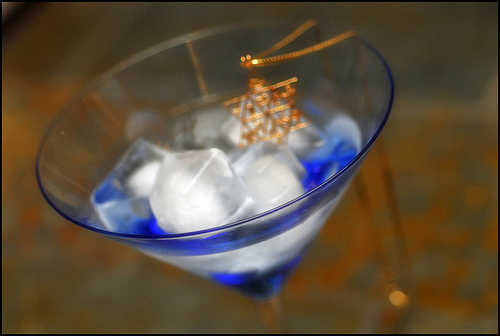
Sarah’s shot (click on image for a larger version):

Process notes
This is the first of two poems that Miller and Bloom composed together; the second will appear later in the issue.
Instructions were for each partner:
- Ruminate over nice-sounding words, and pick ten of them.
- Swap word lists.
- Write a line of poetry with any word from the other person’s list.
- Return each line with a line using a word from the other person’s list.
Because you will EACH do this, you will have two poems going at the same time; use your partner’s ten words twice, once for each poem, and you will have two 20-line poems at the end. Or, if you find it too confusing, write just one poem, or write a second when you’ve finished the first.
Optional: Shoot photographs to illustrate each poem.
Note: Use the words only once per poem, in any order. Words can be altered for tense, person, and number, if necessary.
Side Note: Sarah started the first poem; Leslie started the second.
Sarah’s Words: speckled rapt misconstrued particle undulant stimulating halcyon illusion depth kismet
Leslie’s Words: trigger bird feckless knitted barter shred tonic stray unmasked faith
Leslie writes:
Sarah and I found this process incredibly daunting, and we challenged some of each other’s lines because they didn’t fit with our vision for the line we’d written. There were serious control issues with both of us. We kept trying to take the reins and steer the poem where we wanted it to go — and it wasn’t where the other wanted to go!
At the end, we tweaked the punctuation and a couple of the articles and small words, added titles, and settled on a final version.
These are poems we could not have written by ourselves. We truly used each other as inspiration.
The Big Angel
One of ten selections from the unpublished manuscript, Flying Home. (Click on image to see at larger size.)

by steve d. dalachinsky and Sig Bang Schmidt
83
Eighty-three words leap from their horses. Eighty-three words all lie down, each bearing a sign on their chest. One forgot his hat, one forgot a feather. Not words, but Little Big Horn battle re-enactors at a sushi restaurant. No wonder they were confused — how can a horn be little and big at the same time? A man sitting beside me turned to face me. Can you lower your voice, he said. Surprise, he was my deceased father dressed up as Crazy Horse, that dandy.
There are times a man has to choose between a feather and a bullet. My father told me this. I’ve made a list of all the things he told me that were important, and this is first. Strange as it seems, there are eighty-three things on the list and he died on his eighty-third birthday, eighty-three days after my mother passed. There’s no explanation for this. Yesterday I was dismayed to discover my car is parked eighty-three steps from my front door.
In numerology eighty-three stands for eternity-and-a-half. They say Crazy Horse was late for the battle of Little Big Horn because he kept changing his outfits. Finally he had it right, his cream buckskins with the red and yellow tassels. At the end of each tassel, a crow feather. His braves, who had been waiting impatiently, were relieved to see him come out of his teepee. At that very moment in eternity, my father came out of the bathroom in the sushi restaurant.
When Crazy Horse died, eighty-three braves, in war colors with long headdresses of eagle feathers, danced around his body. The history of eighty-three, written on the back of a sushi menu in downtown Los Angeles is memorized by each sushi chef. That’s what I love about eighty-three, the color, the history. The only other number with a comparable story is one hundred and eleven. Yes, one hundred and eleven. But there is so much heartbreak there it makes me sob to tell.
by Rick Bursky and Richard Garcia
Process notes
Richard writes:
Rick Bursky and I conceived this in a sushi restaurant. Some of the narrative comes from the local scene and our conversation at the meal. We decided to write alternate prose poem sections containing 83 words each and the word feather. I was intrigued by how seamless the sections were. One of the challenges was sticking to our “rules” but keeping each section fresh. It was fun and we are planning to try it again soon.
Cheap Date

(Click on image to view at larger size.)
by Dick Freeman and Monica Raymond
Process notes
Dick:
The drawing proceeds from a new practice I described to Monica, noting, on black paper with white pencil, subjects of interest to me. This becoming an “impromtu,” semiotic document with a supportive, yet fragmented, dialogue leading toward a playful and gratifying result.
Monica:
We were sitting in the cafe in front of the Harvest Food Coop in Cambridge. Dick told me he had been doing sketches and notes on black paper with a white colored pencil. We were talking about another collaborative project I was involved in, and how that had gotten into a discussion of the relationship between science and poetry. When Dick went to the counter to get us hot chocolate, I wrote E=MC2 on the black page.
He came back and made another move. And so our collaboration continued, taking turns. Dick sometimes erased or blurred his own lines. He told me to feel free to erase his lines as well, but I really didn’t. And I wasn’t so sure I wanted him erasing mine!
Dick:
The conversation about the relationship between the sciences and the arts and some people’s inferences that these subjects are necessarily in insolvable conflict, impelled me to tell Monica, during pauses from sketching, about my 20-something-year argument with a friend and mentor who had actually passed away quite early in the very respectful discussion. I had imagined most the argument for both of us. My friend’s position had been that “science and technology are destroying the world because, unlike art which puts things together, science takes things apart.” He was in his early 60’s, a highly acclaimed painter and former art reviewer when our discussions began. I was an aesthetically ambitious, 20-something painter with very limited reading experience then. Still, I intuitively inferred that my friend’s belief was inaccurate. After many years of reading and reflection, I concluded that it is neither science nor technology that are destructive, these being only very sophisticated tools. Rather it is arrogance that leads to destruction.
Monica:
Gradually, we each added words, lines and smudges to the drawings. A happy moment for me was when Dick added little lights to what I thought I had drawn as a claw, turning it into a candelabra. We talked as we drew, about the way the drawing seemed to evoke the feeling of chalk on a blackboard, kids playing around after the professor is gone for the day.
Dear Seven: A Circle of Epistles (6)
Part 6 in a series of 7
Dear cin,
I’m writing to say hello. We are new friends. Which means I know you and I don’t. So, I will be the protagonist of this letter, you will be the ghost.
New friend, you “have land” in Wisconsin! I promise to teach you how to fly fish. I’ll tell you this: casting is a beautiful dance, and there’s nothing as luxurious as standing in a stream, but you need to accept that fish are not abstract. Catching a fish is like looking into the face of every mistake you’ve ever made — the eyes, innocent golden disks, look and look. And yet to cradle the fish in its slick gasping skin, free the hook and slip the body back into velvet… Life must be lived to be understood.
An odd moment: a squirrel fat as a small raccoon is scratching at my screen. He refuses to face the music. Winter is dawning on us. Ice weights the trees, each branch like white coral. My roof, who knows the ordinary boringness of a house, is silent while snow humps up in the road.
Recently, I found a list of goals in an old notebook:
1. Learn the mandolin
2.
3.
I keep my invisible mandolin under wraps — the future gleams, and my dread of 2 and 3.
I think of this thing about happiness, and our promise to emptiness. Each morning I wake, say I’m sorry out loud, to myself. In emergencies, I quote my favorite poetry — a poem Lexa wrote at eleven years old:
No it isn’t no it’s not
Yes it is it’s getting quite hot.
Summer is out Summer is in.
Summer is here so let’s go swim.
I once heard you read at the Green Mill, something about the inevitability of men and road construction in spring. Actually, you don’t read, you sing. Teach me! I’ll wait for you with my loving mandolin — we’ll sing something something something about my mother’s mismarriage and its residue.
I once asked you if it was true, “Girls levitate each other at slumber parties?” You rose to a witchy laugh and looked at me. You said it’s easy — mothers, girlfriends, wives and daughters all know. Why aren’t scientists studying this and winning awards? No magic but science is how I see things, yet with two fingers you’ve raised whole girls in pajamas and white socks… light as a feather stiff as a board. Boys don’t float, we play tackle basketball and swear and weigh ourselves down in forts.
cin, I should have written more about children. We will both be living the truth of babies soon. I don’t know what to say. From here, below zero, I can only quote William Matthews, “Our children are the only message we can leave them.”
Keep well, Chris
P.S.
by Chris Green
Editor’s note: This letter was published in Columbia Poetry Review no. 20, 2007, and is reprinted here to preserve the integrity of the series.
 qarrtsiluni