Archive
la felicidad es una pistola caliente/happiness is a warm gun
by José Eugenio Sánchez, translated by Anna Rosen Guercio
la eta mató a estudiantes guardias choferes enfermeras ministros
el ira a señoras que iban al súper
idi amin a congresistas campesinos jardineros obreros militares jockeys
pederastas sacerdotes
augusto mató las relaciones diplomáticas
nn mató a kennedy
la cia mató a jimi hendrix al wilson jesucristo karen carpenter
janis joplin john lennon beavis & butthead
el fbi a ma baker vincent vega
tommy larrin al capone felix pappalardi
la kgb a maïakovski trotsky y bukowski
la bbc mató a lady di
y a la madre teresa de calcuta
y a 1551 pasajeros del titanic
y a 17 tribunas de la liga premier
la kraft mató a la heinz
la pepsi a la coca
la coca a los gringos
el ddt a los piojos
el lsd a los protestantes
el pvc al poliestireno
al quaeda a sí mismos
el kkk a malcom x bob marley martin luther king garrincha y otelo
jp ii mató a jp i
aburto a colosio
yolanda a selena
camelia a emilo
fuenteovejuna al comendador
el aburrimiento a syd vicius
o jota simpson no mató a nadie
la policía mató indígenas en chiapas
el manchester con gol de último minuto mató las esperanzas del bayern
la emi mató a the beatles
la us army mató a miles de agresivos ancianos y niños
de korea japón vietnam nicaragua panamá irak yugoslavia
y a 140 de un edificio en oklahoma
el video mató a la estrella de radio
el pri mató 1 972 545 kilómetros cuadrados
la pgr mató dos pájaros de un tiro
la sep mató la ortografía
william burroughs a su esposa
:la vida es un invento del dinero
*
eta killed students policemen chauffeurs nurses officials
the ira, ladies who went to buy groceries
idi amin, congress members farmers gardeners workers soldiers jockeys
child molesters parish priests
augusto killed diplomatic relations
john doe killed kennedy
the cia killed jimi hendrix al wilson jesucristo karen carpenter
janis joplin john lennon beavis & butthead
the fbi, ma baker vincent vega
tommy larrin al capone felix pappalardi
the kgb, maïakovski trotsky and bukowski
the bbc killed lady di
and mother theresa of calcuta
and the titanic’s 1551 passengers
and the premier league’s 17 stadiums
kraft killed heinz
pepsi, coke
coke, gringos
ddt, lice
lsd, protestants
pvc, styrofoam
al qaida, themselves
the kkk, malcolm x bob marley martin luther king garrincha and othello
jp ii killed jp i
aburto, colosio
yolanda, selena
camelia, emilo
fuenteovejuna, the commander
boredom, sid vicious
oj simpson didn’t kill anybody
the police killed indigenous people in chiapas
manchester killed bayern’s hopes with a last minute goal
emi killed the beatles
the us army killed thousands of dangerous old people and children
from korea japan vietnam nicaragua panama iraq yugoslavia
and 140 in a building in oklahoma
video killed the radio star
the pri killed 1,972,545 square kilometers
the pgr killed two birds with one stone
the sep killed orthography
william burroughs, his wife
:life was invented by money
Download the podcast (Sánchez’s part of the reading may also be seen on YouTube)
José Eugenio Sánchez is an award-winning poet from Monterrey, Mexico, whose books include Physical graffiti and La felicidad es una pistola caliente, along with several others. His aggressively playful and irreverent work eagerly engages American and Mexican rock music and movies, soccer, drug culture, as well as art history, swine flu, classical music, and contemporary politics. His escenas sagradas del oriente was published last year by Almadía with the title poem presented in graphic form and bilingually with Anna Rosen Guercio’s English version.
Anna Rosen Guercio is a translator and poet finishing her PhD in Comparative Literature at UC Irvine (Iowa MFA ’07, Brown BA ’03). A board member of the American Literary Translation Association, she is currently at work a dissertation on world literature, poetry, and translation theory. Her most recent publication was a review of Jonathan Mayhew’s Aprocryphal Lorca for the Routledge journal, Translation Studies, but her poetry and translations have appeared in journals such as Faultlines, Little Village, eXchanges, circumference, and Words Without Borders.
forms of being

Dorothee Lang is a writer, web freelancer and traveller, and the editor of BluePrintReview. She lives in Germany, and has always been fascinated by words and the way they change in different countries. Recent projects include the launch of >language >place, an open, collaborative blog project. For more about her, visit her at blueprint21.de.
The Dream of the Rood
translated by Marly Youmans
What follows is a translation of the narrative half of the Anglo-Saxon dream vision, a part of the tenth-century Vercelli Book. The text pre-dates the book (a portion in runic alphabet was found on the Ruthwell Cross in Northumbria, dated to the late seventh or early eighth century). The original poem, included below the translation here, is vivid, using warrior imagery to describe Christ, who could be said to become a strange sort of “goldgiefa” or Anglo-Saxon gold-giver, lord to the loyal thane-cross of Middle-earth. The poem is alliterative, hyper-metric, and marked by kennings. This version hews to the formal alliteration that binds half-lines (note that a vowel alliterates with any vowel), striving to give at least a sense of Anglo-Saxon prosody while retaining the sense and color of the original. When I was a young poet, I studied Old English with Geoffrey Russom and hope that he would not be too bothered by how I have dealt with the cruxes of the poem.
Listen! I tell the topmost of trances,
the marvel met as dream in middle-night
when speech-bearers slumbered in bed!
Though sleeping I saw a sight-surpassing tree
aloft in air in aureoles of light,
the brightest beam. That beacon-sign
was garbed all in gold and gemstones stood
fair at earth’s four corners and five also were
set on the axis-span. All stared at the fair-destined,
this angel emissary —no outlaw cross—
that holy spirits here beheld,
men on earth-mould, and all marvelous creation.
The triumph tree, wondrous! Tarred by sin,
Sore stained by wounds, I saw the glory-tree
All clad in costly raiment, coruscating with joy,
geared in gold-gleam, with gemmy stones that
Sheathed in splendor a shaft from the weald.
Yet through gold-thickness I then discerned
Ere-strife of sinners that began to show,
Blood seeping from the side. Sadness troubled me,
I feared the fair sight. That fate-beacon at times
changed its cladding— crowned with treasure
or dowsed in dankness, drenched by bloodflow.
I long lingered, lay there
Heavy-hearted and beheld the healer’s tree
Till flawless fair-wood framed words and spoke:
“In years now yore —I yearn for them still—
I was hewn from havens at holt’s selvage,
And severed from stalk. Strong fiend-foes seized me,
showed me as spectacle, summoned me to lift outlaws.
Some men shouldered me and staked me on this hill;
fiends made me fast. The friend of mankind
hankered to climb me, hastening hearty in his zeal.
I dared not defy the deeming of the Lord,
to shatter or stoop when shudderings
shook the soil, and so I did not strike
the enemy but abided aloft, all firm.
Yahweh, young hero, yare and resolute,
unclothed himself to climb on the cross, naked
and brave before many, being barter for all.
Embraced, I was not bold to burst toward earth,
shocking its surface, but stayed steadfast.
Raised as rood, I reared the ruler of heaven.
They punched with pitch-dark nails: the puncture-wounds
looked deep-maliced and dire. I dared not hurt any . . .
we suffered scorn as one. I was suffused with blood,
gore begotten from his side. When ghost yielded,
a fierce wyrd-fate found me on that hill:
I saw the Savior, Lord-of-Hosts Sore-stretched, racked.
The darkness dragged a cloud-pall on the dead leader,
that shining star-glow; shadow went forth,
duskiness under dome. Dolorus, all creation
cried at the king’s fall: Christ was on cross.
Some coursed and quickened, coming to that place,
to Almighty Aetheling. All I witnessed;
though burdened by dole-blight, I bent, fired
by humility, to hands of men. They handled Almighty God,
upraised from riving pain. I rose, bereft
and bloody, besprinkled, breached by bolts of arrows.
They laid down the limb-wearied, aligned themselves near his head
and looked on the Lord of Heaven, lying at leisure,
weary from war-wrack. Warriors made his earth-house
in sight of his slayer, shaping the bright stone,
settled the sin-conqueror and sang a sorrow-song,
woeful at waning eve. Wanting to wend, wretched,
they left the Lord of glory resting with little company.
Yet we were there, weeping a good while,
Fixed, standing fast, after the voice flared upward,
keen cry of the warrior. Corpse cooled,
the comely life-castle. Men cropped our boles
all to the earth— an awful wyrd that was!
They thrust us in a trench, but thanes of the Lord,
his feudal friends, harrowed me, faced me with silver and gold.
*
Hwæt! Ic swefna cyst secgan wylle,
hæt [hwæt] me gemætte to midre nihte,
syðþan reordberend reste wunedon!
þuhte me þæt ic gesawe syllicre treow
on lyft lædan, leohte bewunden,
beama beorhtost. Eall þæt beacen wæs
begoten mid golde. Gimmas stodon
fægere æt foldan sceatum, swylce þær fife wæron
uppe on þam eaxlegespanne. Beheoldon þær engel dryhtnes ealle,
fægere þurh forðgesceaft. Ne wæs ðær huru fracodes gealga,
ac hine þær beheoldon halige gastas,
men ofer moldan, ond eall þeos mære gesceaft.
Syllic wæs se sigebeam, ond ic synnum fah,
forwunded mid wommum. Geseah ic wuldres treow,
wædum geweorðode, wynnum scinan,
gegyred mid golde; gimmas hæfdon
bewrigene weorðlice wealdes [wealdendes] treow.
Hwæðre ic þurh þæt gold ongytan meahte
earmra ærgewin, þæt hit ærest ongan
swætan on þa swiðran healfe. Eall ic wæs mid surgum [sorgum] gedrefed,
forht ic wæs for þære fægran gesyhðe. Geseah ic þæt fuse beacen
wendan wædum ond bleom; hwilum hit wæs mid wætan bestemed,
beswyled mid swates gange, hwilum mid since gegyrwed.
Hwæðre ic þær licgende lange hwile
beheold hreowcearig hælendes treow,
oððæt ic gehyrde þæt hit hleoðrode.
Ongan þa word sprecan wudu selesta:
“þæt wæs geara iu, (ic þæt gyta geman),
þæt ic wæs aheawen holtes on ende,
astyred of stefne minum. Genaman me ðær strange feondas,
geworhton him þær to wæfersyne, heton me heora wergas hebban.
Bæron me ðær beornas on eaxlum, oððæt hie me on beorg asetton,
gefæstnodon me þær feondas genoge. Geseah ic þa frean mancynnes
efstan elne mycle þæt he me wolde on gestigan.
þær ic þa ne dorste ofer dryhtnes word
bugan oððe berstan, þa ic bifian geseah
eorðan sceatas. Ealle ic mihte
feondas gefyllan, hwæðre ic fæste stod.
Ongyrede hine þa geong hæleð, (þæt wæs god ælmihtig),
strang ond stiðmod. Gestah he on gealgan heanne,
modig on manigra gesyhðe, þa he wolde mancyn lysan.
Bifode ic þa me se beorn ymbclypte. Ne dorste ic hwæðre bugan to eorðan,
feallan to foldan sceatum, ac ic sceolde fæste standan.
Rod wæs ic aræred. Ahof ic ricne cyning,
heofona hlaford, hyldan me ne dorste.
þurhdrifan hi me mid deorcan næglum. On me syndon þa dolg gesiene,
opene inwidhlemmas. Ne dorste ic hira nænigum sceððan.
Bysmeredon hie unc butu ætgædere. Eall ic wæs mid blode bestemed,
begoten of þæs guman sidan, siððan he hæfde his gast onsended.
Feala ic on þam beorge gebiden hæbbe
wraðra wyrda. Geseah ic weruda god
þearle þenian. þystro hæfdon
bewrigen mid wolcnum wealdendes hræw,
scirne sciman, sceadu forðeode,
wann under wolcnum. Weop eal gesceaft,
cwiðdon cyninges fyll. Crist wæs on rode.
Hwæðere þær fuse feorran cwoman
to þam æðelinge. Ic þæt eall beheold.
Sare ic wæs mid sorgum gedrefed, hnag ic hwæðre þam secgum to handa,
eaðmod elne mycle. Genamon hie þær ælmihtigne god,
ahofon hine of ðam hefian wite. Forleton me þa hilderincas
standan steame bedrifenne; eall ic wæs mid strælum forwundod.
Aledon hie ðær limwerigne, gestodon him æt his lices heafdum,
beheoldon hie ðær heofenes dryhten, ond he hine ðær hwile reste,
meðe æfter ðam miclan gewinne. Ongunnon him þa moldern wyrcan
beornas on banan gesyhðe; curfon hie ðæt of beorhtan stane,
gesetton hie ðæron sigora wealdend. Ongunnon him þa sorhleoð galan
earme on þa æfentide, þa hie woldon eft siðian,
meðe fram þam mæran þeodne. Reste he ðær mæte weorode.
Hwæðere we ðær reotende [greotende] gode hwile
stodon on staðole, syððan stefn up gewat
hilderinca. Hræw colode,
fæger feorgbold. þa us man fyllan ongan
ealle to eorðan. þæt wæs egeslic wyrd!
Bedealf us man on deopan seaþe. Hwæðre me þær dryhtnes þegnas,
freondas gefrunon,
ond gyredon me golde ond seolfre.
Marly Youmans (website, blog) is the author of six novels, including The Wolf Pit (Farrar, Straus & Giroux/The Michael Shaara Award) and Val/Orson, which was set among the tree sitters of California’s redwoods, as well as a collection of poetry. Currently forthcoming are three novels: Glimmerglass and Maze of Blood from P. S. Publishing (UK) and A Death at the White Camellia Orphanage (winner of the Ferrol Sams Award/Mercer University Press), and three books of poetry: The Throne of Psyche from Mercer University Press, The Foliate Head from Stanza Press (UK), and Thaliad from Phoenicia Publishing (Montreal).
Love and Light in Brazil: Two Poems by José Carlos Limeira
translated by Bruce Dean Willis
ApagõesNunca tememos o escuro. Senhores donos do poder |
BlackoutsWe never fear the dark. Let the bigshot power-brokers |
* * *
Mágica
Se não houver luz
Vou amar-te em Braille
ou
Escrever com dedos ousados
Em alfabeto jamais usado
Único
Que escorra em nossas peles, verdades
Túnicas, Guias
Pois somos donos da possibilidade de quebrar
todas as bengalas
De reinventar o sol e a mágica dos dias
*
Enchantment
If there be no light
I will love you in Braille
or
write with daring fingers
in an inaugural, exclusive
alphabet
that flows over our skin as truths,
tunics, guides.
Ours is the possibility of breaking all the staffs,
of reinventing the sun and the magic of the days.
José Carlos Limeira (born 1951) has been publishing stories, articles, columns and poems since the 1970s, including frequent contributions to the series Cadernos Negros since its inception. His works have been translated into several languages and studied in theses and dissertations in Brazil and abroad. He has been active in cultural organizations such as the Institute for the Study of Black Cultures (IPCN) and the Black Brazilian Writers’ Collective. He founded the first bloco afro in Salvador and also the Black Writers of Salvador Group (GENS). His most recent work (text and CD) is A Noite da Liberdade (The Night of Freedom).
Bruce Dean Willis (University of Tulsa) is a specialist in the literatures and cultures of Brazil, Mexico, and Chile. He posts his creative writing on Latin America at Macaw and is the author of the one-act play Flower Song Symposium: A Dramatic Dialogue about Art.
awendan
OE vb. (tr.) to turn away or redirect; to translate or transfer from one to another
Plagiarism is certainly criminal in a cultural context in which writing is a commodity to be bought and sold. It such a context, the writer certainly has moral and legal rights over the disposal of his or her writing and is perfectly entitled to feel aggrieved when someone ‘carries it away to another place’. And that is the context we have had since the inception of publishing and the subsequent control that publishers have exerted over the dissemination of writing. Prior to that, plagiarism was unknown among storytellers and bards, who merrily lifted portions of other people’s work to incorporate into their own oratura and literatura. And there are strong signs that the liberation of writing from the publishing industry through its free exchange on the internet has returned us to a similar context, in which the ideas of ownership and plagiarism become meaningless. Creative net-surfing reveals plagiarists who plagiarise the plagiarisms of others, to such an extent that the ‘true’ author is lost and the very idea of an author quickly becomes absurd.
—Ne Aiw: Ekki segja mér að ég hef sagt ekkert nýtt. Fyrirkomulag málið er nýtt (Tórshavn, 2021)
|
ljóð mín eru að mestu stolið frá þér; Ég hef stolið úr ljóðum þínum, of, Mig langar þig líka að stela frá mér; Jafnvel orð verða ekki einkavædd; |
My poems are mostly stolen from you; I have stolen from your poems, too, I would like you too to steal from me; Even words cannot be privatised; |
Suðuroy saga
10th century Íslendingasögur
author unknown
tr. Anders Andersson
Andrew McCallum is a Scottish poet and scallywag with a distant background in European philosophy.
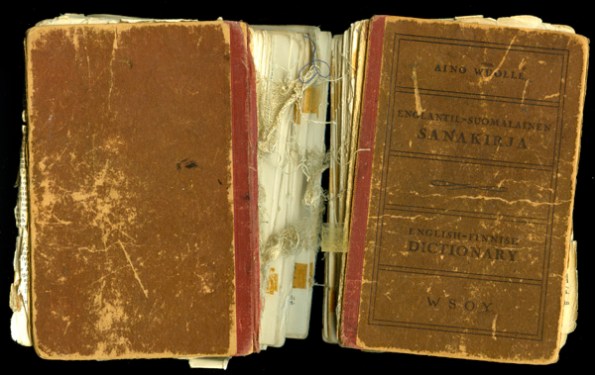
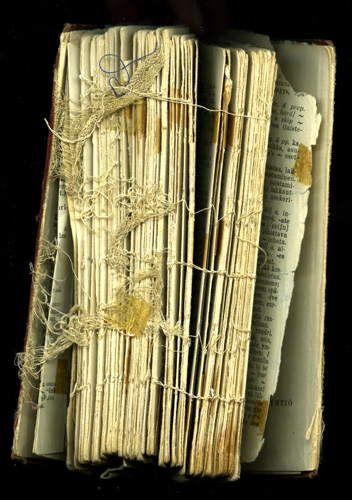
An English-Finnish dictionary
This is the dictionary that was used by my parents and family when we immigrated to Canada in the early 50s: an immigrant’s tool, an almost-bible, a book of days.

Marja-Leena Rathje is a Finnish-Canadian artist-printmaker and photographer who lives and works in Vancouver, BC. She has exhibited internationally and locally. She writes about her many interests including a fascination with archaeology, rocks and learning about her Finnish roots at her eponymous blog.
Three poems in French and English
Hölderlin à la tour / Hölderlin in the tower
(from Seule enfance, 1978)
|
Les oiseaux intermittents À partir d’un moment d’une extrême simpilicité |
Birds sometimes After a moment of extreme simplicity |
* * *
Manawydan’s Glass Door (d’après David Jones, 1931)
(from Pages aquarelles, 1989)
|
Ici rien ne se passe |
Here nothing happens |
* * *
Suite
(from Le Dit des couleurs, 2003)
|
c’est bien d’avoir l’impossible dans sa vie * le difficile * il y a des vitres * comme la marée montante * marcher sur ses pas * la mer est profonde * les fleurs viennent |
It is good to have the impossible in one’s life * the difficulty * there are window-panes * as the rising tide diminishes the island * to walk in one’s steps * the sea is deep * the flowers come |
Heather Dohollau was born in 1925 in South Wales. She moved to France, to Brittany, permanently in 1950, and has written in French since the 1960s. Her books include: Un Regard d’ambre (2008), Une Suite de matins (2005), Le Dit des couleurs (2003), Le Point de rosée (1999), Les Cinq Jardins et autres textes (1996), Seule Enfance suivi de La Venelle des Portes (réed., 1996), La Terre âgée (1996), Les Portes d’en bas (1992), Pages aquarellées (1989), L’Adret du jour (1989; Prix Claude Sernet), Dans l’île (1985), Matière de lumière (1985), La Réponse (1982), and La Venelle des portes (1981), all from the publisher Folle Avoine, and Seule enfance (1978), from éditions Solaire. Of recent years Heather Dohollau has begun writing again in English, and translating her poems in French into English. A selection of these is being considered for publication with Folle Avoine; the poems here are in advance of this.
Two poems with cello accompaniment
by Sheila Packa with Kathy McTavish
in translation
the name of the river
has fallen into another river
Zambini-nimi
names are buried by falling leaves
as the next rise from the roots
in your words, another people
the settlers displaced
in violence is a silence
a river only has its mouth
never saves itself
we know the boundary
the harbor in each breath
the shores but not between
in the currents
journey is erased
we carry a map and a book
say these are the stones
cross a bridge into memory
everything here
will be pulled down by gravity
near the high water mark
the voice and music
of a river gone
Note: “Zambini-nimi” is the Ojibwe name of what is now known as the Sucker River.
*
I SAID I
but I meant
the lonely road where I walk
in the forest
not lost but passing through
boundaries
cold that receded into seasons
before berries
I meant the stones broken and carried
by glacier
that came and left
I meant morning’s heavy mist
rising from the deep lake
to climb the headlands
from the direction of the sun
where hawks fly overhead
where we all come
the place of hidden roots
I put my weight
look for the way
one wild stem of columbine rising
with its bud
opens into a tiny lantern made from sunset
and unborn strawberries
I meant the fox who meanders from this side
to the other
following the scent
not hungry but taken into another
appetite
Note: This poem was written in response to a line from Argentinian poet, Alejandra Pizarnik: “Algo caía en el silencio. Mi última palabra fue yo pero me refería al alba luminosa.” (Something was falling in silence. My last word was I but I was referring to the luminous dawn.) On the podcast, Cecilia Ramón reads the Pizarnik quote, as well as her translation of Sheila’s poem into Spanish.
Sheila Packa (website, blog) is Poet Laureate of Duluth, Minnesota (2010-12). She has two books, The Mother Tongue and Echo & Lightning. She has had her work featured by Garrison Keillor on Writer’s Almanac. Her four poetry and cello CDs with accompaniment by Kathy McTavish may be ordered from her website.
Kathy McTavish (website) is a composer/free-style cellist who uses chance and generative/organic forms to create everything from sparse, minimalist spaces to dense, orchestral landscapes and performs in venues ranging from streetscapes to concert halls. Her work has been used behind spoken word, theater, visual art/sound installations, and film.
Permutations: A Translational Odyssey from Visual to Musical Systems
Watch on Vimeo (HTML5 version available for Chrome and Safari browsers).
A little over two years ago, I started working on possibilities for visual art using simple permutation operations: ways of reordering sets of information. These possibilities multiplied until a black, hardbound, gridded notebook was about half full and bursting with ideas and sketches. One day I took the notebook out to lunch with me and left it — astoundingly — on a park bench! Despite frantic efforts, I never recovered it. The same day I bought a new notebook and began where I left off, but never quite regained the momentum I had established with the original notebook.
But all was not lost with the (admittedly, somewhat deflating) loss of the notebook. I began to focus more on translating these same ideas into sound. This past summer, I decided to attempt to compose a suite of compositions for solo guitar, which happens to be my instrument. I had recently been alerted to the Fibonacci sequence, which is somewhat famous as the mathematical basis for spiral mapping, but I used it in a simpler way, merely as a sequencing method. Starting with certain scales, I constructed generative sequences of notes using the Fibonacci structure. These constituted the originating material, or sets, for the permutations. Next, I used something called a “latin square”* permutation technique to generate re-orderings of the original sequences. This is how the final sequences of pitches were made. I also created sets of rhythms which were reordered in every possible way.
The results of all the above work formed the melody, or as I think of it, the top line of the five solo guitar pieces. Immediately, I realized the pieces could accommodate — and in fact needed — a counterpoint, or “bottom line,” which I created in a traditional, intuitive artistic method involving choices that reflect my taste and sensibilities. Each piece ends with a different chordal flourish that displays the notes of the scale. The top line represents the main substance of the concept: to construct a system which in turn generates music outside my imagination. The bottom line is a concession to taste and volition.
Originally I had wanted to compose very simple solo guitar music for myself to play, as I am not a virtuoso guitarist. As it happens, the music that emerged is extremely difficult, at least for me. The suite consists of five “movements,” called cycles. On the audio/visual presentation above, my rendition of the First Cycle is heard, followed by the Third Cycle played by the computer, and finally the Second Cycle played again by me. The visuals show some of the pages from the second notebook, some finished art pieces, and the scores for the solo guitar suite, titled “Permutation No. 1,” so that this work may more precisely be called “A Translational Odyssey from Numerically-based Visual Art to Musical Systems.”
*Latin square permutation:
1 2 3 4
2 4 3 1
4 1 3 2
1 2 3 4
—James Ty Cumbie
December 2010
Recording by Atom Fellows
James Ty Cumbie has performed with Lukas Ligeti, Daniel Carter, Ned Rothenberg, Samir Chatterjee, Butch Morris, Walter Thopson, and many others. His compositions have been performed at New Languages Festival ‘09, The Vision Festival Series, Detour Jazz, and other NYC venues. He even once performed samba percussion for Lula, President of Brazil! From 2003-08 he produced and presented the Freezone Music Series, which showcased many of the most important avant-jazz artists from NYC, other parts of the US, and Europe. He has written jazz criticism for All About Jazz and worked as a graphic designer for nearly 30 years. He currently resides in Washington Heights where he is focussing on visual art and music composition. Both his art and music are strongly informed by minimalism, conceptualism, mathematics and serial/modular systems.
 qarrtsiluni