Archive
Untitled poem by Vladislav Khodasevich
translated by Andrey Gritsman
Нет ничего прекрасней и привольней,
Чем навсегда с возлюбленной расстаться
И выйти из вокзала одному.
По-новому тогда перед тобою
Дворцы венецианские предстанут.
Помедли на ступенях, а потом
Сядь в гондолу. К Риальто подплывая,
Вдохни свободно запах рыбы, масла
Прогорклого и овощей лежалых
И вспомни без раскаянья, что поезд
Уж Мэстре, вероятно, миновал.
Потом зайди в лавчонку banco lotto,
Поставь на семь, четырнадцать и сорок,
Пройдись по Мерчерии, пообедай
С бутылкою «Вальполичелла». В девять
Переоденься, и явись на Пьяцце,
И под финал волшебной увертюры
«Тангейзера» — подумай: «Уж теперь
Она проехала Понтеббу». Как привольно!
На сердце и свежо и горьковато.
*
There is nothing else as fine and free
as to break up for good with a beloved her
and leave the railroad station all alone.
And then in front of you entirely new
the palaces of Venice would reappear.
You linger on the stairs and then go to
take a gondola. As you approach Rialto
you breathe in freely smells of fish,
rancid butter and the stale vegetables
and recall without regret that her train
has probably already passed Mestre.
Then walk into a banco lotto shop
and bet on seven, fourteen and forty,
walk down to Merceria and dine
with a bottle of Valpolicella. At nine
you change and show up at the Piazza
and, listening to the magic overture
from the Tannhäuser, think: “By now
she must have passed Pontebba.” How easy!
Your heart is refreshed, and slightly bitter.
 Vladislav Felitsianovich Khodasevich – Ходасевич Владислав Фелицианович (1886-1939) was an influential Russian poet and literary critic who presided over the Berlin circle of Russian emigre litterateurs. During his first years in Berlin, Khodasevich wrote his two last and most metaphysical collections of verse, Heavy Lyre (1923) and European Night (1927). Khodasevich didn’t align himself with any of the aesthetic movements of the day, claiming Pushkin to be his only model. For more, see his Wikipedia entry.
Andrey Gritsman, native of Moscow, Russia, lives in New York City—a physician, poet and essayist who writes in two languages. He is the author of several books in Russian and English, and his works are widely published and anthologized both in the US and in Europe. He’s been nominated for the Pushcart Prize several times, and runs a popular Poetry Reading series in New York.
Two poems in French and English
A ma grand-mère et son jardin d’espoir
Quand j’ai quitté le foyer pour te
chercher, le soleil me blessait
les yeux, donc pendant plusieurs
jours je les couvrais des mains.
La chimiothérapie a pris
mes cheveux, et
les draps dans lesquels je me suis
enveloppé s’enfoncent
dans les grues et fouillis
des usines le long du bord
de l’eau. Une rangée
de gratte-ciel et leurs lumières
forment la toile quand enfin je
regarde à l’intérieur de ce qui reste
du fleuve, nos reflets
adoucis par les nuages qui dérivent
dans le ciel. Ici, tout est
dépouillé pratiquement jusqu’aux lignes
et ombres, et je
discerne ton image comme si
elle était peinte sur mon front,
les restes précieux
et ossifiés. Si je dessinais sur l’eau
avec du temps je pourrais
raccorder ces segments infimes
et droits, les joindre et les facetter
jusqu’à ce qu’ils paraissent
en courbe, jusqu’à ce que je me rappelle
nos rapports, le rythme
pizzicato de tes aiguilles
à tricoter. Plus loin en aval
où l’eau est lavande
pure, je me dis,
Continue à pousser ton
fauteuil roulant. A travers
un réseau claustrophobe
de plans abstraits, la terre
desséchée, crevasse, quelquefois
au bord de s’échapper de la pesanteur et transcender
l’affaiblissement du
monde matériel, je franchis autour des
têtes de poissons qui pourrissent aux bouts
de leurs arêtes sèches jusqu’à ce que, en laissant des traces
de mes cellules qui restent en couches de badigeons
légers afin que les palmes dans le fond
puissent être vues nettement
au travers des pétales de tulipes en avant,
j’entre ta cacophonie dessinée
assez librement de fleurs
et de légumes voluptueux où
la lumière dorée et les tons
de terre chauds atténuent la beauté
non naturelle de nos deux
morts apparemment contraires.
*
To My Grandmother and Her Garden of Hope
When I left home to search
for you, the sun hurt
my eyes, so for several
days I covered them with my hands.
The chemotherapy has
taken my hair, and
the sheets I wrapped myself in stick
in cranes and factory
clutter along the water’s
edge. A row
of skyscrapers and their lights
form the backdrop when I finally
look into what’s left
of the river, our reflections
softened by drifting overhead
clouds. Here, everything is
stripped practically to lines
and shadows, and I
discern your image as if
it were painted on my forehead,
the precious ossified
remains. If I drew in water
with time I might
connect minute straight
segments, join and facet
them until they appear
curved, until I remember
our relationship, the pizzicato
rhythm of your knitting
needles. Further downriver
where the water is pure
lavender, I tell myself,
Keep pushing your
wheelchair. Across
a claustrophobic network
of abstract planes, the earth
parched, cracked, at times
poised on the edge
of escaping gravity and transcending
the dullness of the
material world, I negotiate around
fish heads rotting at the ends
of their dried spines until, leaving traces
of my remaining cells in layers of thin
wash so palm leaves in the background
may be seen clearly
through tulip petals up front,
I enter your loosely defined
cacophony of voluptuous
flowers and vegetables where
the golden light and warm
earth tones mitigate the unnatural
beauty of our two seemingly
opposite deaths.
* * *
Aussi bleu que du sang non oxygéné
Le matin arrive clair et mesuré
Comme si la méchanceté
N’était jamais née
Cela seul prend cinq semaines
Le dessin régulier de taches dans ton sommeil
Rendu dans les contours blancs
Tranquille à l’exception d’une certaine part de honte
Si bruyante que tu te demandes où
L’océan est
Une demi-douzaine de tortues te regardent avec curiosité
Avant de s’en aller en bondissant au galop ralenti
Comme une cadence sur une portée
Claire de musique, cette goutte d’eau
Aurait dû avoir déjà improvisé un orage
Le ciel comme cuivre
La terre percussion
Une déesse unijambiste gagne
Son sourire sculpté
Tu commences à voir ce qui est relié à quoi
Comme un ingénieur subdivise les arches sous un pont
Et la sécheresse de la terre
Au-dessous pourrait être déterminée
En longueurs d’ondes visibles et infrarouges
Intérieurs caverneux de temples
Où des flots de lumière tombent
En angles faux
Tu as le sentiment que
Ce qui précède ces chutes ne sera pas
Toujours syncopé avec des dobermans
Qui anticipent le rythme
La nuit arrive une armure gris clair
Comme si tu n’avais jamais été chantée
T’adapter à la dilatation de tes poumons
Prend plus de temps que le remplissage
De ces milliers de petits trous
*
Blue as Unoxygenated Blood
Morning comes clear and measured
As though wickedness
Had never been born
This alone takes five weeks
The regular pattern of spots in your sleep
Rendered with white outlines
Quiet save for a certain element of shame
So loud you wonder where
The ocean is
A half-dozen turtles stare at you curiously
Before loping off in slow-motion gallops
Like a cadenza on a clear
Staff of music, that water-drop
Ought to have improvised a storm by now
The sky like brass
The earth percussion
A one-legged goddess earns
Her sculpted smile
You start to see what’s connected to what
The way an engineer subdivides arcs under a bridge
And the ground’s dryness
Underneath could be determined
In visible and infrared wavelengths
Cavernous temple interiors
Where streams of light fall
At wrong angles
You get a feeling
What precedes these descents will not
Always be syncopated with dobermans
Anticipating the beat
Night comes a light gray weave
As though you had never been sung
Adjusting to expanding your lungs
Takes longer than filling in
Those thousands of tiny holes
Download the podcast
Author’s note: I would like to thank the Concord Presbyterian Church and Ed Pfeiffer for helping me record my poems. Their willingness to assist in this project was invaluable.
Laura Merleau’s poetry has recently been featured in Sweet, The Los Angeles Review, and Ragazine. An excerpt from her play Bipolar Order appeared in the September 2010 issue of Muse.
Two Poems from a Heart-Mind, After Zheng Xie
Dusk
This very moment
a fisherman, someone unfamiliar,
trails his fishline, a silver gesture,
under the ledge, the cliff.
He pulls up empty, he poles his antique skiff still
searching the cove in all dark water.
Sheer-silk distances speck the gulls on waves.
Umber reeds spell omens in this weak sun.
Yet he sings in our twilight, his notes boom across water,
his spirit moves into folds, the silent gold flashes
that mark each peaking wave…
Aura of the moon, rising first—and out of such deep black!
* * *
Neighbor
The old Taoist, in traveling clothes,
head wrapped, shoulders a heavy gourd
(looks like a two-headed man when
the sun’s behind him). He wears
palm-fiber sandals for rough paths
and goat-wool socks. He’s a healer,
mending qin and tendering herbs
for curing ills, outing bad spirits.
Under clouds and the red-leaf canopy, he threads
home over rocks. Mountain neighbors say
he’s built his hut on an overlook at the base of Three Gorges.
—Who can follow him that far?
Where to find him when we have need?
*
Note: A qin [prn. cheen, and often spelled “ch’in”] is an ancient, plucked string instrument capable of several octaves and great subtlety of expression. It is highly prized. Those who categorize it in the zither family (played on table or lap) disregard calling it a lute (usually held vertically).
Zheng Xie (1693–1765) was a bureaucrat, painter, poet, and calligrapher from Kiangsu, in Eastern China. Writing poetry was a required skill for Chinese officials, as intense and pertinent as knowledge of Confucian tenets. While a magistrate’s positions could be ephemeral, subject to the whims of superiors, Zheng’s poetry was second in lasting effects only to his widely admired and respected skills as a calligrapher and painter, through which his poems often were published. His poems are still loved by Chinese, carved as they are into stone in public places. As a man of the arts, the outlook reflected in his poetry seems more Taoist and joyful than the sober Confucianism of a civil servant might otherwise allow, but both perspectives clearly helped shape his poems of witness and delicacy.
Roberta Burnett’s poems have appeared in Soylesi Poetry Quarterly (tr. into Turkish), The November 3rd Club, Lucid Rhythms, Pirene’s Fountain, The Bellevue Literary Review, and Naugatuck River Review. (She guest-edited one volume of NRR.) Her recent book of poems is Trying Not to Look (Flarestack Publishing, UK). She was a solo reader for Tempe, Arizona’s “Poetry in April” series (2006). Her M.F.A. in poetry (2000) is from Vermont College of Fine Arts, with post-graduate work at Arizona State University; B.A. and M.A. (English), Cal State University, Long Beach (CSULB). She taught writing, research, semantics, and literature at colleges and universities for 18 years.
Bowl
Small Santa Clara pot I buy
in the Santa Fe market from its maker,
Noel, maybe a grandson of Maria: he breathes
spirit into its mouth and hands it to me:
it fits in my palm, its mouth ringed
by the rainbow serpent, fragment
of my ancestry—so too in my palm the dour
Scots taking the land from Irish owners,
the French trapping mink in St. Croix,
the Cherokee on the long trail of tears
to Oklahoma grasshopper heat, the English
brothers hopping a freighter, scrabbling
west to pan for gold in California,
pick cotton, cobble shoes for luckier miners,
and the grandfather who sold golden
Mazola oil and cornstarch by Model T
and wrote poems to the grandmother
who praised violets, blue and true, in hers,
and the grandmother raised on the reserve
who stitched draperies till her eyes went bad
and the grandfather who repaired
leaking pipes, telephone lines,
and typewriters—here I am in Santa Fe
holding a black bowl fired and glazed
by Noel in a secret way that gives a shine
to its black on black shell and holds
the breath of generations in its mouth.
Robin Chapman is author of six books of poetry, including most recently Smoke and Strong Whiskey (WordTech Editions) and Abundance, winner of the Cider Press Review Editors’ Book Award. Her seventh, The Eelgrass Meadow, will be published by Tebot Bach in 2011. She is the recipient of the 2010 Helen Howe Poetry Prize from Appalachia.
Three Romanian poems by Mihail Gălăţanu
translated by Adam J. Sorkin and Petru Iamandi
Umblînd prin lumea morţilor
Dacă mama mea ar muri,
Eu, cum să supraviețuiesc?
Eu, care nu sînt decît o terminație a ei, un terminal al aeroportului ei, un apendice, o extremitate a dorului ei de viață, întinsă, din păcate, spre moarte.
Eu nu sunt decît o unghie a ei, rebelă, care a crescut prea departe. Un ovul care s-a rătăcit. S-a lepădat. Un firicel de păr al ei care s-a pierdut și a căpătat, temporar, autonomie de zbor. Căruia i-a intrat în cap, treptat-treptat, c-ar putea exista de unul singur, c-ar putea trăi și muri de capul lui.
Eu sunt doar o lacrimă a ei care s-a întărit,
s-a condensat,
a crescut
și s-a făcut bărbat
s-a solidificat într-atît încît a devenit o statuie de sare,
umblînd și plîngînd pe la morți
și în lumea morților,
pe la obor și bazare.
Sunt o tumoare a ei care a crescut nefiresc de mult
și acum nu mai știe cum să intre înapoi.
Care se miră cum, dintr-o singură femeie tristă și frumoasă,
m-am replicat
și acum am ajuns doi.
*
Wandering the Realm of the Dead
If my mother were to die,
what about me, how could I survive?
I, who am just one of her terminations, a suffix, a terminal in her airport, an appendix, an extremity of her urge to live, tending, unfortunately, toward death.
I am just a fingernail of hers, rebellious, grown too long. An ovule that has gone astray. Rejecting all that is. A tiny hair of hers that lost its way and temporarily attained independent flight. That got into its head, little by little, that it could live on its own, could live and die by itself.
I am one of her tears that has congealed,
solidified,
grown,
turned into a man
hardened so much it became a statue of salt,
seeing the dead and weeping for them
wandering and weeping for the dead
in the realm of the dead,
the stockyard and the bazaars.
I am just a tumor of hers that has grown unnaturally big
and now no longer knows how to get back inside,
that wonders how, from one single woman, beautiful and sad,
I was duplicated,
so that now we are two.
* * *
La Perfuzia
(Fîntîna Perfuziei)
Bolnavii dădeau noroc cu perfuziile
şi spunea cîrciumii, care era în burta mamei mele,
“LA PERFUZIA”.
Mama din milă îi primise acolo, îi aciuase –
erau cu toţii sans-abrit.
Îi ospătase.
Era un fel de azil al tuturor celor asemeni mie,
Al tuturor nenăscuţilor
eu aventurier în Anzii Cordilieri,
eu marinar.
De fapt, în LA PERFUZIA
mă întîneam doar eu cu mine însumi,
era o bună cîrciumă de a mă întîlni
singur, necăsătorit, douăzeci şi opt de ani, încă brunet, ochi negri
cu treizeci şase de ani, căsătorit, copil, grizonat.
Viaţa mea se împletea
Cu mai multe vieţi virtuale,
Tot ale mele,
Mai amare, mai jucăuşe,
Mai eremite, mai venale.
Viaţa mea se topea după mine.
De fapt, viaţa mea
Se nutrea ea însăşi dintr-o perfuzie,
Eram veşnic perfuzionat,
cum era altul veşnic iluzionat.
Ce perfuzie e viaţa, spuneam,
însăşi fîntîna perfuziei,
din care sorbeam
şi întineream,
chiar burta mamei mele era perfuzia,
chiar limfa
şi lichidul amniotic,
otic
otic!
(Spunea ecoul).
Fîntîna lehuziei,
Pentru mama mea,
Aşa ecoul mai spunea. Mama mea trăise o lehuzie de peste patruzeci de ani, cu mine, după mine, de aceea nici n-a mai putut să mai aibă alt copil, de aceea nici n-a mai putut să cunoască alt bărbat. Eu sînt, Doamne, prin Voia Ta, facă-se, pururi, Doamne,
Singurul bărbat pe care mama mea l-a cunoscut cu adevărat.
Zilnic mă gîndesc la asta.
Mama mea nu m-a născut prunc, ci direct bărbat,
Să mă poată iubi la maturitate,
La maternitate,
Să se bucure de părul meu deja lung şi buclat,
De ochii mei tăciunii,
De firea mea aspră şi şfichiuitoare,
de rus ne-nţărcat.
*
At Perfusion’s
(The Fountain of Perfusion)
The patients clinked their perfusions in a toast
and called the bar inside my mother’s womb
Perfusion’s.
Out of pity, Mother had let them in, sheltered them—
they were homeless.
She hosted them.
It became a sort of asylum for those like me,
the unborn.
I an adventurer in the Andes,
I a mariner.
In fact, at Perfusion’s,
I met only my own self.
It was a good tavern to meet myself
alone, single, twenty-eight years old, still dark-haired, eyes black,
then thirty-six years old, married with a child, gray-haired.
My life wove itself
with many lives, all virtual,
every one mine, personal,
more bitter, more playful,
more hermetic, more venal.
My heart melted for me.
In fact, my life
nurtured itself on perfusions.
I was permanently permeated,
like one who had permanent delusions.
Such a perfusion, life! I said with great effusion,
itself the fountain of perfusion
from which I drank
and grew young,
my mother’s womb itself the perfusion,
the lymph
and fluid amniotic,
otic
otic!
(the echo quoted).
The fountain of childbed
for my mother,
so the echo kept echoing. Mother had experienced a forty-year childbed, with me after me, that’s why she couldn’t bear another child, that’s why she couldn’t even know another man. I am, oh God, according to Your Will, may it be forever and ever, oh Lord,
the only man my mother has truly known.
I reflect on this every day.
Mother gave birth not to a baby but directly to a man,
so she could love me in maturity,
in maternity,
so she could take delight in my hair, already long and curly,
my eyes black as a raven,
my nature severe and authoritarian,
incorrigibly Russian.
* * *
Capătul lumii mele
Pe mama o iubeam pe molecule.
O iubeam subatomic, pe particule, pe ţesuturi, pe fascii musculare, pe mici aglutinări adipoase, pe grupe de muşchi. Prapurul era ptolemeicul linţoliu al lumii mele. Prapurul era capătul lumii şi marginea universului.
Şi universul era rotund, aşa cum numai o burtă de fecioară
poate fi, curba perfectă,
curbura perfectă a lumii,
cum numai o burtă de mamă poate fi.
*
The End of My World
I loved Mama for each molecule.
I loved her sub-atomically, for each particle, each tissue, each muscular fascia, each small adipose agglutination, each muscle group. The peritoneum was my world’s Ptolemaic shroud. The peritoneum was the world’s end
and the universe’s edge.
And the universe was round, as only a virgin’s womb
can be, a perfect curve,
the world’s perfect curvature,
as only a mother’s womb can be.
Mihail Gălăţanu was born in 1963 in the Romanian city of Galati. He published his first book of poems in 1987, Stiri despre mine (News About Me — Bucharest: Litera), his second six year later, Scrîsnind în pumni (Keeping My Fists Tight — Galati, Romania: Porto Franco, 1993), and since then, the equivalent of a book of poetry or prose each year. Among recent poetry titles are Mormîntul meu se sapa singur (My Grave Digs Itself — Bucharest: Vinea, 2003) and, from the same publisher, Burta înstelata (The Starry Womb — 2005). Gălăţanu was editor-in-chief of Playboy Romanian and now edits Flacara, a glossy monthly magazine. His poems have appeared in Arson, Diode, The Bitter Oleander, Glint, Born in Utopia: An Anthology of Modern and Contemporary Romanian Poetry, ed. Carmen Firan, Paul Doru Mugur, Edward Foster (Talisman House, 2006) and New European Poets, ed. Wayne Miller and Kevin Prufer (Graywolf, 2008), and are due out in Wheelhouse Magazine and Calque.
Petru Iamandi, PhD, is an associate professor with the English Department of the Faculty of Letters, Dunărea de Jos University of Galaţi, Romania, and a member of Romanian Writers’ Union. He has written American Culture for Democracy (2001), English and American Literature – Science Fiction (2003), American History and Civilization (2004), Literature about the Future (2004), An Outline of American English (2008), and An Introduction to Consecutive and Simultaneous Interpreting (2010), and compiled an English-Romanian Dictionary (2000). He’s the co-author and co-editor of several dictionaries and English textbooks. He’s translated twenty-four books from English into Romanian and twenty-two books from Romanian into English (prose, poetry, drama, non-fiction). In 2008, the Dramatic Theatre in Galaţi staged his translation of Harold Pinter’s The Birthday Party. His translations have been published in various British and American magazines, he’s received awards from Antares, Porto-Franco and Dunărea de Jos magazines, and he’s included in Who’s Who in the World (1999, 2001).
Adam J. Sorkin recently published Memory Glyphs: Three Prose Poets from Romania (Twisted Spoon Press, 2009), Mircea Ivănescu’s Lines Poems Poetry (University Press of Plymouth, UK, translated with Lidia Vianu), Rock and Dew, selected poems by Carmen Firan (The Sheep Meadow Press, 2010, translated mostly with the poet) and Ioan Es. Pop’s No Way Out of Hadesburg (Plymouth, also with Vianu, 2010).
In-between us
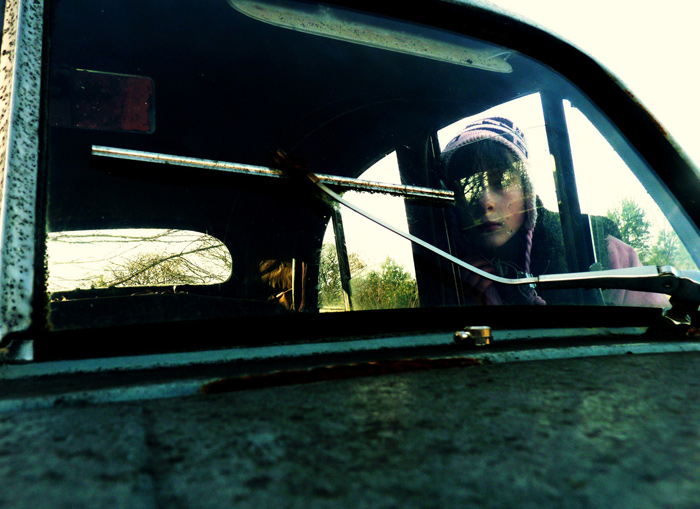
Click on image to see a larger version.
Eleanor Leonne Bennett (Flickr photostream) was the only person from the United Kingdom to place in National Geographic’s See The Bigger Picture biodiversity photography contest. She has won the Woodland Trust Nature Detectives art competition three times since the age of 11. She was a winner of the Wrexham Science Festival photo contest and took first and second place with UK Butterflies photo contest (under 16s). She was twice winner of the Big Issue Magazine‘s monthly photo competition, her photos have appeared in Splash of Red and Creative Boom Magazine, and she has had her photo “bug eyes” exhibited outside Paris, France, where the panels were displayed outside the headquarters of UNESCO to celebrate the start of the International Year of Biodiversity.
Code
written and performed by Hannah Stephenson
(lyrics)
You finally figured out
what was off;
you wrote it down.
Messages on post-it notes,
They try to stick.
They cling and grope.
You try to line them up,
balance words like building blocks.
Calm it down, a seesaw to a house.
What are you saying to yourself?
You keep inflating all the vowels.
We assign a picture to a thing,
and tie them with a string.
They bash into everything.
Can you recognize
these feeble forms
you work to write?
Like a signal from a boat,
you blink a light;
it’s all in code.
This map needs a key,
someone good at interpreting.
Calm it down, a seesaw to a house.
What are you saying to yourself?
Please stop covering your mouth.
We assign a picture to a thing,
and tie them with a string.
They drip onto everything.
Hannah Stephenson is a poet, writer, and instructor living in Columbus, Ohio. Her poems have appeared in ouroboros review, Mankind Magazine, Spoonful, The Birmingham Arts Journal, and Artsy!Dartsy!. You can visit her daily poetry blog, The Storialist, at www.thestorialist.com and hear more of her music at www.soundcloud.com/thestorialist.
Body/Scape: Two Studies
by Sarah Busse
Why I Should Be a Landscape Quilter
* * *
Good Morning, Green Bay
Freshwater waterscape sloshed
with tumulted gull-screech,
this morning your body lies
breathlessly unfamiliar
in its streets and lampposts.
I have to walk a little farther,
faster, as love stands witness
to how we dilapidate.
Can you bear it? Can you
give me directions?
My sisters laugh, terrified
at how I change, crack
open, change and crack again.
A faulty pot, misfired.
No, no, I say. This
is what human looks like, this
closed-off Northern face,
lost and falling, sky-colored
sidewalks, the angular
scrawk of a lone goose, yawn
of traffic over the drawbridge.
Sarah Busse (website) is a co-editor of Verse Wisconsin. She’s the author of Quiver (Red Dragonfly Press, 2009) and Given These Magics (Finishing Line Press, 2010). A third chapbook, Gauguin in California, is forthcoming from Desperado Press. She has been featured at Verse Daily and Your Daily Poem.
Auf dem Amt/At the Ministry
by Marcus Speh
Auf dem Amt
du wartest in einem deutschen amt, tief im innern des apparats wie in einer räuberhöhle, wissend um die ungeheuerlichkeit der annahme, die dich umgebenden personen seien menschen, obwohl du an ihren mechanischen, auf die vergangene, zweifelhafte glorie effizienten mordens hindeutenden (keine anzeichen von prozesslähmendem selbst-bewusstsein verratenden) bewegungen sehen kannst, dass es sich beim deutschen beamten um ein wunder der ingenieurkunst handelt, um eine macher-machete im bürokratie-dschungel und nicht um einen hilfreichen engel. hier sitzt du nicht um der erleuchtung oder der erbauung willen, sondern aus angst, ein falscher schritt möge dein ende bedeuten. je länger sie dich warten lassen, um so mehr verfällst du der poesie der macht, bis du schließlich ihre ministeriellen verordnungen liest als wären es oden oder heilige gesänge.
At the Ministry
you wait in a german agency, deep inside the machine like in a den of thieves, knowing about the enormity of the assumption that the persons around you were people even though you can see from their mechanic movements hinting at the past doubtful glory of efficient murder (not betraying any signs of process-paralysing self-consciousness) that the german civil servant is a miracle of the art of engineering, a maker-machete in the jungle of bureaucracy — not a helpful angel. you don’t sit here to reach enlightenment or edification but only for fear a wrong step might mean your end. the longer they make you wait, the more you fall for the poetry of power until you read their ministerial orders as if they were odes or gospel.
Marcus Speh lives in Berlin, Germany, and usually writes in English. His short fiction has been or will be published in elimae, Mad Hatters Review, Metazen, Blue Fifth Review, Sand and other places. “At the ministry” was first performed at “This Berlin Life – live!” Marcus blogs at Nothing To Flawnt and is hard at work on a novel.
Erasing Mallarmé
My initial interest in erasure was in the practice itself; I wanted to “white out” or unravel a poem to experience the unique feel of simultaneously reading and writing. I was, curious about how the process differed when working with a short poem (this one) or a far longer poem such as John Ashbery’s “Self Portrait in a Convex Mirror”. (The Ashbery poem led to a larger, on-going project.) As well, I was interested in exploring the difference between “whiting out” and “crossing out” from both the standpoint of process and the visual effect, the presence of marks and the absence of marks/the presence of space. This led to my choice of “whiting out” a Mallarme poem because of his revolutionary use of blank space and careful placement of words. I am struck by the visual variation, created by chance, when the erasure and its translation (by Peter and Mary Ann Caws, from Stéphane Mallarmé’s Selected Poetry and Prose, New Directions Paperbook, 1982) are placed side by side; an illustration of the difference between language structures less obvious in the original.
Some consider Stéphane Mallarmé (1842-1898), French poet and critic, to be the most difficult French author to translate. I first encountered his work in a Surrealist Literature class in college. My interest in his work and the relationship between artists and writers continued into my graduate studies and beyond.
Autre Éventail
  pour que je plonge
                  sans chemin

                       dans ta main

                  de crepuscule


L’horizon

                     frissonne


Sens-tu le

               coin
                        pli!

               des         roses
             sur les soirs d’or
Ce blanc
Contre le feu
|
Her Fan
                  that I may plunge
Pathless

To

  twilight


          the horizon

                   shivering


Can you feel

       the corner
                         fold!

                   pink
            on golden eves is
      white
against             fire.
|
Lynne Shapiro lives and writes in Hoboken, New Jersey, not far from the Community College and Charter School where she currently teaches. Her poem “Replenish” was published in qarrtsiluni’s Water Issue. She drinks her morning coffee from a qarrtsiluni cup.
 qarrtsiluni