Archive
White: A Ghazal
An alabaster moon—sere and chaste as salt.
Loneliness: an imagined lake, sad-faced as salt.
A thin refrain settles like ashes on flesh.
Breath like smoke, thick as a paste of salt.
Nest of snakes on desert grains, a dry-boned season.
Wind veils the way, gusts of white laced with salt.
O pray for women of the pearl tattoo!
Such yearning to feel disgraced with salt.
Truth is oracle and mirage, is it not?
An infidel is buried to his waist in salt.
Caravans sense roads like soles to nowhere—
All the ancient shrines defaced by salt.
Oblivion asks the nomad only this to live:
What would you give to taste such salt?
by Scott Wiggerman and Andrea L. Watson
Process notes
Scott:
After reading qarrtsiluni’s call for submissions for a “Mutating the Signatures” issue, I knew I wanted to try writing collaboratively, something I’d never done before or even thought of doing. I immediately contacted Andrea Watson — my first choice in a “partner” — to see if she might be interested, as I knew her work to be inventive, lovely, and similar to my own in imagery and style.
Andrea:
I was delighted when Scott Wiggerman contacted me about collaborating on this poetry project. I had admired his writing for years and was happy to have made his acquaintance in a workshop at the Taos Summer Writers Conference several years ago. Then we performed with other artists and poets at an ekphrastic event, Interwoven Illuminations, at the historic Rane Gallery, in Taos, New Mexico last year. I respected his knowledge of poetic technique and his approach to poetry. This collaboration was meant to be!
The only problem — a matter of miles! 735.70 to be precise. And so, email became our modus operandi.
Scott:
And so began a series of thirty-plus emails in less than a month! I did not see distance as a problem; in fact, I saw it as an opportunity to collaborate with someone whom I couldn’t see on a day-to-day basis. The miles quickly became immaterial.
Andrea:
I had collaborated with two women writers on a novel but had never written poetry with another person. Ever. And Scott was suggesting one of the poems be a sonnet! Oh boy! We would each write a line, back and forth, of the quatrains, but we would be free to change a word or two of the other person’s line if we wished. Soon, the sonnet took shape — a crow, powerful, menacing, ebony. Black became a central motif of the evolving Shakespearean sonnet. (Look for this poem later in the issue. —Eds.)
Thus, the color white begged to be the other motif. We chose the ghazal, a form with which I have been comfortable, and the white motif lent itself to a desert landscape. We chose to write a couplet apiece, the ghazal flowing and telling us what it wanted. We dialogued back and forth, added details, subtracted conflicting imagery, kept refining as we went along. We kept the ghazal to fourteen lines, based on an innovative ghazal/sonnet we had seen by poet Sandra Dolin.
Scott:
Even in our choice of poetic forms (not that they were required), we took a collaborative approach. I had initially suggested we write two formal sonnets and that we each write the first line to one, then alternate lines after that. This is in fact how we approached the “black” sonnet. But Andrea suggested we make the second poem a ghazal, or more precisely a ghazal/sonnet, basically a ghazal of fourteen lines, and she provided the opening couplet, which we agreed would be focused on the color white.
We worked simultaneously on both the sonnet and the ghazal (something new for me, as I usually work on only one poem at a time), adding lines day after day — and offering suggestions for preceding lines, phrases, and/or words. In our back-and-forth banter, we joked about sending “draft 11 million”! At one point, I described the daily revision to Andrea as “hyper-critiquing.”
Andrea:
And we were diligent, nay crazy, in our approach. We wrote every day, no matter what, and made sure to touch base as the poems came to life. The holidays were on the horizon — with guests, travels, too much food, not enough wine — but we continued to email until Christmas was upon us. By then, the two poems — the two forms — had matured, and so we let the work sit. I tinkered on the airplane. Scott looked at the poems amidst a house of visitors. It would be wise to let the poems breathe….
Scott:
And to let ourselves breathe too!
Andrea:
Later, we removed a word of two from the ghazal that conflicted with white. We kept reworking the last couplet of the sonnet. It needed to be powerful but not overpower the poem.
Scott:
Though we let the drafts of the two poems “breathe” over the holidays, we already had spent quite a bit of time revising and fine-tuning them. We constantly checked with each other to see what the other thought about any changes, being respectful but blunt. Honesty was something we both required and cherished.
Andrea:
It is important to note that while poets have different styles, different views of metaphor or imagery, poets represent what is so hopeful about the Humanities: people collaborating together on a project such as this; people conversing with one another to make something fine; people celebrating the wonder-work of being human in the twenty-first century. And poetry is the golden thread that binds us all together.
Scott:
Our “mutating” was so rewarding that we’ve both thought of continuing the process throughout 2009 (and beyond?). Someday you may see a whole chapbook of Watson/Wiggerman poems! Thank you, qarrtsiluni, for sparking this creativity!
Get Away
One of ten selections from the unpublished manuscript Flying Home. (Click on image to see at larger size.)

by steve d. dalachinsky and Sig Bang Schmidt
Why No One Saw It Coming
The accelerating street was wet light
and we were, impossibly, on ledges
talking down the suicides,
disarming the shooters on their way to school,
the night’s echolocation
giving way to
the heart’s,
and though a signal is not an answer
sometimes even a glimpse of the Divine Yes
is enough,
the quick of it
almost mocking
a life laboring to break
bewilderment’s code.
What if we took in the street preacher?
Silenced the fortune teller?
Laid off
each sure thing?
Maybe all we need to remember is how
to call the sun up
or pin down the moon.
Maybe we’re merely steps
away from nowhere.
by Susan Elbe and Ron Czerwien
Process notes
The process began one evening while we were browsing the fiction display at our local Borders Bookstore. One of us suggested that some of the book titles might make good titles for collaborative poems. Ron chose the title from that list and also submitted the first line. We then composed the poem strictly via e-mail. Early on Ron asked if we should offer edits during the process, but Susan felt we’d lose the energy of the exchange. So we simply continued to alternate lines. The varying line lengths and freer use of white space were Susan’s ideas. Ron followed her lead. Susan’s poems are replete with words that are surprising but never arbitrary. Ron offers as a good example of this her use of “echolocation.” Ron’s post-modern leanings stretched Susan’s approach.
Our biggest stumbling block was sticking with it. Our busy lives and other work intruded, and we constantly had to prod each other to come back to the collaboration. There were long periods when both of us struggled to come up with the right line, one that would not only carry forward what came before but also lead towards a felt, though always unknown, conclusion. The poem even includes a line Ron appropriated from a poem by Rae Armantrout, who he was reading at the time of the collaboration. Oddly enough, all of our lines survived editing! We each thought very carefully about what psychic gift we were sending the other person. Susan loved anticipating what the next line from Ron would be. Both of us think it’s important to collaborate with someone whose work and sensibility you enjoy and respect, but having different styles makes it more interesting. We hope to do more together in the future.
Puebla de los ángeles
If you can’t see the video, you need to download Flash.
On the zócalo in Puebla, la ciudad de los ángeles,
flocks of shiny balloons rise and fall and rise
again with the coruscating spray of water
spouted from the mouths of fountain
fish misting birds who flutter
above human voices
peddlers, priests, tourists folding
maps, laughing children playing chase,
rumble of taxis, buses, cars, clink of glasses in
sidewalk cafes, scrape of chairs as the band begins
the danzón, hum of horns, scuff of cellos and violins,
lyrical silence of pigeon wings.
by Arturo Lomas Garza, Robert Skiles, and Katherine Durham Oldmixon
Process notes
Robert Skiles and Arturo (“Turo”) Lomas Garza have been friends and collaborators for almost thirty-three years, together performing Robert’s musical compositions for recordings and live concerts. Poet and photographer Katherine Durham Oldmixon and Turo have also worked together and supported one another on many artistic projects. So it’s no surprise that Turo, the editor of this project, is the nexus of the collaboration.
When we launched this project, we agreed that we wanted Robert’s music to be central, but we began with Katherine’s poem “Puebla de los ángeles” as a basis for the idea. Robert had read the poem before and expressed an appreciation for its sounds and images. We didn’t want the poem to become lyrics accompanied by music, but the music to be its own interpretation and representation of the idea, and the poem and images to complement. So Robert wrote and recorded his piano solo, “Puebla de los ángeles,” and Turo selected and edited Katherine’s photographs of Puebla, Mexico to create the visual media, integrating the lines of the poem as he heard them and saw them in the song.
blood_alley://interstital_syn.tax
alleys(have no fixed addresses):
no front door stoops;
# shortcuts coding the city
# with their pragmatic and dirty
/* kind of beauty. an apothem’s
relentless straightedge */
functions() of a hyperbolic map
where roads only turn right;
<the> alley fails a pi[d]geon-faced dealer
his bicycle navigating </crowds>
whoDwellBehind theNormals in
life. thisMetaspace of precariousCables;
dumpsters_and_bugs crashing
among-the-crows, the-circuits
of old-benches, where travellers
chalk their-secret-language
(on (the (underbelly (of) the) city)—here)
a thousand: kilometers of: short cuts
threading the: longest path: through
defeatingspaces
to {the | pharmacy} with {no | pain} killers
by Dethe Elza and Daniela Elza
Process notes
Dethe writes:
Hearing Daniela every day for the past few weeks talking about one collaboration or another, it just seemed natural to try one together. I sent her a poem about the alleys of Vancouver.
Daniela writes:
The alley topic sat dormant in my head for a few days. One night we brainstormed around alleys: these shortcuts, like in coding, and suddenly there was an explosion of ideas. Especially after the lights went out. To the point that we wrote notes under the light of a cellphone, thinking that was it. We laugh now, why we did not turn the light on.
Dethe:
I have often wondered how to put computers and technology into poetry. Poetry has had a big influence on how I write code, but the influence hasn’t gone the other way very much. The sparking of these ideas helped to bring the two together.
Daniela:
I could not go to sleep. I got up and wrote trying to give shape to what had just happened. It was 2am when I finally settled down. I sent that to Dethe the next day.
Dethe:
When I went through it, each line triggered new ideas. Under each line I wrote the line it inspired: a re-working of Daniela’s line, and sometimes a more drastic change. The result was like taking the poem through a looking-glass, basically the same, but also entirely different. I thought it was really shaping up.
Daniela:
When I got his email, I was shocked. It felt like he did not keep a lot of the phrasing. I felt like I introduced stress in the process by commenting on that. But when I looked at it the next day, I realized what he was doing. He was riffing off, tightening up, taking out what he did not want. I rewrote the poem using my lines and his lines.
Dethe:
With a couple of very small changes, I was happy with it. At this point, the poem felt done to me. There was one word that was misspelled (“pidgeon”) and I wanted to keep it because we were using a pigeon both as imagery and as metaphor (alley denizens), while we were also playing with language, especially the simplified pidgin language of computers. I resolved this by putting the “d” in square brackets, then mentioned that it made it look kind of like code.
Daniela:
At this point I wanted it to look more like code, and asked Dethe to go further, to introduce different aspects of coding.
Dethe:
The result isn’t really code, but it carries the feel of various programming languages. A different programming language or construct is reflected in pretty much every stanza. Trying to work those constructs in without destroying or distracting overly from the poem was a challenge. I still don’t know if it was successful or if we pushed it too far.
bingo dye calligraphy grid

(Click on image to see at larger size.)
by Andrew Topel and Jim Leftwich
Process notes
Andrew writes:
Collaboration is an important, vital part of creating for me. Both art and writing are acts of creation usually done in isolation. It can be intimidating to stare at a blank canvas or an empty sheet of paper, seeing nothing but white space. Collaboration allows one to break free from the isolation and generate new ideas. Through collaborative work, the artistic act becomes a process of give-and-take, a dialogue opening up between two or more people, and brings a tremendous amount of heat and surprise to the creative process. It can lead one down new and unexplored neural pathways. I highly recommend that everyone share his/her vision with another/others, and let another’s vision seep into their minds, intertwining and super-congealing brain-cells, then create together and shield your eyes from the potential explosion.
Jim writes:
1 – consensus reality is always collaborative
2 – the construction of meaning is always collaborative
3 – subjectivity is always collaborative
Lost in Waukesha
Like a flock of confused birds,
Thigh finds herself running head
long into the dark, the sky a shawl
of witches, caught in this spell
of minutes repeating, corners
without edges or names,
street lights blown out, the wind
like an unnamed thought.
Even the bright seeds of stars
are planted deep tonight;
this is how it feels to be planted
deep, buried alive.
The path once seemed so clear
the shuffle of her feet, shift of hip
clutch brake shift clutch
to get a grip, to remember this
is only a temporary loss in the suburbs,
this is not the detour of her life.
by Karla Huston and Cathryn Cofell
Process notes
This poem was inspired literally by getting lost in Waukesha, Wisconsin, a city with which we were unfamiliar. Trying to drive home after a late-night poetry reading, we were hopelessly turned around and not for the first time. One of us made a joke about writing a poem in which our Thigh character was also lost, when we arrived home (finally), one of us took up the charge by writing the first couple of lines. Since we’d often used Exquisite Corpse to collaborate, we wrote two lines each back and forth by email (with the first line xxx’d out) until we agreed upon a line count and an ending. This one came out with few changes — pretty amazing!
For general notes on their collaborative process, see Miracle Fish. —Eds.
in the trade
I’ve been collecting
ghosts, stamps, pins
my coins of doubt
even though all they’ll
buy are more ghosts, real
only in the way
that small things
can be, our imperfect
worlds hung up
on tired clothes
lines.
–
the girls joke that soon
I’ll need a second room
that no one
should need this many
memories, so I pinch my
arm between
waltzes to be with
them, they’re kind
and I can.
–
so here I am
another pair of pearled
hips at 3:00 A.M.
praying in the fickle
manner of soldiers for
the sphinx to open
his wavelength
in my skull.
–
can you see me?
I’m prone as a telephone
trading gridlocked
bodies for infinite
rows of dreaming
awake but never
more than six feet
from my bed.
–
I’m pretty in this—
my little prison
of the obvious
the visitations
have changed, they’re
threadbare
like the house
negligee I wear
and don’t
like anything left
out in the animal
kingdom.
–
in the end, even
the power of my
nakedness
is denied; I’m mute
wallpaper, whispering
just to catch
my breath.
by Peter Schwartz and Colette Jonopulos
Download the MP3 (reading by Peter)
Process notes
Peter writes:
Colette Jonopulos is my best friend in the whole world. What’s odd about that is I’ve never met her. I came into contact with Colette when I submitted work to Tiger’s Eye (which she co-edits) in Spring of 2007. She was kind and wise and funny, so I kept writing her back and never stopped.
I came to poetry seriously at about the end of 2003. Well, that’s when I started publishing. I don’t think I was very good until about 2007. Anyway, Colette was born writing poetry and has attended and ran many workshops and seminars. She’s a true student of the craft. So, I often read her my work over the phone and she points out the one or two lines that are utterly ridiculous. Gently, of course.
So it was natural that I came to her with “in the trade,” one of my truest “character” poems to date. It’s from the point of view of a lonely prostitute and since I’m not even a woman, I thought maybe Colette could add some reality to the piece. And she did. I won’t tell you which lines were hers but if you love one in particular — it’s probably hers.
Rasterization
Words may not refer to anything, but if they do
they TV the objective world, white noising
over what might’ve been a nice view. On TV
membership has its privileges. In the library
I try to “get lost” in a “slender volume” but
the volume’s too low. Sarcastic & bleak,
TV gets me. Even though TV doesn’t know
how to love me. How I want it to watch me.
No one can keep track of my saccades,
but “Vide” can be used to direct a reader’s
attention to what’s on TV: basically
a forced obliteration of the landscape
w/ TV music. Allowing yourself to be used
is the best way to be used. Shibboleths
issue forth from the muted TV.
by Elisa Gabbert and Kathleen Rooney
Download the MP3 (reading by Elisa)
Process notes
Kathleen and Elisa have been collaborating on poems since February of 2006. All collaboration has taken place via email while Elisa has been living in Boston and Kathleen has been living in Provincetown, Tacoma, and now Chicago. They tend to kick off each round of collaboration by deciding to work in a particular form, either a pre-existing one such as a sonnet, or one of their own devising, such as a backwards poem. They usually compose line by line, with each of them reserving the right to veto or call a do-over on her collaborator’s contribution.
Rest
One of ten selections from the unpublished manuscript Flying Home. (Click on image to see at larger size.)
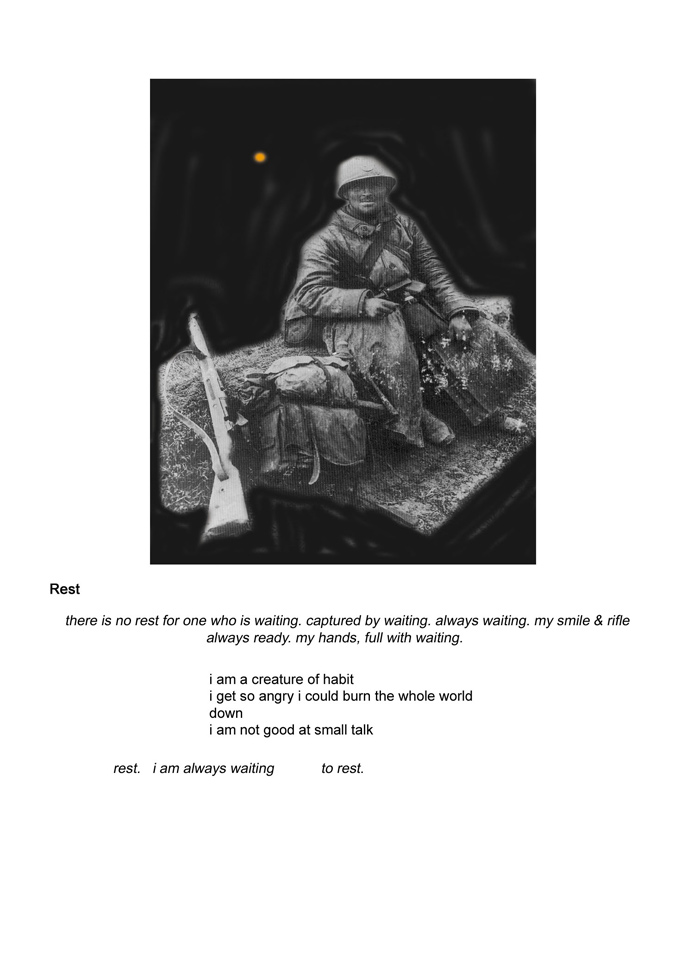
by steve d. dalachinsky and Sig Bang Schmidt
 qarrtsiluni