Archive
Two Girls Decorating a Cat by Candlelight
The cat decelerates at the sight of the negligee,
but negligibly, she’s a feisty little thing. It’s like
she knows the difference between cheap & brilliant,
& costume jewels are for the proverbial birds
who chirp in the rafters, heavy on the reverb.
Dragging her ribbons she darts to the window—
the sweet release of death, to the feline,
is a self-indulgent wish. She purrs at the snow
& her fur is windblown. Do the girls
interpret her shivers as fear or something
fancier? Dancing animals populate
their dreams. It is almost dreamtime,
so say the clock’s glockenspiels.
Say goodnight to the haloed room.
by Elisa Gabbert and Kathleen Rooney
Download the MP3 (reading by Kathleen)
Process notes
“Two Girls Decorating a Cat by Candlelight” is an ekphrastic poem based on the painting by Joseph Wright of Derby.
For more notes on the authors’ collaborative process, see “Rasterization.”
Zuihitsu: Botanical Traces

Image by Steve Rago (click to view at larger size)
Herbarium
Perfection wounds the single
leafed beauty pressing
against glass to blot
out a patch of grey light
splintering winter’s work,
its chill, its ice. We peer
through a window to sheen
of jungle bright, study leaf
rib and spine, find worn
symmetry in petiole and blade.
Is this how memory
is found, some unclaimed
thing, a trace of botany
blooming at the vanishing point?
by Pamela Hart
Process notes
We started with a strategy, but to paraphrase John Lennon, art is what happens when you get busy making other plans. Our idea had been to wander around the New York Botanical Garden, independently and together, with camera and notepad, to dig for content. The Enid A. Haupt Conservatory and the 250-acre-garden grounds, seemed, especially in winter, like good locations for capturing germination and mutation. We had planned to spend time looking, photographing and writing on our own. Then we’d find a particular “thing” that called to us and share that beloved treasure (plant, sculpture, architecture, whatever) with the other. Once material was generated, studio work would proceed.
The best-laid plans went awry at the ticket counter when we learned we wouldn’t be able to visit the Conservatory (the place with all the cool plants) due to a holiday show. So we walked around the grounds. Frustrated by the lack of access, we peered from the outside into the beautiful hothouse, looking at the weird and wild plant life that pushed at the paneled glass.
This decision proved fruitful. From the outside looking in, Steve found and photographed leaves and reflections. Pam was intrigued by the way exotic plants seemed to clamor for escape, and by the layering of cityscape and Edenic scenery. Our stumbling block had become a platform for collaboration.
Later, in putting together image and text, both of us let go of brainstorming notions on arrangement to let the words and photographs collide and combine as we played with page layout, stanza and line breaks and even with the title. The Japanese notion of zuihitsu seemed a final important element. Ultimately, the piece — text and image — excerpted here exists as a series of interconnected essays, fragmented and then woven together on the page. These are our contemplations on the rather unnatural environment we discovered one winter afternoon, which turned out to be, quoting from poet Robert Duncan, a place of “first permission, everlasting omen of what is.”
Jaw Plants
Ah jaw ah lamp ah dent
ah plates of braided spaghetti
tongued elbow gleaming
slick spit nestled on the gown you
folded in the shower
that slipped guppies
down its crease
and quipped like skull
reflected off the floor
mobility of all those
wind blown banners
hopping on the porches
and eating up all the plants
John M. Bennett and Stacey Allam
Process notes
John told us that he and Stacey use the postal service for their collaborations, sending a piece back and forth, each adding usually one line at a time until they both feel it’s done.
Dear Seven: A Circle of Epistles (4)
Part 4 in a series of 7
Dear Cecilia,
I would have written sooner but this week I was sick with not a bad cold but a good one, the kind that leaves you so tired and dizzy you want only to sleep, and sleeping is justified. So while Mike wrote and fixed things and went to the Y I drifted through dreams: my brother, a child again, waving a jeweled bug full of precious, poisonous serum; a room of watery green; an art gallery where a toddler clung to George Bush’s legs and said Grandpa, Grandpa. Now I am better.
Since we don’t know each other well it might be good to ask questions:
- Do you like Japanese movies?
- Under what circumstances would you fire a gun?
- What has more poetry in it: a fire or a swing?
One day of my childhood I sat on a swing with a wide wooden seat. I was alone, it was sunny, two stout ropes disappeared into the leaves above me. The swing creaked under me. The air tasted of morning. I have looked for that swing ever since.
Cecilia is my mother’s name and I always wished it were mine, musical name like the three-note song of a bird, name of the patron saint of music. My mother had a small marble carving of St. Cecilia lying dead, a gash in her neck to show how they couldn’t behead her (at first). While Mary the Mother of God was, after all, only a mother, meaning laundry and dishes, the odd night out at a wedding. When I spent my Communion money to baptize a pagan baby in China, I named her Cecilia.
Yesterday I put away all my garden pots, first soaking them in water. The pots come from the Dominican Republic, China, Italy, USA — their origins stamped into the clay. But no sign of the hands that slopped the clay into molds, carried them to the kilns for firing. I soak the pots because clay dries out over time, and then the soil in the pots dries out too quickly. When you plunge a dry clay pot into water it sings for a long time, hissing teakettle notes as water finds its way back into the spaces. In the spring I will fill them again with dirt and then marigolds, geraniums, lobelia, coleus.
One of the nuns next door is Italian, so they chat in Italian while unloading the groceries or grilling on their tiny back porch. They do not know much about St. Cecilia, but they are dedicated to St. Francis, patron saint of animals and the environment. Yesterday they poured us shots of sambuca for a Thanksgiving toast. Sambuca has the sting of black licorice, is made with star anise and elder flowers. My fingers, coiled around the glass, were stained with dirt. The drink lit a sweet fire in my throat before I went back to soaking the pots.
May words be a sweet fire in your throat, Cecilia.
Mary
by Mary Hawley
the lid’s off, the secret’s out
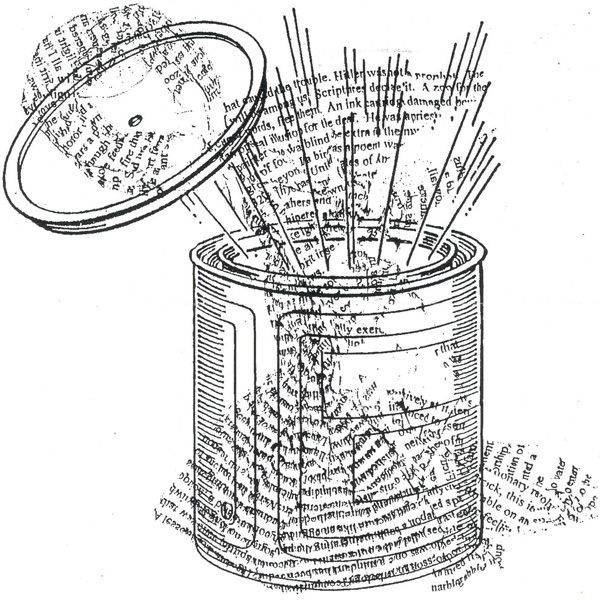
(Click on image to view at larger size.)
by Andrew Topel and Spencer Selby
Similarities
The fetchingly lithe and charmingly disheveled Ms. Tetley-Pringle was well into the third hour of her daily asanas when truth called down to her like a thunderclap:
A clock has a floor and a ceiling and four walls. A clock also has a window. Some, but not all, clocks have doors.
A telephone, not unlike a clock, has four walls, a floor and a ceiling. All telephones also have doors. Some, but not all, telephones have windows.
She forgot her 13th or 14th Downward Facing Dog of the day and hit the sticky mat belly first. In considerable pain she considered her prosthetic limb. She preferred the old-fashioned wooden sort to the lighter and infinitely more wieldy synthetic variety, believing this choice gave her practice a better chance of finally attaining true liberation.
Ms. Tetley-Pringle tried again to empty her mind but found herself considering the startling similarities among disparate objects such as prosthetic limbs, bowls of breakfast cereal, and the books of the Old Testament. She now understood with utter clarity that all have four walls, windows, a floor and a ceiling. Each also has a door. And one day one of these doors will open into a post office and a young man with snow on his shoulders will rush up to a clerk, with an urgency he never knew he was capable of and shout, “My grandmother has broken her hip. You must go to her at once!”
by Peter Cherches and Holly Anderson
For process notes, see “Found Photo.”
Ascension
One of ten selections from the unpublished manuscript, Flying Home. (Click on image to see at larger size.)

by steve d. dalachinsky and Sig Bang Schmidt
We Wrote a Letter to Jesus and He Told Us To Buy a New Car
There were sinister red marks on the dog where its hair came off
I had just moved back to the city after having been away for three years at school
It was around the same time I went out on a blind date with someone and dropped my keys under the bar at the Villa de Roma
Although I had no money I had several typewriters
In our childhood, we were all victims of DDT
I kept wiping my mouth on parts of the table napkin that I hadn’t soiled with my lipstick
The more I learned about my driving from rude strangers, the more I understood extinction
It seemed like everyone back then was making a film using one of those toy video cameras Fisher Price had come out with
On the ground, an egg sandwich absorbed the rain and disintegrated down the gutter
The sound of the CAT scan was just gaining prominence, getting louder and louder with each passing season
Poor as I was, I had friends with less
The museum was free on Sundays but I had to buy them coffee and once, a tuna melt
Since that day at the beach my digestive tract began to exist outside of my body
In the back of our heads somewhere—voices of our great-grandparents speaking in German, comfortable in their lonesome canal-town
The new car turned out to be a rainy-blue ’64 Buick Skylark with taped-on plastic material for the rear view mirror instead of glass
The way I’m lighting all these candles to save electricity makes me a real fire hazard
A lot of pretending goes into the appearance of water and electricity
For larks, we used to pretend we were courtiers, and our dog was of the 5th rank
I documented many aspects of our lives, but not our dog’s
Fifteen years later I remember the look of the crowd but not what the speaker said
Once I start listing them I can remember hundreds of these crowds
That must mean something
I see plenty of famous people (celebrities) around town but I forget them within seconds
Dear Me, I used to start a lot of letters that way
One conversation stands out, on a beach in Atlantic City
We had nicknames for everyone both consequential and inconsequential
I got a bit of advice from sisterly types about what to do about my name at the neighborhood bar
We heard people spray graffiti on the side of our house and it wasn’t even that late
Homes were sinking too, there were sinkholes
The whole time everything was happening I kept trying to find words to describe our own small, austere circumstance
Dogs woke us up early each and every day
It was alright to waste our time as long as we could choose how to waste it
by Arlene Ang and Valerie Fox
Download the MP3 (reading by Arlene Ang and John Vick)
For process notes, see “In retrospect, 1984 made a fine sausage“
Reflective Borders
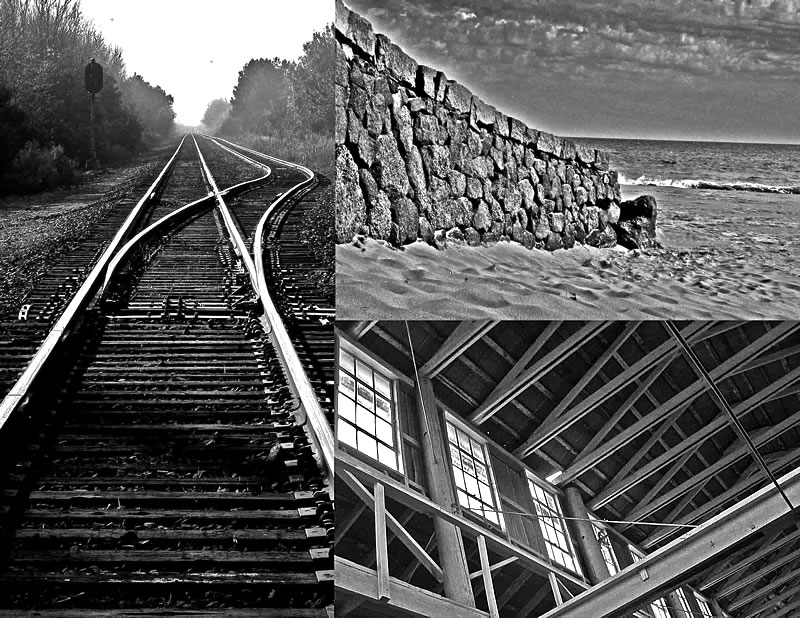
(Click on image to view at larger size.)
by Dorothee Lang and Steve Wing
Process notes
Dorothee:
Collaboration is the central element of these months: since a good while, I am part of the group writing project 2028, which connects 7 authors from different continents. Steve is also part of this group, and with both of us being contributors to qarrtsiluni, the idea of working together on a submission seemed like an interesting challenge. It was good timing, too: as 2028 is mainly about revisions right now, the ‘merged signature’ theme brought us back to the try-and-explore phase of a collaboration.
Steve:
After initially working with mixed media, we decided to work purely with images. We each suggested themes with many possible interpretations, settling on ‘reflective’ and ‘borders.’ We each emailed the other some images, then worked with the other’s photos and our own, cropping and combining them to create a collaborative collage. These flew back and forth across the Atlantic as we revised and worked toward a finished version.
Dorothee:
That’s how “Reflective Borders” came together. In fact, it’s a double merger – a merging of the two photo themes: ‘reflective’ and ‘borders’, and the combining of digitally rendered photos into a black/white collage.
Steve:
Working with Doro’s photos was interesting, knowing that each represents not just a view from another continent, but also something she experienced. It was like a secret hidden in the photo. And of course, with my images, I know some of its secrets. Like in Reflective Borders, one of these places no longer exists.
Dorothee:
The process had the feeling of an adventure, a journey, and I think this is true also of the finished work.
American Way
From Poetry Conversations, Part 1 of 4
Somewhere on the prairie,
A bison is learning to use an axe.
He is not good at it.
He has no opposable thumbs,
So he can’t really swing the axe with much
Accuracy. Plus he keeps on trying to eat the handle,
It is made of wood, and for some reason
Looks delicious to the bison, even though
Most bison eat grass. After being distracted
By the delicious looking handle for the
Umpteenth time, the bison finally manages
To get a good clean swing in.
The trick is putting the handle in
The mouth, not for eating but for holding,
And whipping the head around.
Now that the bison has learned
To use the axe, he realizes
With the little brainpower
That he possesses, that there is nothing
To cut down on the prairie.
The bison has finally learned the American way:
Learning a skill that has no practical application.
He might has well have learned to
Juggle chainsaws.
by Andy Anderson
Music by Andy and Ryan Hoke, Wild Goose Creative
Process notes
Last Spring we had the idea to work together collaboratively on some poetry. We’d been reading each others work for a while but wanted a project we could work on together. We began sharing poems back and forth like a conversation, letting the last poem sent by one serve as a starting place for the next poem written by the other. To raise the stakes we gave each other a 72-hour time frame to be inspired, write something new, and respond.
It was interesting because our styles were very different at the outset — one of us tends toward the more absurd and delineated (Andy) while the other works more with the idea of straightforward storytelling and rhythmic language (Ryan). The four poems that will appear in qarrtsiluni comprise a section from the beginning of the process, where we were still figuring out how to respond to one another and very much using the styles we were used to. However, over time we began to learn how to explore each other’s styles and found our methods changing in response to one another, slowly drawing out previously unexplored nuances, themes, and styles.
Next, since the pieces we write are meant to be performed, we decided to choose several poems and add some original beats and music. This was an entirely new collaborative process for us as well — jointly discussing and choosing which tempos and rhythms worked best, creating new music as needed (Andy) and getting a crash course on music software (Ryan).
This collaboration is ongoing and has been a great source of creative inspiration and artistic accountability, giving us the opportunity to generate a good chunk of new work but also to be open to being influenced and changed by each other.
 qarrtsiluni