Archive
Voice from the Porch
Open your mouth! I implore you. Don’t just sit there with your face melting, tragic over trash and the cold wind.
Make a shape. Any shape. A sound. You’ll feel better. More possible. More like tomorrow than today.
Wake up, honorary roadkill! There’s still time. Name your comforts: dark rooms, standing up, Wanda, oranges and almonds.
Sweet, sweeet, sweet, sweet, sweeet, sweet the distance. Remember, the distance is sweet. Memories are dusty, but plush, lush, but cold. Cold and sweet as ice.
Wrapped in ice, I am telling you this. This is me, the one from the porch.
Catherine Ednie (louder) works as a systems analyst in the New York metropolitan area. Her work appears in In Pieces: An Anthology of Fragmentary Literature (Impassio Press), and in various locations online.
The Curses
The curses were
pleated, language folded like dense
integuments of muscle, like the heart
tougher
to bite through than
any organ. “I like it because
it is bitter,” like a miner, turnip
pressed down
flesh insisting
lively through silt, no one would take that
shape, dwarf’s bulb bullet, unless resisting
being
nothing, growing
downward what’s possible, travel through
filth, earth, call it what you will, had your fill
knowing
dull gravity,
brown and ochre, cursing the mother
for always having to carve into her
to be.
Above ground,
easy leaves find themselves differently,
all furl and crinkle, like fans, flirtation’s
light sound—
banter, repair.
These dare health, but the accordion
expansion of the root, the curses, what do
they dare?
Download the podcast
Monica Raymond won the Castillo Prize in political theater for her play The Owl Girl, which is about two families in an unnamed Middle Eastern country who both have keys to the same house. She was a Jerome Fellow for 2008-09 at the Playwrights’ Center in Minneapolis, among many other honors and awards. Her poetry has been published in the Colorado Review, the Iowa Review, and the Village Voice, and her work has been selected for publication by every pair of qarrtsiluni editors for ten issues in a row now (counting the upcoming Health issue).
Angra Mainyu

Click on image to view a larger version.
Harvey E. Parker is a visual artist who teaches Gifted and Talented in four public schools. His interests include mythology, history, maps and books. Most of his work is currently in ATC format (Artist Trading Cards), the only requirement being that the finished piece be 2.5 x 3.5 inches, the size of a standard playing card.
Cruickshank’s Farewell
by Irene Brown
The rumble of the Lord’s Prayer
mumbled through the chapel
and, with Presbyterian necks re-set,
the piper’s notes tapsilteeried their way
over the damp, sober shoulders of the mourners
who silently tutted and smirked
at the vital ‘HEUCH’
that rose from the back.
Irene Brown lives in Scotland’s capital and has had her first poetry pamphlet, Glass Slippers, published this year by Calder Wood Press. She provided definitions of two of the Scots words in the above poem that might be unfamiliar: tapsilteerie means “topsy turvy; state of disorder,” and heuch is an expression of exhilaration uttered especially while dancing.
No Place Like Home: Kansas 1965
Her bicycle and broom, her fingers bony
As catfish barbels, skin the shade of scales
Scattered from the luna’s wing—oh, the witch entire
Is what I craved—her pointed hat, her widow’s
Weeds trailing behind her like a burning
Bride’s veil, and her voice—pure power—
And your little dog, too. I mimicked
That rasp for days, and I was never
Afraid… Never. What scared me were the trees,
Apple-laden branches that groped and grabbed,
False faces, wrinkling grey bark… Trees like him,
Mr. Monday, who lived across the street,
Who clutched at my hair and my red car coat.
When I wouldn’t go back to the porch slanting
Before his pointy house. Da duh, da duh
Da duh—each lurching pair of steps was perfect
Iamb, a meter I’ll scan again, again.
No one heard me shriek, my voice was too faint
To carry. Later, I didn’t have words
To say what I cannot say. As I watched
The Wizard of Oz the weekend after,
Hexing, oh, I called down my worst on him,
Curses like poppies, poppies that sent
Dorothy and the Cowardly Lion
To sleep, to sleep. No one will wake him up;
Mr. Monday lives alone, not even
A dog… Before the mirror, as I murmured,
I gazed at my unfamiliar face:
Oh, these things must be done delicately.
If they have ears to hear, then let them hear.
Download the podcast
Pamela Johnson Parker (blog) is a medical editor and adjunct professor in creative writing and poetry. Her inaugural collection A Walk Through the Memory Palace was the winner of qarrtsiluni’s 2009 poetry chapbook contest. Her poems, flash fiction, and essays have appeared in or are forthcoming in The Binnacle, The Other Journal, New Madrid, Pebble Lake Review, Holly Rose Review, Six Sentences, MiPOesias, Muscadine Lines: A Southern Journal, and Anti-. She is also the featured poet in the April 2009 Broadsided series of poetry and art. A graduate of the MFA program at Murray State University, Parker lives in western Kentucky.
Abracadabra
Our father used to chop off his own fingers,
pull quarters from our ears or clap his hands
to conjure Jolly Ranchers out of thin air.
We were heirs to the secret knowledge: that our father
was better than the other dads, with a gleam in his eye
that suggested he knew Important Things.
We shrilled with joy when he’d lift us onto his shoulders,
or do handstands and circle the yard.
Our birthday parties were always the best in town.
Abracadabra! and we were instant celebrities,
leading charmed elementary school lives.
Girls wore their admiration on their sleeves.
Not that we didn’t have it rough.
Times are always hard for dishonest men, no matter
how many rabbits they could pull out of a hat.
Some nights we heard our father swearing;
he muttered in his sleep.
Later the novelty would wear off, and perhaps
we had our shame on our faces once too often.
None of the card tricks or magic words
held the mystery and fascination they once did.
Abracadabras won’t put food on the table.
They won’t keep your kids out of fights or
your hands out of the liquor cabinet. They won’t dry up
sudden squalls of tears.
Maybe we should’ve seen it coming.
He lost the sparkle in his eyes, and fumbled the coins.
His breath was sweet with brandy. His armor rusted.
There were signs, but we thought he’d say, and now,
with a flick of the wrist, abracadabra! you can watch
me
dis
ap
pear!
It’s never that simple, and it’s always messy,
if you don’t know how to do it right.
There’s a gravestone, even though we never found a body.
The current was stronger than his soul. What if
we’d had a father that wasn’t larger than life, a farmer,
a pharmacist, someone boring who wouldn’t leave
his goddamn kids this way;
but then, we might accept this, move on easy.
His love was no legerdemain, so it must be this,
this passing away, this attempted suicide,
this sleight of body,
this Greatest Trick.
We wait for him at night. We whisper,
abracadabra!
we squeeze our eyelids tight,
count one-mis-sis-sip-pi,
open them,
and —
Joseph Harker is the pseudonym of a foolish twentysomething, lately located on the East Coast of the US. He dreams more than he ought to, scribbles less than he wants to, and is a textbook Libra in just about every way. If you’d like to bother him, it’s best to visit his online demesne, naming constellations (but do mind your step).
Personnage
14 August 1971 (Picasso is painting)
I lay the yolk-y yellow ground down
now here goes my triangulated body
here is my flesh-colored jock strap
my flesh-colored wings ready for take-off.
It’s hot as blisters and look how the sweat
still runs off me like a young man.
My balls hang heavy and damp.
My dark-veined stones.
Still here. Still have it. It’s all in here.
I’m bringing it out bringing it forth.
I can do this. I can always do this.
The paint still listens.
I talk to the colors and they come —
from the fields this yellow mustard
from fields seen from a train trundling south
then blue canvas awning stripes
sandy Torremolinos days with mother
green seedlings black taxis in the Paris rain. Drunk
and taking Fernande home to finally touch her secrets.
Finger her notch her crook tongue her cleft
heft her high and bury my self.
Now I have wings.
Flesh now yes it’s always been flesh to flesh
and light shifting shapes changing course
of course I’ve followed the light all my life
and strung the string of shapes that tell the stories.
All the stories I’ve lived them all.
89 and the line still excites still makes me hard
the kernel of sex was and is and will always be there
as it should be as it must be forever and ever
so help me god.
So help me work these hands wash in pigment
wash in rapture.
The seed is there
the bursting is still there.
The bursting remains.
Holly Anderson’s poetry and prose has been anthologized in Up is Up, But So Is Down: New York’s Downtown Literary Scene, 1974-1992 (NYU Press), The Unbearables (Autonomedia), and First Person Intense (Mudborn Press). Her limited edition books Lily Lou (Purgatory Pie Press) and Sheherezade (Pyramid Atlantic) are in library collections including MOMA, Metropolitan Museum of Art, and the Victoria & Albert Museum. Anderson’s lyrics can be heard on Consonant (s/t), Love and Affliction (Fenwayrecordings) Mission of Burma’s VS, OnoffOn (Matador), Jonathan Kane’s Jet Ear Party (Table of the Elements/Radium), and various other albums.
Silent Messengers: Writing on Stone III
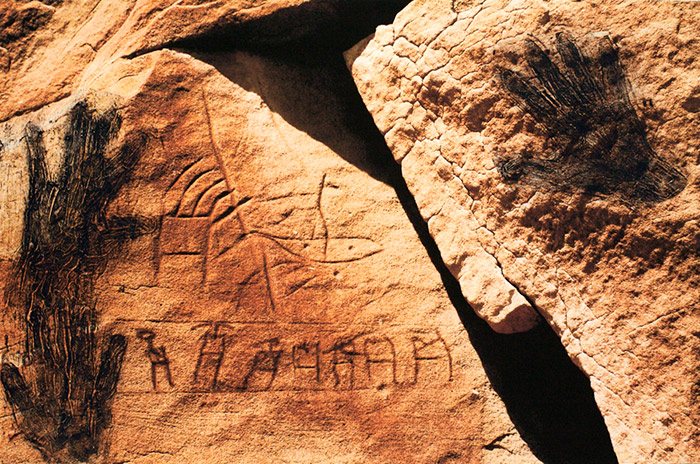
Click on image to view a larger version.
archival inkjet and collagraph on paper
76.2 x 50.6 cm. (20″ x 30″)
Ancient writings on stone may be silent but still send powerful messages spanning great passages of time.
To see the rest of the Silent Messengers series, please visit Marja-Leena’s online gallery.
Marja-Leena Rathje (blog, gallery) is a Finnish-Canadian artist specializing in printmaking and photography. She is crazy about weathered rocks, prehistoric art and the archaeology of past, present and future. She lives and works near the sea and the mountains of Vancouver and has exhibited widely, both internationally and in her local region.
Excerpts from Seven Anglian Spells
aairvhous
the house appointed for judgement
marked by an arrow bearing certain signs
to assemble the multitude
a decisive place
where we lieutenants add our arrows to
that of the headsman
pushing them into the soft belly of the earth
to signal our kinship
planting a henge that shall
over time
grow into chapels and parliaments
the house appointed for judgement
two or three men clad in the pelts of beasts
heads close
conferring on a skyline
aaron’s beard
a charm against enchantment
a cure for bad milk
a sprig placed in the milk pail
before milking afresh
a sprig hid with cunning
from the priests
about one’s person
against their malignancy
adderstane
earth baked hard
almost glass
a bead
a lentil
an unnatural device
disguised by name and
allegory
to protect against
the uncanniness of nature
afterwald
land taken in from the forest
stolen
domesticated
like the dogs that scavenge our touns
accepting sometimes
a kind hand
a docile word
that warn the approach of our enemies
yet slink back to the wilderness
when the spirit takes them
Andrew McCallum is a widely published and award-winning poet from southern Scotland. The countryside around his home is littered with relics of his forebears, who speak through them from as far back as mesolithic times, and with whom Andrew strongly identifies in his poetry. Heideggerian in temperament, Andrew is convinced that language is constructive of the world inhabited by the language user; hence the incantatory or ‘spell-like’ character of the old Anglian words he casts in this poem.
With Nebuchadrezzar in Jerusalem
Just because Jeremiah complained,
God turned over Jerusalem
to Nebuchadrezzar, who burned it.
Not that we didn’t enjoy
splashing fuel around the temple
and cooking the so-called great Men
in their houses; not that we minded
toppling bronze pillars and stealing
oil lamps, pots, shovels, snuffers,
copper vessels, firepans, and scraps
of gold and silver; not that we paused
an instant before we murdered
threescore men at Riblah
and set that corrupt old slob
Gedaliah in the governor’s seat.
But Jeremiah bothered us
with his offhand eloquence,
his pipeline to heaven. Who explained
how to read the dry sticks and bones
in the desert? Who bribed him
to squeal on his own people?
Who directed him to pray
to the pantheon’s weakest figure,
a god who’d quickly see
the logic of the anti-Semite?
Who knew he’d like the taste of ash
on his tongue, the screams in his ears?
Who taught him how to invoke
Nebuchadrezzar without smiling
like a child who just killed a fly?
William Doreski teaches at Keene State College in New Hampshire. His most recent collection of poetry is Waiting for the Angel (2009). He has published three critical studies, including Robert Lowell’s Shifting Colors. His essays, poetry, and reviews have appeared in many journals, including Massachusetts Review, Notre Dame Review, The Alembic, New England Quarterly, Harvard Review, Modern Philology, Antioch Review, and Natural Bridge.
 qarrtsiluni