Archive
Dance of the Doves
by Donna Coffey
Fat-bellied, stick-legged, we sway awkwardly.
As doves’ wings whoosh and flap-flap-flap,
our flabby arms flutter. We play ballerina, play girlhood.
Our ringed hands reach beyond what summer offered:
scant seeds and thin grass. What can we pull from the air?
Ourselves, like a bird from a tall black hat?
After the dance we sit on the floor, and the teacher asks,
how did it feel? A woman is weeping. She is fifty,
plain and plump. She smears mascara across her cheeks.
I felt not alone, she says, and I am caring for someone
who is dying of alcohol. But from the dance I saw
that he is really dying of loneliness. The women in the circle
nod and blink at the floor. Each of us a mourning dove.
They mate for life. My husband found an empty nest
in our backyard. They build their nest in pairs
and take turns warming eggs and feeding chicks
from a milk they make in their throats. I kept it on my desk.
So intricate, the way she wove what he supplied,
concentric circles of twigs, pine straw, some small flower.
We used to hear his oo-wah-hoo-hoo-hoo and her reply.
Rain doves, they call them in Georgia. I don’t know why.
They hunt them, though, with guns that are bigger than birds.
I’ve never seen the tiny bullets. Can only picture the canny hunter
hidden in the brush, the dogs’ sudden leap to flush the unsuspecting
birds. And does some woman make a feast of doves,
leaving only the feathers and bones?
At a funeral, my husband’s cousin gave me a recipe
for squirrel dumplings. My husband said the only thing
he’d ever killed was a chipmunk; it quivered as it died.
He shot at his brother once, but missed. Over his desk
he’s hung a photo of himself dressed in camouflage,
playing paintball. Now he only plays at death.
How unlikely a vision: me in a matronly apron,
cooking squirrels or doves. My husband sitting expectantly
at a formica table. I ask if he has enough sweet tea.
He pats me on the behind. And I serve him
a steaming platter of tiny bones like a pile of fingers.
The dove is the Holy Spirit, our teacher reveals. The woman that she
always was, Sophia, Wisdom, hidden goddess. Her breath in us.
I don’t think so. The whole time that my hands were in the air,
my foot was caught. I could turn with one leg only. For all my flutter
I did not ascend. The dove is the bird who marries. Who mourns
not because she doesn’t love him, but because she does.
Donna Coffey is an Associate Professor of English at Reinhardt University in Georgia. She completed a Ph.D. in English at the University of Virginia in 1996, and just completed an MFA in Creative Writing at the Solstice Low Residency Program at Pine Manor College. She has a number of scholarly publications but has just begun submitting poetry. A piece called “Saint Margaret” is forthcoming in Calyx.
Between Us and the Slow Fall
by Susan Elbe
of light, hardly enough to see sparrows
in tattletale air, clouds
dirty as bootscuff and bundled with winter,
hail on the window,
a cold cant of pistol and steel.
::
Between us and the slow fall, the news
just keeps coming—red waves
of oil wash ashore at Biloxi
and pelicans sink in the muck,
honey bees die from colony collapse,
children flare up in the crosshairs,
so many too quick to forgive
our recklessness, greed,
our mistakes, the stellar wreck
we’ve made of this world.
::
But on the moon’s desert, there’s water
and lost dogs do return home.
To survive flood waters,
frogs hitch rides on snakes.
Song bursts open in shopping malls
and neglected art is found.
The sun grows stronger, its winter edge
carving cold panes into gold.
We still create myth, practice magic.
::
Between us and the slow fall, we live,
sometimes with grace,
sometimes without,
and in the elephant hour, the grey
skin of air before dawn,
I tell myself no more, no more
will I waste the big, soft-eared days.
Susan Elbe (website) is the author of Eden in the Rearview Mirror (Word Press) and a chapbook, Light Made from Nothing (Parallel Press). Her poems appear or are forthcoming in many journals and anthologies, including Blackbird, diode, MARGIE, North American Review, Prairie Schooner, Salt Hill, and A Fierce Brightness: Twenty-five Years of Women’s Poetry (Calyx Books). She lives in Madison, Wisconsin.
The Key of Joy
by Caitlin M. Daphtary (music), Zackary Sholem Berger (lyrics), and Rachel Dudley (vocals)
To listen to today’s podcast while browsing the sheet music, either click on the document to view at full-screen size, or go straight to its location at Issuu.com.
Caitie Daphtary is a composer and award-winning amateur chef living in the Boston area. She has come to feel, particularly through her struggle with fibromyalgia, that her life (and all life) is a spiritual exercise, in which the question of “What am I not?” has particular relevance. In accordance, her music has taken a turn toward the simple and devotional — coming into being only when it is asked of her. “The Key of Joy” was composed in this fashion for her life-long friend Rachel Dudley upon her marriage. Currently she is working as a Director of Religious Education within the Unitarian Universalist Church and is just as eager as anyone to discover the next “hat she’ll wear.”
Zackary Sholem Berger (website) is a poet and translator living in Baltimore who writes in Yiddish and English. The words to The Key of Joy were written by Zack as a thank you to Sam Zerin and Rachel Dudley, who supported the publication of his poetry chapbook Not in the Same Breath (a happily conflicted volume which is 1/3 English, 1/3 Yiddish, and 2/3 pretty pictures, and can be purchased here). Caitie wrote the music, and the whole was premiered at Sam and Rachel’s wedding.
Rest
by Cynthia Cox

Click image to see a larger version (or go to Flickr for an even larger one)
Cynthia Cox (website) taught high school English before returning to graduate school to pursue a Master’s degree in Counseling at the University of Houston. She has been writing poems for 16 years, with publications including The Houston Poetry Festival Anthology 1996, Tres-Di-Verse-City 1999, and, more recently, Cider Press Review, Albatross, and Epicenter Magazine. Her poem “Dog Years” was recently selected as the winner of the 2011 Austin International Poetry Festival.
AKA Annie
So now
I take the car service way out there for what?
To THE Bronx? What is that anyway?
Some wrong turn a Dutchman took?
It’s all gone. None of it is
here: Fulton cobbles dipped in pewter, the shitting,
shrieking gulls
wearing their necklaces of fish guts and dawn-tinted tiaras.
This new joint looks like an airport.
The sweet sweet reek and bladderwrack all gone. All gone.
Some of those weisenheimers always called out ‘Nice rack, Annie’
my buoyant my
bouncing clouds of joy Oh!
how the boys enjoyed the chest that some god somewhere
gave me to share
joyfully with all the world. All gone.
A bit of luck for the really young ones now.
A floppy bit of rest for me old market boyos.
Game over.
Nothing left to sell.
Better to bundle these riddled bones and storied skin
mottled blue and tallow yellow, red bursts and pin dots. What the hell happened to the queenly scroll of vellum that men pored over, studied and adored?
so I just watch wonder
and wait now for warmth to find me again.
Tucked up in a tidy corner with some busted flat, waxed boxes underfoot
and a tower of clean crates at my back.
Dozing. Nothing left to sell.
I’m happy to sleep. When I sleep I can fly. Not so dramatic that
just me running hard
running full-out down a lake road sun-blistered and so
much hair where is that hair now?
The way it wagged like a tail like a curtain like water tumbling over rocks
my mouth laughing the panting he is chasing my fine frame wanting me again wanting to worship at my freckled altar
but I’m always running hard and then
and then I’m lifting off tanned legs bicycling over spruce tops far
far beneath the skittish clouds and I can read all the
alphabets of pine pitch birds bottle green and blue sky symbols.
Flying high where it’s clear and it’s cold as pack ice.
Where it’s polar. Where it’s quiet. It’s so quiet.
Maybe I’m a satellite.
‘AKA Annie’ was inspired by a New York Times article about Gloria Wasserman’s storied life dated Oct. 10, 2010
Some of Holly Anderson’s recent work can be heard on Peg Simone’s 2010 record Secrets From the Storm (Table of the Elements/Radium). Forthcoming in 2011: ‘The Night She Slept With A Bear,’ a collection of flash fictions and mesostics shipping with an original soundtrack by Chris Brokaw from Publication Studio in Portland OR.
The Widow Discovers the Secret of Leona Canyon
by Lenore Weiss
Before dog-walkers with squadrons of panting beasts
pull up in SUVs, I arrive early—a woman without a pooch
who can be trusted to make a game of counting packets of shit
set aside for some doggie walker’s return trip.
I start early, knot a hoodie around my waist,
hiking in the sun I want to lose myself,
balance on a branch of a buckeye tree
with its candelabra of mock lilacs,
walk past hemlock that lace the trail,
everything is a blaze of white
as spring marries summer and loosens her veil.
I dip my hands in water and wash my face.
Anna’s hummingbird, with her red crown
and red spotted throat, sips right along with me.
Shepherds follow their off-leash flock up the canyon.
Lenore Weiss (blog) is an award-winning writer who has made her home in New York City, Chicago, and now Oakland, California. She edited From the Well of Living Waters: Voices of a 21st Century Synagogue (2011). Recent collections include Tap Dancing on the Silverado Trail, from Finishing Line Press, and Mother and Other Love to be published in 2012 by West End Press.
the artist’s hand
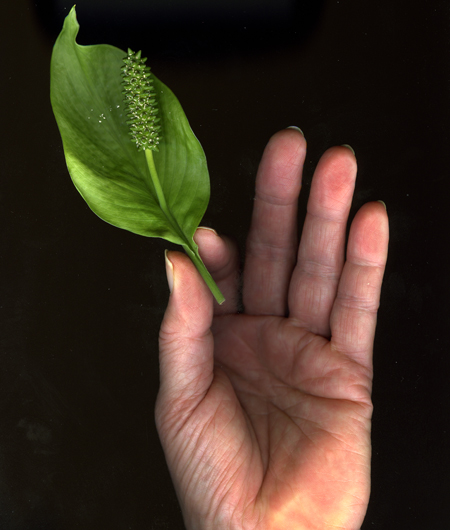
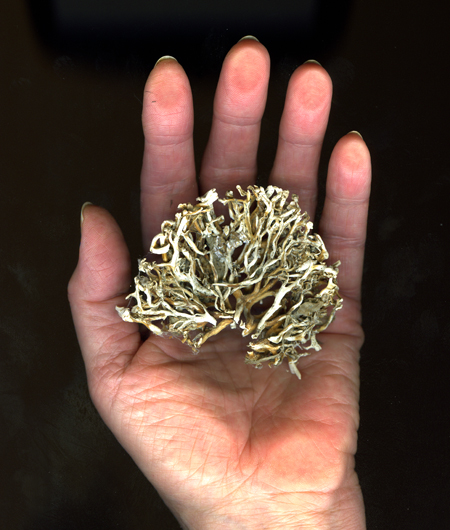
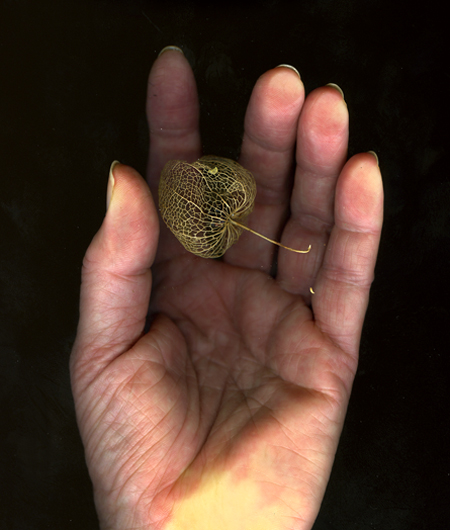
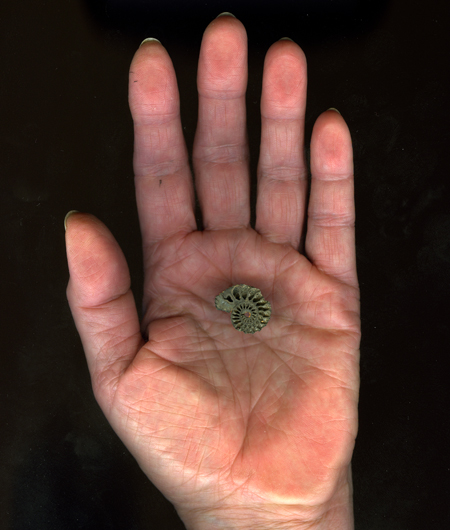
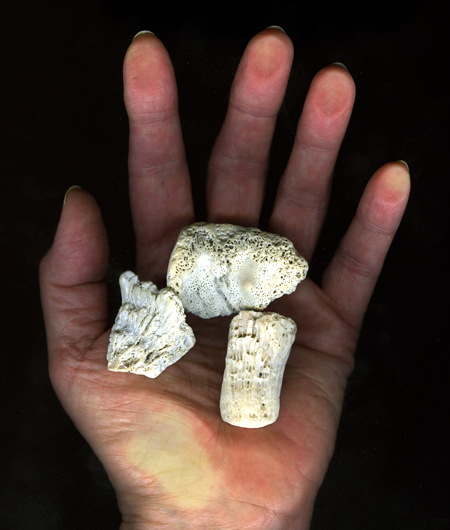
Marja-Leena Rathje is a Finnish-Canadian artist-printmaker and photographer who resides near the sea and mountains of Vancouver, BC. On her blog, she writes about her work and interests including a fascination with weathered rocks, prehistoric art and the archaeology of past, present and future.
The Open Bible Baptist Church Hymnal, Sword of the Lord Publishers, Murfeesboro Tennesee
by Lynnel Jones
They strike a cord — these good old hymns —
even the Alzheimer-regressed pretend
to sing
“Tell me the old, old story…”
Catherine Hankey wrote the lyrics for that one.
I wonder if she’s titled “pastor’s wife”
like so many others in this book.
“Tell me the story often, for I forget it soon…”
I tell it every week.
It’s each time new.
Today the text is vineyards and wine.
“What did they make with grapes?” I ask.
Long pause.
Finally
“Grape jelly,”
says one, who wipes frail fingers
on her stained ghost-apron.
“…in a land where we’ll never grow old.”
she drones.
We stumble along.
“Count your many blessings.”
See what God has done.
Lynnel Jones is a Minnesota native. Her poetry is steeped in the joys and struggles of Minnesota’s immigrant mining community, and the lives of the people of rural southern Virginia and Pennsylvania’s Pocono Mountains, where she now lives. Her undergraduate degree is in English. She holds graduate degrees in divinity and law. She is an experienced academic and community workshop leader and reader. Her poetry has appeared in numerous online and print journals. Her chapbook, Rocks and Crazy People, was published by Foothills Publishing in 2008. She was a 2009 Pushcart nominee.
In praise of zero
by Joe Hyam
During the funeral service a bird flew
into the glass door of the chapel with a thud
and, having interrupted the eulogy,
also departed this life.
To monitor the flight of birds
in consideration of what is received
(for which we should be truly thankful),
to count and name their variations,
their prey and predators,
is reason enough to be on Earth.
Numbers are the one certain thing:
and of numbers, The One is superior
to all others, excepting “The Zero,
in which lies a great and sacred mystery”.
Inside The Zero is the ache
of things longing to be alive:
the eager whisper of beak and claw
within the breaking shell.
Small waves creep up the expectant shore,
nudge and smack the rocks where sea bass
soon will nose the swaying wrack,
and overhead gulls shout “mine, mine”
to the spreading territories of the sea.
In holes in the wet sand, razor clams
wait for the water to cover them
to emerge in safety and learn what’s up,
unless red billed oyster catchers, ankle-deep,
come first to hook them out; or comes a man
to squirt salt water with a plastic bottle
into the holes to make the molluscs think
that the tide has risen, and captures his lunch.
Of the 8.7 million species of living things
deemed to be on Earth (viruses excluded
and incidental extinctions), these few are data
to be tabulated, the answers to questions
and the questions themselves, as the pinhead
whereon they swarm and multiply
vanishes into absence, into the absence,
the absolute absence of zero.
Joe Hyam lives in Tunbridge Wells, Kent where he grows vegetables and writes poetry. His blog, Now’s the Time, records the pleasures and surprises of existence in a particular place in troubled times.
behold the minotaur
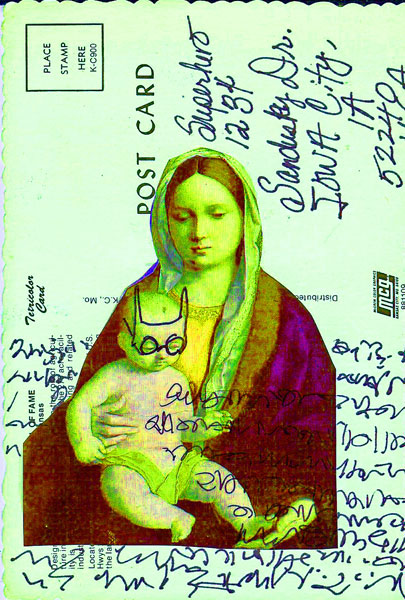
dear i m a superhero,
thanks for the mailart depicting the minotaur with the menacing head and slim, innocent body of an adolescent. it put me in the mind of a photograph i once found of the baby minotaur sitting on his mother s knee, his little head turned toward her breast. he looks sweet as the baby jesus. he looks like the baby jesus wearing a mask he made in kindergarten.
you probably know about pasiphae, his mother and minos his father, but don t think of this married couple hurting each other. think of the minotaur who wasn t always a beast. once he was a baby. once he was even a god, worshipped by the cretans.
Theresa Williams has work forthcoming or published in Barnwood, Contemporary Haibun 12, Gargoyle, Paterson Literary Review, The Prose Poem Project, This, Segue, Up the Staircase Quarterly, and many others. This poem is part of a collection of prose poems she’s working on called “the eternal network” in which the unnamed speaker writes a series of letter responses to the mail art community. The image accompanying the poem is an original collage by Theresa and an actual piece of mail art.
 qarrtsiluni