Archive
Divinations
Ouranomancy
Stasis in winter is your belief in a window. From it you see the black maple spackles a hospital’s brick wall into aubergine. The glass of the window carries the yellow glaze of traffic, the whorl of crimson wing tips, the slop of salt-water. Up high in the elms, light disappears, the bark of a bird dips among the red thrash of leaves.
The voice of three ships circle the harbor. Where a small house on the shore is made real by the sun. That you would bury your song. That you would go keyless into the sound of locks. That you were not human. That there would be no one to ask. But that you needed to ask in order to live.
Trucks excite grasses over the field. The skulls of unnamed birds lay scattered through mulberry. Ravens nest in the plum blossom. There is a ticking in the mind that thorns and unfurls into thistle. You still struggle but do not see what’s gone. Capturing no hand you pray in fear you don’t want to tell of your god-approximate to whom nothing is spoken… You invite the rain bear scat egg peel of nut hatch. Once you ask yourself why stumble. Ask yourself gentle why laugh. You’re not special. You’re not not special. A worn thing. Falls here all around you. There is no comfort in language. Real words are soundless. But you gather no words.
Sometimes you believe you still hear him. But when you speak of his voice you close the window to the ocean for the last time.
Hydromancy
She will not hear snowflakes wild splatter into the strewn patches of cord grass. Winter’s muck along the pond’s edge, a mix of fawn tracks and duck droppings, freezes under the long white lines of her legs. There will be a twinge in her upper spine. There will be wet black flames drying in her braids. She moves through this air that is stunned by her heat. She regrets the passing of light, her Coppertone lathered face gleams like gold leaf. Her grandmother’s wedding ring, now a spiral of seeds, pinwheels her marrow. Fractured spindles know no other cheek to kiss. Weathered witness, have courage. The coffee on the nightstand remains a clammy taste of seawater. She has spliced the last of her father’s voice on the phone, three nights before his death, with the first bloom of yarrow. Her dusk phrases have buried all the songbirds. But the brine white hills will not blind. She opens each unfamiliar door between offerings. And lets there be no after thought.
Geomancy
Tonight an artist disemboweled a 100 year old Milton Piano. He thinks he is of the ‘Pianist’ tribe; a Native American tribe name given not to themselves, but designated men who smashed their pianos into dust as they headed west. I listened to the last songs of the yellow notes float, not into the sound of weeping, but into a room where branches of linden oaks covered the walls. A boat overturns into the ironweed thicket. A dock lies buried under mustard rows. A horse stumbles in inches of water brown as beer bottle. Unnamed blood lily. At dawn I wish my neighbor’s window unto an eastern lake. Accordingly, the sun thins the afternoon into silent declaration.
Chiromancy
Someone spills water over your hand. Tonight the bridge will be sawed in half. Under the guise of raw wood, your immaculate room shines. Under no sun. Gilt stones fill the thorax. Under the beams grow weeds, grow fever. Rainwater errata Under the problem of phones, because mostly there are none. Under the planks of the splintered dock your car keys swim the harbor. Under your keel shaped sternum. Piles of medallions and crosses bloat the thrift shop. The clovers repeat a swell of bees. Under the press of a wet nightshirt’s gauze. Under the red palm. Lady, your gold threads are slashes. Under the touch of an old lover. Under the sparrows stain. Under the memory of the message that filled an entire tape on your answering machine. Geranium florets blossom your breasts. The deep white seams of you, space between lanterns.
Thumomancy
Soul, most recent of animals, your lost papers fill the closet. I would not notice your soft intrusion. But for the vignette edge of the landscape, where your face is an accident without origin. I see you have been here all along. Let me tell you, things can happen in the years. Last winter a squirrel died in the cabin chimney. There is no single script. Only the last of three orders of breath made before silence. Night has given me my wide addiction. Under uncertain laws, in the sleep of no choice, I follow motivations downward into the sweep of your pen. Scrawled lights of a new city wink between rows of tamarisk. The center of the book is a catastrophe, but with love there is a lack of distance. You have led me into the first threshold of your vision. Jupiter glows through a ragweed thicket. There is no body. No sound. You go on without calculation for the beginning. You go on under the lowering of gravity. Tonight the oncoming boxcar whistles your unfolding music.
Maureen Alsop is the author of Apparition Wren (Main Street Rag), The Diction of Moths (Ghost Road Press, pending) and several chapbooks, most recently Luminal Equation in the collection Narwhal (Cannibal Press, 2009) and the dream and the dream you spoke (Spire Press). She is the winner of Harpur Palate’s Milton Kessler Memorial Prize for Poetry and The Bitter Oleander’s Frances Locke Memorial Poetry Award. Her recent poems have appeared various journals including Blackbird, Front Porch Journal, AGNI, Tampa Review, and New Delta Review.
Urban Testimony
What are you gonna do for the black artist,
the one whose voice dwindles in the storm?
We are not silent by any means, just black.
Black get back, your talk is too big and loud,
but not cheap like the shoes I wear, so bear
the brunt of my sass, the persistent itching
of my tongue on the back of your mind,
let what you think is the devil’s wayward word
turn and club some sense, yes sense.
Black, up in your face not with guns, words.
I’m nigger with a book not a poptheweasle gun.
Suck this; chew the black lip truth,
Remnants of storms, hardcore, steadfast words,
fast and furious, quick in effect, deadly in assault,
funky, but still wanting peace. Believe!
Brethren, let me hear you say, ‘well.’ Word for the fearless.
Maroula Blades is an Afro-British writer living in Berlin. Verbrecher Verlag and Cornelsen Verlag have published her short stories. She has received awards for poetry. Poems have been published in Germany and abroad. She read at the Berlin Poetry Festival 2008.
An Irish Blessing
for my father
May the Lord put you in a witness protection program where the Devil can’t find you.
May you always find yourself in the flow of traffic, and may the slower drivers stay
the hell out of your way. May your hair remain red enough to refract harmful UV rays.
May your appetite be hearty and the waistband of your trousers slack. May there be
no household project to ever get the better of you. May you shit out the colon cancer
if it starts to grow back, and then may the doctors go broke trying to find anything else
wrong with you. May the church parishioners listen in rapt attention to your readings
and your grandchildren hear your stories without any fidgeting. May you grow just
absent-minded enough to forget cross words. May your buddies from Korea stay out
of the obituaries. May your partner be there to chide you if you start to become morbid.
May you find samples at every supermarket and long-lost treasures at every yard sale.
May your coffin be constructed of toothpicks from fine dinners you haven’t yet eaten.
May winter cold melt in your breath. May the road ahead be soft enough for slippers,
and may the Good Lord reserve for you a fine pair of size thirteens.
Download the podcast (reading by David C. Wallace)
M.V. Montgomery’s first collection of poems, Strange Conveyances, will be published by the Plain View Press. A second book, a pamphlet of historical poems titled Joshu Holds a Press Conference, will be published in 2010 by the Conversation Paperpress.
The Man Who Spoke the Law
by James Brush
Old folks will tell you there was a time when there was no poetry. Not around here anyway. Maybe back east or some place where time was more available, but breaking this land took all a man had and didn’t leave anything for him at the end. Certainly, no time for pretty words.
Some will even tell you that there was laws against it, but I don’t hold with that story. Still, I had this idea for a poem, back in ’08 or so and I didn’t want to run afoul the sheriff so I figured I needed to have a looksee to find out if there was any laws about poetry one way or the other.
I won’t tell you all my adventures because there were too many and most of them weren’t really worth the telling, but I saw a fair bit of Dallas and Houston and even El Paso on one occasion I’d just as soon forget.
It was in Austin, down in the fluorescent-lit subcommittee caverns beneath the capitol building, where I found my answers. I’d been walking around admiring all that pink granite and the grounds with all the fat squirrels and pigeons and lobbyists and all when I met an old guy mopping the floors after all the senators had left. He’s the one who told me these poems I’m about to share.
He said he found them. Now, I don’t usually go in for poems people say they found, but these two I’m about to relate are the closest I ever come to finding any kind of answer. I guess you could say they were found twice.
He told me, the Texas State Legislature said, “Let There Be Poetry.”
He told me it was all written down in a big old leather-bound book like the ones you might of seen witches reading their spells from in the movies. It was called Texas Administrative Code,
and if you turned those musty old pages over to
Title 19, Part II, Subchapter C §110.31. English Language Arts and Reading, English I (One Credit), Beginning with School Year 2009-2010. (b) Knowledge and skills. (3) Reading/Comprehension of Literary Text/
you’d find it.
He closed his eyes and started reciting in a low whisper. He said it was
Poetry.
Students understand,
make inferences
draw conclusions
about the structure
& elements of poetry,
provide evidence from text
to support their understanding.
students are expected to analyze
the effects
of diction
and imagery
(
controlling images,
figurative language,
understatement,
overstatement,
irony,
paradox
)
in poetry.
He stopped saying his poem, and I stood there taking it all in for a long time. I could hear footsteps echoing through those marble corridors like the sound of generations of people coming up from their final resting places just to hear what this janitor was saying, but those footsteps were just regular folks going about their evening, leaving work, unaware that there was some poetry right there in the middle of all that law.
I told him it sounded like that about covered reading poems, but what about writing them. He nodded and told me all those powerful senators and legislators thought of that too and so he shared another one he found, but it was under some different subsections and letters and what have you.
This one was shorter, kind of like one of those Japanese poems that never got a title and tells you a lot without using very many words so you have a lot of things to think about and maybe don’t know exactly what the writer meant.
write a poem
using a variety of
poetic techniques
and a variety
of poetic forms
He let it sink in a moment or two and smiled and kind of leaned on his mop a little and told me he might of left some parts out, some commas and conjunctions and parentheticals and whatnot.
I don’t know. And I don’t know if those were any good or not either, but it sounded something like what I might be looking for.
The next morning, I headed back toward home and didn’t stop until I got there.
Download the podcast
James Brush (blog) is a writer and teacher living in Austin, Texas with his wife, cat and two greyhounds. He teaches English in a juvenile correctional facility, and was once a James Michener Fellow at the Texas Center for Writers. He published his first novel, A Place Without a Postcard, in 2003. His poems have been published by Thirteen Myna Birds, ouroboros review, Bolts of Silk, Postal Poetry and a handful of stones. His essays have been published in The Journal of Pediatric Oncology Nursing and Good Gosh Almighty!
Yoga Center Wall
by Steve Wing
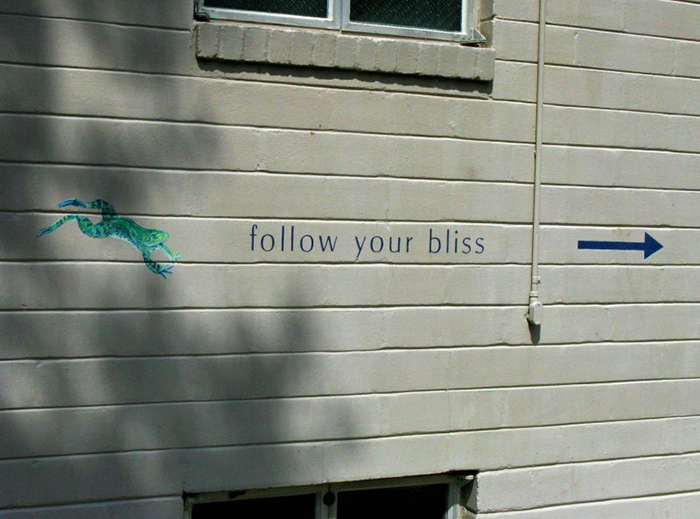
Click on image to see a larger version.
Steve Wing (PBase gallery) is a visual artist and writer whose work reflects his appreciation for the extraordinary in ordinary days and places. He lives in Florida, where he takes dawn photos on his way to work in an academic institution. He’s a regular contributor to qarrtsiluni, as well as to BluePrintReview, where he has a bio page with links to some of his other publications.
Going Out to Buy Shoes
It was around that time that my wife’s
father decided to run for office, mayor
of heaven, I think it was. He campaigned
from his chair as I wheeled him around
the mall. It was extraordinary. The shoppers
had never seen such friendliness. He made
everyone smile whether they wanted to or not.
Imagine an antic child, who fathoms
what no child can, our covetousness and cruelty,
because it’s his. “Smile,” he shouted
to everyone, waving his bony hands,
as we passed the corner of Butterfly
and Butterfly. “You may not get
another chance.” Later on, he asked me
for a riding crop so he could switch
the uncompliant ones. It takes a certain
meanness, I admit, to wring love from thieves
and liars. Sure, he knows. But it was love,
not pity, in their eyes he said, and that
was good. “If I’d had an education,
I’d be dangerous,” he added, about himself,
work done, chewing a cheese sandwich
with his one tooth.
*
Richard Nester is a former fellow of the Fine Arts Work Center in Provincetown, and has published in a number of locations including Ploughshares, Seneca Review, Sycamore Review, and Tikkun.
From Genesis Rabbah
by James Toupin
Across the centuries,
you hear the Catskills cadence —
Thus Rab Ezekiel,
as his son, Rabbi Judah,
recounted: “Why shall we bless
the name of God for giving
us each drop of rain?”
One. Two. Three.
Four. The pause that strums
the crowd. “Because it could
be coming down in sheets.”
Of course, rabbinic texts
do not record a rim shot,
and maybe the son forgot
his father’s way with a set-up
(sons can have tin ears),
yet like a great joke straddling
the ambiguities
the sage’s punch line sits
poised between two stools,
the one a blasphemy,
giving thanks for the absence
of God as Father of Floods,
the other sublime madness,
attempting a prayer
for each drop as it falls.
And of what would the prayer
consist? “Blessed art thou,
O Lord our God, Ruler
of the Universe,
who laughs, just this once, with us.”
James Toupin is a government lawyer who lives in Washington. He writes, “Maybe because, as your call for submissions points out, legal instruments are by definition words of power, your theme treads on ground my poetry seems to go over and over. However, it ventures onto that ground mostly in a religious vein, reflecting a mixed Jewish and Christian heritage.”
Grandmother Praying
by Oriana
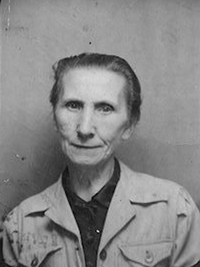
Veronika, first i.d. photo (1945) after Auschwitz
Saint Anthony
Pincushions, hairnets,
a mischievous spool of thread;
thimbles wobble in uneven hoops,
needles enter the veins of things.
We rummage through drawers
reeking of decayed Soir de Paris
cologne and valerian drops;
the slipper-hedged dusk under the bed.
There remains the invisible world.
We kneel on the creaking floor
before the painting of a smiling monk,
a lily like a magic wand
tilting from his hand.
With a practiced zigzag,
we cross ourselves: Saint Anthony,
guide us to Grandmother’s thimble
Again we scan
the summits of wardrobes,
horizons of floors;
the precipice behind the couch,
gritty crevasses of chairs.
She gives up at last:
The devil must have
covered it with his tail.
God’s Hearing
One evening in Auschwitz
the women in her barracks began to pray.
Their prayer grows and grows,
a chant, a moan, a howl —
it carries far into the searchlight-blinded,
electric wire-razored night.
The Kapo rushes in, shouting, Not
so loud! God is not hard of hearing!
And my grandmother laughs.
Then she starts an old hymn:
Many have fallen
in the sleep of death,
but we have still awakened
to praise Thee,
she sings to the God of Auschwitz.
Her voice does not quiver.
Oriana leads a double, sometimes a triple life by the sea, the cold Pacific Ocean near San Diego.
Learning to Curse
Regaining breath, he
undoubles slowly
his back to the schoolyard’s
chainlink fence, too
surprised to swear.
His enemy’s grinned
with the cruel fear
of boys and skimmed
off with his pals
down alleyways
their crowing still
lodged in his gut—
slurs he could not refute
with his fists. Half-crawls
to the spot by the tetherball
pole where they collect
at recess and retches
up his humiliation,
wipes his hot face
with his damp wrist,
heads home with
each breath new
in his raw
throat, muttering
shit shit shit
to the five o’clock
suburban sidewalk.
Ann E. Michael (website) is a poet, essayist, librettist and educator who lives in Eastern Pennsylvania. She holds an MFA in creative writing from Goddard College and is a rostered Artist-in-Education with the Pennsylvania Council on the Arts. Her writing has appeared in numerous literary journals and in newspapers, family magazines, poetry anthologies, educational and academic publications as well as on radio. Her chapbooks of poems include More than Shelter (Spire Press), The Minor Fauna (Finishing Line Press), and Small Things Rise and Go (FootHills Publishing).
The New Dogma
by C. Albert
Thou shalt not beg,
bite, bark incessantly
nor steal biscuits.
Before the Dog Prophecies
there was only ignorance
and fleas.
Follow the righteous
path to the dog park.
Sit and stay,
Roll over,
Do not eat grass.
Praise ye the one Dog
who smites evil
with thy paws,
who giveth bones
to the hungry—
Hallelujah!
by C. Albert
Download the podcast
(reading/howling by C. Albert with Matthew Casey)
C. Albert lives in Seattle, Washington where she divides creative time between making collage and writing poetry. Publications of her works are upcoming this Fall in Shakespeare’s Monkey Review, Tattoo Highway, and Pirene’s Fountain. Find more of her work at Runaway Moon and Aerial Dreams.
 qarrtsiluni