Archive
Tricks
by Zoe Polach
We had a list of all the things that were important. It was a long list, but not too long, because it was very carefully edited. Thrift was on it, and wearing pants, and so was keeping good records. We’d made too many mistakes to forget that one.
One day at the end of winter, we were debating over lunch whether we should add something to the list. In the middle of the discussion, a stranger wandered in. We asked her what her name was, where did she come from, but she just smiled and asked politely if there was enough to share. We said, of course there is (hospitality was #14), pull up a chair and help yourself.
We continued talking, and the stranger listened attentively. At the end of the meal she thanked us for our kindness. She was a wandering magician, and she wondered if she might pay us back by putting on a little show. We said, we love a good magic trick, what’ve you got?
With great ceremony she pulled out a deck of cards. They were bigger than your average playing cards, and we thought they had different pictures, but we couldn’t quite make them out.
After shuffling them with all kinds of fancy flicks of the wrist, she fanned the cards out face-down and offered them to the nearest person. Take one, she said. He did, and turned it over. It read, simply, #20: paying debts. He read it out loud, and everyone looked at each other.
The magician took the card back. This is my best trick, she said, proud and a little shy. She traced the letters on the card with one long finger and they disappeared under her touch.
We wanted to be polite, but we didn’t understand. She said, you’ll see it if you try again. This time the card read #14: hospitality. As the word dissolved we felt something, a feeling whose name we couldn’t remember. Maybe we’d better see it again, we said, sitting up in our seats.
We erased our portraits, too, and our mortgages, and lots of things that people believed in. And every entry on our list had gone up in smoke before we were done. We felt better than we had in years.
When we were finished, we told her that after all this, we had to know her name. She said, I forget, I’m sorry, was it important?
Zoe Polach is from the Maryland suburbs of D.C. She started as a freshman at the University of Chicago this fall.
Afterthought
by Steve Wing

Click on image to see a larger version.
Steve Wing (PBase gallery) is a visual artist and writer whose work reflects his appreciation for the extraordinary in ordinary days and places. He lives in Florida, where he takes dawn photos on his way to work in an academic institution. He’s a regular contributor to qarrtsiluni, as well as to BluePrintReview, where he has a bio page with links to some of his other publications.
The Butcher’s Wife’s Tale
His heart was a poppy, paper-thin.
From the women’s balcony I heard it
during the silent prayers.
His shoulderblades trembled under his tsallit, weapons
I wanted for myself. Blame it on Lilith,
on boredom. Blame it on dirt
got into the mikveh. Blame it
on my red hair, or the gap between
my front teeth, which is a sign
of lustfulness in women, or at least distracts men
from my lack of beauty. But on what
shall I blame love? I asked him
to bring me a loaf of challah,
made in his mother’s kitchen.
I was his first. It was easy from there.
The rebbe’s son, I would meet him
a bit before dawn, holding a lamp,
the cellar door barely open.
Koomt tsoo mir — my hand in the door,
pulling him in, under the earth
fragrant with apples. We kissed
in the darkness of apples.
Upstairs, we smoked cigarettes, and the last of the night
clung to our skin: the dark gold of tobacco,
red gold of his hair, the silver of moon
and of smoke. Our picnics in the garden
of my hand-embroidered bed. A few braids of challah,
the twice-blessed wine, the spiciest
wursts, slaughtered and stuffed by
my husband’s callused hands.
On the trousseau, a half-eaten apple
bruised red to gold.
How could I do it? you wonder,
soft and snug before dawn,
as my husband fed cows
from bare hands? I did it because
of my husband’s hands, because
they were twice as big as my own, animal-
grizzled and freckled and red, pushing
me down and inside me, pushing
beyond what I had. Understand, he was
what I wanted. But then, I wanted a pet of my own. I wanted
white skin of my own to whip,
to kiss and surprise, to bind.
We’d smoke my husband’s cigarettes, rolled
between his thick fingers, pilfered
from his gold case. One morning,
(my husband in Chelm to see about buying a goat)
we woke late to embroidered sheets smeared with ash,
dirty vines on the hem of the bed,
gray pomegranates where we laid our heads.
A dusting of ashes covered the floor —
my lover was the first to notice
the tracks in the ash, like a bird’s,
but the size of a woman’s foot. And the lid
was off my jewelry box, my necklaces scattered
in front of the mirror. Who had been trying them on?
My husband’s gold cigarette case
was newly engraved with some letters — Hebrew —
I cannot read — when I asked what they said,
my lover just clutched at his curls and wept.
Dybbuk, dybbuk, he muttered. Lilim, lilim, ach…
He drew diagrams in dust with his fingers
as I pulled up my stockings and braided my hair.
He told me to hide the cigarette case.
I dropped it in the well, watched the gold
Flash in the sun and the water.
There were spots in my eyes all day.
I told my husband it was an accident.
Today, the rebbe’s son barely looks up from his books
when I buy bread from his mother.
Every morning there’s a sea in my belly.
I can’t bear the salt sweat
beneath my swollen breasts, or the scent
of meat, though my husband makes me eat it,
for the child, he says, for the roses
in my cheeks. He hopes for a boy
and is happy, but I know it will be
a girl like me, that the restlessness
I bear inside me will beat
in her poppy-thin heart. For her I won’t bother
with ribbons, red ribbons in my hair,
or hers, in the doorway, the bars
of her cradle. I will name her after me. Everyone
will whisper, How can she do such a thing?
The Angel of Death is not so smart.
When he comes to your house, two with one name,
he won’t know who to take.
I am an animal, an animal in love.
Love is lodged in the muscle, the best cuts
of meat. Fire cannot wash love away, nor
can salt scour it clean.
Of ashes will always be embers.
When my daughter is born, I will hold her,
glistening red. I will kiss
her pink hands, her gold curls.
I will call her a shayne maidl.
I no longer fear
the evil eye.
I will take her
to the well, toss
my gold bracelets in first.
When she reaches for them,
I’ll give her a push.
All day long, I know,
I will be punished
by spots in my eyes
from her gold curls
flashing in the sun as she falls.
When they ask, I will say,
It was an accident.
Because, in a way, it was.
Colleen McKee is the author of a collection of poetry, My Hot Little Tomato (Cherry Pie, 2007) and co-editor of an anthology of personal narratives, Are We Feeling Better Yet? Women Speak About Health Care in America (PenUltimate, 2008).
Man Date
by Penn Kemp
House. Hold. Man. Age. Meant.
Well. Well, whoever would have
guessed? Not me, when I was up
and away, running and running off
steam, that I’d return to a house to run,
the one I ran from forty-odd years back.
Now resounding, rolling round and
round the block, the wo(r)ld follows,
shouting curses, blessings, woundings,
winding me back here where I began.
Only courage lets me remain, lets me rest,
to maintain the stiff demeanour of brick
veneer by which I was raised. Rest and all
the rest is easy always. Words to swear by,
words to return here, open-handed. Home.
Canadian poet, performer and playwright Penn Kemp has published twenty-five books of poetry and drama, had six plays and ten CDs produced as well as Canada’s first poetry CD-ROM and several award-winning videopoems. She performs in festivals around the world. Her Muse News is renewed monthly on Penn Letters and on Facebook. Penn can also be heard on MySpace and mytown.ca. Penn is the Writer-in-Residence at the University of Western Ontario for 2009-10, hosting the radio show Gathering Voices.
How I Would Do It
by Angela Just
on seeing my baby picture in an album
Come here and be my child. I will force-feed
you to fatness: nothing denied — and everything
that was. Cram it all down your throat.
(You will write it later, of course, my meanness
and my kindness, the teeter-totter you’ll call mother.)
How roly-poly a baby, your face buried in the cake and frosting
of nursery rhymes. Start you on Emily at six and hide
Sharon Olds under the bed for your adolescent consumption.
I will take you to the deep forest and leave you
without breadcrumbs to take communion
with weeds and berries, the sap of maple trees.
There among rooted things you will forage for the roots
of words, dark etymologies for the poems to come.
I’ll plant memory chips the size of poppy seeds
behind your ears so you can find your way back
to all you will read and touch — nothing
will escape you. In this way you will grow large.
At night your arms will accept the slow drip
of world mythology and baseball, biology
and quantum physics. Thus, time is saved for practice
of three instruments: piano, cello, and your own voice.
Especially your own voice.
And when your eyes are bulging and your ears
grow like cabbages, when your teeth are working
overtime in your full mouth and your greedy pores
binge on whatever the air brings, then we will see
what you do with this excess of flesh and blood. Choose
starvation if you will. My work is done: I leave you
with a full larder and a root cellar
that will never lack for words.
Angela Just thinks she can do things better than most people — no, really, ask her friends and family. Naturally, she wishes she’d had more input into her upbringing and she’s still mad about it.
Elements of Force
by Karyn Eisler
Clouds

Lightning
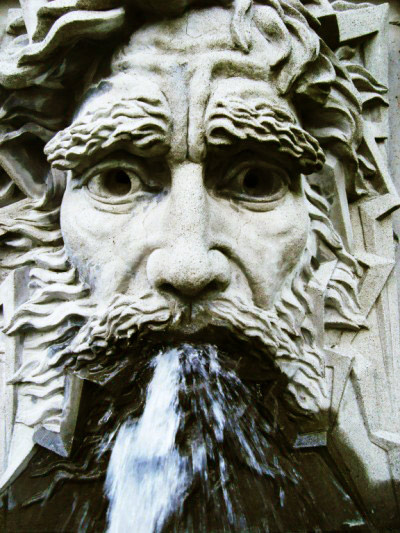
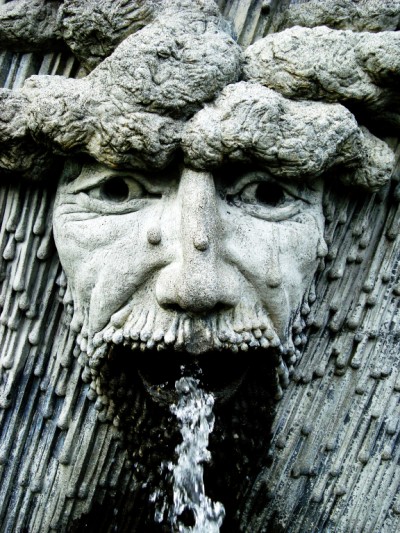
Wind

Rain
Karyn Eisler is a Vancouver-based writer, educator and interdisciplinary artist. She holds a PhD in sociology from UBC and teaches at Langara College. In a past life she worked as a radio and television broadcaster. Find links to her work on her page at BluePrintReview.
Unenforceable Promise
by Julia Martin
The party of the first part
to this most personal service contract —
departed
Scratch that clause
on successors and assigns
Our vow to love forever?
Void ab initio
per the statute of frauds
Not to impugn or imply
a deceptive intent
The existence of mutual mistake
— a flaw in formation —
is not material
yet loop-de-loops
through my head
A closed track clacks and shuttles
an infinitely regressive plea
v. renvoi
Julia Martin is a lapsed lawyer who now battles the apocalypse by bringing new books and pleasure reading to low-income children in the Chicago area. She blogs at Clumps and Voids.
Pomegranate
by Maya Massar
So ripe
I cannot eat it
With any semblance
Of politeness
Gory with its black-red juice
I am an animal
Vibrant with the naked hunt
Lush with the kill
I return to the prayer of ancestors
Mother of the Cave
Make me your witness:
I am She who Lives
Pomegranate
Too bloody for the rest
Has saved my life
Amen.
Download the podcast
Maya Massar (website) is a poet who dances, loves Africa and sings to celestial bodies and stones. Her first book of poetry, Risk; A Month of Poems, is available on Amazon.com. Maya’s current painting project “Sacred” will be on display at Vancouver, B.C.’s East Side Culture Crawl on November 20-22, where she will also be reading from her upcoming book The Amen Poems.
Islam for Americans
1. means god in Arabic
99 names
no eyes
no ears
Al lah
Al lah
AL LAH
alif lam lam hamsa
Allah is not male
NOT male
not a man
or he
or HE
or anything that
you
can imagine
2. Does your husband make you wear that?
I am a
wrapped piece
of candy a
swaddled jewel
I am perfect
woman under
my packaging
you may not see
my effusive gold mahr
my fruitful awrah
3. Does your religion make you wear that?
the woman
who does not
cover her hair
should have it
shorn
~ Corinthians 15:6
4. Tessellation
Middle Eastern Art Scheherazade veil sheikh
The Alhambra calligraphy Afghanistan burqa
Palestine hashish Morocco pyramids violence
hooknosed Arabic sword mosque haram thief
sand nigger Sinbad jihad camel whore infidel
Iraq belly dancing terrorist Aladdin barbarian
Sahara couscous hookah Rumi rag head bitch
5. last words
I see a woman covered
in a long dress, headscarf
and face veil
salaam aleykum, I say
and as she looks at my
bare head, tank top
and tattoos
she replies,
wa aleykum salaam sister
Khadija Anderson (blog) returned last year to her native Los Angeles after 18 years exile in Seattle. Khadija’s poetry has been published in print and online. She has been a featured reader numerous times in the Seattle area. She is also a Butoh dancer and collaborates with her eldest son in their dance company, Tanden Butoh.
 qarrtsiluni