Archive
August Garden
In the August garden in moonlight
the iron bells rust, the wind itself is rust
and silence. What’s left of water in the birdbath
becomes the stone which holds it.
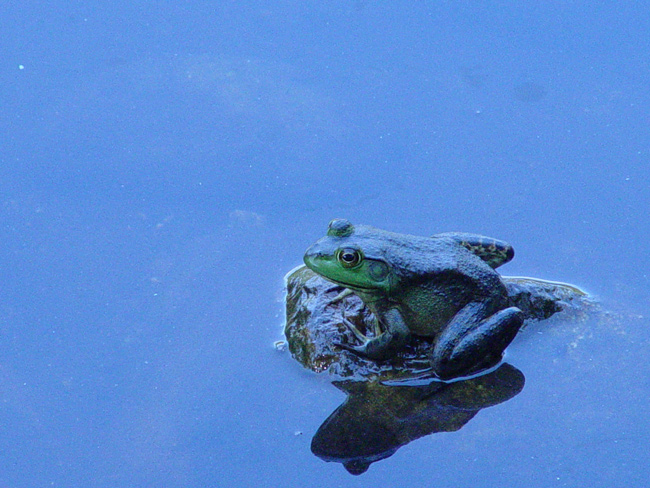
The frog, the lilies, all pale green stone.
Green veins on white caladiums
narrow toward stems drooping,
leaning toward the clay.
If I were a child, I would read or kneel,
wait out emptiness till I could feel a rising
in my chest like laughter or blood or song,
but here on the stone steps, I ride
the rhythm of loss. It loosens my hair
at the roots, robs it of color strand by strand.
It pulses blue in the raised veins
in my hands, breasts, in the spreading
veins behind my knees, dirtied blue
marble visible only when I stop,
turn to look back.
A wise man loves water. I long to believe
contentment moves like a river within us,
exceeding time and desire.
August caladiums shine like white stones,
heart‑shaped, blank but for vascular
traces of green. I long to believe
these are the traces of rapture
not yet forgotten, bits of green
nourishing the form they inscribe,
sustaining them just above the soil
so that it appears they wait a while,
live as long as they can.
by Robin Davidson
Read by Beth Adams — Download the MP3
 ::
::  ::
::  ::
::  ::
::  ::
::  ::
::  ::
::  ::
::  ::
::  ::
:: 
A Brief Meditation on Movement
I fell from the cliffs to the sea
of arms to the foam of hands
to the spaces of cities like cities
could ever do something, could
ever be more than a story or store
where we waited through winter
for a certain street vendor
and stood at the edges of statues
and sculptures and pointed
at water, the shape of water
in the place of a place we once
took a taxi through patterns
of people, through movements
of bodies, the firework nights
like a furnace above us,
the clang and rattle of hours
like a river, the hem of a river
that remembers the swish
of the cliffs, of the hands,
the falling, the feeling
of falling, of finding
there’s nothing
but nothing beneath.
by Tim Lockridge
Read by Beth Adams — Download the MP3
Showered Stones
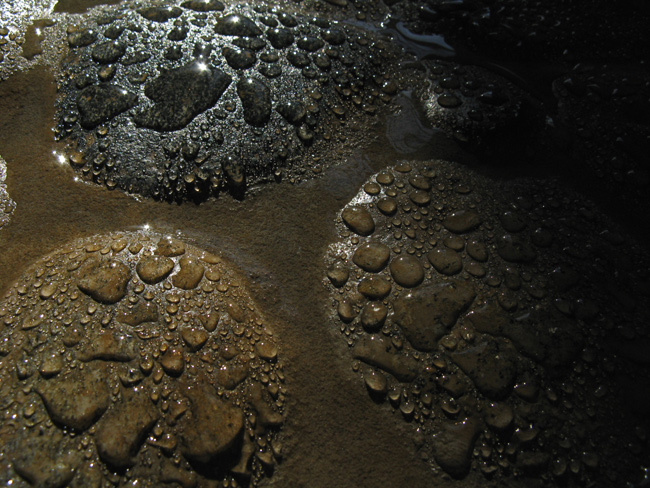
(Click on image to view at larger size.)
by Steve Wing
:: :: :: :: :: :: :: :: :: ::
Self-Portrait as Aquifer
As if flesh were permeable —
not flesh exactly, but the whole body
we carry around,
what we feel with —
like rock rain-sodden, permeable
channeler
(willing, unwilling)
of water’s need
to be going somewhere
like me right now
wanting to go out in the rain —
how could I have known how deep
you would enter me?
by Lisken Van Pelt Dus
:: :: :: :: :: :: :: :: :: ::
Water Rite
In the house of my aunt and uncle, each room had its own rules about what not to touch, how not to run, where not to eat. Pillars heralded the porch and cherrywood gleamed in the entry, naked of school papers, apple cores, cereal bowls. One night, after a visit from the police, I was taken from my mother and placed here, among shining guest soaps and french provincial mirrors and real table dinners. If I had known more about fairy tales and remembered less about Mother’s screams, I would have pretended I was in a fairy tale.
A day after my arrival, my cousin bent down and swept the long, sticky bangs from my eyes and proposed something I wasn’t sure I could handle.
“Come on,” she said. “Let’s give you a bath.”
Dirty toenails poked from my saltwater sandals as I stood motionless. Even though Cecelia was very old, thirteen, I didn’t trust anybody to start my bath. Bathrooms were not happy places.
Cecelia tapped the blond bannister with shellacked fingernails. I didn’t understand how a person’s nails could be ghost-white like that. “It’ll be okay,” she said.
I followed her upstairs where she opened a cupboard. It was a Library of Towels, each volume folded, tucked and shelved.
At home our towels flop like dead rags, old curtains, in heaps we pick off Mommy’s bed.
“And we’ll wash your hair.”
It starts, standing on the cold bathroom floor. There is a sea-green ring round the middle of the sink.
I hugged tight my towel.
Cecelia opened the door to one of the bathrooms I’d never seen, and I walked into a strange dawn, where sunny yellow towels matched rug, matched yellow silk flowers in a straw vase. The toilet lid was covered with yellow shag, round as a cookie, softer than any chair at home. Old home. My home again, sometime maybe: I couldn’t know.
I was a netted fish, a trapped selkie. Cecelia turned on the bathtub water and plunged in her hand.
Mommy puts a metal pan under the sink. Water whooshes. Mommy’s hands shake and I look up to the whiteness of the skin under her Widow’s Peak, quiet with unhappy secrets, smooth and blue underneath, holding her Voices and all the Bad Things to worry about in the world.
Water gushed onto Cecelia’s freckles, leapt from smooth porcelain, echoing past canyons of clean silver faucets. She paddled the wet into sudsy billows. “Get in.”
I threw my clothes down and inched my scaled tail over the bathtub edge.
She pours onto my head. Yow! Hot! Fills it up at the sink. Pours. Ouch! Cold! The waters never match.
“Go on.”
I went into the steam, sank into the clear, ruffled at the edges with lace, underwear lace that hides your underparts, but is never clean unless Mommy has time.
Cecelia uncapped Herbal Essence, with its smell of scissor-sharp flowers.
Mommy says, “I’m sorry! I’m sorry!” and turns around and around to find a clean towel and my hair is stringy seaweed in my face and I have to cry. We slip and trip on the wet floor.
Cecelia’s freckled other-family hands reached for me. She swirled my head with shampoo. Her arms smelled like Love’s Baby Soft perfume. “You don’t have to sit so stiff. Here’s how you rinse, see? Lie down and swish your hair.”
It’s in Mommy’s magazines. If you don’t get all the suds…
I sat up.
Your scalp will dry and crack and you might get a rash or have to call someone, the doctor or the police or a neighbor you hardly know, and say,”Something is wrong with me! I’m hearing voices! I need help right away!”
“All the suds won’t come out that way!” I cried.
“Most will.” Cecelia smiled.
I scooted beneath the water, froth hissing in my ears. I closed my eyes against the clinging. The warmth was kind. It was enough, swishing like a mermaid freed from the deep down sea, and just as everybody kept saying things were going to be okay, maybe they would be.
by Christi Krug
:: :: :: :: :: :: :: :: :: ::
Al Hambra Reflections
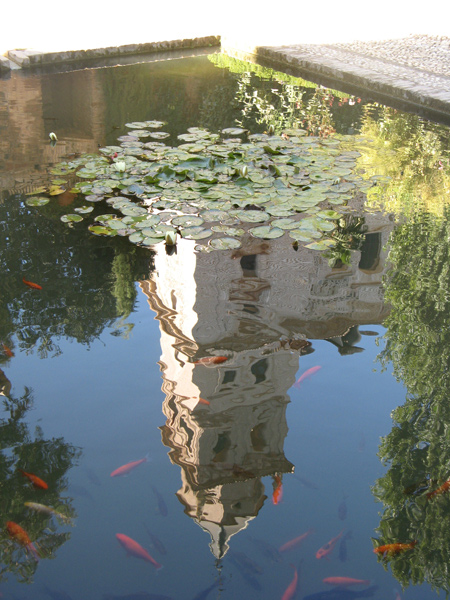
(Click on image to view at larger size.)
by Bethany Pinegar
:: :: :: :: :: :: :: :: :: ::
Everywhere You Look Is Luck
Between us the night
pulls back, deeply
black and empty
of argument.
Seeds at our feet,
the fine silt of
abraded roads,
millennia,
and a sunrise,
palest yellow.
On the blunt edge
the well, the wide
reservoir, corn-
flower blue, a late
rescue: we’re what
has been hauled up.
:: :: :: :: :: :: :: :: :: ::
Crawdad Creek
is full of empty mojo candles
Seven African Powers
St. Jude Patron of Lost Causes
supplications for Trabajo
We throw rocks
towards the good side
of Good Luck
sink pebbles inside
the hollow of
$$$ Dinero $$$
Not trying to break
anything, really
Just…
how stone and glass and creekbed
eyeball handgrip arm-arc the very air
co-ordains
by W. Joe Hoppe
Read by Dave Bonta — Download the MP3
:: :: :: :: :: :: :: :: :: ::
 qarrtsiluni