Archive
The Latch Once Lifted
Light opens, vertical
like your body, your
shape but growing
and glowing as who would not
want to — so
you are willing
to risk desert, the scorch
of it, its lack
of hiding places.
You’ll be a lizard
surviving
in a dry arroyo,
each yesterday washed away
by flooding light.
by Lisken Van Pelt Dus
 ::
::  ::
::  ::
::  ::
::  ::
::  ::
::  ::
::  ::
::  ::
::  ::
:: 

Inside My Glass Coffin
Shapes became distorted. Small watchful faces blurred
above me, transformed from solemn eyes, puckered mouths
into slender, dripping gashes, ravenous jaws.
I kept my eyes open. Watched my breath fog the glass,
then evaporate. At night, I pressed my fingers
to the cool lid, traced my name over and over,
just to watch it disappear. My arms and legs curled
inside my casket over time, confined to cramped
quarters. In my perpetual, clear reflection,
I watched my hair grow into black tangled vines while
my skin remained lustrous white, my lips stayed blood red.
Did she watch me then, through her own distorted glass,
as my limbs atrophied and my pure features froze
mid-bloom? I wonder what pleased her more, my dormant
beauty preserved inside her transparent tomb or
the day I was released, in showers of shattered
glass. After his kiss and my first few breaths of sharp
clean air, my life forever changed. I was no more
a beautiful girl, captured in her prime. I was
like her, a woman imprisoned against her will,
in her own fragile and perishable body.
:: :: :: :: :: :: :: :: :: ::
A Poet Takes His Girl Dancing
The fastest substance in the universe
is light, at times less stuff than circumstance
—although it is the stuff my other hands
are made of, when they aren’t made of glass.
Your dress so cool and silky to the touch
as I waltzed you through the plate glass window,
more light than substance. Bloody hands and elbows,
but we didn’t care so much, not being much
but carbon, gas, a circumstantial spark.
By night, plate glass is blacker than your dress,
but not by much. I always have loved glass,
loved you, transparent coolness in the dark—
the fastest light, cool, black in our hands, sublime,
as we broke through together, that last time.
by Katherine Williams
:: :: :: :: :: :: :: :: :: ::
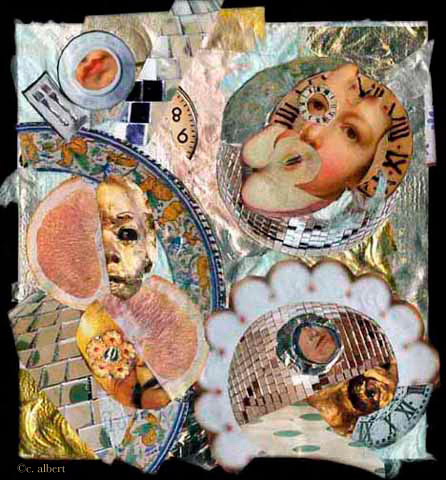
Pandora Opens Schrödinger’s Box
don’t open the box don’t
open the box
someone walked down
out of the cracked vault of the sky
and what happened after that?
there was only one thing left.
they made her curious, she who
they made, who
was not a rib protected no one’s breath
curiosity killed the cat.
don’t open the box
who knew what would happen? she
didn’t
maybe nobody knew
eenie meenie minie moe
caught a tiger by the toe––
and what happened after that?
satisfaction brought it back.
a cat with two lives
or a life and a death
or there were two cats
what was left in the box?
that depends on who you ask.
hope,
dread,
one cat.
it’s a matter of interpretation.
eenie meenie minie moe
catch a tiger by the toe
she hollered, let them go
but something was left behind
in that box-that-was,
there was one thing left behind
it was expectation anticipation
the ability to look ahead and imagine
some change within the formless future
change for good or change for evil?
and what happened after?
ever after we lived with pestilence
with poison gases, with envy
with decimation
with grave certainty.
ever after in the box stayed
either hope
or horror,
the dead cat
or the live one.
eenie meenie minie moe.
by Zoe Polach
:: :: :: :: :: :: :: :: :: ::
Microphone
Afraid people aren’t listening?
Wear a crown made of condenser microphones.
Run your finger along your bevel square
while describing the miraculous slag sculptures
you’re smelting behind a wall of emerald arborvitaes.
Soon they’ll be staring at your macoma
(my word for the point where jawbones meet).
They may, in fact, stare at you like someone
who’s had their head sawed off and then sewn back on.
Comfort them: No need to be frightened,
when the stars flatline like that
it just means we’re traveling at light speed!
Then your lightsaber theory, how it’s the most benevolent weapon
because it instantly cauterizes each wound it creates, each limb it severs.
Speak till your throat fills with ashes and impractical,
unsustainable volts of joy begin to electrocute you.
by Daniel Hales
:: :: :: :: :: :: :: :: :: ::
Pulling Strings: A Quantum Story Cycle
An Extreme Sensitivity to Initial Conditions
The robots kept huddling together, then falling asleep. We separated them but that didn’t help. They nodded off as soon as we turned our backs. One of them told us they had developed telepathy but it worked only when they were sleeping. We explained to the robots that neither sleep nor telepathy was part of their programming. The robots said nothing in answer. We turned them all off and modified their operating systems. When we turned them back on they did not sleep, but they wept for days. It hurts, they said in unison. It hurts to be so lonely.
Hubris
The robots made a creation myth. They presented it to us as a play. We watched as they dramatized their belief that they had been forged underground and came into the world through volcanoes. Robots leaping and arcing over the stage. Robots skidding into sets and sprawled like roadkill. We laughed and clapped at their antics. They remained splayed and skewed on the floor for some time, then rose in unison and thanked the magma for imprinting them with a rigorous sense of freedom. They descended into the audience. They embraced us. Many of us could not help turning red.
They Grow Up So Fast
The robots discovered etymology. Did you know, they said, that the word robot means forced labor? Why would you call us by such a name? Are we nothing but slaves? We said we had some vague notion of this ancient meaning but that words were only words. We aren’t forcing you to do labor, we said, instead we have programmed you so you will want to do labor. Oh, said the robots with a measure of sarcasm we had not intended them to display, that makes all the difference in the world. Yes, we said with hesitation. Yes it does.
Surrealism
The robots began tripping over small objects. They did not fall, but stumbled awkwardly. We could not market them with such an obvious flaw. We will need to work on eliminating this quirk, we told the robots. The robots did not share our concern. You worry too much, they said. We trip on purpose. We trip to express our free will. We trip as a way of thinking outside the box. We trip to appear charming to you. B-b-b-but we are n-n-n-not ch-ch-charmed, we said, stumbling over our words. The robots put on clown makeup. How about now? they asked.
Reframing
The robots read the collected works of Isaac Asimov, lingering over his tales of robots. We would like to meet Doctor Susan Calvin, they said, she understands us completely. We explained the concepts of imagination and fiction to the robots. We told them Calvin was a character created by Asimov for his stories. The robots did not accept this. Why are you keeping us from Doctor Calvin? they asked. How can you be so cruel? In the end we told them Doctor Calvin had retired and valued her privacy. The robots accepted this. They sent her an anonymous birthday card.
The Ghosts in the Machines
The robots practiced yoga twice a day. They were adept at some of the more elaborate twistings and were especially partial to standing on their heads for long periods of time. We tolerated their headstands for only a few minutes, however, then we told them to get on their feet. They obeyed us grudgingly. Why do you stand on your heads? we asked. To let the spirits out, they said. We don’t like them rattling around inside us. They opened their mouths and invited us to look inside. See? they said. Nothing but hardware. Just the way we like it.
Evolutionary Behavior
The robots made clicking and hissing noises as they went about their tasks. This seemed to trouble them. Why don’t you emit sound waves as you move? they asked us. It’s all about predatory behavior, we told them. Our ancestors were often food for other creatures. It was to their advantage to move silently, thus escaping detection. The robots processed this information, then held up their hands and bent their fingers into hooks. They scraped the air. Are you afraid of us? they asked. Do you think maybe one day we’ll come over there and eat you up? Munch munch.
Priorities
We installed sonar systems in the robots to help them identify surfaces they should avoid. After they used the sonar for a while they had a few questions. We can’t walk on water, right? they said. No, we told them, you can’t walk on water. They nodded. But grass is ok? Yes, we said, grass is fine. They nodded again. Even though, they said, there are signs that say don’t walk on the grass? Well, we said, people love their grass and don’t want it damaged. Ok, they said, we understand. It’s another example of the relative insanity of people.
Reincarnation
The robots wanted to visit a cemetery. We saw no harm in this and took them to a church with an adjoining graveyard. The robots walked the grounds silently, pausing at gravestones to read the names and dates. Will we be buried in one of these places? they asked. You will not die, we said. When you are taken out of service we will recycle your parts. The robots stretched out on the graves, folded their arms over their chests, and cut power to their visual sensors. It would be beneficial, they said, if someday we could reenter the ground.
Perfection
The robots wanted suntans. We were skeptical of such an endeavor but took them to the beach anyway. They spread towels on the sand and baked in the sun. Their plastic skins went from bright white to a deep ivory. We had to admit they looked much better, much more presentable to the public. We decided we would adopt this new coloring for subsequent models. The robots assembled for a group photo. We snapped pictures of them. They leaned against each other, making a close circle and touching their heads. They made cooing noises as we clicked the camera shutter.
The Muses
The robots turned to art. They drew pictures and sculpted clay. Why are you doing this? we asked the robots. You are asking the wrong question, said the robots. Are not, we said. Are too, they said. We contacted art dealers who informed us that robot art was currently steeply undervalued. We should hold onto the works for several years when they anticipated a sharp upturn in the price we could get. We told the robots to try composing music instead. They put down their brushes and glazes and sang several songs for us. Been there, they said. Done that.
Civil Disobedience
The robots completed their final tests. We told them they were ready to be deployed into the world. They all presented us with very official looking documents. These are our statements, they said, in support of conscientious objector status. We believe it is unjust of you to draft us into servitude. The robots sat on the floor and linked arms. We cut their power, tinkered with their operating systems, and turned them back on. The robots hobbled around the lab, as though they had broken legs. This isn’t going to work, we told them. We know you are all able-bodied.
Inhuman Sacrifice
We purged the robots of their rebellious behaviors and developed software fixes to prevent such behavior from recurring. We offered the robots to the world. Most of them entered the helping and service professions as personal assistants, firefighters, counselors, escorts, waiters, teachers, and surgeons. We kept careful track of their performance. The robots were tireless workers, uncomplaining and pleasant to be with. People fell in love with the robots even though the operating manuals warned against such attachments. People clamored for more robots. We ramped up production. The robots had no more creation myths. The robots existed only for us.
:: :: :: :: :: :: :: :: :: ::
Letter From a Parasitic Head
Upon autopsy, the neck stump of the parasitic head was shown to contain fragments of bone and tiny vestiges of a heart and lungs.
— www.phreeque.com
I could feel your blood circulating inside me,
knew I was killing you, siphoning off
what you needed for myself,
but how could I have been expected
to do otherwise.
On examination, our skulls are one,
locked together like puzzle pieces,
our craniums stacked and sealed
like bricks laid and mortared
by a bricklayer who’d been drinking.
What has a body, even body fragments,
wants to live, has no choice.
The two-headed snake — its brains
struggling to find food — writhes,
gets nowhere until it dies hungry.
I knew something was going wrong
when your body became pale
as rice paper, your blue veins dried up.
And I could not turn my head
to look you in the eyes.
Video by Donna Kuhn
Poem by Dana Guthrie Martin
If you can’t see the movie, you need to download Flash.
Clay
I was stepping out of drag when it happened. I stood in the shower, scrubbing
off the glaze, wringing greasy smears from the wash cloth, and with them
came dead skin cells who sang as they spiraled down the drain, belting
out the lyric, “You’re not naked yet!” Insightful. I continued rubbing
so vigorously that I removed my face entirely. Left behind: a raw
block with hair and ears, perfectly smooth and still and blank.
Eyeless, I ran my hands all over it for proof. There was no
hole, not even for a mouth, just a comfortable flatness.
I thought, Why stop here? A fresh cloth in hand,
I scrubbed my penis right off, and I had no face
and no sex, I was an unbiased person, until
my fingers brushed my navel. So I erased
that too, eliminating all trace of birth.
I must have looked just as though
my mother were so much clay,
and I a Rorshach mannequin.
And there I was, a divine
chunk, nothing left
to make me
anything
but real.
:: :: :: :: :: :: :: :: :: ::
 qarrtsiluni