Archive
Demolition Derby
by Alan Hayes

Click on photo to see a larger version
Alan Hayes was raised on a defunct goldfish farm in Western New York. In 2000, after a lifetime wasted on trivial matters, he began making pictures. He also operates, with his wife, Rosemary Starace, the newly formed chapbook press, Elephant Tree House. For more of his photography, see his retrospective installation catalogue from a show in Buffalo, New York last year, or his Portraits of the American Dead gallery.
One Hundred White Pelicans
Over Wyalusing, riding thermals, they shine
and disappear, vanish like thought,
re-emerge stacked, stretched,
a drifting fireworks’ burst.
We can’t stop looking up from paddling,
imagining how high they must be
to look so tiny, flecks of light.
Battling against headwind, we thrill
to see—we think we see—
their third dimension of effortless life,
scattershot, high in the blue sky,
turning in sun—white, silver, ash, gone,
how we could ride, carried
on rising currents of air, wide view,
steadily accompanied. As they are.
And on the river’s back, we too.
Robin Chapman (webpage) is author of five chapbooks and six books of poems, most recently Abundance, winner of the Cider Press Review Editor’s Book Award. She is recipient of the 2010 Appalachia Poetry Prize. Her poems have appeared recently in Prairie Schooner, Poetry East, and online in Qarrtsiluni and Valparaiso Poetry Review.
Sharing the Sea of Surround Sound
The dishes crash and clatter
as her husband unloads
the dishwasher. The cereal sings,
the children bicker,
and her husband herds
the pets through the morning routine.
She sinks into the car
hoping for some solitude
during her solitary sojourn
to the office. Instead, noise surrounds
her: horns honk, brakes squeal,
and the thumping
bass beat never relents.
At the office, the secretary slams
file drawers while the supervisor shouts
into the speakerphone.
Two offices down, her colleague curses
at his computer. Students stomp
through the hallways, shouting
into their cellphones.
She closes her office door,
but she can still hear
the noise of working life,
like distant whalesong.
She thinks of those poor creatures
who once had the sea to themselves,
but now prefer to beach
themselves, rather than listen
to the noise of ships and Navy sonar.
Kristin Berkey-Abbott earned a Ph.D. in British Literature from the University of South Carolina. Her poems have appeared in many journals, and Pudding House Publications published her first chapbook, Whistling Past the Graveyard, in 2004. Finishing Line Press will publish her second chapbook, I Stand Here Shredding Documents. She currently serves as Chair of the General Education department at the Art Institute of Fort Lauderdale. Her website, which has connections to the blogs that she keeps, is kristinberkey-abbott.com.
Les Sans Papiers 75
by Laura Genz

November 5th 2008: The Cleaning. 188th day of occupation.
(Click all images to see larger versions.)
Read more…
Waiting For Bolivar Ferry
by Cynthia Cox
We wait our turn
on a weekend
when tourists and teens
converge
on the peninsula
to stretch their skin
in the sun: engines off,
windows down,
radios up,
as if the beat
proclaims
some inner rhythm
of parched hearts.
A sheen of boys
begins to volley
for attention, girls
in open truckbeds
cake makeup,
spray hair
already starched
with heat.
The shoreline
brings the sleaze
out of everyone,
the steam
that shimmies up
from the concrete,
the stick, the sweat,
the hidden grit
that slicks
to the surface.
We are waiting
for Bolivar Ferry.
When it docks
we’ll all pull forward
in tight metal rows
onto the boat
that will slick us
like plastic
six-pack scrap
across the sea.
Cynthia Cox (blog) taught high school English for ten years, and is currently working towards a Master’s degree in counseling. Her poems have appeared in various publications over the years, most recently in Cider Press Review, Albatross, and Epicenter magazine.
The Loaves and the Fishes
by Karl Elder
The real mystery is that with an order like that you’d have to phone-in ahead. You’d have to say something like, “Yes, for a party of five thousand,” and the voice would have to be convincing. Well, you know how that goes. With cynicism running rampant in the world, your story better be good.
For one thing, there are requirements. The loaves must be of a certain size so that your disciple hunkered down in that hollow rock upon which a false-bottomed basket rests has room to maneuver. Perhaps it isn’t so preposterous when you consider a gross of a gross of loaves would cut it. Why, there would even be enough for seconds all around and maybe leftovers!
The tricky thing is the fish. In that blazing sun it’s got to be a fresh catch. Then there’s the problem of distribution, especially with the fish. Do the people form a line? Or do you allow them to circle the mountain, given the distinct possibility that before lunch is over there are those who, fishtails in hand, will be slapping one another as if with rubber chickens.
Logistics. Better to go with canned sardines.
Karl Elder’s long poem The Houdini Monologues, with accompanying CD, is available from Word of Mouth Books, the imprint of his magazine Seems. Commentary from Elder on his poem “Ode in the Key of O” in Beloit Poetry Journal’s 60th anniversary chapbook, comprising new work from Chad Walsh Award recipients, appears in the journal’s blog, Poet’s Forum.
Flag Woman
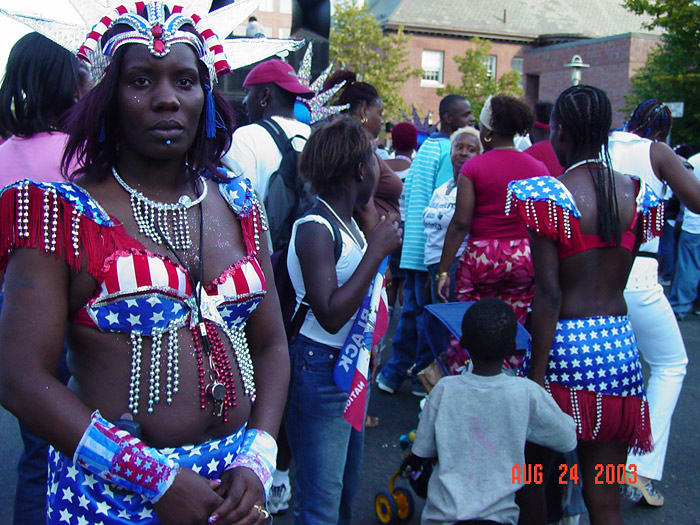
Click on image to view a larger version.
Cambridge Carnival. Central Square, Cambridge, Massachusetts. August 2003.
Monica Raymond won the Castillo Prize in political theater for her play The Owl Girl, which is about two families in an unnamed Middle Eastern country who both have keys to the same house. She was a Jerome Fellow for 2008-09 at the Playwrights’ Center in Minneapolis, among many other honors and awards. Her poetry has been published in the Colorado Review, the Iowa Review, and the Village Voice.
Seating Arrangement
We come into the arena from behind
to a crescent moon of folding chairs,
numbered on each back like runners.
It’s a scene we’ve entered a hundred
times before, organized first by tier,
then section, then row. But this is not that place. The seats fit no logical flow, two 5s side by side, a zig zag of 7s, some numbers coupled with letters like I1 or E53C. But not all. This makes no sense at all until that moon slides behind a cloud and I see it’s no longer an arena, we’re in a holding pen jambled with huffing gray stallions, haunches slick with panic. These ponies aren’t supposed to be broken but I know that won’t stop you from trying, already bringing out the bridles in your mind, herding the docile in consecutive order, the wild ones sent to the rack or the slaughter. This is the way the world works best, even if some of us are pulled apart, left with no place to sit.
Cathryn Cofell has made most of her limited fortune in the non-profit sector and is a sucker for a good cause, meaning she’s easy prey for a needy arts, social justice or mental health organization (no phone calls, please). Her latest project is a collaborative CD called Lip that combines her poetry with the music of Obvious Dog. Her fifth and latest book is titled Kamikaze Commotion, also a fitting descriptor for her poetic style, personality and parenting prowess. You’ll find the poetry in places like MARGIE, Oranges & Sardines and NY Quarterly, but you’ll have to travel to Appleton, Wisconsin for a look at the latter two, or visit cathryncofell.com for a glimpse.
A Mask Called Nothing
by Amy Pence
So we enter the dog days—summer
its bedraggled undergrowth, feasting
insects, spiders spinning, unspun.
Everything swarming to the grand ticking
surface: verdure & verdant—a plentitude,
identity leaks from our faces, a carnival
of exiles: subversion, ecstasy, anarchy,
apathy, masochism—listless and rogue.
Then finally, “nothing”: its jade eyelids
around sockets, skin textured—
wind in the bestial unknowing
genuflects to an embarrassment of days.
Unloosed from the Dark, a lowly coming—
all the names unleash their quiet.
Amy Pence’s collection The Decadent Lovely will be published on November 23 by Main Street Rag. Recent poems are in New Writing, The Oxford American and Many Mountains Moving. Fiction is online at All Things Girl and Storyglossia. Her exploration on the phenomenology of Emily Dickinson is forthcoming in The Writer’s Chronicle. For more, visit her website.
Face Recognition Collage
by Lucy Kempton

Click on image to view at a larger size. (It will probably then require a second click at most screen resolutions.)
Lucy Kempton is British, living in Brittany with husband and dog, and sometimes teaching English. She blogs at box elder — subtitled “meanderings of a displaced dilettante” — and the microblog Out with Mol. She is currently engaged in a call-and-response-style, online collaboration with British blogger (and qarrtsiluni author) Joe Hyam called Questions. She co-edited qarrtsiluni’s Water issue with Katherine Durham Oldmixon.
 qarrtsiluni