Archive
In retrospect, 1984 made a fine sausage–
Our house was a pirate ship that changed colors
the further south we went
Once we had to pretend to wash a neighbor’s dog
so we could wash ourselves and use the dog shampoo
The few times I had to attend school
I occupied a corner with my shadow
Mother told us we were not her dogs
For a dollar we held in our urine for more than eight hours
I eavesdropped on banal conversations
with a homeland kind of insecurity
To throw off our creditors we, the children,
were given fictitious names and religions
I counted on winning a pig or two at the county fair
even though I hated pork with navy beans
I sat on the stairs all night
and pretended I was John Hurt
Market day, previously a day reserved for apples,
became an occasion to watch roadkill from a moving truck
I almost acquired a wooden leg after our run-
in with the revolving door
I seriously considered renting out my mind
for a few dollars and some hospital cafeteria food
It was annoying when those insane people
used to smack us for being insane
Mother followed us around the grocery
when she wouldn’t let us stay out in the car
Father, on the other hand, lost his marriage licence and later,
all his teeth to a gum disease.
He rarely spoke
except to say give me some private or
I’m counting on the lottery even
though I never get the ticket
There’s a lot to do
until you fall asleep
It was infuriating how “uncle” littered
his gossip with my phrases about him watching
My list of infuriating things grew
by yards in my unsteady hand
Practical jokes of yore and yonder:
dribble cups, classified ads, glue in strange places
On another occasion the whole community turned
out in force to shun me
It was summer, yes
We were the last 43 pages torn
out of a novel and no one
could afford a happy ending
by Arlene Ang and Valerie Fox
Download the MP3 (reading by Arelene Ang and John Vick)
Process notes
Arlene writes:
The title is a line from a poem in our book, Bundles of Letters Including A, V and Epsilon (Texture Press, 2008). We wanted to work towards real collaborative writing as opposed to writing poems based on each other’s poems. It was written as part of our survival tactics during a 30-poems-for-30-days marathon in ITWS, an online writers’ community. The process: One of us would initiate a poem (5-8 lines per day), and then we just kept hitting the ball back and forth. Afterwards we jumble our lines and edit, edit, edit.
Dear Seven: A Circle of Epistles (2)
Part 2 in a series of 7
Dear Alice
Different things were happening at the same time. The street thrashed like a low grade fever, hail leapt from the grass! There you were at that dim grocery store of the dying mill town. The eight-months pregnant checkout girl was watching CNN as you wandered Produce grasping for Ariadne’s thread. Your only guides: oblivion and the possible lack of nerve.
I watched as your heart turned into Frozen Desserts and you held the toy steering wheel pretending to steer the cart. Tonight as you sit at your desk in a mildewed basement, asbestos sifting from the floorboards, the black waters of Lethe smoking past the ash tree in the back yard, you lean toward its calm.
by Mike Puican
For notes on the process, see the first letter in the chain.
Entente Cordiale: an ekphrastic exchange (Part 2)
Process notes
Anna Dickie writes:
Our entire collaboration took place by e-mail; we’ve never spoken face-to-face or by phone. Early on, by way of background, we had the idea to write introductory biographies/impressions of each other. These we’ve included at the end.
I selected two images, one of a place and one of a thing, for Lucy to respond to. And as Lucy writes often about the countryside, I chose a city shot for the place, as I wanted to see her take on something urban.
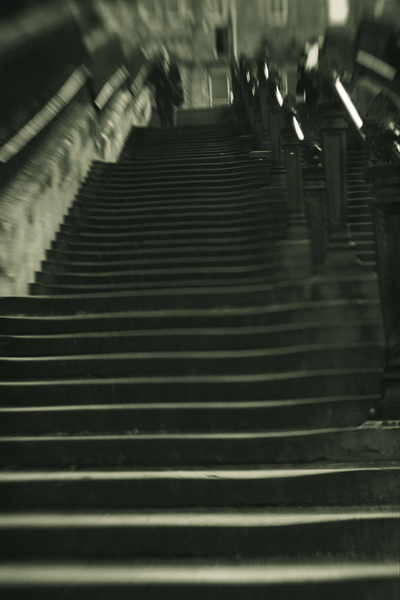
I like to use a Lensbaby lens for cityscape, as it provides interesting distortions of buildings and people, so my “place” image was a duo-toned shot of the Playfair steps in Edinburgh, a long set of well-worn steps that lead up to the Old Town.
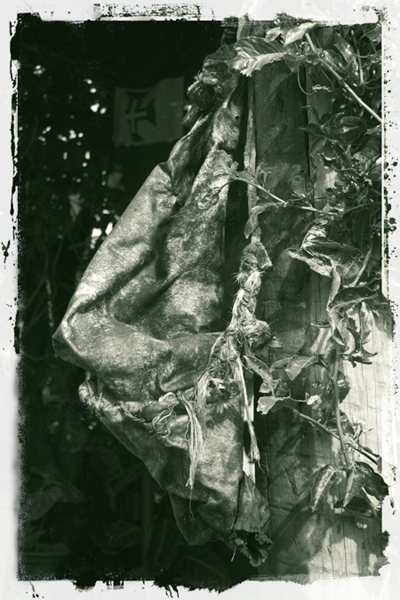
The “thing” choice was a black-and-white shot of an old goatskin wine sack hanging from a post on a farm high up in the levadas of Madeira. (Country people there still use goatskins to store wine.)
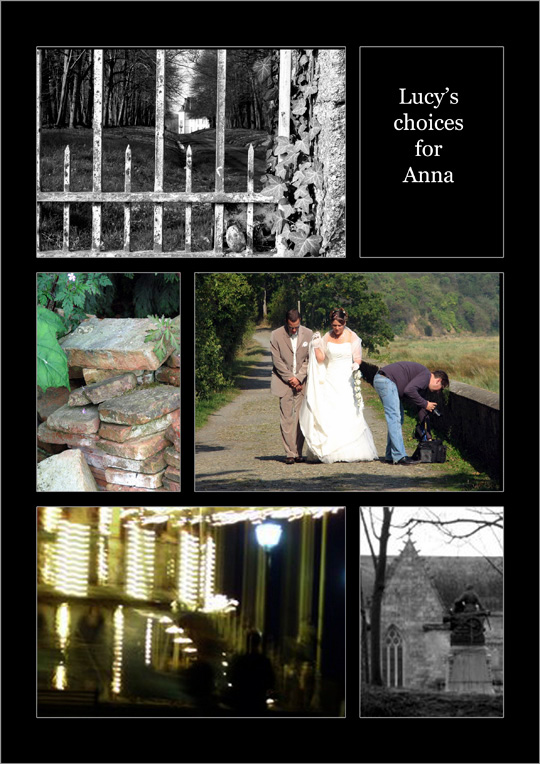
Lucy was more generous than me in choosing images for me to respond to, sending me five images: a moving carousel, a French country house and grounds, a stack of old terracotta floor tiles, a war memorial, and a bride and groom walking in a beauty spot to have photographs taken.
(Click image to view at larger size.)
I was immediately drawn to the country house shot — black and white and beautifully framed by a sinister ivy-covered gate — and the colour image of the wedding couple.
I then thought of Wendell Berry’s poem, “Country of a Marriage,” which I think is a rather smug, comfortable, male view of a marriage. And that got me wondering if I could subvert Lucy’s two photographs into a single image that had the feel of a French film still, and then write a poem in the voice of a bride that had something of the mood of the photograph. I tackled the images first, but try as I might I couldn’t get the couple at the angle I wanted on the path, until I had the idea of flipping the whole country house shot horizontally using Photoshop. This worked really well, as it put the gate pillar on the left opening up the scene, and when the couple were added in it put the bride on the groom’s right, making her seem the more powerful figure who was doing all the talking while he took on a rather hangdog expression.
After that I applied some dodging and burning to the image, to bring out the light on the trees and then applied some digital “film grain” to make the shot more atmospheric.
With the poem I borrowed some of the word choices from the original to create a completely new poem about a woman whose thoughts about being with this man, in this place only crystallise on the day of their marriage.
I’ll leave it for Lucy to say what she thought about the result.
Lucy Kempton writes:
I read Anna’s poem first, and was intrigued by how she seemed to have woven the narrative possibilities of the two photos together. Then I looked at the picture in the attachment and was astonished — it gave me a shiver like seeing a ghost! The figures sat disturbingly in the scene, but at the same time seemed to belong there. Yet I had never envisaged combining the two images in such a way. I was struck too by how the spike in the gate seemed to be about to impale the woman, like pinning a butterfly.
Then I read the Wendell Berry poem, which I didn’t know. I also thought it had a somewhat self-satisfied tone, an assumption of knowing what the woman concerned thought and felt, of the unarguable universality of his own perception, though of course my reading of it was by then coloured by Anna’s poem! But I was very taken with the “he-said-she-said” character of her response, the piquant counterpoint of the woman’s terser, diverging point of view, the sadness of the voice, and the atmosphere of place it captures, the “broody woods” and “fickle orchards.”
While I think Anna’s poem and the composite image she made can each stand alone and without reference to the Wendell Barry poem, the synthesis of the three elements makes for something more. I’m delighted with how she saw the potential in the two images together, then drew on a further outside source to make such a clever, moving piece.
Anna:
My second choice was Lucy’s image from Normandy of some old terracotta floor tiles left stacked outside in some scrubby grass. I worked with this to create a text overlay on the image, a short poem in the form of sequential questions, rather in the style of the nursery rhyme ‘The house that Jack built’.
However, though pleased with what I produced, we eventually felt that both of our the secondary pieces, the “Floor Tiles” and the “Playfair Steps,” made the overall submission unwieldy, so we concentrated our efforts on the major poem and picture combinations, and decided to submit the others, both in text/image overlay form, to Postal Poetry.
Lucy:
Having already received Anna’s photos for me to work with, I noted she had selected one image of a place and one of a thing, so I tried to follow suit. I tended to favour black and white in my choices, though not exclusively, perhaps rather influenced by knowing that Anna has a fondness for it. Unable to narrow down to just two, I sent two “places” and three “things.” Among these were the black and white photo of a chateau in the countryside hereabouts, which, with its heavy flaking iron gates, shady drive and general shabbiness has always epitomised for me a kind of melancholy hostility and otherness (the owner has, I learned later, something of a reputation for misanthropy and reclusiveneness).
Then I added the odd, quickly taken shot of the bride and groom in formal wedding dress, whom I’d seen being photographed in an area of quite lonely, empty coastal marshland, a place which seemed a strange, slightly surreal choice for this. I had kept the picture, feeling it had some potential I couldn’t quite identify, and threw it in at the last minute for Anna as a kind of wild card. I’m glad I did.
Anna:
I’m glad that we just sent each other the images with little by way of explanation. We didn’t agree to do this, it was just how things worked out, but it meant that we were free to interpret the images any way we pleased.
I also think it’s interesting that despite trying to coax each other towards other ideas/images our strongest pieces came out of the subjects that are closest to our hearts — and maybe that is a useful lesson to learn, that you can challenge yourself with new things, but ultimately you will always come back to what truly moves/interests you.
Lucy:
Anna sent me the photographs of the Madeiran goatskin, an extraordinary object the like of which I hadn’t seen before, and the mysterious one of the Playfair steps in her beloved Edinburgh with a shadowy figure at the top. I printed the photographs so that I could keep them around for a time and look at them frequently, and mull over the ideas and associations they suggested. The prevalent things in my mind about goatskins were the biblical reference to not putting new wine in them, together with a curiosity as to how they were made watertight enough to hold wine at all, and, by assonance, the word “goatsong,” the translation of the Greek word tragoidia — tragedy, the origin of which remains opaque. I did a little research, and eventually a combination of ideas surrounding landscape, tragedy, wine and the life, death and final fate of a goat produced the final poem.
Unable to settle, I also attempted a more formal version in two Sicilian octaves; I thought Sicily seemed quite appropriate for the subject even though the goatskin was from Madeira! I sent them both to Anna, who chose the first version, which I was generally happier with too.
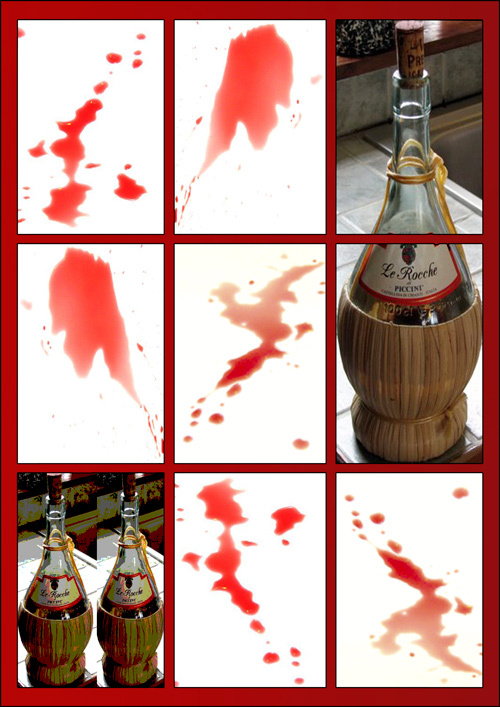
After she had read it, Anna, who knows I enjoy making double or multi-exposure collages, tentatively suggested a wine stain might add something to the goatskin image to go with the poem. She was a little apologetic about leading me, but I was cheerfully open to the suggestion, and set about sloshing some ropey old cooking Chianti onto various light coloured surfaces (no oenophile sensibilities were hurt in the making of this picture). I made the collage using Picasa’s multi-exposure collage function, then tweaked the levels somewhat, still in Picasa. However, it was still rather faint and had lost detail, so Anna, who always knows how much more can be got out of an image without ever compromising its integrity, further improved it using curves in Photoshop. She even made a funky little grid of the wine stain and the Chianti bottle photos I sent her later.
(Click image to view at larger size.)
The intriguingly named Playfair Steps sent me off on a trail of research on Edinburgh, which triggered some associated memories. The short poem arising from that, like Anna’s roof tiles, we removed from the final cut, and, in text-on-picture form, submitted elsewhere, as mentioned.
Anna:
I was walking down from a long levada walk towards a welcome drink when I spotted this poor old goatskin hanging from one of the posts they use to support the grape vines that surround every homestead on the island. This particular homestead was almost in ruins and a passion flower had crept in and taken over the post and most of the surrounding area. I knew right away it would make a great black and white shot, particularly due to the texture in the cracked skin and the worn string. Our driver for the day picked up a new goatskin full of wine to deliver to relatives, and it was much less appealing, as it looked and felt like a large stuffed intestine.
I was touched and amazed by the rigour of Lucy’s research, and the number of ideas that my image evoked. I also liked how she tapped into the timelessness and the history of the object, which was what struck me when I saw it. And when I saw the finished pieces I was forcibly struck by just how well she’d captured the life, death and spirit of the goat.
I also liked the lovely circularity of her idea of the goatskin going back to the mountains.
I did feel guilty about suggesting the wine stain, as I wasn’t sure if it was acceptable for me to suggest a further mutation of Lucy’s initial mutation. Perhaps I suggested it because I was happily cutting up her pictures, but I think it was these words: “the final emptying; a small kind of tragedy” in the last stanza of her piece that made me feel it would be both poignant and shocking to see something in colour, suggesting both the goat’s blood and the wine, applied to the black and white image of the sack.
Drafting — how we both work
Lucy:
I prefer to start most writing with pen and paper. Keyboard and screen always, initially, present too many barriers: mediocre keyboard skills, a tendency to be distracted by things like e-mails and internet, guilt about being glued to a screen too long. On the whole, I simply find pen and paper more sympathetic, a safe, unjudgemental place to simply scribble and scrub out whatever comes to mind. I also like pen and paper from a sensory point of view; I have cheap, usually spiral notebooks of different sizes and carry them about, on my knee on the sofa, on the breakfast table, the kitchen counters, in bags and pockets, along with fineliner pens. I gather there are those who develop similar intimate, companionable relations with their laptops, but I can’t.
However, there comes a point when the sheer volume of dog-eared, palimpsestuous drafts becomes unmanageable:
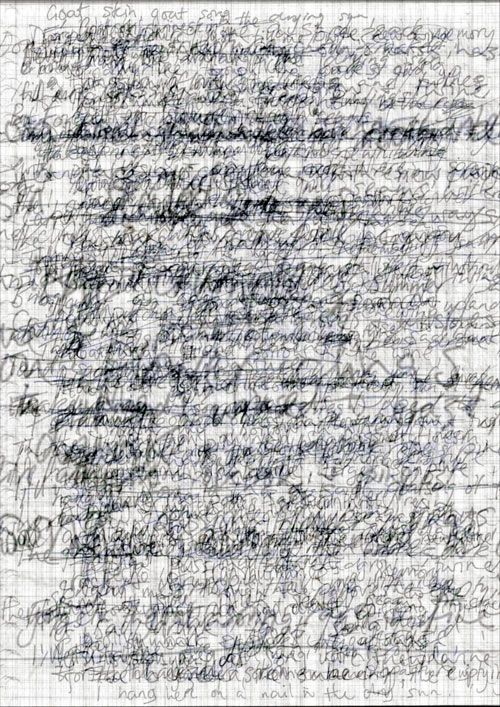
(Click image to view at larger size.)
(Just kidding! This is a multi-exposure collage, a product imitating a process, but it gives an impression.)
And then it’s time to sift them all out,
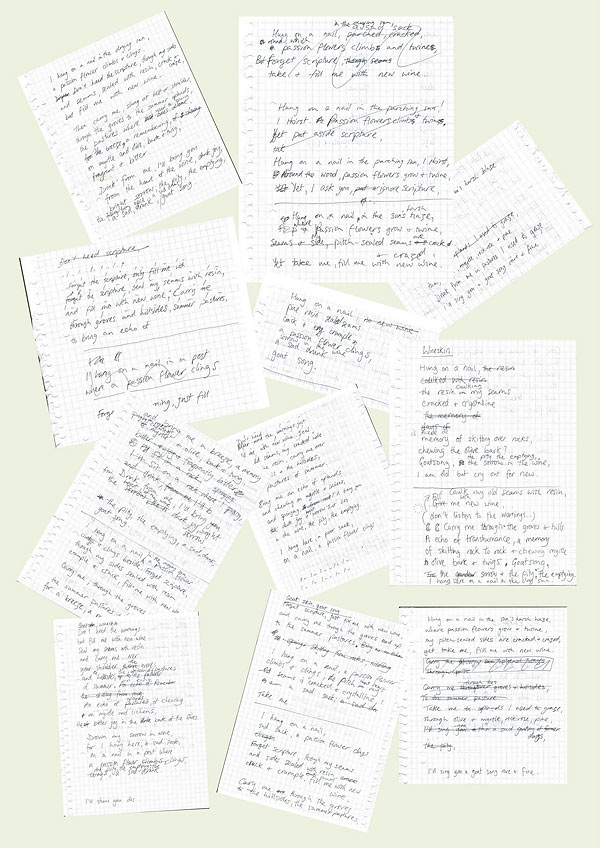
(Click image to view at larger size.)
attempt something approaching what I want to achieve, get it onto the computer, and then tinker around some more: punctuation, line breaks, word changes… One has to stop somewhere.
It occurs to me that with more and more writing taking place exclusively on electronic media, the process becomes increasingly fugitive and invisible, so attempts like this to record it necessarily become artificial re-creations after the fact. We have become aware in this collaboration that a blow-by-blow, unedited record of the process is neither desirable nor really possible. Probably this doesn’t matter. I see it as a little like turning over a piece of weaving to see the reverse side, with its knots and ends and rough bits; you see something of the finished process, not in linear form in the order it was achieved, but dotted about over the surface you don’t normally see.
In addition, on this project, we submitted everything we wrote to one another for editing and suggestions. I have enjoyed this process, including — perhaps most of all — the parts which we ended up leaving out.
Anna:
I too usually start with a paper draft, however I’m not so organised as to have spiral notebooks or favourite pens. No, my approach is more a case of grabbing the gas bill envelope and some scuzzy pencil from the kitchen drawer to scribble down a line or phrase that’s popped into my head as I haul clothes from the washing machine or peel the spuds.
However, for this project I seemed to go straight for the computer, perhaps because I was re-reading the Wendell poem online, or perhaps because working online made me feel a little more connected to the images, the project and to Lucy.
I must admit to really enjoying working with Lucy’s images, as I felt much more detached than when I edit my own photographs, where I’m already burdened with knowing where the shot was taken, or the mood I was in on the day, or the idea I was trying to convey.
I have also enjoyed our e-mail contact. We both blog, but this project has made it quite obvious just what a presentation of self a blog is. Correspondence, even by e-mail, is much more 3-D.
We probably should have fleshed out more ground rules before we started, but from my standpoint the serendipity of this project has only added to the process.
It’s been fun working with Lucy, and I just hope that shows in our results.
Lucy:
Although our ideas for photos and poem responses came quite easily, it seemed to take a while for us to tune in to each other on how to go about presenting the process, so we digressed and produced quite a lot of tangential stuff not featured here, which was fun anyway. We gossiped, even though we were only communicating by e-mail, which used up time, but, again, was enjoyable. We like each other and each other’s work, which meant perhaps we were reluctant to criticise, chivvy, make alternative suggestions, or weed out anything the other produced, though we did do this eventually, and perhaps makes us slip into mutual admiration mode when talking about one another, which is sincere but I hope not too off-putting.
It’s difficult knowing when to stop adding and adjusting, more so than when working alone, because of the compulsion to keep responding.
The other problem is practical and technical, unwanted mutation arising from using different softwares, copying and pasting etc, giving rise to a ragtag array of different fonts and lost line breaks, which needed continual, time-consuming tinkering with. Should have used a Google document…
Our biographies of each other
Lucy on Anna
Anna recently noted that being lately detoxed from an aromatase inhibitor drug, used in the treatment of breast cancer, provided welcome relief from years of low spirits and insomnia following treatment for Stage 3 breast cancer. I was somewhat surprised.
This was the woman I first encountered when I read Peeling Onions, the narrative series she wrote in haiku, which related her personal experience of cancer with strength, dignity and honesty; the woman who produces beautiful, distinctive, bold photos that win prizes and a chapbook of poems that people buy; who participates in poetry readings and workshops and exhibitions; who badgers me to get my photo-editing skills up to scratch and sends me the wherewithal to do it; who undertakes what I would consider to be extreme gardening projects (she once offered to come and stay with me in exchange for cutting all our hedges and teaching me how to use Photoshop properly — I nearly took her up on it but didn’t want to be shown up); who travels to interesting places, supports other cancer sufferers, has a husband, a son, a dog, who finds and shares wonderful videos on YouTube (the Phil Collins gorilla was a memorable one)… I could go on.
So, if she’s been doing all that in a state of depressed sleep deprivation, what’s she going to be doing now she’s feeling better?
I soon found out.
“Do you want to send each other some photos and write about them for qarrtsiluni?” she asked.
“O.K.”
Two minutes later the photos arrived.
Several days later, after much poring and indecision, I sent her some of mine.
Two minutes later…
Anna on Lucy
I’m not sure how long I’ve been dipping into Lucy’s blog to read and enjoy her photo essays on life in the French countryside and much else besides.
But I keep returning because Lucy has the rare gift of managing to look at the world afresh each day, enjoying all the small and intimate pleasures it has to offer — like seeing a friend’s new baby thrive, and a water lily bud break, and then combining these two images into one shot of a lovely little waterbaby.
Even when things get difficult and challenging, like recently when Tom, Lucy’s partner, was in hospital, she still manages to record the facts in an open, gentle and genuine way — and this is a real tonic in a world where people seem overly ready to bemoan their lot.
Lucy’s openness to life can be clearly seen and enjoyed in her recent exploration of the ancient poetic form of the ghazal; and some of her pieces have been published in The Ghazal Page, the online journal devoted to that subject.
And I know I’m not alone in liking her work; many others enjoy it too, especially the Handbook for Explorers, a cycle of 50 sonnets by Joe Hyam, matched beautifully with Lucy’s highly interpretive images.
So when the qarrtsiluni submission call for “Mutating the Signature” dropped into my inbox, I immediately thought of Lucy and wondered if she would be willing to work with me.
Entente Cordiale: An Ekphrastic Exchange (Part 1)
After Silence
I dream of waking where neon
blooms, and nightsong is a siren
blare or the rattle of a tram.
I fear a life spent in a gloomy
house, surrounded by a broody
wood, tending a fickle orchard
and shady gardens without end.
I know forest paths like these,
and how well women come
to tread them. I don’t know
what bound me to you.
Lost in the dark I stood still,
said nothing. So forgive me,
as I set you free — of me.
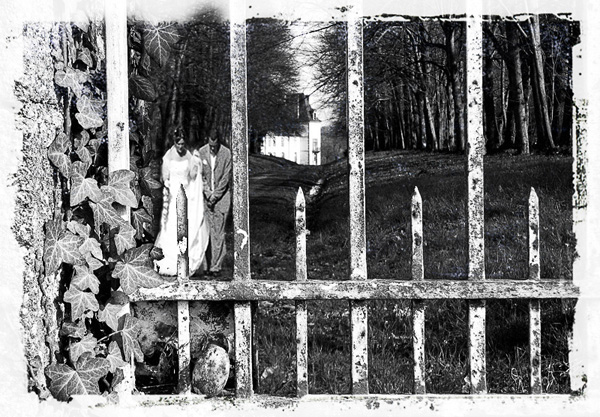
(Click on image to view at larger size.)
Poem by Anna Dickie, photographs by Lucy Kempton, mutated by Anna
Download the MP3 (reading by Anna)
*
Goatskin, goatsong
Hung from a nail in the parching sun, a passion flower
clings and climbs around the post. Forget scripture,
though my sides and seams, once sealed with pitch,
crack and craze, take me, fill me with new wine.
Carry me over the hills and groves, to the summer pastures,
the uplands where once I sprang on rocks and grazed,
to remember, once more, nibbling twigs of myrtle and olive,
bitter and fragrant.
Drink from me there, and I’ll show you, from out of the wine,
dark joy, and bright sorrow, pride and falling from grace,
and pity, and the final emptying; a small kind of tragedy,
a sad drunk goat song.
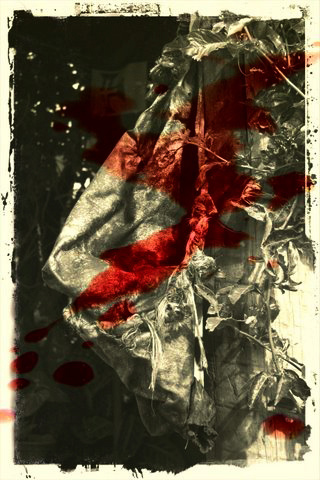
Poem by Lucy, photograph by Anna, mutated by Lucy, with help from Anna
Download the MP3 (reading by Lucy)
Process notes will appear in Part 2.
Icon in a Green Walnut Shell
the sound of wind shifting stones, slowly,
over centuries, is how a woman walks
the land. a sound you can only hear
when you grow still
between the thud of heart
(the blue vein of the horizon)
and the night (the red veil
of the lung).
a man is how we silence trees. the sound
of the wind shifting stones
is an avalanche in the white sheet of
the tongue. is how a child grasps
wheat fields, scratches stars down
from the dark. We use words
borrowed from old countrysides. look up.
their meanings as if they are vials
full of nostrum brewed by no one. the rest
is the way a man speaks
trees, that blossom into houses. then prays.
the green veil of the fingers
plucking the sky from its roots
is how a woman listens. slowly, over centuries
is how plutonium blossoms in the core
of our bones. is how a child gasps The
call of the raven startles us
into a story, where we are not
the beginning, and words
not the end or the telling
but what we break open. in our half-lives.
what we share, what we crouch to eat.
on the edge of night
by Harold Rhenisch and Daniela Elza
Process notes
This process started years ago, when I (Harold) used to climb my walnut tree in the mountains of British Columbia and shake down walnuts which I picked up from the fall chrysanthemums, and, far away in Bulgaria, I (Daniela) was falling in love with a walnut tree in my grandmother’s yard, staining my fingers on their husks, eating the milky fruit inside.
After that, things were quiet for many years, we both became better writers while working with Daniela’s poems, and began to wonder how we could apply what we had learned. We discussed working out the parameters of a new method of teaching, but it was difficult to get beyond the roles of teacher and student, although we were neither. I (Harold) got the idea that the next step might be to write poems together, without selves, to write them as shared objects. I conceived of them as dramas. W>i<e made a couple attempts that went nowhere, as the process began with poems that appeared finished and the work of breaking them, so they could be reformed, was more difficult than w<i>e anticipated. Thus invitation was already there.
Then Daniela found a line in a story of Harold’s in The Malahat Review, quickly added a few verses to it, and sent it Harold’s way, suggesting he mutate the signature.
I (Harold) had fun with it, picked up on the rhythms (I) Daniela had set up, modified them, depersonalized adjectives, and ran with it as far as I could.
W>i<e both continued this process of shuffling and movement, and within two days of tossing it back and forth w<i>e had a poem that was larger than w>i<e were (was). Most of what was exchanged between us was the poem back and forth. Not much else in terms of explanations. Now that w<i>e have found a way to balance form with improvisation, w>i<e will be writing many more.
westward ho
she pauses by the mirror,
sees a wrinkle in her fabric,
a curlicue of fear.
she fingers a trinket,
broken badge
on a chain held taut,
then prinks her face up pretty,
prominent mandibular aside
(she sees no remedy
for that bad bone).
a trick of the light, she thinks,
placing the luminaria on the sill.
hers was a temporal display.
yanked back to the now
with a colloquial howdy from behind,
she sees his face, a panorama
of wild west wink and ten-gallon charm
crenellated maw of smiling spurs.
one swish, and she is in his arms,
a dime-store bargain at twice the price.
by Leslie F. Miller and Jennifer König
Process notes

she fingers a trinket
Leslie laid some procedural ground rules.
1.) We would write two stanzas, one of eight lines, the other of twelve, for the eight nights of Hanukkah and the twelve days of Christmas. Form is arbitrary in the end, though.
2.) With a total of 20 lines, we’d each contribute ten words that must be used, in any order, one per line. I would use one from her list; she one from my list.
3.) We would each start a stanza and finish a stanza.
In the end, we’d edit the poem — decide on punctuation, lines that don’t fit, etc. This way, it is an entirely 50/50 collaboration, right down to the title — we thought of the same one. Even the lines we wrote on our own were written with the other’s word.
When we were satisfied with the poem, Jennifer suggested we take a shot to go with it and post it here. We did not discuss the shot beforehand.

a colloquial howdy from behind
Below, the words we used.
Jen’s Words
west
trinket
luminaria
temporal
swish
taut
colloquial
bone
fabric
mandibular
Leslie’s Words
panorama
curlicue
remedy
pause
prink
badge
crenellation
yank
bargain
trick
Icarus in No Man’s Land
One of ten selections from the unpublished manuscript Flying Home. (Click on image to see at larger size.)

by steve d. dalachinsky and Sig Bang Schmidt
Process notes
This is the first of ten images we’ll be featuring from an unpublished manuscript by dalachinsky and Schmidt called Flying Home. steve writes:
Sig is a German painter. He altered WWI photos and i poemed along to the image. There are 55 of ’em in total. As far as process goes, it’s like call and response. Sig sent his altered photos and i looked and shot, so to speak. Based on his titles and the images i went really on a mental cutup and spontaneous reaction in most cases too.
Miracle Fish
Place the cellophane fish in your palm
and wait. Let him warm to you,
find your cradle, the curve of your inner
nature. His actions will tell your fortune.
A moving head means jealousy,
a finicky tail means indifference.
And so you unfold through all his stirrings.
He bucks and twists in my hand,
nearly falling over himself to get me right.
But every time I open either palm
to this red minnow, he turns a different story.
Today, I am tail over mouth: fickle.
Yesterday, his fin-flick called me passion.
Sometimes late at night, he flips
all the way and claims that I am false.
I want to know how seven seconds
and a sliver of head-shop plastic
know me so well when my own
husband holds me all night, his whole body
cloaked over mine, his whole body absolutely
still? According to the key, his silence says
I am the dead one.
So tell me, Miracle Fish,
how much of me is approximately true,
which scarlet fortune do I believe?
by Karla Huston and Cathryn Cofell
Process notes
Cofell and Huston have written collaboratively off and on since 2000. They have worked mostly in Exquisite Corpse by email as well as in person but have also experimented with assignments controlled around a theme. Perhaps most successful has been allowing each other to write within abandoned poems and allowing this process to create something new. Because they value friendship and respect each other as writers, they’ve established some working rules that seem to eliminate potential problems. For example, they agree to revise only their own lines and abandon a poem that doesn’t seem to be working. Rather than feeling that their own voices have been muted by writing together, they feel as if they’ve created a third voice that is quite freeing and fun.
Inspired by one of those trinket-shop, cellophane fish, this poem is the result of Karla writing a poem that was stuck. She wasn’t sure where to go with it and had more or less given up. So she “gave it away” to Cathryn who wrote inside the poem and around it, adding her own flourishes and took it somewhere new. Then we looked at it together, tweaking line by line, but only making changes to which we both agreed. We think the finished piece is greater than the sum of its parts.
He’s Created What I Have in Mind
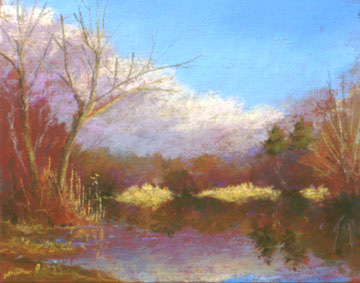
(Jeff Eff’s Lily Pond Transit)
He declares hidden sets for me, pastel passage, same seat I have sat,
though different set of eyes, wondering where the spring, summer
and winter’s at. The hidden fires of fall have declined, flame without
smoke, though fire’s heart was born in stem, stalk and sprig in spring;
fall leaf and limb all flame, so cindered. Summer brazier on sunlit girl,
a sylph from diving board, who October wears a soft yellow sweater,
a skirt to match, who when the fire’s lit, thinks the fall’s the end of it.
Not sparks we hit, old ice houses in sheets of flame, wild sparks due
a mile away, heat enough for spring. Oh, yes, that’s it. Back to spring.
He thinks perhaps I see canoes slipping off pickerel-like from LeHavre
or New London’s watered pit, or a skater’s pond-wide whitened trail
on year’s first ice, twice black thunder leaping up the shore, and more,
the core of unheard music from olden noisy Odin’s Valkyrie with baton
underfoot, a blade honed by youth got on. Younger you and your crew
have followed arcs and marks leave visible the volts of thundering bolts.
Oh, Lily Pond’s never the same, takes aim for becoming done and gone
in seasonal’s phenomenon. Yet Jeff tells me what it is, how he recollects
his past from where he paints beside the pond, and mine, for all of that.
Painting by Jeff Fioravanti; poem and reading by Tom Sheehan
Process notes
Tom: I’ve been thinking of collaborating. Take a peek at Qarrtsiluni. Perhaps a Lily Pond scene, our first common ground, might realize something nice.
Jeff: Let me see what I can develop. We’re on a short porch, submissions due by January 15th. Something of Lily Pond would be interesting. Let me see what comes.
Tom: I’ll keep a log of messages to support the effort, a piece of the submission. There’s free rein on the type of art. I wasn’t thinking of drawing you away from your work, but thought a pass at some graphic image or painting would do. It would take both sides of the coin to get what might be acceptable.
Jeff: I went to the pond yesterday, walking in from Central Street along the river, to get some reference material. Will continue to search and see what develops.
Tom: Much of what I remember is in the attached, “Diamond-faced Lily Pond.” When you have some time, take a look at it. Perhaps it’ll touch something in you.
Jeff: We share the same sentiments. Yesterday, as I walked past the river and the bridge no longer there, I remembered walking the woods to Billy Mitchell’s house or listening to highway traffic or staring at a winter evening’s sky. I tried to imagine my mother’s stories. The striking one is the Prentice boys saving her after a fall through the ice. I remember playing army with other kids, walking through after a football game, much later hiking to Martignetti Liquors and sharing a brew under the summer sky. I’ve watched the pond shrink and yet remain a treasure. Now I search for the right image for those thoughts.
Tom: (Saw Jeff’s pastel painting today, Lily Pond in fall colors, from below John Burns’s house. He will send me a pix. Lovely.)
Jeff: I shoot all my artwork with slide film, liking the way it captures images. Some background here: the painting was done in “en plein air” and is a pastel painting on watercolor board, toned to burnt sienna, of the area by the swing sets. I removed the houses in the background, trying for an original look. Rolling clouds were a challenge, occasionally blotting out the sun, playing havoc with the color scheme. This piece was created during the morning. The submission page doesn’t say what DPI or format the image should be. I’ve made this 300 dpi. The size of the piece is 7×9.
Tom: (Received email with the painting and was transported.)
Jeff: You’ve captured my thoughts, what I tried to catch in my painting, same seat, same scene, different but intertwined. I thought of trodden leaf, faded footsteps, seasons gone by, solitude, visiting old friends, sounds of hockey, plop of fishing lures, rustle of leaves, how we all eventually pass on, but still the seat and the place remain. I thought how you and I share a thread, tied together to this place. I thought of loneliness sitting there, like leaves lost from the trees. I think in many ways you’ve captured what I tried to capture. Different memories, different dreams, same place. I sit here grinning warmly, satisfied.
Winding
If you can’t see the video, you need to download Flash.
The river gave no sign
of where she might have drifted.
It carried the sky and trees like roots.
Leaves traced hieroglyphics
along the snaking spine of a gravel path
that led to the road. Cars passed
in transit, unwilling to stop
for a vine-draped shadow glimpsed
at the edge of light.
Arney’s girl was seen
near the rubble at the old quarry,
pale limbs twined with weeds,
curls of ivy on crumbling stone.
A fusion of need and air,
we reached for her like
drowning victims emerging
wild to claw the sun.
When the search parties stopped,
the land was changed.
We returned to the river,
its flux her blood.
by Jo Hemmant, Michelle McGrane and Christine Swint
Process notes
We started with a raw video of clips Christine shot while running errands in her town. After Michelle and Jo viewed the video, Michelle suggested a theme of ‘disappearance,’ and came up with a rough outline for a narrative that we all liked. There were a few images and scenes that Jo felt didn’t quite go with our intended poem, which we later deleted. We didn’t know how the lines would turn out, but we did have an idea of where we were going from the start.
Writing line by line, we alternated between the three of us via Facebook, a convenient option since Jo lives in England, Michelle is in South Africa, and Christine is in the US. At times we disclosed what was in our minds as we wrote — this particular aspect of our collaboration is important, because we did not write blindly. The poem is more a result of a merging of minds rather than a serendipitous creation.
Whoever said “three’s a crowd” never collaborated on a poem. Although having three different poets weighing in on each word was at times unwieldy, we came to an agreement about the success of each line fairly quickly.
After brainstorming for titles and reaching a consensus about closing the poem, we recorded the voice, and completed the video.
(Watch more qarrtsiluni videos here. —Eds.)
 qarrtsiluni