Archive
Debating Love
PAT: How easily a sight of anything distracts a thought of a lover. I would, if I could, shut down the world.
FRANKIE: Don’t talk crazy talk. You would shut down the generators that make the electricity that sends the lift to my flat? You would shut down the factories that make the sheets on which we lie? You would break the pipes that bring us water for us to brew tea and brush our teeth? The whole world is in a conspiracy to support our love.
by Tammy Ho Lai-ming and Reid Mitchell
Download the MP3 (reading by Reid)
Process notes
Tammy writes:
Reid and I have been writing together for about three years now. We write what could be called “literary dialogues,” although someone has commented that what we write are really “juxtaposed monologues” because the characters are often engaged in displaced conversations with themselves. We have also tried writing poems together and found the Villanelle works rather well. Since we live in two places, we write via the internet. Maybe one day we can write together for a longer period, sitting face-to-face.
“Debating Love” is a brief exchange which shows two people’s collaborative effort to delude each other: Pat thinks the world is an obstacle to love, Frankie thinks the world is a confidant of love.
Dear Seven: A Circle of Epistles (3)
Part 3 of a series of 7
Dear Mary—
I would like to talk about rooms. William Gass proposed that a book is a building for what the brain has spun. So a letter is a room. Your husband’s letter to me was full of location, as if he and therefore I were rapidly beaming in and out of chaos: Captain Kirk and his obedient lackey. Basements and parking lots, orchestra pits and grocery stores. He is so active, your guy. (But when we sit at the table, he is stalwart at your side.) I want this letter to be a little sendable bag for what my sleepy Sunday brain is knitting. Wooden needles click.
I am writing to you from a new room. An old room in our 120 year-old house, the room that was first my son’s then my daughter’s and now refitted for the son again in preparation for his return from college. Everything is IKEA neat right now, the only muss the dust on top of the plastic fortune-telling Buddha, the one I gave him last Christmas, the one sitting on some glib western manufacturer’s idea of buddha responses, like look within.
Content as a mug of tea here, because Sam will return in a few days. We hung a long green batiked scarf in the window and everything is now watery green, my hands as I write you, my pajamas, his posters and books. A moist, dim green against the November outside.
If letters are little knitted compartments of saying, then I should hurry and say before I run out of yarn. Your daughter is a temple. My daughter is a swimming pool. Your daughter is an atrium. We are both splendid galleries within the museum of this city. You are a library stacked with real wisdom, truly. Your daughter is a volleyball court. My son is somewhere in Boston now, his body a concert hall, his eyes will be blue all the way back to Chicago.
Yours, Alice
PS Don’t show this to Mike yet, he needs to wait.
by Alice George
For notes on the process, see the first letter in the chain.
Walking the Dogs Between Blizzards
(Click on all images to see larger versions)
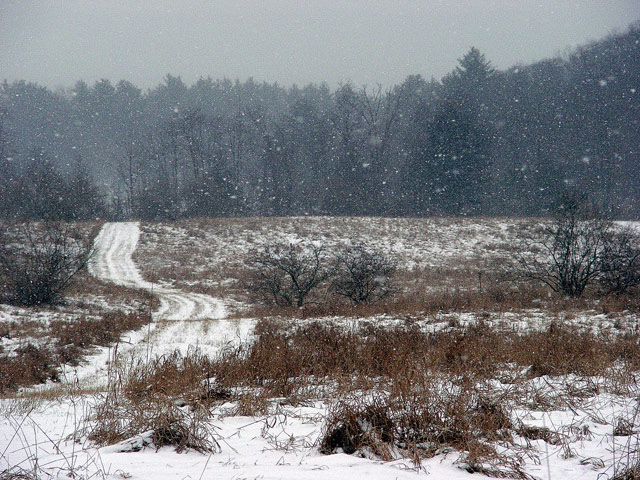
We walk, Gilgamesh and I, in preparation for the storm, twenty-five inches predicted. Weeks below-zero and chilling winds solidified feet of snow already fallen; finally,
we can walk, skating across surface, only occasionally breaking
through. Gilly runs for sheer pleasure, throws himself forward, compensates with sheer velocity
for uncertainty of ground. He hurls his body into space, ahead, ever
ahead; plants his face suddenly into snow when he falls. He always comes up laughing, black fur dusted white, ears crinkled. This is what dogs do. We haven’t walked enough lately;
snow too deep, crust too unreliable. I want to check on the beavers; it’s been many weeks
since we’ve walked enough, in the back field and the woods by the stream. So we pass
Shalom’s grave, a circle

of stones and a Japanese Maple surviving its second winter under heaps of snow. In a few months, the leaves will appear, scarlet, determined; yellow Narcissi will rise around the small tree and shout aggressive, happy color at the sky.
I invite the dead on my walks.
Gilly leaps
gratitude for our Northwesterly direction: behind the house, no stacks of wood to fuss with, no barns in which we do mysterious, officious human things
—sorting recycling, trying to get the damn mower to work—
no mailboxes to check, no boring cars for grocery shopping. To the Northwest, only trails; the ones I built with an ancient pair of garden shears, with bleeding, blistered hands while I grieved
Shalom
one tough, fibrous goldenrod stalk at a time,
for miles. Gilly bounces me repeatedly; I shove him off, but he doesn’t stop, because I’m laughing. He knows that if a joke is funny the first time, it’s even funnier the next
twelve times. He bounces, I laugh. He bounces,
I laugh. This is what dogs do.
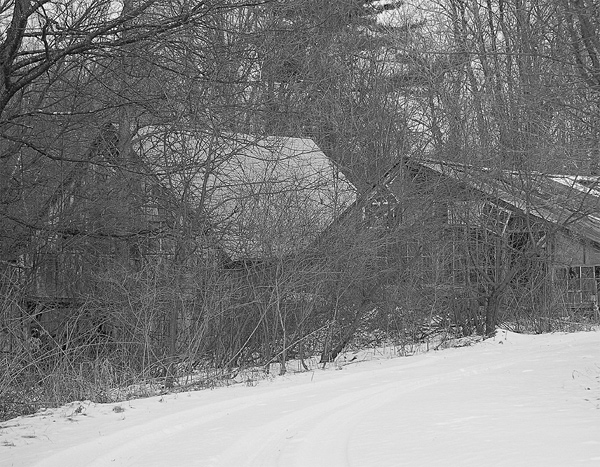
We pass the old shed full of ancient farm equipment abandoned
by the hippies who built our place, the dairy farm family before them. Manure spreader, enormous steel carrot washer, old sleds, hay rakes with snapped handles, detritus from ramshackle greenhouse. The piles irritate. We have history enough
of our own, the interesting nature of the machines notwithstanding. They threw nothing away, ever, and everything left is broken, it weighs
a ton, it has to be dug out of the ground where they let it rot. One person’s history;
another person’s litter. We crunch through the stretch of trail that is marsh in spring; quails and pheasants nest there, sudden explosions of wings when we pass
the Christmas tree I dragged out to the property line, barricading the gap that invited hunters from the next farm. Gilly pees on it obligingly. Do not pass, no killing
here, the yellow snow says; this land is a territory belonging to the living, and to certain ghosts who are in that condition because of the likes of you: you who are not welcome
here with your gun and your beer can and your ‘he came out of nowhere,
he died within minutes.’ Here
is what dogs understand about time:
now. Or:
forever away from now. For a long time now I have walked, understanding what ‘minutes’ means to a dog who is dying,
alone.
Good boy, Gilly, I say. You have a nice, big pee right there. There is other pee around the Christmas tree, too; coyote, probably. Good coyotes. You mark that territory line. Mark it
well. We pause

at the choice of trails: left into the lower field and a short-cut to the beaver lodge, or straight toward the woods and stream, the long way ‘round. The sumac canopy over the track into the woods beckons. Gilly looks at me, I look at him, and we break
for the woods. I lecture him: stay off the ice! He dances ahead, happily
ignoring me. At water’s edge we see tracks and follow them to summer swimming hole, a convergence of streams. The small pool is frozen
now, swift waters bubble under ice. Dry Brook—named for miles of course that run underground—rises ice-cold, even in August, from the South. From the East,
Unadilla Brook runs warm through the swamp where trunks of dead trees rise gracefully, sometimes home

to eagles, herons, hawks. The tracks to the pool are large, but dusted with new snow; I can’t tell who made them. Gilly tests the ice on the swimming hole, of course. I cringe
at creaks under his feet, his spread-wide toes, the light from below makes his webbing purple, his claws scrape for purchase. Convinced he will break through,
knowing he won’t, I have to look away. I inspect the deepest mystery track, shout: ‘I thought so!’ Gilly hurries over to see
what’s so exciting. ‘Look,’ I say, squatting down, pointing into large pad impressions and the outline of claws. ‘Bear.’
Gilly plants his nose in the print, snuffles enthusiastically, inhales snow, sneezes it back out in an explosive
burst. His eyes water. I laugh, so he does too, ears crinkled, teeth half-revealed. He slaps my knee with his paw. Another good joke. This is what dogs do. Back through the woods,
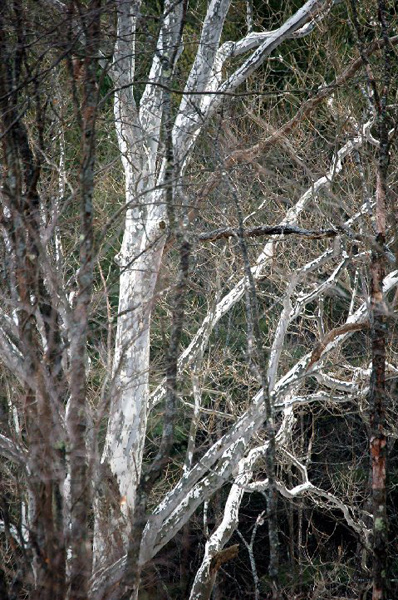
we skirt frozen stream, through maple and birch, under giant sycamores’ thick, mottled, white trunks that rise like enormous
bones overhead. The lodge: a white heap at a bend in the stream. Ice unbroken around it; no tracks. Utterly silent. I wonder if it is warm
in there, under the ice and snow, in the muddy heat of bodies, snacking on stored branches. I guess it is, if you’re a beaver.

We back away from the water: I don’t like to intrude
at the lodge for long. We never see the beavers. We eavesdrop on summer cannonballs into water, felling of trees. We spy on smooth impressions of teeth everywhere. We admire amazing feats of engineering. We sneak glances at the living, as unobtrusively
as wonder allows. Above the lodge, the field we mow into a rough circle each summer is smooth, a white ballroom floor now. Gilly races to the center
and does a gavotte.
I used to come here with Shalom, renovating the abandoned house; before trails, before carrying furniture, boxes, his body, shovels to dig
his sudden grave. One day, Shalom and I stretched out in this wildish ring of field grass and milkweed, goldenrod, buttercups. We cloud-busted
together, for an hour; each chewing a piece of grass, on our backs. My arm around him. His head on my shoulder. His heart beat on my ribs. He smelled like grass,
Shalom did: even in winter, he had a grassy smell. I buried
my face in his fur during February cabin-fever and March doldrums and breathed deep summer. Gilly’s smell is more floral, especially
when he’s hot. His little armpits reek of flowers. His breath smells like mushroom soup. Right now, he has his first cold, so his nose is running
in the chill. The sky has a laden, leaden look all too familiar this winter. The light the soft-focus of imminent storm; edges softened, outlines blurred. It’s warmer than it’s been. Gilly and I follow tracks:

rabbit, then squirrel, chipmunk, deer. Rabbits and deer move in purposeful direction. Squirrels, chipmunks, mice, and dogs run in circles; they leave intricate swirls and knots of passage in the snow. We follow them all, winding
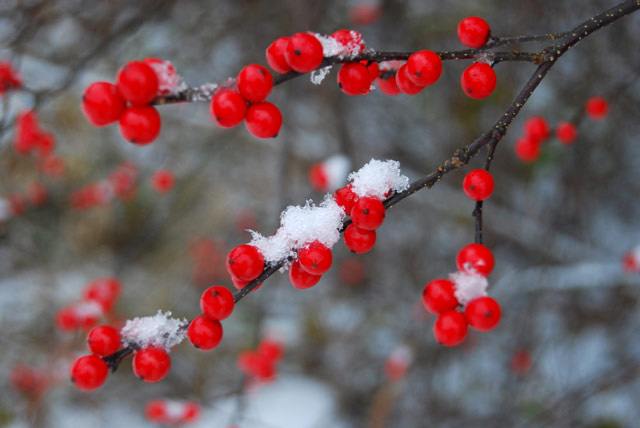
home past sleeping pear and cherry trees, cluster of pines, winter-berry brilliant red, we avoid hawthorn spike, drink land. Near the house, mulberry trees tangle messy and delightful. In summer, their berries turn bird guano the most alarming shade of fuchsia.
Shalom
goes and lies down in his grave. I wonder if it is warm in there, under the ice and snow, with his buried bed and his toys and his
emerging bones. I guess it is, if you’re a ghost.
Ducking under tree boughs, treasure: ‘Gilly!’ I point. He looks up at the branch above my finger, where a single, frozen apple hangs. Apple,
one of the first English words he learned. He apple-dances every summer, tossing them over his back and leaping to catch them
before they fall. His first autumn, he ate so much fermented fruit he got drunk. Dog Farm Apple Wine, we laughed, sitting at our fuchsia-streaked picnic table under mulberry.
Gilly sits for his apple. I jump
for it, hand him treasure he carries inside to thaw by the wood-stove. Later, he’ll throw it around, smear it all over the couch and the floor. This
is what dogs do.

The storm arrives.
Chinese pear a lemon-summer burst on my tongue as outside the window fine, small flakes fly in diagonal sheets, the kind of snow
that isn’t fooling around. Shalom’s grave looks snug, and lonely, a white heap beyond glass walls. ‘Come in
by the stove, love, if you want,’ I say, through ice, through silence. Gilly, in his bed by the stove, looks up at me, bleary, already asleep. I wink at him. He goes back to sleep. The wood hoop is full, the covered shed stocked,
the stove-flue seems to be working again. I have candles, kindling. My favorite tea, cream. A working flashlight, another pear in the fridge. Vitamins, St. John’s Wort, good dark coffee. Andres Segovia and Yo-Yo Ma,
split pea soup. We are settled,
in for the duration.
by Jessamyn Smyth and Anne Morrison Smyth
Download the MP3 (reading by Jessamyn)
Process notes
This is a walking collaboration. A collaboration of loss and witness. A mother handing down particular vision of love and love of place, a daughter handing it back transmuted through a different life and a separate sensibility.
This is what happened when the daughter said: help me keep this place, help me document its magic, the bones of it, the love buried here. This is what happened when the mother said: this is convergence, this is the blood of those we’ve lost on cold and frozen ground, this is some of what home and history is.
In January of 2007 and December of 2008, a mother and daughter walked in storms, bearing witness to loss and history through separate sensibilities.
It shouldn’t be literal, necessarily, the daughter said. I mean, some of them might be, but not all — I want your interpretations of these words, your wholly separate vision of these themes as they exist for you. I know, the mother said. She doesn’t like to talk about her photographs.
Look at that, the daughter said, on these walks.
I did, the mother answered.
Sad, fierce, true: something universal emerges through unshared particulars. A fundamentally shared experience of love, loss, and complicated history blows in sharp, diagonal sheets.
April 21 Rooftop Corpse
Dad & me race up the elevator, wow
we’re liable to see Tahoma’s Columbia Crest
which is why, in all my wildest dreams I never thought
the sun knows you are not a teenager. You
are only a mist in this downpour of old strangers &
coffee table conversation & dusty apricot sky above the feed
store. Rooftop tiles, scattered through the windowpanes of justice,
plane lights brighter now that the sun has just set,
behind my shin splint lay an assortment of chocolatey flavors
like the top of the mountain throwing off spring clouds
or the nesting lion, awakened by the unfamiliar
noises of mad hit & run whistlers (whistle & run?) does
that make the puppies fight for the dogwood,
pink in the middle as clouds above the sunset blinded Cascades
or the cliff-ghasts might get you. Sleep well my child, or
you will watch the sun’s fatal hurtle toward Japan
& realize that conga lines do exist; Clifford suits ARE
real,
& determined as dusk — as the 150 — as
bricks in an open sort of way, like they weren’t really there,
like old Tahoma pinking itself in muted lavender
just so, like all the evening’s gray coming 2gether in 1 last burst of life.
by Paul Nelson and Rebecca Rose
Process notes
Paul writes:
I wrote this as an Exquisite Corpse with my daughter Rebecca Rose, who was 13 at the time. I started with a line and continued with one word on the next line and folded the page over so she could not see anything but the one word I left for her. She did the same and we kept doing that until the end of the page. We recorded it at the studios of Auburn Community Radio, a project since canceled by the city. The rooftop is the Auburn Transit Center, a prison-like structure in downtown Auburn.
Writing these spontaneous poems, made popular by the surrealists, has been a fun way to pass time, document the moment and liberate full metaphoric activity as Andre Breton said about corpses. It allows for a truly organic process.
(Listen to the recording to hear which words were authored by whom. —Eds.)
Arena Chapel
“Follow
me to Florence?” my
master asked, spying my sheep.
Just ten, I said, “Yes,
I will.”
“I will “I will
not forget.” “You will,” teach,” Cimabue
old Scrovegni scoffs, then turns promised, “painting.” “I’ll finish this
away. “Please. Restore first. Please. Step out of
my name.” my light.”
“My name The light
is in your hands,” he dimming, he can still
exchanged with the gold. Giotto picture when their forms began
smocked the son’s orders to jell: flowing gowns
and tears. and tears.
Enter-
ing the fresco, he
presents his gift to Mary.
The father doesn’t
follow.
by Greer DuBois and Wendy Vardaman
Process notes
We began writing this poem at the end of a semester in Florence, having spent several months traveling and studying the amazing medieval and renaissance fresco cycles throughout Italy. Both poets with an interest in visual art, Greer (the daughter) and Wendy (the mother) studied and wrote about these paintings individually over the months. When qarrsiluni’s call for collaborative pieces came out, we thought that the subject of fresco would be exciting to take on, since fresco is itself a collaboration among many artists—masters and apprentices, sometimes over decades and among more than one master. Although the Sistine Chapel in Rome is probably the most famous example of these artworks, the earlier, more intimate Arena Chapel of Padua, by Giotto, may be the most moving, and after much discussion, we agreed that we would like to try writing about it.
Both of us entered into the project with larger artistic ideas that we wanted to explore through the collaborative project. Greer, who had previously been moaning about conventional ideas about the place of the artist within a work and art as a whole, looked on the project as a way to challenge current ideas about poets as individualistic “loners.”
Meanwhile, Wendy wanted to create a form that would somehow capture and imitate the way that individual paintings in a fresco cycle stand on their own as narratives, but connect with the other paintings to create a larger story, sometimes playing off pieces painted above, below, or across from each other. After some thought, she came up with the individual, syllabic stanza units used in “Arena Chapel,” which she called giottos after the painter that inspired them. These units fit together architecturally, one beginning with the same two syllables that end its predecessor, reflecting the multi-voiced, collaborative nature of this project. Although we chose to put the giottos of this poem together in the round, any number of alternative spaces, or chapels, could be created this way, and in fact, the poem already does continue in a number of other directions.
We each wrote three of the individual stanzas in this piece, beginning with a stanza of Wendy’s that was pulled out of a sample cycle she composed to illustrate the form to Greer. After deciding where to start, we divided up the remaining stanzas, and then worked together at several sittings to put them together and revise, commenting on each other’s words and characters, enjoying the sometimes serendipitous interplay of opposite lines, and actively working to create a unified story about two father/son pairs: Cimabue and Giotto, a master and apprentice, and the two Scrovegnis, immortalized both by Giotto’s chapel and by Dante in the Divine Comedy. The brevity of the form we agreed to use, as much as the collaboration, shaped our work. Both of us found the form pushed us toward saying certain things in fairly telegraphic ways and prevented us from saying others; we had to keep renegotiating with each other the direction the narrative would take, how that would happen, and which individual giottos did not fit our shared vision. We have also talked about the possibilities of the form in performance with more than one voice, and would like to develop multiple ways of reading/delivering these pieces as we continue working on them.
What’s displayed here is a section of what, we hope, will eventually be a long poem that tells more of the story of the Arena (Scrovegni’s) Chapel.
Wood for Your Fire
“Wood for Your Fire,” by 12 Measures of Interest
When your faith is a desert, under darkest of skies
When you wander empty tombs in the wind,
When all your rivers have gone silent, and your streams have run dry
When your roads have all come to an end,
Chorus:
I’m the wood for your fire, what you need in this land
Of prophets and poets, scratching psalms in the sand. [repeat]
When grace is a desert, under hottest of suns
When your love is as bare as the trees,
When there’s nothing in sight, of a swift, clearing dawn,
When your death is a morning to me,
Chorus
When heaven is a wasteland, under clouds without rain,
Your song is the sweetest of springs.
Like you I have wandered, like you I was lost,
Now all that you need I will bring.
Chorus
When your faith is a desert, under darkest of skies
When you wander empty tombs in the wind,
When all your rivers have gone silent, and your streams have run dry
When your roads have all come to an end,
Chorus
I’m the wood for your fire, the sandals for your street
The heart of your desire, the stones beneath your feet.
I’m the honey for your hunger, the well for your thirst
The roar of the thunder, the breaker of the curse.
Lyrics by Melissa Lamberton and Ken Lamberton
Music by 12 Measures of Interest: Melissa, Ken, Bill Devinney, Eric Cross, Celia Major, and Pat Kelly
Process notes
Ken writes:
My daughter Melissa and I have been writing music recently, which my band 12 Measures of Interest then performs at church — a Lutheran church with a rock-and-roll band. The end result, however, is really a composition from six people since each member of the band contributes his/her own artistic flare. Our first original song, “Wood for Your Fire,” was first performed a few months ago. The recording isn’t professional, just a couple of microphones set up in front of us, but it’s not too bad.
Melissa first came up with the idea in a “love” poem she wrote that had the line “I’m the wood for your fire” and some other phrases like “prophets writing in the sand.” She and I then began playing with the lyrics as I worked up a rudimentary melody on my acoustic guitar. It took several months of hashing out the final song, working from the “wood for your fire” theme — Melissa was very particular about every word. She didn’t want the final result overtly “religious” and wanted to maintain the original love poem. Once we had the lyrics and basic melody, I shared the song with my music group, who added their own quality. I play bass, so I turned the guitar rhythm over to Bill Devinney, who also added a harmony line. Eric Cross developed the percussion and additional harmony. Celia Major came up with the wonderful high vocal harmony while Pat Kelly on lead guitar chose the slide bar to add his own particular flavor to the end result.
Melissa writes:
This song began life as a poem. The line “I’m the wood for your fire” stayed with me long after the poem was finished — this idea of a love so pure it consumes itself to keep another warm. Love strips you down to the essentials, so I wanted the scene to be a desert — a place where simple necessities become an abundance. The words changed as we fit them to music, but that sense of haunting desolation remained. It seemed impossible to play in anything but a minor key.
Seurat to Continuity
Hills hills miles miles
empty of us Each
under our 4am blankets
in our funnels of breath
nearer to the dark
glass bottom of emptiness itself
Deeper than the glass we peered through
at dinner under the clicking of conversation
No conversation now
where a goblet of breath empties
down a gullet red with swallowed distress
into the cavernous never-lit void
There an undiscovered aurora
borealis emits its lonely
sheen onto the dark sea
starry acidic deep
infinite and intimate where
we meet
It’s no farther from my house to yours
than an arc inside
a star’s pinpoint of light
against the clear dark of tonight
And still nearer
the distance between us
Under the roads hills breath
is a cat’s cradle of hollow fibers
where once is forever once
we’ve touched We’re the sparks
arcs of urgency to connect
the dots Seurat to continuity
end the awful space
inside between us
Filled glass unfilled
lungs dots in the lightdark spectrum
white of our eyes
black of the room
We’re blind pixels of a story
we can’t tell or see
Without effort our lungs fill again
Starlight soaks the hills seeps
in reaches us here
by Jed Myers and Priya Keefe
Process notes
Jed writes:
When Dana invited me to give this venture a try, I thought immediately of Priya, with whom I’ve collaborated in various ways many times in recent years — we’ve written poems back and forth, I’ve performed aloud with her some poems for two voices, backed her up with guitar while she recited or sang, she’s helped me host poetry gatherings… and our sensibilities, as persons and poets, are deeply resonant. So I had no hesitation in asking her to join me in the emergence of a poem for Dana’s potential editorial delight.
Upon agreement from Priya, some weeks back now, I sent her a “seed” of something, a short segment starting “hills hills miles miles…” with the idea she’d respond by adding, altering, subtracting, reacting — who knew?! I knew I was addressing, in a kind of gut language, the reality of what separates us across the landscape of space and time, inviting her to wrestle with this with me. And she did — she added to it, and then I added to that, and then in the several backs and forths of it by email attachment exchange, followed by meeting over coffee and phone conversation, we elaborated and shaped and modified this little piece that seems to express a shared feeling about our lives being too separate, where distances that manifestly get in the way of more abiding connection are inescapable yet at the same time not present in our depths, not actual at the deepest levels of personal truth, but O how we do struggle with the distances, the discontinuities, the hills and miles, as our more overt conscious usual selves. We sense there is a deeper stratum, a “cats cradle” of interconnections, between, among, any and all who’ve ever really touched, been moved or shaken, loved, changed or been changed, but this sense is usually remote. The poem hopes to bring this a bit closer.
The process of the poem — and a way to wonder about its success as a poem, I think — is a struggle toward resolution of an irresolvably dual truth. We are at once in the actual and the experiential worlds — the world of the hills and of the “hollow fibers/where once is forever” — and it may well be that at some fundamental level deeper than conscious experience, “under the roads,” an ineradicable continuity abides. This is a wish, a longing, a conjecture or intuition, and one pole in the tense polarity explored by us organically in the poem.
Priya writes:
We didn’t discuss topic or approach beforehand. My partner Jed started the poem, wrote eight lines and emailed it to me. I wrote eight lines, emailed it back. We each took another turn and then seemed to agree, without discussion, that the first draft was complete. Although I did not state that I had written a conclusion, he responded with an email that indicated he also felt the first draft was complete. My favorite part of this process was watching the mystery unfold.
We agreed to each take a pass at editing before we got together via phone or in person. I edited lightly, trying to stay true to the original version and not insert too much of my voice via editing. I felt there was only so much further I could take the poem without discussing its meaning with Jed.
We met in a coffee shop on a rainy Saturday afternoon. I brought a copy of each version of the poem: the original, Jed’s edited version, and my edited version. Knowing it can be informative and inspirational to hear one’s work read by someone else, I read aloud Jed’s edited version, then he read aloud my edited version. Then we discussed areas where we felt meaning or language was unclear. New understandings evolved through this process! Through reading and discussion, we came up with another version that was more lucid and balanced our two voices.
I think the next time I embark on a process of writing a poem collaboratively, I would like to try discussing an approach beforehand. Although challenging to find and integrate a balance between both voices in the writing and editing we did apart, the discussion and editing we did together was playful and energized the poem.
Flying Home
One of ten selections from the unpublished manuscript Flying Home. (Click on image to see at larger size.)
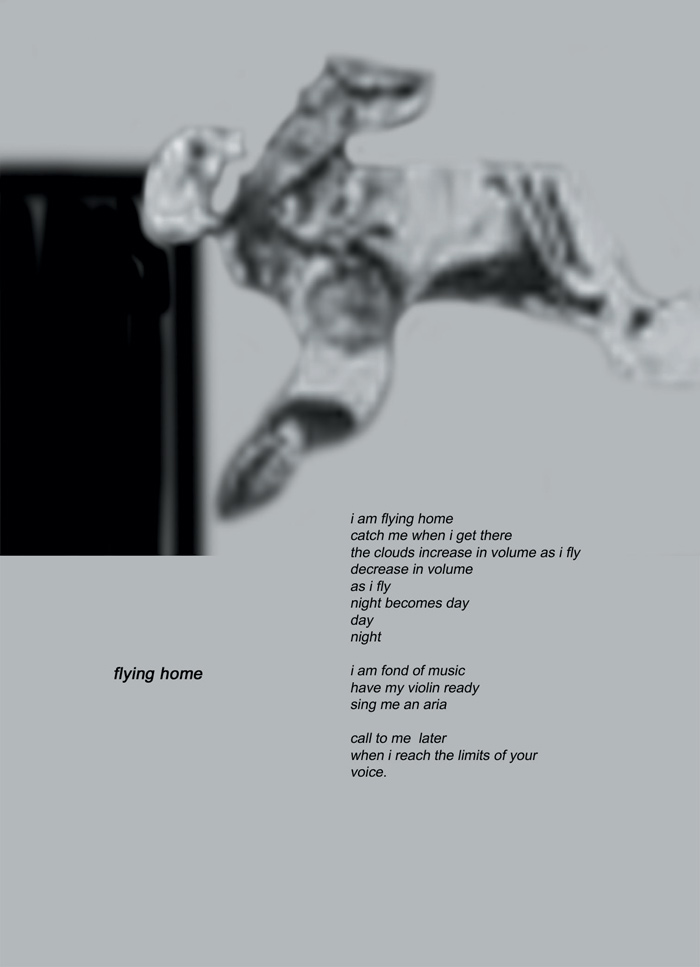
by steve d. dalachinsky and Sig Bang Schmidt
Process notes
Sig writes:
I began working on objects connected with the Great War in 2002. I chose photographs from the war and painted over them digitally, cutting parts out, “rearranging” the pictures. This fragmentation made new images arise, transmitting ideas and messages that were not — or not directly — visible in the originals.
For steve’s notes, see Icarus in No Man’s Land.
OY YO
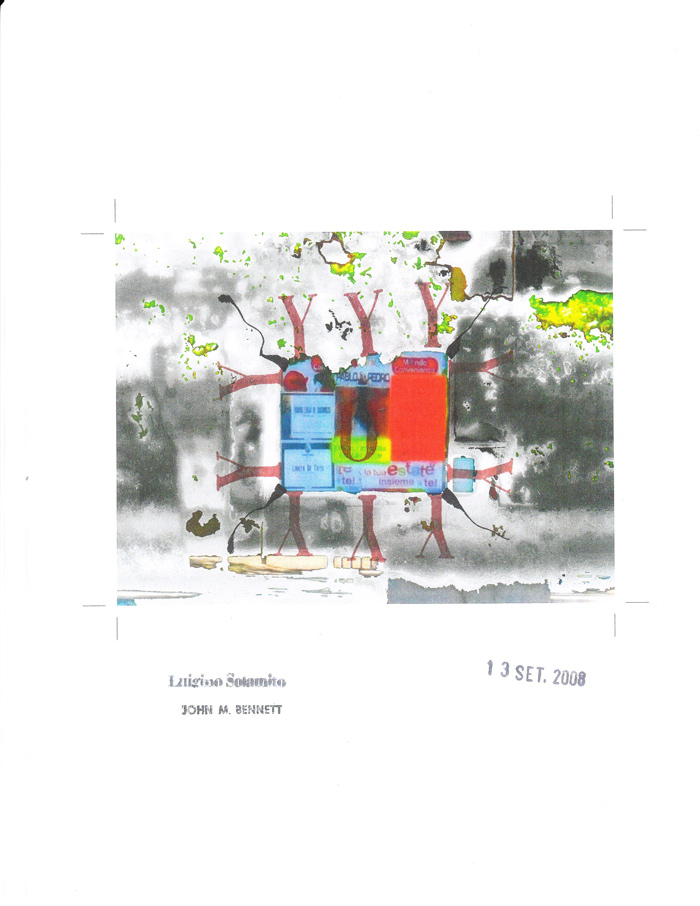
(Click on image to view at a larger size.)
by Luigino Solamito and John M. Bennett
Oracle at Acres of Books
A capella in the Greek and Roman
stacks, the woman clears
her throat. She seems to like
moderato cantabile, sings on her knees,
a babble of feeling
out of her life into mine.
Hair wild, body masking
new paperback smell, soon
she’ll be asked to leave
the slick unbroken
spines that keep in tact
days of the market god, a pillar
with the bearded head of Hermes.
Back then, you laid
a coin on the altar before whispering
a question in his ear.
The answer: first words heard outside.
Her voice is good, a chanson in some painful
minor key. Notes falter, the manager arrives.
I slip away, pay for my books. Tom
behind the counter hands
me a receipt, wishes me good night —
his eyes never meet mine, as if we shared
some guilty past. Two smokers laugh
outside the door, kicking up snow.
We’re not helpless!
yells one of them. Stamping their feet,
they go back inside, tired of being cold.
by Greta Aart and Sally Molini
For process notes, see “Vanishing Biography“
 qarrtsiluni