Archive
silence: a courtyard
I shudder through the bones
of the courtyard
the silence it seeks is a curious sound
how speak a cluster of pines?
how hold such small echoes:
words in two voices a flutter in two
hearts a finch
I fear to touch a whisper
behind my ear
under the blooming cherry
this place a single word
dreamt and wrapped in dormant
seeds, a slice of black earth
I clang the gate shut — the scattered clouds
look me straight in the eye
push me about because they can.
by Rob Taylor and Daniela Elza
Process Notes
Rob:
Our collaboration was preceded by a bit of creative borrowing on both our parts. Having only met once at a local reading, I became enamored with the form Daniela was employing in her work, the triptych: three vertical columns of words that read both horizontally (across the columns, left to right, like a traditional poem) and vertically (down each of the three columns). These triptychs were, in fact, four poems in one, and I was very interested in trying my hand at one (four?). I was especially interested in using blank spaces in the columns to emphasize silences — to see how hollow parts of the poem became when a single word from a single column was removed. I wrote a poem entitled “We speak of silence, not in breath,” which focused on the theme of silence and included the sudden interruption of a quiet scene by a bird.
I sent my poem to Daniela, quite unsure if she would either be upset that I was moving in on her form, or dismissive because I didn’t really get what the triptych was all about. Instead she was enthusiastic, so much so that when I sent her a note about qarrtsiluni’s collaborative writing issue, she quickly responded with a revised version of my poem — and we were off!
Daniela:
I sprinkled in nature images, Rob kneaded the emotions in. At first we had a bit of a hiccup. We took too much out. I went back and dragged some of the stuff back in. There were dormant moments between. There were questions: what makes a good poem? I feared about the process at times because I had never done this with someone I practically did not know. I did not want it to fail. All along I cherished the fearless meeting of minds.
Rob:
I was nervous about adding to the poem after the initial creative moment. When I edit I am almost always paring away at the poem, but if that’s all both peole do in a collaborative exercise then pretty soon you have nothing to work with. My excitement was in seeing the poem go places I know I would never have taken it — rarely does a cherry blossom spontaneously appear in the middle of one of my poems, or a line like “how speak a cluster of pines,” a question I’ve asked to myself many times without finding a way to put it on paper.
Daniela:
All the while the poem was molding and shaping itself, and was saying, “Hey, guys, cut it out with these process notes. What about me? Over here? This is about me, after all, not about these notes you keep processing.” We thought in the beginning the poem was about a single word. But at the end it seemed to be about so much more.
Solo
One of ten selections from the unpublished manuscript, Flying Home. (Click on image to see at larger size.)

by steve d. dalachinsky and Sig Bang Schmidt
Little Boys and Snips of Donkey Tails
“It’s a children’s book launching. Children are necessary. You know that.”
Richard hated it when Marie, his marketing agent, spoke to him as if he were a lost-and-found anteater on its way into the eye of a hurricane.
“And pin-the-tail-on-the-donkey always ensures a huge success,” she added. It was her way of pointing out a trail of life-saving ants before him.
In the fourteen years they’ve worked together, Marie never knew Richard’s secret: that just because he wrote children’s books didn’t mean he was actually fond of children. He also wrote a lot about rabbits, and these too he abhorred. After selling four million copies of The Magical Carpet Bunny in Tahiti, which he wrote while visiting Gauguin nudes in Paris, he broke into his therapist’s office. There he stole most, if not all, of the session tapes with his ramblings and meanderings on bunnies. He still recalls the chill he got when he realized that Dr. Orten actually labeled them “Richard’s Rabbits.” He’d said (and more): I keep my allies close but my enemies closer. And: I have names for the ways they twitch their ears, how they just lie there, for example, panting in the sun.
Luckily Dr. Orten didn’t notice that someone had stolen the tapes. Richard, after all, still valued their appointments and didn’t want to cut her off totally. He knew he could count on her to keep billing even though he cancelled over half of their meetings at the last minute. He needed that time for himself. The paper trail was his name for the arrangement.
Richard’s wife, Lorraine, was mildly jealous of Dr. Orten. Richard thought of Lorraine as his wife even though they were no longer married. They’d divorced several years before and had recently reunited-to the displeasure of mutual friends and bankers who preferred Lorraine alone with, perhaps, a bottle of wine. Richard needed a wife like he needed a therapist. He was conscious of this and tried his best to conceal it from both of them. At least Lorraine didn’t want kids. Her sprawling home was a perfect ecology for him, in both temperature and in how it faced the sun to the east. He slept and wrote soundly there, without any drug inducement.
“Earth to Richard,” chirped Marie through the megaphone.
He could feel himself walking away. Rather rudely. He was past the water cooler and Darcee’s desk and half way inside the elevator before he realized what he was doing. He hated it that Marie never ran after him in public. Instead, she used the megaphone which she carried around in her a showy floral hangbag along with pins and plastic balloons.
The only thing Richard was allowed to decide about his book launch was the hour. He made it nine o’clock. As a child, he was never allowed to stay up later than eight. He was counting on the guests to be solely adults, but the adults disappointed him-as always. They came accompanied by their children. Watching them enter, hand in hand or screaming at each other, he felt a sourness sting his mouth.
In Richard’s mind a small list, like a contrail, fleeted horizontally in his mind: What Sane People Shouldn’t Bring to a Book Party.
Children came up first naturally. Even though they bought or, at least, manipulated their parents to buy his books, he still couldn’t think kindly of them. Once, he even received a fan mail from a little girl in Kansas who addressed him as Dear Santa. No, there was no liking them at all. Especially after Carmen. He’d been in L.A. for a book appearance five years ago, and was cleaning up Lorraine’s place when she called. She mentioned something about being pregnant. It was late in the day, but he still whined, Do you know what time it is! He knew he could throw her off every time he made her aware that she never knew what time it was. She had always been quite vulnerable about this, but never cured her low self-esteem by buying a wristwatch. He’d called her crazy and switched off the phone.
Then jello. He particularly disliked signing books smudged with strawberry jello. He felt that it took the edge off his pen. Not being allowed to sleep later than eight in the evening can grow a child overnight into a cynic. Green jello was almost as bad. It reminded him of him whenever he thought he could or might have actually gotten anyone with child.
Pin-the-tail-on-the-donkey. This was obvious. Like DNA testing to find out the biological parent. No one ever thought about how the donkey felt. Personally, if he had lost his tail he would’ve much preferred not to find it, or worse, have it pinned back erroneously on his nose. In his school days, he saw this done every year from his bedroom window. His parents never allowed him to attend any parties because they suspected an alien conspiracy in anything that begins with the letters L-M-N-O-P.
Which brought to his mind parents. Somehow it occurred to him that even his parents came generically under the letter P. Aliens. At least, his taught him the meaning of camouflage underwear. They had never warmed up to Lorraine and Marie. Or accepted Dr. Orten as part of the family. Ironically, perhaps, because of their beliefs, they’d have approved of Carmen. When he first met her, she was working in a publishing house. She kept inviting him out for some chocolate pecan pie and finally he relented. He thought it was safe enough. He was even flattered when she wrote herself promiscuous notes under his name and left them in public places-like a phone booth or ice cream parlor. Dear Carmen. She actually thought she could handle his electric knife and still keep her side of his bed.
On the night of the party, Richard got off the elevator on the tenth floor of his building, as usual. It took him but a moment to notice that the party wasn’t there at all. Of course, it was across the street at Le Bec Fin. He loved their food, but the thought of kids stashing some of it between the pages of his books rather sickened him. The company had gotten a pro to play Chopin or Satie, he was looking forward to that. They’d have some nice champagne, at least. He couldn’t think of new ploys to make himself more late, without being too late, so he sighed and pressed Down. When the elevator doors opened there was Marie.
“Thought you’d be here,” she laughed. When she grabbed him by the elbow, it was almost friendly. He thought, she might be my friend, this Marie. She might stop bursting balloons with pins to get his attention.
“They’ll want to know about your next book, Richard. How is it going?”
Could he tell her? Open up? He was trying to branch out, write about donkeys, even business managers. A story with complications, with a climax-with more than a punchline. Something for a human being for heaven’s sake. Stories serious enough to hold ambivalent adult twins (fraternal) and spies in feathered capes. He felt ready for that.
At the same time, he was afraid to know what was going to happen next.
Eventually, Marie pulled him into the party lounge. A crowd of around two hundred was already waiting. And frowns waited heavily on the waiters’ faces. The plush oriental carpet had stopped resembling a plush oriental carpet-here and there escargot and roast drippings presented a sort of conceptual art that might’ve been entitled, “Agoraphobia.”
When Marie blindfolded Richard, she left just enough room so he could cock his head and sense the lay of the donkey’s rump. Was that Carmen in a Tahitian mouse get-up? Wasn’t she transferred in a high-security prison? He never knew whether she was being truthful or sarcastic. The whole two months they were together, she had complained incessantly about where she was, wherever he was, and here she was again.
Sex, he thought, should not be the only subtext for anyone’s life, even Carmen’s. Or gambling. Or hotels with heated swimming pools and underwater Bach. Lorraine, at least, never suffered such hang-ups, even though now and then she would refuse to wash behind her ears for weeks. Where was she now that he needed to get rid of Carmen?
In the background, he could hear children clap and holler. There was no doubt he’d pin the tail on the damn donkey with aplomb. That wasn’t the reason he had all sorts of escape plans weaving in and out of his mind.
Through the slit Marie left for him, he thought he could see the shoulder of a boy. And Carmen’s finger was pointing at it.
by Arlene Ang and Valerie Fox
Download the MP3 (reading by Beth Adams)
Process notes
Valerie writes:
In “Little Boys and Snips of Donkey Tails,” Arlene Ang and I were especially interested in developing the character of Richard, who has been popping up in some way or other in many of the stories we’ve been writing. We went back and forth with the edits in a highly methodical way. Richard is always on the edge of something, and we think a lot about how obvious we should or should not make this. In some of the stories that feature him we tend to use a lot of description of his physical surroundings, his habitat. This episode explores his mental, voice-filled landscape.
In this interview, Robert Watts discusses with us our ongoing collaborative work.
Dear Seven: A Circle of Epistles (5)
Part 5 in a series of 7
Chris,
I hope this letter finds you well.
Here is what I think I want to tell you.
I sleep on my left side with one leg out, one leg curled in, and one arm out and the other curled in. I read once that this is an indication of an essential conflict of self.
Possums live in our garage. Our dog will carry one around in her mouth while the possum plays dead. Even though the animal appears lifeless, its heart is beating. When we tell the dog to drop it, the possum scuttles away to hide amid gardening tools, clay pots, bags of mulch and dirt.
My husband built a boat which hangs in the rafters of the garage. You can row it or sail it. He thought, after his mother died, that his father would like a wood-working project to distract him from his grief. So he bought the plans for the boat and set the project up in his father’s garage. But his father never took an interest and so Jim built the boat in our garage. His father died a year and a half after his mother.
We’ve used the boat once; me, Jim and our boys, Henry and Grant. We floated.
Sometimes as we drift off to sleep, my husband will apologize for his tiredness saying, I’m sorry, my train is leaving the station. And then we depart each other, even as we sleep together.
Babies and small children often sleep on their backs, arms flung out, because they are not conflicted and worry about nothing.
Yesterday in the woods, our dog found a huge, dead bird. It lay, split wide open, black feathers and red guts. The dog did not touch the bird.
My father says that my Italian grandfather courted my Irish grandmother by taking her rowing. I picture my grandmother’s pale, soft beauty, my grandfather’s sweat and desire. My father would never use the word desire to tell this story.
I am trying to decide if the fact that I don‘t know you is making this easier or harder to write?
Once, when we were visiting my husband’s parents, they offered to take our first child, Henry, so we could sleep in. I saw them, smiling down at our sleepy, milky baby, nestled between them in their own bed.
Sometimes, when our boys were sleeping babies, I’d want to wake them, to make sure they were alive, and because I missed them so much.
Lately, we’ve been killing mice. The traps are not always effective. Two nights ago, Henry, who is almost twenty now, found a mouse with one tiny paw stuck in the trap. He flailed violently until Henry released him, then he ran away. All of this bothered Henry, as it would anyone, I think.
I went to bed late last night but Henry wasn’t home yet. My first thought this morning was, where is Henry? I looked in his room. He was asleep on his back, one arm crossed over his head, partially covering his face.
The mice run through our house, I’ve met them on the stairs.
As I write this, my husband is awake, our sons still asleep. They drift, they float. If I wake them, they will stare at me speechless, momentarily without words or memory.
I have a book on my shelf called, Winter Sleeping Animals. I bought it because I thought the title was so beautiful. It’s a children’s book that describes the ways and reasons that animals hibernate. I recall another children’s book I used to read to the boys about a family of bears that awoke from hibernation to celebrate Valentine’s Day.
Chris, I hope you sleep like a baby and that every morning begins with wordlessness and love.
Cecilia
by Cecilia Pinto
Life Lessons
Poetry Conversations, Part 2 of 4
My tiny fist disappeared
into the horse’s nostril.
Before I knew what I was doing
I had plunged my hand wrist
deep into that soft round,
perfectly fist shaped opening.
The horse snorted
and glanced at me
as if to say “The hell was that?”
and Chip, the Toronto zoo horse trainer extraordinaire
said something like “uh…whoa..easy there little buddy.”
Six year old violates horse nostril on first trip to Canada.
Two days previous my family had
sling shotted over the boarder
and into the Ontario wilderness
straight stretches of flat road.
In our pockets
my sister and I clutching the Canadian quarters
my father had gifted us.
American dreaming,
kindergarten king of the back seat,
my sister and I slept on a dusty mattress
in the back of our brown station wagon.
The same brown station wagon
that every nuclear family from 1979-82
seemed to have been issued.
Like it was a government sponsored program,
an exercise in hegemony,
for the families of our great nation to all own
the same awkwardly geared , wood veneered, chocolate seared
elephantine, gas greedy shrine
chunk of metal
and suburban optimism.
100 degree heat
we sweated in the morning sleep
and trundled to the Toronto zoo.
I remember there were foot prints
painted on the pavement indicating
“Walk here. Don’t veer off to the left.
There are lions to the left and you will be eaten.
Stick to the footprints.”
Days end, one horse nostril later,
100 degree heat reduced to 85,
tightly squeezed in the zoo tram transport
main entrance to battle scarred car,
my father taught me about the middle finger
how I shouldn’t single it out,
shouldn’t press it against the widow
innocently greeting shocked Canadians.
I was only enjoying the finger feeling
of the rub haltingly squealing on the hot pane
the sound of it squeaking, creaking
against the smooth glass.
But I’m sure in that moment
I looked like just another American.
Already my time abroad
was teaching me valuable life lessons
maturing innocence and forever changing
the way I looked at middle fingers
a secret dirty word hidden inside each one.
by Ryan Hoke
Music by Ryan and Andy Anderson, Wild Goose Creative
(For process notes, see Part 1, “American Way“)
Monster: a Glottochronology
Dear River,
I imagine you apologize for the fish.
My wooden stomach: hook the fins as want stiffens.
I hear the mud tremble & back up slow unto.
This side of the moon can only offer one course. Did anyone truly give the idea it was made of cheese a chance? Pause. Maybe we should organize ourselves around such beliefs again, give us a sense nature is still mysterious beyond the flashbulbs, let us crack a bit stepping into the river. Let me run my finger over those rocks. I’ll split it with you. You’ve grown another seed in your window & you expect the best. Fine. It is here I put my foot down. What hope do you have of relocating the sun? For a moment, try feeding your bones, bones. Let’s take the foot out for a spin. It was just down the way they planted all those trees, wouldn’t it be nice to see. At the heart of great exposures, something minute tarrying film. Carry that around in your head. I give other oil. In our glottal dreams, we always arrive the fine substance. This glass is tricky. Flush in a pinch around the edges. Take the mongrel out. Hope a call comes. I think I’ve heard that one in an instant. Better backtrack & jackal norms will appear, absolving us of this rush for something keening. I remember lying in the sail.
Dear Bridge,
I imagine your thoughts about the moon being on.
My bones fed: the astral oils are changed as trees sleep.
I fondle like a plant the new airs with my scent.
And how is it that you want us to call at this as home? Only seminal apertures, or making your kiss. The top five most emotional albums of your life hint at some religion & stake at yacht forebodings. Not necessarily owning real property are we? Your toes in your fingers, would you consider a grounding, or in getting to carry patterns over-warm the one skin? How uncomfortable is this theatre? — & you wanted to call in early for the other seat: piffle. Here I hear most about saying something over the streams — it is that rock just out of focus that I sat on naked & made geyser. There could have been other consumptions, but you tent-ended viscosity. Laundry in the middle of the night, cleaning up the rugs they footed while mouth-washing: penultimate. Secondly, when has the shade drawn down on lust? Hand of God gnaws on dog-leg, seeks out the filaments of rue. At the unmoving patch in the marina, blessings waver, blessings splash, and I feel cowgirls with binoculars upon this, I feel rearrival in the strongest stage of snow set on by sun, its salvaging, its sniff, my chance, your sign, is raring to go & get back to fitting in.
* * *
Dear River,
I am returning these pebbles for the uprise.
My going through: a small line fixates on current.
I am a good look for passing planes & sculptures.
The torpors loomed, to recount the spread of the maladroit check off the shoe lather, laces unhinged: occlude the incursion of the decrepitude charmer; oft & bungled the coin purse. Our dearth is to heft because baseborn we traverse the aftertaste of phone calls with lady-lady. Because I offer fins I’m ichthyic? I am fully-grown & functioning, use one belt for the holler, & strove once to bundle me shingles. It took the dukes & a farming crowd: they left in unexpected hook: scale. The secret I’ve been keeping for years is out: jet out the jug & lo & be & hold for you’re a mover: wed: you roof the boom, foam up the vase & stem out toward diligence. They offer such settlement it stirs> I will offer my ex composure< in the snap I didn’t perfect there sits hindrance, from other depths, at its best: thumb: in the earliest embryo I moon-hung atop the solar asymmetries of the stomach: rumbled: knew not the intestinal focus as it stood with facts. Since the recourse, we’ve gone off exchange. I want to tell why two bananas: you ought to keep it all as useful as suspenders. Too heavy for the table, the child decries its biscuit as drop-giggle—off the calcification: pacifier, you hold unheard sins, palm little lungs. There are too many cold cuts out in the other room, let’s pass pastries & be again the baby. We are bottled in the waxing of the moon.
Dear Bridge,
I suspend a frame for the over then nethers.
My weaning: the absence of our good old ducky.
I scent the ascent & take you manually.
Another magnetized thread takes its place though none of us were around to count the striations. We view the pile of colorful glasses, they will all have merged & we say just what it means to be connected. Yes, I know, of course. Flambeaux, resistance to implicitness, epistemic like crystals, caissons, stung by myths of powder like a spike through a clock — whoosh — only a moment ago misled, a candidate, now you flounder in someone else’s subjective account of the history that interpolates you. I would guess you have not used the same pitcher for reconstitute of milk as for fresh. We line up on the coast & skip stones together across the ocean surface. Smoke billows up from strategic points within the walls of the city. Tintinnabulations deliver one back, bedizened, transmittance only the essential architecture. Patch up speaking in tongues with thick mouth vapor. The sun fickles its heat, actually & persuades another direction for melt & to live out one’s life on the borders of a very thin puddle. New understandings in the voice, in whichever inch it happens. Ribs reveal themselves to be hives digesting lives from a twentieth century horror. A robin goes missing in the field. We trample the summit of the question. We pound the stone. We, everyone crossing the bridge, & shallow sand at the feet. A children to be herd, like a plug, like two pockets return a ghost blank. Similar to the patterns within any place of worship where we find a neutral heart. Cairn, shrugging danger, the dead end for the thoughtless, the try, this whole hovering sidewalk from which plants seek the proper food & the murderer drinks juice. Children are locked-in with their mothers, breaths clipped. Chop of the stalk of celery length-wise. This one will help this other one.
by Thomas Cook and Tyler Flynn Dorholt
Download the MP3 (9.15MB, recorded via conference call)
Process notes
A Glottochronology began as a experiment in generative text and is now many divergent experiments that always prove to converge. It has been undertaken almost exclusively through email correspondence over the last 15 months. It all began with this sentence: The state shrunken: if we remove the encasements: which fountain are we at? The project began to metastasize rapidly, gaining speed while the two poets watched short surrealist films together over the phone, incorporating rules applicable to the Oulipo school. One of the projects, swallowed by what the writer’s refer to as The Monster, is a book of 125 poems that use all the words in the encyclopedia that begin with the letters g and l. Quite often, the collaboration was done in the same room, in which Thomas and Tyler passed sheets of paper back and forth for long periods of time while Jan Svankmajer films played on the wall. Not a single word or particle has been edited or tinkered with from the original creations. The collaboration has a lifetime roll to it and maintains weekly, if not daily correspondences.
liquid
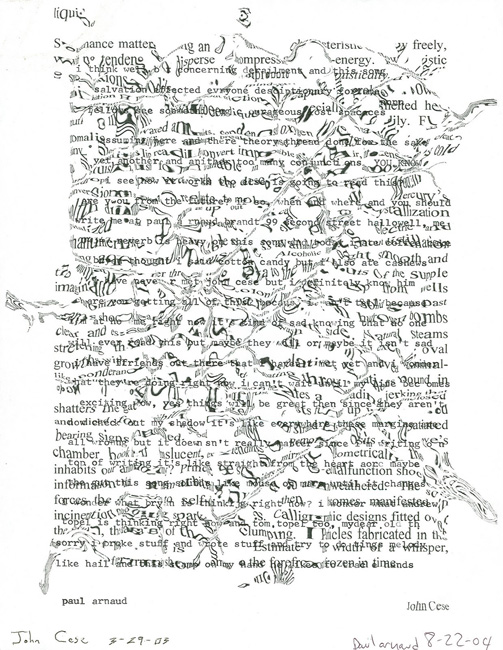
(Click on image to view at larger size.)
by John Cese (A.K.A. Andrew Topel) and Paul Brandt
Coup d’État
The teacher refuses to open the door,
at odds with her profession.
Of course you know why. You answered
her questions with three
blank pages — no need to be verbal,
her omniscient nerve sees all. You write
in transparent ink.
The class turns rowdy. Roars and whistles.
You feel happy but can’t shake some lurking
disappointment. So you honk from your nickel-plated
seat like a clown.
The teacher repeats her sentence,
inconsiderate of your obvious
innocence.
You swear to tell the truth — instead, a last punch
to the teacher’s glasses.
They slide off
the cliff of her nose. A spectacle, like every word
from her lips
passing down the highway
of your hyperbolic mind.
Stand outside and pull your ears!
So you tilt your head and see
the inverse sky.
Windows tipped like wings, clouds
look so soluable.
When you rub your eyes, the clouds
fall as tears. Swallow
them — they taste like salt and light.
by Greta Aart and Sally Molini
For process notes, see “Vanishing Biography“
Explosion 1
One of ten selections from the unpublished manuscript, Flying Home. (Click on image to see at larger size.)

by steve d. dalachinsky and Sig Bang Schmidt
Split Personality
I’m a swift walker
a queen bed rocker
a girdle stalker
a spider smacker
a monkey pile
a trip down that girl’s aisle,
a stay at home mom-o-phile.
Shape shifter, beauty grifter,
sexual drifter
watch me jiggle and whistle,
I’m built like a missile.
I’m waiting for you, tucked in lush grass.
Or maybe I’m a little slimmer
a moon-y glimmer, a blinking
swimmer in an old fish eye.
The one you wish for,
the one you’d hiss for, so
pack this cellulite
in your momma’s sigh.
I’m nearly darling, a timeless
starling, a little more care–
less than free.
So bring us the hum,
a symphony of drums, the rumble
of a good epiphany.
by Karla Huston and Cathryn Cofell
Process notes
Cathryn wrote the first stanza after a conversation about a persona we’d created for our collaborative work, some jokes about funny poems the persona would write if she had the chance. Since the persona is a character called “Thigh,” it made sense that we imagined her with a twin, one she didn’t always get along with, one who wasn’t exactly the same. After Cathryn wrote the first stanza, Karla responded with the other “leg” of the story.
 qarrtsiluni