Archive
Homage to Weston
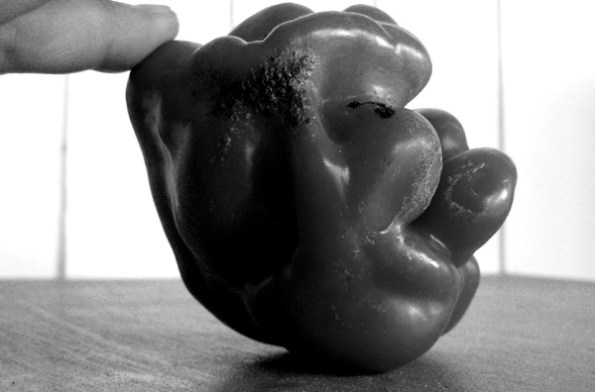
Karen Greenbaum-Maya is a clinical psychologist in private practice in Claremont, California. Her poems and photos have appeared in numerous journals in print and online.
My Floater
(with apologies to Robert Louis Stevenson)
I have a little floater that goes in and out with me
And what can be the use of her is more than I can see.
She’s very very jumpy like a little black fruit fly
As she swoops and flits and quivers ‘round the corner of my eye.
The funniest thing about her is the way she never stares
me full face-on but rather lurks beside me unawares
like a glass chip in a window, cobweb fragment, spot or thread
she’s a bit of protein darting through the humor of my head.
She hasn’t got a notion of how floaters shouldn’t stay
within one’s line of vision but should gently drift away.
The way she hovers near me, paranoia it must be
I’d think shame to stick to anyone like floater sticks to me.
Perhaps one morning early, when my monitor’s alight
I’ll rise and find my page displays without a spot in sight.
My annoying little floater will be nowhere about
because my brain has finally figured how to tune her out!
Violet Nesdoly is a grandmother and a lay-poet, meaning she has no formal poetry degrees or credentials of any kind. She has had poems published in a variety of print and online publications, including Vogue Patterns Magazine, Prairie Messenger and Your Daily Poem. Find more of her poetry online at Violet Nesdoly / poems.
Olé
by Judith Terzi
after Raymond Queneau
A lover slips off his cotton tee
and flings it on a llama in the páramo.
Caballos spin past like devotees.
Lariats slap the air in tango code.
The Latin state seduces him like sleaze.
The lover speaks his words fortissimo,
chills out like nudists put on ice to freeze.
Supine or prone he relishes the pose.
He’s heard that Buenos Aires is the spot
to sip yerba maté infused with pot.
From Jujuy to the Pole the gauchos dine
on empanadas stowed in leather totes.
This gringa interprets everything baroque.
My lover wishes he were Argentine.
For many years a high school French teacher in Pasadena, California, Judith Terzi (website) has also taught English at California State University, Los Angeles, and in Algiers, Algeria. Her poetry has received prizes and recognition from numerous journals in addition to nominations for Best of the Net and Web. Recent books include The Road to Oxnard and Sharing Tabouli.
JUBILATE PUERIS (Christopher Smart gratias)
For I will consider my Boy Michael.
For he is the servant of no one, although we do request his assistance.
For when it comes to food, he worships in his own way.
For this is done by opening the peanut butter jar and swirling a knife seven times round with
deftness.
For then he spreads the peanut butter upon the bread, and closes up the jar, and leaves the
dirty knife upon the counter.
For he layers jelly upon the sandwich.
For having thus made his own lunch he does pride himself.
For this is the minimum of what is expected of him, that he make his lunch and put his
own clothes upon his body and occasionally wash his ears.
For having considered the basics of survival in a cursory way he then considers himself.
For he is a 13-year-old boy in each of the following degrees:
For first he outgrows his shoes in speedy fashion.
For secondly he practices insouciance.
For thirdly he sprawls himself upon the furniture, so as to take up as much room as possible.
For fourthly he allows no kisses at the bus stop.
For fifthly he provokes his sister into wrath.
For sixthly he does not always wash.
For seventhly he tosses his soiled clothing upon the floor of his room.
For eighthly he leaves his sneakers where we may trip upon them.
For ninthly he does look up to us for his instructions.
For tenthly does he ignore us.
For having considered his parents and himself he will consider his sister.
For if he meets another 13-year-old boy he will play games with him.
For when homework or piano practice are required he will devote his time to dallying.
For when dallying is no longer an option he will attempt to argue.
For he will attend to his work at long last, and receive good grades in school, and be considered
among the best of students.
For when he is awake his chatter is ceaseless.
For this chatter is a pleasure to his parents and an irritation to his sister.
For he is merry and of pleasant countenance.
For when his day’s work is done he will retire with a book.
For this his family feels gratitude and thankfulness, and tells him he is a good Boy.
For each family would benefit by having one such boy.
For Michael is the best boy in the World.
Poet, essayist, librettist and occasional radio commentator Ann E. Michael (website, blog) is also Writing Coordinator at DeSales University in eastern Pennsylvania. She is the author of four chapbooks of poetry, most recently The Capable Heart, and a full-length collection, Water-Rites, is forthcoming from Brick Road Poetry Press. An avid gardener and an advocate for the arts, she is a past recipient of a Pennsylvania Council on the Arts fellowship in poetry. She’s helped edit two qarrtsiluni issues: New Classics and Imprisonment.
Ginsberg, Like You, I Feel the Pull
Dangerous to flip though the Weeklies
they capture vulnerable minds, the buzz—
hunger-edge yearnings to be satisfied
the allure of exotic Happy Hours
the nightlife throb—plays, burlesque,
fringe—late shows set in back alleys
beg you out of the house into the
fray of bodies who wield themselves wily
for pleasure to perform. The calling is loud,
boisterous, buoyant, stirring the brainwaves—
endeavors that catapult the peace of a quiet evening
reading, disturbing a good night sleep.
Polish the mind, Ginsberg said, it is not the poem
you must fuss with, it’s in the breath—the message
from the senses enable the vision that lands on
the page one frame at a time—caustic they fume
like an apricot sour, or soft, a Smith and Hawkins
you want to sip and swim immersed venerable soul.
There is not enough time to read every paper
explore every page or eat in every restaurant,
embrace every beautiful person, enfold your arms
comfortable into each S curve waist your body
imagines, longing always to nest, so let the papers rest.
Tomorrow there is somewhere to be—
always tomorrow, or next week, some random
day the mind has already fled to—
Was this how you planned to live your life?
Did you want to be here now? Present. Buddha.
Slow, cooking beans, chopping vegetables—being
centered. Taking long walks easy on Sunday
mornings. Ideals like memories fade fast.
How to get back—it’s in the breath
you’ve heard, there were conversations
with gurus, there were moments of insight
there was that revelation that time you slipped
out of your body—but then some president
had to go start an illegal war. But then, you
live in the best imperialistic country ever.
And you had a sore throat and you had fifty
friends who called and everything speeded up
and there was that calendar filled into next year
already by July and of course your breath
fell behind.
All the people needed you—expected you to show up
at the corner Polish restaurant, follow your hunger
to eat Chinese noodles or pan sautéed fish—they
knew what you liked—exalted you, but you are gone.
So many leave so fast these days cause there’s no time
to cut vegetables, cook slow beans all day, we must join
the nightlife, see the plays—take our mind off the shit
happening, drown ourselves in litter busted lives
we fill to no end with the crap slave-driving corporations
exploit to sell. There are alternatives
if we look beyond—when we breathe
the last breath, step across an altar waiting, it’s okay
now you exhale—then there is the one final inhale—
long and slow while the soul leaves—it’s hard to
take that last breath in, hard to suck—hard to fill
each cavity when you know you’re gone for good.
Julene Tripp Weaver has a private counseling practice in Seattle. Her book, No Father Can Save Her, is published by Plain View Press. Her chapbook, An AIDS Case Manager Wails Her Blues, is writing from her work through the heart of the AIDS epidemic. Her poems are published in many journals, including Drash, Menacing Hedge, Gutter Eloquence and Future Earth Magazine. Most recently, her work is included in Garrison Keillor’s collection, Good Poems American Places, and in the anthology, Wait A Minute, I Have to Take Off My Bra. She does wordplay on Twitter @trippweavepoet and has a website, julenetrippweaver.com.
Paris
after Johannes Bobrowksi’s “Fishing port”
At evening, before snowflakes fall
one after the other,
then I love you.
I love you in the uncomfortable bed,
on the second floor of the converted horse barn
with the white light of morning
with a shadeless window,
with the sheet’s iron warmth.
Our mouths are tricked with licorice—
you come, unconcerned with Henri’s key.
The Eiffel has stopped glittering
and the man who raged at his wife
has left the metro long ago.
Here you come with your sweet mouth.
Now you walk across the last snow.
Lois P. Jones’ poetry and photographs have published in American Poetry Journal, Raven Chronicles, Tiferet and other journals in the U.S. and abroad. She is co-founder of Word Walker Press and host of Los Angeles’s Poet’s Cafe on KPFK 90.7 fm. She co-produces Moonday East and Moonday West’s monthly readings in La Canada and Pacific Palisades, California and is the Poetry Editor of Kyoto Journal, a 2009/10 Pushcart nominee, and 2010/11 nominee for Best New Poets.
Tell Them
by Lauren Banka
after Carvens Lissaint
When I am dead,
when the snakes and the beetles come to take my body away,
after you have spent a year in silence sewing shirts out of driftwood
and the pilgrims come to you with bloody feet to ask of me,
her glory, they say
her aura, they say
the glittering light that shone from her ears,
the dark flame of her hair, they say, tell them
I was all this and less. Tell them
my bones were made of packing foam
which stank to Hell in the summer and melted in the wet winters.
Tell them the shovel of my jaw was full of brass bearings,
sweating and fighting in the mosh pit of my mouth,
my throat a BB gun, that I used to spit them sizzling
at the faces of my closest friends. Tell them I was a fast learner.
Tell them my aim improved each time you saw me.
Tell them my eyes were shotglasses I asked everyone to refill.
Tell them I broke all my mirrors, just so I could have more mirrors.
Tell them you could always find me near mirrors, staring into gloss,
recognizing myself nowhere. Tell them I made too many promises
and too few secrets to ever keep any of either. When they ask you of me,
her tongue, they say,
it was a yellow hydra, wasn’t it,
and its five heads spit bitter, spit salty, spit sweet and spicy and strong,
and each head with twelve teeth,
and each tooth with a single cavity,
and in each cavity a tiny pearl,
and in each pearl a tiny door,
and in each pearl a truth, wasn’t it?
wasn’t it just like that?
You tell them
a truth that can fit in a door in a pearl in a cavity in the mouth
of one fifth of anyone’s hydra tongue is a useless truth. Tell them
I spit pearls at people too, and nobody thanked me for it,
and nobody should. Tell them I made them in my gut, swallowed
every irritant anyone sprayed, swallowed my own phlegm,
and clutched myself,
and hardened.
And when they stop asking questions. When their hearts
are vomiting a little in their own heart mouths, and they have just realized
how lost they are,
in a foreign country,
with bloody feet, they will ask you this:
but what about her size? We have heard
that she fit inside a mustard seed,
that her hammock was a half a walnut shell,
that she wore infant’s shoes her whole life long,
that she flew for free in a carry-on bag,
that she didn’t grow after age eight,
that she didn’t grow after age fourteen,
that shirts were dresses on her and capris, full-length pants,
that she had to look up to talk to children,
that she had to look down to talk to her uncles,
that she beanstalked over tall men,
that she could barely fit into most buildings,
that you had to hold meetings outside if you wanted her to come,
that she held her closest friends in her pocket
that she held power tools and sawdust in her pocket
that she held the continents stacked like baseball cards
in her pocket.
Tell them. Tell them I was all this and I was all this
and I was all of this. Tell them a third time
of my bitter anger, my hydra fury, my spitting mad.
Tell them I was small enough to fit in a brass bearing.
Tell them I scarred anyone who ever spoke to me,
that they carried my weight in their cheek. Did tricks
with it, when they wanted to flirt. Tell them how everyone left,
that they were right to. How these anchors of my anger
drifted like galaxies expanding, and the shortest distance
between one brass bearing and another was me,
and the longest distance between pearl and pearl was me.
Tell them how small I was. Tell them how large I was. Tell them
how small I still was. Tell them I took shots, and the world
was not always better for it. Tell them I left scars. Tell them
you can still see the mark.
Lauren Banka is an award-winning visual artist, poet, and organizer from Ann Arbor, Michigan, currently living in St. Louis, Missouri. She has performed and competed nationally, and has been published in the Lake River Review as well as two self-published chapbooks. She believes in the fundamental goodness of human nature.
Alone with a Toad
(After Jim Heynen)
The schoolhouse was empty when the youngest boy moved the toad from the jar. It hopped twice on the counter leaving slimy prints before the youngest boy wrapped his fingers around it. The sun was easing off for the day and the light, as it dimmed, muffled the images in the room. He rubbed his cheek against the toad’s slimy skin. The smell, the boy decided, was something like licorice whips gone wilting in the lake. His stomach lurched upward.
He had something here to prove: that bump like warts meant nothing, that moments like these came as proof of living. He stuck out his tongue and flicked it against the toad’s back. His tongue tingled and he thought: this is what my tongue feels like. He held his hands closed and placed the toad’s head just past his lips. The older boys said to expect to slice the amphibians open. That when he sliced it open he would see a stomach, a liver, a heart. If he were quick enough he might see the lungs still flexing. What’s ownership if not this? If this toad was now his, he thought, as it squirmed and burped into his mouth the very least was to give it one last moment in the damp. The next day he cut open the toad and the lungs did not move.
I didn’t grow any warts either, he said.
Corinne Manning’s work has appeared or is forthcoming from Drunken Boat, Arts & Letters, and Hoarse. She was the 2010-2011 Writer in Residence for HUB-BUB, an arts and culture nonprofit that awards year long live work fellowships. She currently lives in Seattle, Washington.
One More: After Elizabeth Bishop’s “One Art”
(and perhaps addressed to “The Prodigal”)
The art of boozing isn’t hard to master.
So many drinks seem filled with the intent
To be drunk that drinking, drunk, is no disaster.
Drink something every round. Tell that old bastard
Of a bartender you’ll drink until you’re skint.
The art of boozing isn’t hard to master.
Then practice drinking harder, drinking faster,
Spend happy and happier hours, spend up the rent
To be drunk. Drinking, drunk is no disaster.
You drank your apartment up. And look, your last or
Next to last of folded twenties went
To buy a round. The art of boozing isn’t hard to master.
You’ve lost two days, lovely ones, while plastered
Like pig shit to a wall—your job, the argument
That to a drunk, being drunk is no disaster.
Even now, as you belly up to the bar
Like a sick fish floating—it’s evident
The art of boozing isn’t hard to master.
As you drink doubles—prodigality’s no disaster.
Pamela Johnson Parker is a medical editor and adjunct professor of creative writing and literature at Murray State University. A Walk Through the Memory Palace was the first selection in the qarrtsiluni chapbook series. Another chapbook, Other Four Letter Words, is available from Finishing Line Press. Pamela’s work is also featured in Best New Poets 2011, edited by D. A. Powell.
 qarrtsiluni
