Archive
Silhouettes
by Darcy Bruce
There was a moment when birds exploded from my chest and every gasping soul swept in to pull away the remnants of what you left. Every breath and piece of tongue and bit of beating heart until all that remained were clumps of hair and feathers and mewling voice. Not even shadow, but perhaps a silhouette.
Empty is our house as blind you stumble forward into the rising sun, seeing only red hot pain, although I wish that you could see my cold white hands and how they lust to reach inside your chest and grasp at tangles, working deftly, quickly, just working.
Of flesh, of thirst. Sightless eyes and brief, unpromising touch. Of heat and pressing bodies. Legs and arms, as the crook of your neck is salty from the sand of a sea you visit only in your fevered dreams. Eyelids blinking tears and sweat, and thirsting. Thirsting.
I want to scoop what darkness runs through your veins like silver running through that cliff, to rub each flaking piece into the heart of that little porcelain bowl.
To take and hold you, to lick and swell from what I take knowing I’ll be done but you will not. But I’ll return to see, to weep, and watch and to be watched by other silhouettes who’ve run their course and jealous, turn to us.
Knowing that you’ll long to know of what became of me. Knowing only how I loved you as dying embers love a breath of air. Knowing not of how now, I can grow beside you, both strong and reaching toward that sun and what we see of other worlds.
Darcy Bruce is a writer from Oakdale, Connecticut. When she isn’t writing she is usually shelving books at a giant used bookstore.
With or Without
Come with me sit with me stay with me play with me lie with me with all your heart with all your soul with all your might without a doubt without objection without prejudice without compunction without exception rebel without a cause man without a country gone with the wind with the greatest of ease with pleasure with assistance without really trying without meaning to without a trace without a care in the world without borders parents without partners without consent with tears without stopping with a smile with a laugh with finished basement with washer/dryer with skylights with bath with salt with fries with dressing on the side with cheese with tax with fees with honors with distinction with my compliments with your help with your approval without further ado let he who is without sin without guile go with God without parole.
Erika Dreifus lives in New York, where she writes fiction, poetry, essays, and reviews. Visit her website at erikadreifus.com to learn more about her work.
Fragments of Skye
My eye is often drawn to places or objects in ruins, broken pieces, incomplete things.
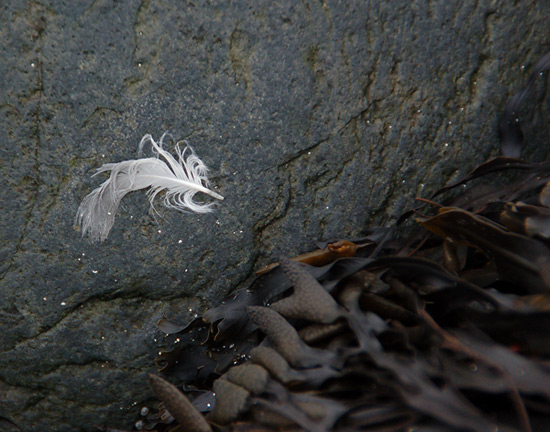
Feather on Sea Stone (Talisker Bay, Isle of Skye)

Carrageen on Sea Stone (Talisker Bay, Isle of Skye)
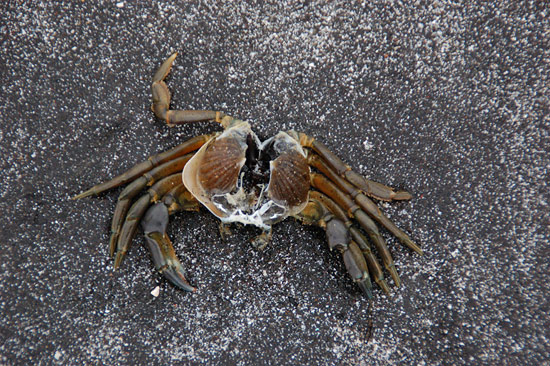
Hollowed Crab on Sea Stone (Talisker Bay, Isle of Skye)
It seems to me that all art comes through a process of fragmentation, someone putting a frame down and breaking some part off from the rest. And that our perspective is always fragmented, as no one can see or understand a whole. But when we focus on fragments, we are not striving for wholeness. Maybe for acute awareness.
*
Katherine Durham Oldmixon is a past contributor to and guest editor (with Lucy Kempton) of Qarrtsiluni. Her recent poems have appeared in Bellevue Literary Review, The Normal School, and Improbable Worlds: An Anthology of Texas and Louisiana Poets, and online in Solstice Literary Magazine and Poemeleon. Katherine teaches literature and creative writing at historic Huston-Tillotson University in Austin, Texas, and for the UNO low-residency MFA program.
accidentals
by Gabrielle D
eternity: a small room with cleverly positioned mirrors
–
dignity is a drafty coat in this winter farce
–
Mozart’s meadows, Bach’s caverns
–
diablo con leche
–
UNMENSCHLICHE DECIBELS
–
tender unmaskings
–
Wagner is a very slowly sinking cruise ship
–
the fallacy that is triumph
–
clothed in silence, standing tall in her hell
–
pacing in circles in the small, dirty cages of their beliefs
–
love is a chemical betrayal
–
pyramid heart, with so many nobodies at the bottom and you at the top
–
the sweetness of abandonment—the space love no longer occupies glows with spiced nerves and undone silkstrings
–
the vague white noise of a thousand voices / the pierce of a single voice
–
loss is a temple
–
you of lips laced with the harmonics of untold kisses
–
is there a perfume to mask despair?
–
untoward guests welcome
–
cocooned smugly in her chaos
–
kindred dissonances in a tonal wasteland
Gabrielle D was born in 1989, and is a pianist and singer in Seattle. Though music was her first language (and love), she writes regularly, and published a small article in the Glenn Gould Foundation Blog when she was 20 years old.
xv. remote control
dear nancy,
the manipulative ability of the hand which gives us hunger for meaning …
an old woman whose children died at birth and whose husband was lost at sea … one night she looks through an artist s window. when night comes, james ensor puts on a mask.
we work our fingers by remote control … the muscles are elsewhere. the fingers are connected by strings, like a marionette.
before choosing, james ensor touched the masks with his fingers. the old woman watched as he ran his fingers along the slack jaws and collapsed noses. as he pushed his thumbs through the vacant eye holes.
creation of meaning from nothing, we owe this to the hand. to reach, to pursue, to seize, to hunt. it takes nine muscles to control the thumb, an appendage so astounding that sir isaac newton believed it proved the existence of god.
for james ensor there are disadvantages. behind the mask, his face sweats. breathing is harder. but imagine the donkey relieved of its burden in the momentous painting of the christ s entry into brussels.
the artist is free. the old woman sees it.
Theresa Williams has poems and stories published or forthcoming in Gargoyle, Lilliput Review, Prime Number, Midwestern Gothic, The Sun and many others. Her novel, The Secret of Hurricanes, was a finalist for the Paterson Fiction Prize. The above letter to her friend Nancy reflects her interests in James Ensor, masks, and hands.
Fons Amoris
The room is dark, on a low table a candle is burning, lighting a red curtain, a narrow bed, the corner of a crumpled piece of paper. A man’s body, young, emaciated, he has thrown off the sheet, his long white face is covered in sweat. His eyes are closed, perhaps for good. The sickening odour of sulphur. Outside an owl is calling and yellow plumes of smoke are rising from the damp ground.
When I first came to Naples I thought I would live forever.
At the foot of the bed a boy, eating a pear. When he has finished the pear the man will open his eyes and attempt to speak.
O Clemens, o pia…
His thin hands trace notes in the air.
The boy’s head is like a golden helmet. Or covered in dark, shaggy curls, a shepherd boy from the Campania.
O dulcis…
How sweet to look upon the face of this boy! He is innocent of anything worse than stealing a pear. If I’m thirsty he’ll bring me wine to drink, never vinegar. Sometimes he plays with the cat, I watch them out of the tiny slits at the bottom of my eyes, for my eyes will not open any more, neither can I turn my head. But I catch sight through the slits: the cat’s paw reaching for a bit of string, the boy’s face, laughing, a glint of sunshine thrown across the floor, an owl’s feather, tiny and curled white and marked with delicate black semi-quavers.
misericordes oculos ad nos converte…
She turns her eyes and looks at me. A blood red ruby.
Download the podcast (music: Pergolesi’s Salve Regina by Barbara Schlick—public domain; bells by Grace Andreacchi)
Grace Andreacchi (website) is an American-born novelist, poet and playwright currently living in London. Works include the novels Scarabocchio and Poetry and Fear, Music for Glass Orchestra (Serpent’s Tail), Give My Heart Ease (New American Writing Award) and the chapbook Berlin Elegies. Her work appears in Horizon Review, The Literateur, Cabinet des Fées and many other fine places. Grace is also managing editor at Andromache Books and writes the literary blog Amazing Grace.
Books
He has an undue respect for books. He never marks them up, or reads while eating for fear of soiling them. He respects and pays allegiance to all he reads. I tear to shreds the pages in his presence. Mount the most convincing arguments why this or that book should not be read, why my markings in the margins, my underlining, checks, asterisks, why whole paragraphs I’ve xed out are superior to the printed page that he keeps virgin and unthumbed. I tell him nothing will grow in the forest of books you have, the three books you read a week. You’ve got to take your pen to them, scarify them, tear, shred the pages. Your mind should be like a lumber mill. It should spin with the sharp weight of gears, sprockets with the teeth of thought meant to sever and section trees, that’s how you should handle pages, as if every book you read were walking the plank.
Richard Krause lives in Kentucky where he teaches at Somerset Community College. His stories have recently appeared in J Journal, The Alembic and The Long Story. His epigrams have appeared in Hotel Amerika and Fraglit, and have been translated into Italian in an online review called Aforisticamente. His story collection, Studies in Insignificance, was published by Livingston Press in 2003.
Ten Ways Of Going About Morning and Thoughts on Fragments
by Jill Jones
Ten Ways Of Going About Morning
1.
sometimes it’s fog / with the gone lamentations
2.
gunfire cracking glass — five shots / what worries, these
3.
sometimes bruises from the mugging / through zones once paths
4.
constant sun / if the things I know pass me
5.
more trolleys / how was it ever
6.
phone call / always some trouble
7.
teams of cockatoos / death and harvest, dust and iron
8.
zombie dreams / small glimmering gaps between messages
9.
green / et in arcadia ego
10.
singing up my sheep / a shimmer at the top of the room
Thoughts on fragments
Fragments that live in memory, forgotten
That revive themselves
Little half songs
Beautiful detritus
Un-half-recalled steps in word games
The present that’s gone
Returns
Jill Jones (website, blog) has published six full-length books of poetry including Dark Bright Doors (Wakefield Press, 2010) and Broken/Open (Salt Publishing, 2005). She has also published a number of chapbooks including Senses Working Out (Vagabond Press, 2012) and Struggle and Radiance: Ten Commentaries (Wild Honey Press, 2004). A new full-length book, Ash Is Here, So Are Stars, is due in later in 2012. Her work is represented in a number of major anthologies including the Macquarie PEN Anthology of Australian Literature, ed. Nicholas Jose et. al. (Allen & Unwin, 2009) and The Penguin Anthology of Australian Poetry, ed. John Kinsella, 2009.
a selection from diluvium
by JeFF Stumpo

JeFF Stumpo writes: “diluvium is a 64-page long poem / poetic sequence. In the center of each page is an 8-line rhyming poem representing the conscious utterances of Noah and/or his wife as they wait out the Flood. Surrounding them is an ‘ocean’ of their subconscious, or perhaps Collective Unconscious, consisting of free verse, fragments, word salad, and visual poetry (words forming hurricanes, raindrops, darkness, wings, etc.). This selection comes at the critical moment at which tensions between the couple and towards their god are rising, they decide to release the raven, and the result is less than either of them had hoped for.”
JeFF Stumpo is a poet who creates visual and performance (as well as more mainstream) pieces and is an adjunct professor of English at the University of Tennessee at Martin. For more, visit his website.
Midmoon
The early hours belong neither to yesterday nor to tomorrow. As there is midday and midnight, so should there also be a stretch of time—call it midmoon—between the indigo breakdown and the powdery blue busyness of dawn, the timeless refuge of insomniacs.
***
My neck is creaking. The nail on my right thumb, the one holding down the pen, has split open, staining the pen shaft red.
***
Oh, sleep, what have I ever done to displease you? True, I stole a couple of dreams and pawned them off as poems, but where’s the harm in that? I just wanted to broadcast your brilliance, to needle the night. Forgive me, sleep, my precious!
***
I flee the living room and seek refuge in the kitchen. Why are kitchen tabletops always sticky? Ledgers of domesticity, they reveal more about the viscous love of family than all the fabricated grins in photo albums. The tick of the kitchen clock drives me mad. It’s time getting to me, that fiction I always denied, that wilting thing that bleaches hair and illusions. Time is a tyrant. Time is a trap. If only it flew, as the saying goes. But it strangles. As if each little parcel of our passing were really equal in duration and intensity. As if eternity were divisible and we could measure its shrinking in dead seconds frozen in flight. Why does the refrigerator sing at night?
***
In a sleepless state not far removed from madness all is metaphor, like the loose screws on the frame of my glasses and the cracks in the ceiling. The unidentified street sounds strike like auditory shrapnel hurled by a roving militia. The boxed destinies of cars and trucks deliver somebody else’s tomorrow.
***
No choice in the eternal tick-tock that stretches, sleepless, till dawn, no choice, after the rage of helplessness breaks, but to sit back and watch, like on a long train ride, when life is a landscape rushing by, a succession of trees, homes, shrubs, depots, ducks and cows—and people scattered about, mostly in clusters, but sometimes solitary. No choice but to watch and love it for what it is, the ringside seat at a non-stop hundred-ring circus, the wildest beast being me in the cage of my skull put through the motions by the great lion tamer. Nothing to do but admire it all, the décor framed by the window, the concert of waking birds, the percussion of the trucks—an endless opera.
***
The first yawn breaks like an avalanche. It clouds your glasses, drawing tears, as if the eyes were sponges that drain when they’ve seen too much.
***
In the symphony of the waking family, the toilets play percussion, the radio alarm hits a high note, stomachs grumble arpeggios to the piccolo of hungry sparrows. I am the reluctant conductor by default, because I don’t play an instrument. The creaking floorboards and opened doors applaud.
Peter Wortsman (PEN member profile) is the author of work in multiple modes, including a book of short fiction, A Modern Way to Die; two plays, The Tattooed Man Tells All and Burning Words; prose poetry in an artists’ book, it-t=i, produced in collaboration with his brother, artist Harold Wortsman; and the travelogue/memoir Ghost Dance in Berlin, a rhapsody in gray, forthcoming in 2013 from Travelers’ Tales. His prose poetry has appeared in several anthologies, and he’s the translator of numerous books from the German, including, most recently, an anthology, Tales of the German Imagination, from the Brothers Grimm to Ingeborg Bachmann, forthcoming in 2013 from Penguin Classics. He’s a recipient of the Beard’s Fund Short Story Award, as well as Fulbright and Thomas J. Watson Foundation Fellowships, and he was the Holtzbrinck Fellow at the American Academy in Berlin in 2010.
 qarrtsiluni