Archive
Two poems from the Spanish by Enrique Moya
translated by Nathan D. Horowitz
Ante la tumba de Søren Kierkegaard
1.
Devoto era del azul,
mas al conocer el gris de Copenhague
me consagré al sacerdocio de sus tonos.
Ahora escucho atento las voces
procedentes de la niebla.
Transcribo sus ecos con tinta de agua y memoria.
2.
La tumba de Søren Kierkegaard, vacía de crisantemos
La sombra de un árbol reposa sobre su lápida
Trozos de luz alternan con trozos de sombra
El cielo del camposanto aún está en la nevera.
Los gorriones daneses alternan sus melodías,
saben cuándo es tiempo de requiem
y cuándo, de fanfarria.
En sus Estudios estéticos, el filósofo aconseja:
“El que […] se haya perfeccionado
en el arte de olvidar y en el arte de recordar
podrá jugar a la pelota con la existencia entera”.
Nada tan efímero
como la muerte ante un retoño
bajo el cielo de abril.
3.
Sentado y sin palabras
ante un epitafio.
El mejor poema a la primavera
es permanecer en silencio un instante.
At Kierkegaard’s tomb
1.
I was devoted to blue.
But when I met the grey of Copenhagen,
I consecrated myself to the priesthood of its tones.
Now I listen carefully to voices emerging from the fog.
I transcribe their echoes with ink of water mixed with memory.
2.
The tomb of Søren Kierkegaard is empty of chrysanthemums.
The shadow of a tree reposes on its stone.
Pieces of light alternate with pieces of shadow.
The sky above the churchyard is still in an icebox.
The Danish sparrows alternate their melodies:
they know when it’s time for a requiem
and when it’s time for a fanfare.
In his Aesthetic Studies, the philosopher advises:
“When you reach perfection
in the art of forgetting and remembering,
you will be able to play games with all existence.”
Nothing is as ephemeral
as death faced with new shoots under an April sky.
3.
I sit wordlessly
before an epitaph.
The best ode to spring
is a moment of silence.
*
Verano en las tierras de Islandia
1.
En Ódáðahraun el viento bautiza
los puntos cardinales de este desierto hijo de la nada.
El silencio tiene su modo de decir las cosas,
cada pisada posee un eco profundo, expansivo.
Así que más vale entender bien lo que dice
o serás alimento de los fantasmas de la arena.
2.
Vatnajökull tiene forma de eternidad
y su infinito cubre mi mano con su niebla.
Mas intuyo la distancia entre mi alma y el glaciar
por los susurros del hielo,
por el tímido saludo del disco solar.
3.
En Kerlingarfjöll no ayuda echarle un vistazo a la brújula;
hay que orientarse por la sombra de las piedras.
También puedes cerrar los ojos
y dejarte llevar por la ventisca del glaciar.
Todos los caminos llevan a Reykjavík.
4.
La noche está allí
aun cuando nadie la vea.
2.56 am en la bahía de Faxaflói,
y el sol levita
sobre el frío verano de Islandia.
Summer in Iceland
1.
In Ódáðahraun
the wind baptizes
the cardinal points of this desert
born of nothingness.
The silence has a way of saying things.
(Each step has a deep echo, expansive.)
So it’s best to understand clearly what it says,
or else you will nourish the ghosts in the sand.
2.
Vatnajökull is shaped like eternity,
and its infinity covers my hand with its fog.
But I intuit the distance between my soul and the glacier
through the whispers of the ice
and the timid greeting of the solar disk.
3.
In Kerlinarfjöll it doesn’t help to glance at the compass.
You have to orient yourself by the shadows of the stones.
You can also close your eyes
and let yourself be guided by the breeze from the glacier.
All roads lead to Reykjavik.
4.
The night is there
even when no-one sees it.
At 2:56 a.m.
in the Bay of Faxaflói
the sun levitates above the cold Icelandic summer.
Enrique Moya is a Venezuelan-Austrian poet, fiction writer, literary translator, publisher, essayist, and music and literary critic. He has published works in diverse literary genres in newspapers and magazines of Latin America, the USA, Asia and Europe. His collections of poetry include Oval Memory (Eclepsidra Publishing, Caracas, 2000, Bilingual English–Spanish Edition), Café Kafka (Labyrinth Publishing House, Vienna-London, 2005, Bilingual English–Spanish Edition), Theories of the Skin (La Bohemia Publishing House, Buenos Aires, 2006, Bilingual German–Spanish Edition) and Before Soren Kierkegaard’s Tomb (Lilla Torg, Malmö, Sweden 2007, Swedish-Spanish). His poetry has been translated and published into English, German, Italian, Swedish, Turkish, Hindi, Arabic, Rumanian, and other languages. Enrique Moya is director of Latin American – Austrian Literature Forum.
Nathan D. Horowitz teaches English in Vienna, Austria.
Mary: A Yiddish poem by Anna Margolin
translated by Lawrence Rosenwald
Anna Margolin (pen name of Rosa Lebnsboym) was born in Russia in 1887 and died in the United States in 1952. She published only one volume of poems in her lifetime, in 1929. It includes a seven-poem sequence titled “Mary,” Margolin’s imaginative exploration of the sensibility of the mother of Jesus; below are all but the fifth poem in the sequence. Some, e.g. “Mary’s Prayer,” are in psalm-like free verse, the rhythm carefully worked out (the translator’s challenge is of course hearing and rendering those rhythms). Other poems combine free verse with intermittent rhymes, which provide a sort of punctuation, an ordering of sections within the poem (“Mary and the Priest” for example). The last poem, “Mary and Death,” is the only one consistently in couplets, though even here the rhythm and line-length vary. All of this is characteristic of Margolin, whose work moves back and forth between free verse and highly regular and rhymed verse. A recent reviewer described her poetry as “sensual, jarring, plainspoken, and hard, the record of a soul in direct contact with the streets of 1920s New York.”
Note: Yiddish does not use capital letters. These transliterations do, both for proper names and indicate the beginnings of sentences. The original Yiddish texts are not numbered;the numbers are added only for convenience.
I: Vos vilstu, Mari?
Vos vilstu, Mari?
Efsher a kind zol likhtik drimlen in mayn shoys.
Di tife shtume ovntn in shtrengn hoyz
aleyn. Pamelekh vanderndik.
Alts vartndik und vartndik.
Un zol mayn libe zayn tsum man, vos libt mikh nit,
shtil un vi fartsveyflung groys.
Vos vilstu, Mari?
Ikh volt gevolt di fis farvortslt in der erd,
aleyn shteyn in der mit fun toyik-heln feld.
Es geyt di zun durch mir vi durch a yunger velt,
dos rayfn un der duft fun drimlendikn feld.
Un plutsem yogt zikh on a breyter vilder regn
un shlogt un kusht mikh tumeldik un shver,
a shturem vi an odler kumt gefloygn,
zinkt shrayendik in mir un boygt mikh hin un her.
Bin ikh a mentsh, a blits, der umru fun di vegn,
oder di shvartse krekhtsndike erd?
Ikh veys nit mer. Mit trernshvere oygn
gib ikh zikh op der zun, dem vint un regn.
Ober vos vilstu, Mari?
I: What do you want, Mary?
What do you want, Mary?
Maybe a child brightly asleep on my lap,
in the deep and silent evenings, in the strict house
alone. Slowly wandering.
Everything waiting and waiting.
For my love to go to the man who does not love me,
silently and huge as despair.
What do you want, Mary?
To root my feet in the earth,
to stand alone in the dew-bright field,
the sun passing through me as through a young world,
the blooming and scent of the dozing field.
And suddenly a broad wild rain
pursues me, strikes me, kisses me, loud and heavy.
A storm like an eagle comes flying,
sinks into me with loud cries, bends me this way and that.
Am I human, am I lightning, the unrest of the roads
or the black, groaning earth?
I do not know any more. Tears heavy in my eyes
I yield to the sun, the wind and rain.
But what do you want, Mary?
*
II: Maris tefila
Got, hakhnoedik un shtum zaynen di vegn.
Durkh fayer fun zind un fun trern
firn zu dir ale vegn.
Ikh hob fun libe geboyt dir a nest
und fun shtilkeyt a templ.
Ikh bin dayn hiterin, dinst un gelibte,
und dayn ponem hob ikh keynmol nit gezen.
Und ikh lig oyfn rand fun der velt,
un du geyst finster durch mir vi di sho fun toyt,
geyst vi a breyte blitsndike shvert.
II: Mary’s Tefila
Lord, these roads are plain and still.
But roads that pass through fire of sin and tears
still lead to you.
I have built you a nest of love,
a temple of silence.
I am your guardian, handmaiden, and beloved;
and I have never seen your face.
And I lie at the edge of the world,
and you go darkly through me like the hour of death,
like a broad and glittering sword.
*
III: Mari un der prister
Mari, bizt a bekher mit opfervayn,
a tsart-farrundikter bekher mit vayn
oyf a farvistn mizbeakh.
A prister
mit shlanke langzame hent
hoybt oyf hoykh dem krishtolenem bekher.
Un es tsitert dayn lebn un brent
in zayne oygn, in zayne hent
un vil in glik ekstatishn un shvern
teshmetert vern.
Mari, Mari,
bald vet mit a hel geveyn
dayn lebn zikh tsebrekhn,
un farbn vet dayn toyt
dem toytn shteyn
heys un royt.
Un es veln shmeykhlen di fargesene geter
heys un royt.
III: Mary and the Priest
Mary, you are a cup of offering-wine,
a delicately rounded cup of wine
on a ruined altar.
A priest
with slender, slowly-moving hands
raises the crystal cup,
your life trembles and flames in brands
of fire in his eyes and in his hands.
And seeks to be shattered in this
ecstatic, heavy bliss.
Mary, Mary:
soon your life will break apart
in bright sobbing;
and when you are dead
you will color the dead stone
hot and red.
And the forgotten gods will smile
hot and red.
*
IV: Eynzame Mari
Tsvishn mentshn iz zi
vi in midber geven,
flegt zi murmlen aleyn
ir nomen: “Mari.”
Un gevezn Mari
un oykh gelibter man:
“vi durkh heysn tuman,
Mari,
her ikh dayn kol,
ze ikh dayn shotn,”
flegt zi murmlen amol
unter ir otem.
Un bletern veykh
dos glik dos oysgetrakhte,
un vern plutsem bleykh
fun zelbstfarakhtung.
IV: Mary Alone
Among people, she was
like someone in a wilderness,
would be by herself
and murmur her name: “Mary.”
And was Mary
and also beloved husband:
“as through a burning mist,
Mary,
I hear your voice,
see your shadow,”
she would murmur
under her breath.
And gently page through
the fate devised for her,
and turn suddenly pale
from self-loathing.
*
VI: Mari vil zayn a betlerin
Zayn a betlerin.
Vi fun a shif, vos zinkt,
varfn ale oytsres oyfn vint:
di last fun dayn libe un last fun di freydn,
un az ikh aleyn zol mer zikh nit derkonen –
oykh mayn gutn tsi mayn shlekhtn nomen.
Zayn a betlerin.
Shtum zikh sharn iber groye trotuarn,
vi der shvartser shotn fun ale hele lebns,
un far geshenkte groshn
koyfn zikh tsum shpiln
a vanzinikn kholem un a shtiln,
vos knoylt zikh zilberik in roykh fun opium.
Eynshlofn in gas unter der zun,
vi in feld a mider zang,
vi a tseflikte blum,
vos iz farvelkt un umreyn,
un dokh getlekh,
un hot nokh alts a por sheyne zeydene bletlekh.
Un oyfloykhtn mit krankn likht fun a lamtern,
zikh oysviklen fun der shtumer groyer nakht,
vi a nepl fun nepl, vi a nakht fun der nakht.
Vern a gebet un vern a flam.
Zikh avekshenken tsertlekh, brenendik un groyzam.
Un umgliklakh.
Un geyn azoy mit farvunderte oygn
durch groyse soydesdike teg un nekht
tsum hoykhn gerikht,
tsum shmertslakhn likht,
tsu zikh.
VI: Mary wants to go begging
To be a beggar,
the way on a sinking ship
the treasures are thrown to the wind:
the burden of your love, the burden of joy,
till I myself do not know who I am —
not even my good or evil name.
To be a beggar,
to shuffle along the gray sidewalks
like the black shadow of all bright lives,
and with the pennies I’m given
to buy a crazy silent dream
to play with,
coiling all silvery in opium smoke.
To fall asleep on the street beneath the sun
like a weary song in the fields,
or like a plucked flower
withered and stained
but divine
with a few still pretty, silken petals left.
To shine with the sickly light from a lantern,
to unwrap myself from the quiet gray night
like a mist from mist, a night from night.
To become a prayer and become a flame.
To give myself away, tender and burning and cruel.
And to be alone
as only kings and beggars are alone.
And unlucky.
And to go along this way with wondering eyes
through long secret days and nights
to the high court,
to the painful light,
myself.
*
VII: Mari un der toyt
S’hot mari zikh gezegnt mitn likhtikn hoyz,
far di vent zikh geneygt un geneygt un aroys.
Un avek in der nakht, vi men geyt in a wald,
vu gots otem iz nont un s’shrekt yede geshtalt.
Di nakht hot geleygt zikh veykh oyf ir vey,
geleygt zikh vi shvartser, vi lashtsender shney.
Un gegangen nokh ir zaynen freylakh un bunt
betler un shiker un vagabund.
Vi troyerike feygl, krank farlibt,
hobn kalikes nokhgehipt.
Un kretzike hobn farshemte genent
und zikh di vundn farshtelt mit di hent.
Un foroys iz gegangen farbenkterheyt
der yingling toyt mit der tunkeler fleyt.
VII: Mary and Death
Mary said good-bye to the shining house, and bent
low to the walls, bent low again, and went
away in the night, as in a wood, where you are near
the breath of God, and in each shadow there is fear.
Gently the night lay down upon her woe
like black, caressing snow.
Right after her a rabble comes
of drunks and bums.
Behind them hopped along
cripples, like birds in lovesick song;
pressing close came shamefaced bands
of lepers, hiding their wounds with their hands.
And Death, a young man full of longing, played
on his dark flute, at the head of the long parade.
Lawrence Rosenwald is the Anne Pierce Rogers Professor of English at Wellesley College. He has published scholarly and literary translations from Latin, French, Italian, German, and Yiddish, and a number of essays on translation theory, in particular on Martin Buber and Franz Rosenzweig’s German translation of the Hebrew Bible. His most recent book is a study of American literary multilingualism, called Multilingual America: Language and the Making of American Literature, which was published by Cambridge University Press in 2008.
Mrs. Moshiach
With her help-opposite otherwise preoccupied,
Riding on donkeys, listening to silver trumpets,
Mrs. Moshiach emptied her collection box of dollars, euros, yen.
There was marketing to be accomplished. The world’s
Souk was offering opinions in various sizes, colors, tastes,
To sagacious and foolish buyers, alike.
Whereas some folk prefer to grind their gists on old-fashioned quems,
Most takers happily chomp pabulum, that bland stuff lacking
Sufficient nutrients; cognitive-heavy absorption takes too much time.
Accordingly, the prophetess, who dressed in ticky-tacky,
Her autogiro equipped with six forward gears,
Flew in for a day at the mall. Yellow journalism was on sale.
Home, she deigned to hijack seemingly sated media crews by dint of her
Tahini, hummus, falafel, especially, her sandwiched analyses of cultural switchbacks.
Know, extra sugar makes arak, rose-petal tea, also oishr, so much sweeter.
Women’s work remains unacknowledged. Those reporters,
Workers-for-hire, scriveners, burped politely, yet filed prescripted stories.
Her man’s campaign, in contrast, changed the course of history.
KJ Hannah Greenberg (website) and her hibernaculum of imaginary hedgehogs roam the verbal hinterlands. Her creative efforts are devoted to lovers of slipstream fiction, to second chair oboe players and to mothers who despair of finding the bottom of Mt. Laundry. Hannah’s newest book, Oblivious to the Obvious: Wishfully Mindful Parenting, is available at French Creek Press. Some of the homes for her poetry have included: Cantaraville, Language and Culture Magazine, Poetry Superhighway, New Vilna Review, and Vox Poetica. Last year, Hannah read poetry submissions for Sotto Voce and was named, by The Shine Journal, for the Pushcart Poetry Prize.
Downtown Montreal
by Éric Dupuis

Click on image to see a larger version.
Éric Dupuis (website) writes by way of a bio: “Photography is a form of artistic expression that I am passionate about. It is my way of freely exploring the surprising world we live in. Most of my recent work tends to be project-driven, developing a specific theme. One series proposes an insight on spirituality and the religious heritage, while another project explores the ephemeral character of life — a subject very close to my heart. My passion for traveling has led me to work on yet another portfolio that documents opposing aspects of the social fabric of Cartagena, Colombia.”
Two Romanian poems by O. Nimigean
translated by Chris Tanasescu and Martin Woodside
nu-ţi garantează nimeni nimic
întâi treci prin foc focul nu e aşa cum îl ţii tu minte
un caras auriu cu aripi lungi înotând în sobă
sau alintându-se în iarbă (ochii lui fără pleoape
te-au urmărit o vreme te mai privesc şi acum)
focul e altfel nu se vede nu îl
vezi când arde curg de pe tine sudoare şi
zgură arde cu cuvinte incendiază
fantasmele provoacă metamorfoze groteşti vei
trăi nopţi în care statuile se schimonosesc stelele
fixe se zbat în zig-zag-uri lumina însăşi se umple de
pete hohotind ca o hienă vei trăi zile pline de fum
şi de mucuri zilele mutului
nu-ţi garantează nimeni că nu vei crăpa
că nu te vei întoarce bâţâindu-te
nuâţi garantează nimeni nimic e pe bune
no guarantees
first you walk through the fire fire not as you remember
a golden carp with long fins swimming in the stove
or prancing in the grass (its lidless eyes
have followed you awhile follow you still)
the fire is not like that not visible you don’t
see it when it burns sweat and dross flow
from you burns the words sets
phantasms on fire triggers grotesque metamorphoses you will
live through nights with statues distorted fixed
stars zig-zagging the light itself fills with laughing
spots like a hyena you shall live days full of smoke
and cigarette butts
no guarantees that you won’t croak
that you won’t return trembling
no guarantees from anyone about anything. This is for keeps.
*
din străinătate
gol într-o noapte încinsă
undeva la marginea germaniei
fosta fermă tace în întuneric
viermii moi se preling în sus şi-n jos
pe punga de gunoi bio de sub chiuvetă
îi privesc fără scârbă
şi constat că moartea
nu mă mai înspăimântă
poate e o trufie
ce va fi pusă cândva
crâncen la încercare
dar moartea
nu mă mai înspăimântă
mă înspăimântă cumplit
respiraţia mea liniştită
pulsul
odaia noaptea românia
căreia-i simt de departe
mirosul dulceag de stârv
moartea—nu
from abroad
naked on a scorching night
somewhere in far off Germany
one time farm keeps quiet in the dark
soft worms streaming up and down
around the recycled trash bag under the sink
I watch them without disgust
and notice that death
no longer scares me
maybe that pride
will someday be
bitterly put to the test
but death
no longer scares me
what scares me completely
my calm breath
the pulse
the room at night Romania
where I sense at a distance
a cloying corpse smell.
death—no
O. Nimigean is a poet, novelist, and critic — one of the major voices of contemporary Romanian literature. His style is praised for its freshness, versatility and chameleonic variety, while his wide range of registers and forms span pastiche, satire, profane experiments with reshaping the sonnet, ballad, love-song, and elegy. Scathing political sarcasm shortly follows intimately harrowing confession, while jocular (self-) irony goes hand in hand with deep heart-felt genuineness in a poetry that speaks with both strong urgency and thoughtful serenity.
Martin Woodside is a writer and translator whose chapbook of poems, Stationary Landscapes, came out in 2009 (Pudding House Press). His translations of contemporary Romanian poets will be featured in a forthcoming feature section from Poetry International and in an anthology from Calypso Editions. He spent 2009-10 on a Fulbright Fellowship in Romania, researching/translating contemporary Romanian poets.
Chris Tanasescu (blog) is a Romanian poet, academic, critic, and translator whose work has appeared in Romanian and international anthologies and publications. He is author of four collections of poetry, recipient of a number of international awards and leader of the acclaimed poetry performance / action painting / rock band Margento. He is spending 2010-11 as a Fulbright visiting professor at San Diego State University in California, researching poetries and communities.
Two poems from the Plant Kingdom
The Birthday Roses
from The Book of the Red King
Their fine green feet are pointed, hovering in the vase,
Close together as if in love but slanting outward,
Their petal perfection, their fine-grained velvet red
Is wonderfully marred as if by sgraffito—
Is there an inner layer of rot or ebony?
Dragon-toothed and tongued, the sepals of the calyx
Make up a star tightly cupping the corolla.
In time the sepals arch and thrust the widening
Whorls of petals upward: loosened wombs of fragrance.
Glasshouse dryads, the roses hold out helpless arms
That backroom florists filled with stems of babies’ breath:
The Fool drinks in the red that tends toward black, the sage
Of paddle leaves, and cranes his head to see the stars
Half-hidden underneath. I see that you are twelve,
He says aloud, as if they might be listening.
Perhaps you are the twelve months of the zodiac,
Virgins, water-bearers, archers with sheath of thorns.
Perhaps you are the twelve apostles of good news.
Perhaps you are a twelve-string lute of silences.
Or else you are the winter’s Twelve Days of Christmas
That in the cold and blackness rise to flowering.
No, I know what you are, the Fool tells the flowers,
For days or months are one, and so are blooming you…
The one who stumbled from his bed of rotten leaves.
You are my rose-red heart, my rose-red birthday hat,
The blossom in my mind: you are the Red King’s Fool.
*
Wielding the Tree Finder
Do you ramble the ground—are you a tree and yet a forest,
does your great bulk blossom in one night
like an elephant singing a love-song to the moon,
do you transform to a reservoir for water and stars,
do you grow hollow for whistling,
do you become an ossuary,
do you hold African mummies in your heart,
are you baobab?
Were you sacred to healers and priests who haunted oak groves,
golden shoulder pins on their woven garments,
your parasite branches in their hands
—the raspberry girl slaughtered, seeds between her teeth—
were you sharpened to a Norseman’s spearpoint,
did your mischief kill a god, fairest of the Aesir,
do you draw warmth of kisses to an orb of leaves,
are you mistletoe?
Are the rosy pastors and the bulbuls feasting on your seeds,
are you red and hairy like Esau,
are your flowers good in bowls of curried pottage,
are you a tree of red silk cotton,
bombax malabarica?
Were you a thousand scented pillars
around the forecourt of an emperor,
are you malleable in the whittler’s palm,
are you swooning-pale and infant-smooth,
are you a parasite tethered to roots of others,
are you sandalwood?
Are you loose-tethered, a yielder of leaves to wind,
are you a sender-out of roots, are you clone,
is a forest of your kind one sentience,
and in fall are you quivering yellow,
boreal, afflicted with melancholy,
a breather of mists and cold,
are you quaking aspen?
Do your flowers steam with fragrance as the heat increases,
do the chrysomelids rut within your clutch of petals,
do your blossoms shatter as the beetles copulate,
are you Amazonian—are you annona sericea?
Are you a kingdom, are you castles in the air,
are you a garden of Babylon in mist,
are your branches colonies of dreaming epiphytes,
are the flicking tails of lizards lost inside your cities,
are you flying above the prayers of the Maori,
are you kauri, the tree that must forgive?
Were you as dense and black as mythic thrones of Hades,
were you strong, were you midnight ripped in lengths,
were you foretelling gleams—Victoria’s jet beads—
were you heavier than the fat man’s coffin,
were you Pharoah’s favorite chair,
are you ebony?
Are you dawn redwood or frangipani,
are you whistle thorn or cannonball,
are you linden, myrtle, jacaranda,
are you sourwood or silverbell,
are you a branch of good and evil,
are you the lemurs’ Ravenala,
are you Yggdrasil, axis of nine worlds,
are you a cross whose branches reach forever,
are you water-tapping, cloud-catching, sun-devouring,
are you leaf, are you branch, are you root, are you tree?
Marly Youmans (website, blog) is the author of six novels, including The Wolf Pit (Farrar, Straus & Giroux/The Michael Shaara Award) and Val/Orson, which was set among the tree sitters of California’s redwoods, as well as a collection of poetry. Currently forthcoming are three novels: Glimmerglass and Maze of Blood from P. S. Publishing (UK) and A Death at the White Camellia Orphanage (winner of the Ferrol Sams Award/Mercer University Press), and three books of poetry: The Throne of Psyche from Mercer University Press, The Foliate Head from Stanza Press (UK), and Thaliad from Phoenicia Publishing (Montreal).
Three poems by Osip Mandelstam
translated by Stephen Dodson

Mandelstam in 1914 (courtesy Wikimedia Commons; public domain)
Есть иволги в лесах, и гласных долгота
В тонических стихах единственная мера.
Но только раз в году бывает разлита
В природе длительность, как в метрике Гомера.
Как бы цезурою зияет этот день:
Уже с утра покой и трудные длинноты,
Волы на пастбище, и золотая лень
Из тростника извлечь богатство целой ноты.
*
In the woods are orioles: the length of vowels
in tonic verses is the only measure.
But only once each year does nature lavish out
lagniappe duration, as in Homer’s metrics.
Like a caesura yawns this day; since morning
there have been peace and arduous longueurs,
oxen in pastures, and a golden languor
to draw out of a reed a whole note’s richness.
* * *
Возьми на радость из моих ладоней
Немного солнца и немного меда,
Как нам велели пчелы Персефоны.
Не отвязать неприкрепленной лодки,
Не услыхать в меха обутой тени,
Не превозмочь в дремучей жизни страха.
Нам остаются только поцелуи,
Мохнатые, как маленькие пчелы,
Что умирают, вылетев из улья.
Они шуршат в прозрачных дебрях ночи,
Их родина — дремучий лес Тайгета,
Их пища — время, медуница, мята.
Возьми ж на радость дикий мой подарок,
Невзрачное сухое ожерелье
Из мертвых пчел, мед превративших в солнце.
*
Take—for the sake of joy—out of my palms
a little sunlight and a little honey,
as we were told to by Persephone’s bees.
You can’t untie a boat that isn’t moored,
nor can you hear a shadow shod in fur,
nor—in this dense life—overpower fear.
The only thing that’s left to us is kisses:
fuzzy kisses, like the little bees
who die in midair, flying from their hive.
They rustle in the night’s transparent thickets,
their homeland the dense forest of Taygetus,
their food: time, pulmonaria, mint…
Here, take—for the sake of joy—my wild gift,
this necklace, dry and unattractive,
of dead bees who turned honey into sun.
* * *
Бессонница. Гомер. Тугие паруса.
Я список кораблей прочел до середины:
Сей длинный выводок, сей поезд журавлиный,
Что над Элладою когда-то поднялся.
Как журавлиный клин в чужие рубежи—
На головах царей божественная пена—
Куда плывете вы? Когда бы не Елена,
Что Троя вам одна, ахейские мужи?
И море, и Гомер — всё движется любовью.
Кого же слушать мне? И вот Гомер молчит,
И море черное, витийствуя, шумит
И с тяжким грохотом подходит к изголовью.
*
Insomnia. Homer. Taut sails.
To midpoint have I read the catalog of ships:
That long, that drawn-out brood, those cranes, a crane procession
That over Hellas rose how many years ago,
Cranes like a wedge of cranes aimed at an alien shore—
A godly foam spread out upon the heads of kings—
Where are you sailing to? If Helen were not there,
What would Troy be to you, mere Troy, Achaean men?
Both Homer and the sea—everything moves by love.
Who shall I listen to? Homer is silent now,
And a black sea, a noisy orator, resounds,
And with a grinding crash comes up to the bed’s head.
Osip Mandelstam is universally considered one of the greatest poets of the twentieth century. He was born in 1891, grievously offended Joseph Stalin through his insistence on truth-telling, and died in 1938 on his way to a prison camp. These three poems are from his early, classical period; they are among his most famous. The translator has not attempted to reproduce the rhymes but has tried to provide an equivalent sonic richness, and the rhythms have been carried across as accurately as possible.
Stephen Dodson was born in 1951 into a Foreign Service family; he has seen many cities and learned many languages. Having given up on an attempt to join academia as a linguist, he earns his living as a freelance copyeditor and since 2002 has written the blog Languagehat, where language and poetry, among other things, are discussed. He has both hats and cats.
Los Angeles and Hong Kong: two poems
by Floyd Cheung
At Queen’s Bakery, Los Angeles
In my mind’s Cantonese,
my favorite pastry sounds
like the words I know for
assassinate ride horse:
Saat keh mah—
syllables spliced together
from Chinese gangster films.
The worker points and says,
You mean rice puffs?
I nod but think of the hero shot dead,
his rickshaw driver oblivious.
On Jogging in Hong Kong with My Daughter
Five years ago, I jogged alone—
my first visit to the land of my birth
after a long absence.
I noted the tai chi practitioners’ slow elegance,
toddlers’ first steps,
old folks sitting still,
other joggers apparently not noticing me—
a rare sensation
in Western Massachusetts,
where neighbors make assumptions
about where I’m from,
what I do, who I am.
Today, my daughter jogs with me.
She notes the birds,
asks what kind they are.
I don’t know their species,
but we conclude
that they are Chinese.
*
NOTE: This poem originally appeared in The Aurorean.
Floyd Cheung was born in Hong Kong and grew up in Las Vegas. He teaches at Smith College in Northampton, Massachusetts. His poems have appeared in the Apple Valley Review, the Bryant Literary Review, the Naugatuck River Review, Rhino, and other journals.
Reclamations
by Anna Dickie
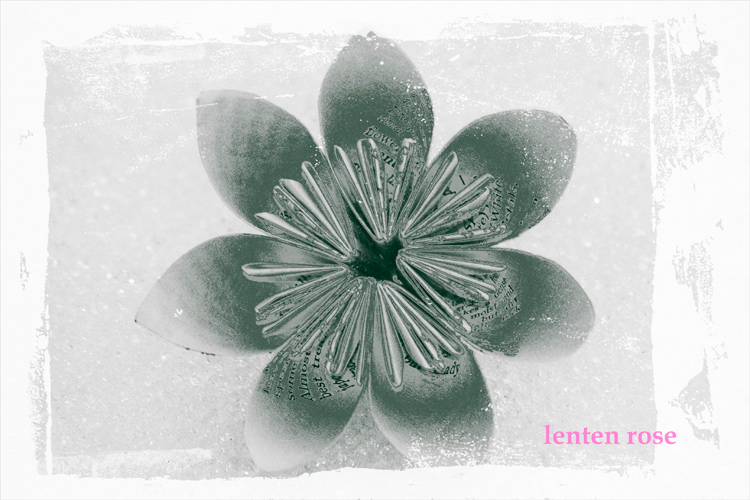
Lenten Rose
Click on image to see a larger version.
This is a photograph of an origami flower made from an old gardening book. The flower was a gift; I don’t know who made it. But I’m grateful for the opportunity to participate in a chain of translation: from idea to paper, paper to form and form to a solarised photograph.
*
Hill’s Vest-Pocket Flemish-English/English-Flemish Dictionary
Published, London 1917
A spent volume,
bound in frayed vermilion.
Left behind on bare boards.
Inside, on a flyleaf:
The Briton Abroad Series,
Indispensable to every traveller.
I thumb what must have been
Great Uncle John’s lexicon.
Eye picking out an alphabet
that lips can barely form:
Aanbruisen, to rush on, to foam
Bemind, beloved
Cipres, m. Cypress
Dampig, vapourous,
Eeheid, f. unit, unity
Flikken, to patch, to mend
Geklep, n. tolling, peel (of bells)
Hunkeren, to long for
Insmeren, to grease
Kankerbloem, f. wild poppy
Leeuwerik, m. lark
Maan, f. moon
Nok, f. ridge,
Opwekken, to rouse
Pel, f. shell
Raap, f. turnip
Snipperkoek, m. gingerbread with orange peel
Toon, m. tune, tone, voice
Uur, n. hour
Vlasbaard, m. (fig.) beardless boy
Wapenstilstand, m. truce, armistice
Zaad, n. seed
Anna Dickie lives near Edinburgh in Scotland. She started writing poetry in her late forties and has been placed in a number of competitions. Born in West Africa and educated in Scotland, she is married with one university-aged son. Anna has had two pamphlets published, Peeling Onion and Heart Notes, published in 2008 by Calder Wood Press.
In 2009 she co-edited the Economy issue of qarrtsiluni. She performs with two other Scottish women poets in a group called Poetrio.
Max Ernst
by Marie-Claire Bancquart, from Avec la mort quartier d’orange entre les dents
translated by Wendeline A. Hardenberg
Du papier émeri, laissé brut et coupé de fentes.
Le peintre
a mis dedans
en cage
des oiseaux.
Il les a mis en cale
en décalage
sur la toile
les a engeôlés.
Les oiseaux réussissent à glisser quelques plumes multicolores à
travers les barreaux,
ils implorent, ils forcent.
C’est un carré de quatre centimètres sur quatre, dans la grande toile peinte en
couleur aurore.
Mais on ne voit que ce devant de cage, aux reflets coruscants.
*
A bit of emery paper, left rough and cracking.
The painter
has placed inside,
caged,
some birds.
He has put them in the hold
out of step
on the canvas
jailed them.
The birds manage to slip a few multicolored feathers
between the bars,
they beseech, they break out.
It’s a four centimeter square, within the large canvas painted in
rosy gold.
But you see only the front of this cage, and its coruscating sheen.
Marie-Claire Bancquart (b. 1932) is a prolific and prize-winning French poet, novelist, essayist, and critic, as well as a Professor Emeritus of French literature at the Sorbonne (Université de Paris-IV). Her most recent book of poems, Explorer l’incertain, was published by Amourier in 2010.
Wendeline A. Hardenberg received a dual Masters degree in Comparative Literature and Library Science as well as a Certificate of Literary Translation from Indiana University Bloomington. She is currently pursuing a dual career as a librarian and a translator. Some of her translations of Marie-Claire Bancquart’s poetry have previously appeared in Ezra: An Online Journal of Literary Translation [PDF] and Ozone Park Journal, and are forthcoming in The Dirty Goat.
 qarrtsiluni