Archive
The Man Who Spoke the Law
by James Brush
Old folks will tell you there was a time when there was no poetry. Not around here anyway. Maybe back east or some place where time was more available, but breaking this land took all a man had and didn’t leave anything for him at the end. Certainly, no time for pretty words.
Some will even tell you that there was laws against it, but I don’t hold with that story. Still, I had this idea for a poem, back in ’08 or so and I didn’t want to run afoul the sheriff so I figured I needed to have a looksee to find out if there was any laws about poetry one way or the other.
I won’t tell you all my adventures because there were too many and most of them weren’t really worth the telling, but I saw a fair bit of Dallas and Houston and even El Paso on one occasion I’d just as soon forget.
It was in Austin, down in the fluorescent-lit subcommittee caverns beneath the capitol building, where I found my answers. I’d been walking around admiring all that pink granite and the grounds with all the fat squirrels and pigeons and lobbyists and all when I met an old guy mopping the floors after all the senators had left. He’s the one who told me these poems I’m about to share.
He said he found them. Now, I don’t usually go in for poems people say they found, but these two I’m about to relate are the closest I ever come to finding any kind of answer. I guess you could say they were found twice.
He told me, the Texas State Legislature said, “Let There Be Poetry.”
He told me it was all written down in a big old leather-bound book like the ones you might of seen witches reading their spells from in the movies. It was called Texas Administrative Code,
and if you turned those musty old pages over to
Title 19, Part II, Subchapter C §110.31. English Language Arts and Reading, English I (One Credit), Beginning with School Year 2009-2010. (b) Knowledge and skills. (3) Reading/Comprehension of Literary Text/
you’d find it.
He closed his eyes and started reciting in a low whisper. He said it was
Poetry.
Students understand,
make inferences
draw conclusions
about the structure
& elements of poetry,
provide evidence from text
to support their understanding.
students are expected to analyze
the effects
of diction
and imagery
(
controlling images,
figurative language,
understatement,
overstatement,
irony,
paradox
)
in poetry.
He stopped saying his poem, and I stood there taking it all in for a long time. I could hear footsteps echoing through those marble corridors like the sound of generations of people coming up from their final resting places just to hear what this janitor was saying, but those footsteps were just regular folks going about their evening, leaving work, unaware that there was some poetry right there in the middle of all that law.
I told him it sounded like that about covered reading poems, but what about writing them. He nodded and told me all those powerful senators and legislators thought of that too and so he shared another one he found, but it was under some different subsections and letters and what have you.
This one was shorter, kind of like one of those Japanese poems that never got a title and tells you a lot without using very many words so you have a lot of things to think about and maybe don’t know exactly what the writer meant.
write a poem
using a variety of
poetic techniques
and a variety
of poetic forms
He let it sink in a moment or two and smiled and kind of leaned on his mop a little and told me he might of left some parts out, some commas and conjunctions and parentheticals and whatnot.
I don’t know. And I don’t know if those were any good or not either, but it sounded something like what I might be looking for.
The next morning, I headed back toward home and didn’t stop until I got there.
Download the podcast
James Brush (blog) is a writer and teacher living in Austin, Texas with his wife, cat and two greyhounds. He teaches English in a juvenile correctional facility, and was once a James Michener Fellow at the Texas Center for Writers. He published his first novel, A Place Without a Postcard, in 2003. His poems have been published by Thirteen Myna Birds, ouroboros review, Bolts of Silk, Postal Poetry and a handful of stones. His essays have been published in The Journal of Pediatric Oncology Nursing and Good Gosh Almighty!
Yoga Center Wall
by Steve Wing
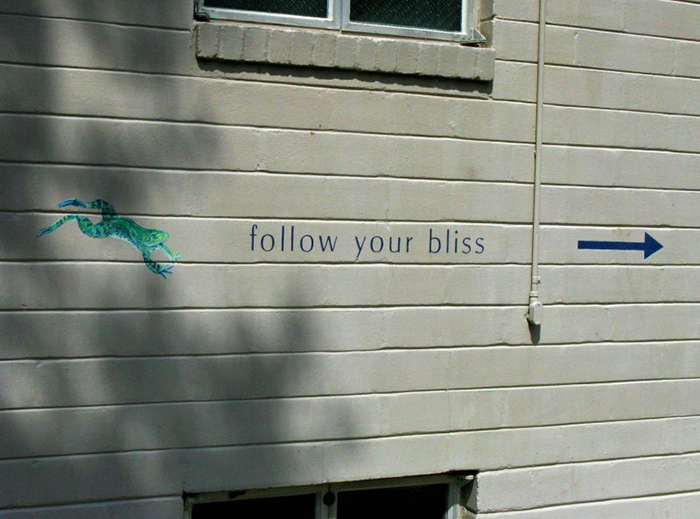
Click on image to see a larger version.
Steve Wing (PBase gallery) is a visual artist and writer whose work reflects his appreciation for the extraordinary in ordinary days and places. He lives in Florida, where he takes dawn photos on his way to work in an academic institution. He’s a regular contributor to qarrtsiluni, as well as to BluePrintReview, where he has a bio page with links to some of his other publications.
Going Out to Buy Shoes
It was around that time that my wife’s
father decided to run for office, mayor
of heaven, I think it was. He campaigned
from his chair as I wheeled him around
the mall. It was extraordinary. The shoppers
had never seen such friendliness. He made
everyone smile whether they wanted to or not.
Imagine an antic child, who fathoms
what no child can, our covetousness and cruelty,
because it’s his. “Smile,” he shouted
to everyone, waving his bony hands,
as we passed the corner of Butterfly
and Butterfly. “You may not get
another chance.” Later on, he asked me
for a riding crop so he could switch
the uncompliant ones. It takes a certain
meanness, I admit, to wring love from thieves
and liars. Sure, he knows. But it was love,
not pity, in their eyes he said, and that
was good. “If I’d had an education,
I’d be dangerous,” he added, about himself,
work done, chewing a cheese sandwich
with his one tooth.
*
Richard Nester is a former fellow of the Fine Arts Work Center in Provincetown, and has published in a number of locations including Ploughshares, Seneca Review, Sycamore Review, and Tikkun.
From Genesis Rabbah
by James Toupin
Across the centuries,
you hear the Catskills cadence —
Thus Rab Ezekiel,
as his son, Rabbi Judah,
recounted: “Why shall we bless
the name of God for giving
us each drop of rain?”
One. Two. Three.
Four. The pause that strums
the crowd. “Because it could
be coming down in sheets.”
Of course, rabbinic texts
do not record a rim shot,
and maybe the son forgot
his father’s way with a set-up
(sons can have tin ears),
yet like a great joke straddling
the ambiguities
the sage’s punch line sits
poised between two stools,
the one a blasphemy,
giving thanks for the absence
of God as Father of Floods,
the other sublime madness,
attempting a prayer
for each drop as it falls.
And of what would the prayer
consist? “Blessed art thou,
O Lord our God, Ruler
of the Universe,
who laughs, just this once, with us.”
James Toupin is a government lawyer who lives in Washington. He writes, “Maybe because, as your call for submissions points out, legal instruments are by definition words of power, your theme treads on ground my poetry seems to go over and over. However, it ventures onto that ground mostly in a religious vein, reflecting a mixed Jewish and Christian heritage.”
Grandmother Praying
by Oriana
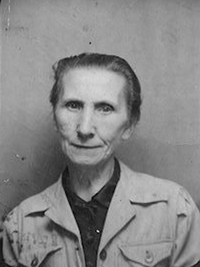
Veronika, first i.d. photo (1945) after Auschwitz
Saint Anthony
Pincushions, hairnets,
a mischievous spool of thread;
thimbles wobble in uneven hoops,
needles enter the veins of things.
We rummage through drawers
reeking of decayed Soir de Paris
cologne and valerian drops;
the slipper-hedged dusk under the bed.
There remains the invisible world.
We kneel on the creaking floor
before the painting of a smiling monk,
a lily like a magic wand
tilting from his hand.
With a practiced zigzag,
we cross ourselves: Saint Anthony,
guide us to Grandmother’s thimble
Again we scan
the summits of wardrobes,
horizons of floors;
the precipice behind the couch,
gritty crevasses of chairs.
She gives up at last:
The devil must have
covered it with his tail.
God’s Hearing
One evening in Auschwitz
the women in her barracks began to pray.
Their prayer grows and grows,
a chant, a moan, a howl —
it carries far into the searchlight-blinded,
electric wire-razored night.
The Kapo rushes in, shouting, Not
so loud! God is not hard of hearing!
And my grandmother laughs.
Then she starts an old hymn:
Many have fallen
in the sleep of death,
but we have still awakened
to praise Thee,
she sings to the God of Auschwitz.
Her voice does not quiver.
Oriana leads a double, sometimes a triple life by the sea, the cold Pacific Ocean near San Diego.
Learning to Curse
Regaining breath, he
undoubles slowly
his back to the schoolyard’s
chainlink fence, too
surprised to swear.
His enemy’s grinned
with the cruel fear
of boys and skimmed
off with his pals
down alleyways
their crowing still
lodged in his gut—
slurs he could not refute
with his fists. Half-crawls
to the spot by the tetherball
pole where they collect
at recess and retches
up his humiliation,
wipes his hot face
with his damp wrist,
heads home with
each breath new
in his raw
throat, muttering
shit shit shit
to the five o’clock
suburban sidewalk.
Ann E. Michael (website) is a poet, essayist, librettist and educator who lives in Eastern Pennsylvania. She holds an MFA in creative writing from Goddard College and is a rostered Artist-in-Education with the Pennsylvania Council on the Arts. Her writing has appeared in numerous literary journals and in newspapers, family magazines, poetry anthologies, educational and academic publications as well as on radio. Her chapbooks of poems include More than Shelter (Spire Press), The Minor Fauna (Finishing Line Press), and Small Things Rise and Go (FootHills Publishing).
The New Dogma
by C. Albert
Thou shalt not beg,
bite, bark incessantly
nor steal biscuits.
Before the Dog Prophecies
there was only ignorance
and fleas.
Follow the righteous
path to the dog park.
Sit and stay,
Roll over,
Do not eat grass.
Praise ye the one Dog
who smites evil
with thy paws,
who giveth bones
to the hungry—
Hallelujah!
by C. Albert
Download the podcast
(reading/howling by C. Albert with Matthew Casey)
C. Albert lives in Seattle, Washington where she divides creative time between making collage and writing poetry. Publications of her works are upcoming this Fall in Shakespeare’s Monkey Review, Tattoo Highway, and Pirene’s Fountain. Find more of her work at Runaway Moon and Aerial Dreams.
book of spells
by andrew topel

Click image to see a larger version.
Andrew Topel, standing at 5 feet 11 inches, could indeed be considered short. More of his “solo and collaborative visualanguage and wreyeting” may be found at vviissiioonnss.
The Smiling Beaks of Bluebirds
by Christi Krug
The packing list said sunscreen, sleeping bag, trail mix. I would tame the wild woods with flashlight and wool socks. But the word swimming suit choked my mind with unknown waters.
I’d been living with Grandma since fall, and nobody seemed to know how long it would last. We didn’t discuss Mother’s illness, only that she was “sick,” and “in the hospital.” But it was the most frightening hospital I’d ever seen, where a teenage girl with a crewcut sat hollow-eyed in a TV room, and an old lady shuffled back and forth holding a doll, and a bearded man with a greasy T-shirt talked to a plant.
Not to mention Mother, dressed in a bathrobe, moving slow as if she were drowning. Speaking in a flat, faraway voice, with eyes that looked in your direction but didn’t see. There was a breadcrumb in the corner of her lips.
Now it was summer. No talk about fall, past or future. “You’re going to camp,” said Grandma. The only words I had were mysterious, in Helvetica typeface, next to tidy checkboxes.
Pillow, I read. Out loud I said, “Camera.”
“You can borrow my Instamatic,” said Grandma. She frowned and tapped a pen against her lips.
I looked at that one word again. It reminded me that I could not swim. It told me I might drown.
“It’s only for a month,” Grandma added. “A whole month! You’ll have So. Much. Fun.”
The last word on the list was stationery. Grandma wrote letters every week on her Smith-Corona typewriter. Letters were what you did when you couldn’t do anything else. When home couldn’t hold the right people, at the right time.
I stood in the parking lot, sun gleaming off the gravel. Grandma gave me a peck on the cheek and handed me a package just as I was about to board the bus. It was a see-through box tied with blue ribbon: stationery topped with bluebirds. Their beaks smiled grandly.
Two hours later, the Hidden Valley Camp bus turned out into wide, green fields bordered by forest.
Two days later, I knew the names of everyone in my tent, and what they got in the mail. Stacy got a care package of chocolate chip cookies. Jenny got a troll doll. Terri got a very small pillow with white daisies. I got a letter from Mother.
The return address was Western State Psychiatric Hospital. On the stamped letterhead, Mother’s penciled handwriting sagged like a sprung spiderweb. She wrote, I forget if it’s two or three sentences to a paragraph.
When I was five, I used to lean against the window and cry whenever Mother left. Now I crumpled her letter in my hands.
***
“Canoe time,” Counselor said, some days after. Stacy and Jenny cheered. Terri said, “All riiight!” I shivered at the water’s edge.
I don’t know how I made it into the boat, fat in my orange life jacket. Then I dipped my oar in the blue-green lake of shadows and it was easy. Like sticking fingers into frosting and pulling away a smooth, silky hunk. It was like mirror writing, the way you paddled opposite how you wanted to move.
After, I sat on the dock with my tentmates, dabbling toes in the ripples. The warm wood scratched my thighs.
“I saw ‘The Omen’ before camp,” said Stacy. “It’s rated ‘R’ but my Dad takes me to any movie I want. It scared the hell out of me.”
“Yeah?” said Jenny.
“In ‘The Omen,’ there’s this kid, Damien. His parents don’t know where he comes from. He’s a child of Satan.”
And with three words, the terror was back. Child of Satan told me everything I needed to know. The water wouldn’t kill me. Neither would it kill me to have a mother in the mental hospital. But this was the ultimate terror, and the reason I felt different from the other kids: I was a child of Satan.
The truth of it was a shadow, thick and empty, filling my stomach. I fed on it at night in my sleeping bag, the trees whispering about the canvas tent walls. It exhausted me at craft time. Child of Satan. It yanked me from the inside and outside, stretching me until I was thin and see-through like the taffy we pulled at Group Activity.
Three weeks, those words threaded through my mind.
Then, one day in the woods, I forgot to think them.
Our hike leader led us high along the forest trail. At last she said, “Okay, guys. Lean your heads back. Look up to the highest branches. Squinch your eyes. Can you see how different everything looks?”
There was a shine that wiggled in the treetops, like soap bubble liquid stretched over a plastic hoop. The light was changing, things were shimmering. Walking back to camp, I saw a trail mix of leaves and mushrooms, frosted ponds, sugar-daddy creeks. Old trees offered friendly, knobby hands. The creek was not afraid to sing.
That night, Jenny, Stacy, Terri and I held flashlights to our chins, laughing as our faces glowed molten red, changing from human to alien. I took out my packet of bluebird stationery.
Dear Mom,
I was very happy to hear from you! I’m going to tell you a little about this camp. There are many different things to do. There is Archery, Rifelery, Hikes, Riding horses, special events, sailing, canoeing, swimming, sports, overnights. Its hard to think of everything… Camp fires. Every person has to do something around the tent. One day you might be the sweeper. Another day you might be the Person that puts up the Tent flaps. Everything is fun. Hope your glad to hear from me! Love ya!!
Love, Christy
P.S. I’m beginning to miss everyone a little.
When camp was over, Grandma met the camp bus, tapping my shoulder with her driving glove, ready to hit the road. A month later, she would put me in a foster home.
For years, Mother would save my letter, shuttling the bluebird pages from drawer to suitcase, from dresser to shoebox, in the halfway houses and care facilities where she spent her life. Home would never again mean having her with me.
I stopped crumpling Mother’s letters when they came. I answered them, putting down my thoughts — even when they were bright and flighty and fake as bluebirds that smiled. In this way, I learned to make my own magic words.
Christi Krug’s work has appeared in Umbrella, VoiceCatcher, Defenestration, Halfway Down the Stairs, Colored Chalk, The Absent Willow Review and previously in qarrtsiluni. She coaches beginning writers and blogs about the writing life at christikrug.blogspot.com.
Incantations Over Alloys
by Kaz Sussman
for the carburetor gladiator
O spirit of alloys, valves and kin
I sacrifice to you my knuckle skin.
O floating butterfly choke and rotor
get the juice to the damn motor.
O spirit of alloys, valves and kin
I sacrifice to you my knuckle skin.
Spark, fire and suck up fuel,
grant me luck and work now tool.
O spirit of alloys, valves and kin
I sacrifice to you my knuckle skin.
Choke it out easy, bleed out the glitch,
work now tool, you son of a bitch!
Kaz Sussman is a carpenter by trade, an anarchist by nature, and an expatriate New Yorker by circumstance. He got into poetry (just like everyone else) because he knows that’s where the big bucks are. He now lives in a home he built in Oregon from recycled rejection letters. His work as a writer and artist has seen some regional success, including From Here We Speak: an Anthology of Oregon Poetry. His work is upcoming in Dance Macabre.
 qarrtsiluni