Archive
Him or Me
Poetry Conversations, Part 3 of 4
I realize now that it was a big mistake
to purchase a Zebra sight unseen.
More caution was necessary,
and I’d been foolish to make such
a large transaction on the internet
with a company that I didn’t even know.
The animal was delivered in a large crate
that could only be opened with a crowbar,
giving the delivery vehicle plenty of time
to get away, as I didn’t have a crowbar
handy at the time of the delivery.
When I finally got the crate open after
a half hour of banging and swearing,
I immediately realized that the so-called
“zebra” was in fact a horse that had been
painted to look like a zebra.
Poorly painted, I might add,
as there was paint slopped everywhere,
some of which wasn’t even completely dry.
Not that it wasn’t a very nice horse,
probably a thoroughbred from the
look of him. Worth more than I had
paid perhaps, but I didn’t want a horse,
I wanted a Zebra. That was what I
had ordered. Referring to the internet
receipt, I called the customer service number
and instead of unhelpful call center workers
got an adult chat hotline. Surprisingly,
they were of no help either, even after I explained
the whole situation to them.
Disappointed, I went back outside
and found the horse eating all of my flowers.
He’d already made a huge mess in my driveway
and kicked in the driver’s side window of
my car. He had quite a temper, which was
understandable because he was likely upset
about having been painted to look like a zebra,
when he was obviously a horse.
We’d both been deceived, that was for sure,
although I still don’t know who was worse off
for it, him or me.
by Andy Anderson
Music by Andy and Ryan Hoke, Wild Goose Creative
(For process notes, see Part 1.)
I Should Write Soap Operas
My neighbor, well technically she isn’t my neighbor
since she lives on the other side of the building, two floors below,
appeared with a baby a few weeks ago.
I’ve been meaning to tell Paul about the baby
but the daily hum drum of life — work, rest, write —
has blocked my thoughts, but today,
we were walking Daisy and turned a corner
and there she was — baby strapped to chest
with its legs swinging. I think it might be a boy,
but I’m not sure. All the other time I’ve seen it,
it has been covered in a red blanket, which is no help
since red is like yellow when babies are concerned.
Anyway, I’m losing track of my point.
I think the baby is stolen. Paul tells me she is probably babysitting.
I say, She probably stole it. Then add,
But not from another country, as if this legitimizes
my comment. Paul rolls his eyes and tells me she can steal
the baby in one of my poems, but this is not
why I am writing this poem. I’ll admit
I’m the kind of guy who enjoys a giggle
when I hear of someone objecting at a wedding.
I’ll admit I’ve watched Soap Operas since I was eight
and rooted for the villain most of the time.
I adored Vivian and Sami on Days of Our Lives.
My mother threatened to quit taping episodes
when I would cheer for them. You might not know,
Sami stole her baby sister. Well, she stole her half baby sister,
but only she and her cheating mother Marlena
knew about the half part. I’m not saying this is the case
with the mystery baby in my building. I’m only saying
it’s OK not to accept what’s in front of you at face value.
by Genevieve Lyons and Dustin Brookshire
Process notes
Dustin writes:
Genevieve and I like to do a basic poetry workshop writing prompt. We give each other five words. In the case of “I Should Write Soap Operas,” Genevieve gave me five words to use. Once we have our words, we have to write a poem within seven days. (If one of us doesn’t write a poem, the slacker could be subject to a wedgie and/or a smack with a large stick.) Upon finishing a poem with the words, we call each other to do a first read. At this point we do not delve into deep criticism; we keep it simple — i.e. I like where you’re going with the poem, etc. Then, we meet up on day seven to hash it out. We each read our poems and give the other a chance to read the poem quietly. We go through each other’s poem and mark 3 to 5 lines that we believe to be strong and 3 to 5 lines that we believe are weak. We explain why we picked the lines and continue to discuss the poems. After the meeting we work on revising our poems and trade the next version via email, sometimes slipping into a phone conversion, making sure to comment specifically on the revisions made. We keep this up until we each have a “finished” poem.
Fude
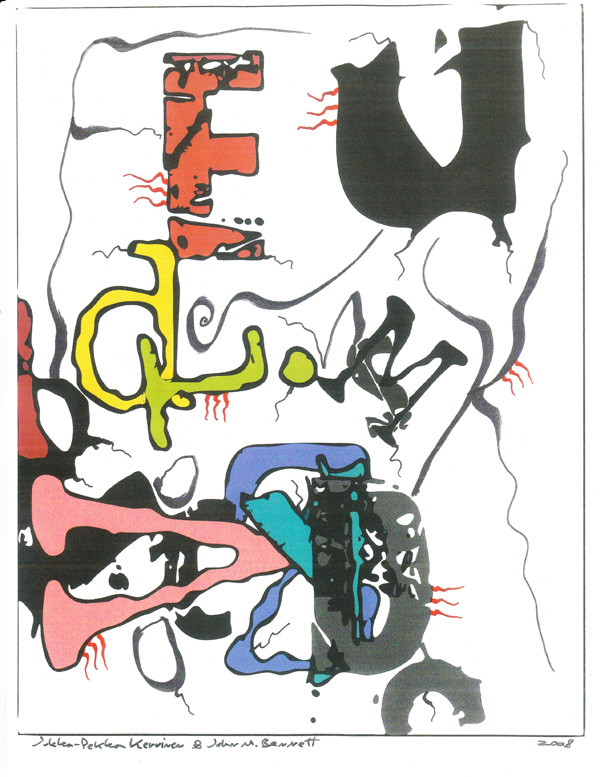
(Click on image to view at a larger size.)
by Jukka-Pekka Kervinen and John M. Bennett
Process notes
John writes:
This and the next one* were done by Jukka emailing me his visuals, which I then printed out and added to. Then I scanned them again.
*To be included later in the issue. —Eds.
Class Action
My galpal bought everything—even her apples—through PayPal.
“I just love the sound of it,” she said. “Some ethereal Pal paying with my money…”
Like that was a favor? I said she was crazy to trust a virtual buddy
and told her that CNN just ran a story about this illegal
tender, that her Pay Pal was really a Pay Foe. Her eyes glinted like coins
in the belt she bought me from ABBA.com, a replica
of their Greatest Hits Gold, the back etched with lyrics from “Mama Mia.”
“Listen,” I said. “You have a problem. Anyone who joins
a club called ‘Rip Us Off’ with annual meetings in tourist traps and airport bars
needs help.” Her eyes glazed. “Ooo,” she squeaked. “I have to check
the status of my potluck entree, Old ElPaso’s Tex Mex
Upside-down Surprise. I hope the cornmeal crust’s not in arrears.”
I told my galpal she needed some fresh mall air, live pushy salespeople, on commission.
“Walk around, press the flesh, you know? Reality, remember?”
She reminded me that last time she left the house she got into a fender bender
with a UPS truck delivering her Amazon.com order. “Poetry or fiction?”
Her iBook blinked a message about unauthorized electronic transfers.
“Gotta go!” she said. “My Prescriptions.com account! My Prozac!”
Like it or not, she was part of a class action lawsuit with Germany, Greece, Finland, Denmark—
the whole damned EEU and part of Asia. PayPal had screwed up, and the bankers
were confiscating the grilled cheese with the Virgin’s face toasted in
when bidding on e-bay reached sixteen grand. “MORAL VALUES”
spelled out in pepperoni on a pizza: that seller was deluged
with offers after the election. “Red in Ohio” posted on
his Seller’s Profile: “What would Jesus pay for shipping and handling?”
“Christ!” I said when my galpal finally called me. “What the hell
are you doing auctioning off your styrofoam wedding bells?
Is your intellectual credit no longer in good standing?”
My galpal huffed—perhaps I’d forgotten about her university.com degree
in Consumer Studies. “You think you have a mandate?
You think you’re the patronizing Patron Saint of Patrons!” It was too late.
“Buh-bye—I’m off to blog,” I said. “At least that’s free.”
by Denise Duhamel and Amy Lemmon
Process notes
Amy writes:
“Class Action” is from a series Denise and I have been working on. The poem has these two constraints: our stanzas are written in abba rhyme, and there must be a mention of Abba, the singing group.
Variations on a Theme
i.
Painter 1: Let me paint over this part.
Painter 2: But that’s my signature.
ii.
Woman: Will you not sit down for just ten minutes? Ten minutes is all I need.
Man: I gave you ten hours yesterday. You know we have run dry.
Woman: I will dig a well deep into your skull.
Man: My brains are dust.
Woman: Then we will excavate the marrow of your bones.
by Tammy Ho Lai-ming and Reid Mitchell
Download the MP3 (reading by Reid)
Process notes
Tammy writes:
“Variations on a Theme” is composed of two very short and quirky sections. They are in fact variations of the same theme: intensive collaboration going sour. The first part features two painters working on a painting together. The second part is more ambiguous on what the man and the woman are collaborating; the explicit sexual language adds a gothic atmosphere to the piece.
For additional process notes, see “Debating Love.”
Fade (Gas Total)
One of ten selections from the unpublished manuscript, Flying Home. (Click on image to see at larger size.)
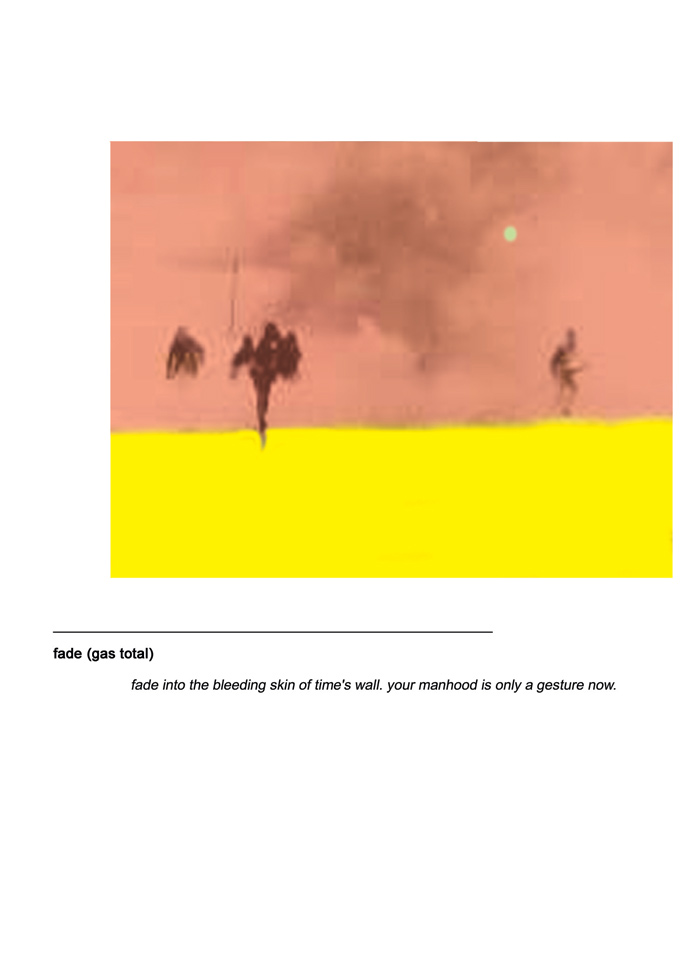
by steve d. dalachinsky and Sig Bang Schmidt
When Dreams Swim With Cities of Men
Pipe dreams, they’re called, leading to nowhere,
steps off a parapet, a leap into the chasm,
that trill in the chest
that pause before one silent lift.
Rushing temples burn a heart,
rush of a city, wind against skin,
a place you had forgotten until now.
Pressed against invisible threads the clouds hiss,
don’t go too high. Scents of pine and laurel rise
from humus beds, sending soft, beguiling
messages of comfort —
an urge to burrow competes
with a cirrus-streaked bowl of sky.
Moisture glistens against panes,
scratching branches etch gaunt wraiths of the past.
They coax you down from the stratosphere
to ring the sentries, shatter glass,
wrestle slights, travel
into a channel riddled with crevices,
a game of blind man’s bluff into depths
charted or unknown.
A contest that wills you to expose roots
lost under melted glaciers,
entwined in the hulls of shipwrecks
where liquid dreams turn on a dime.
Relish worlds deep and salty, blur the line
between breathing underwater and taking flight.
by Deb Scott and Christine Swint
Process Notes
We started this work with a desire to create and collaborate together, but no clear idea of where and how exactly to start. Our intent was always to have fun, and to not worry about the finished project. As long as we were poeming and creating, we didn’t care (too much) what the finished product looked and sounded like. Deb was interested in learning about the video pieces Christine had been doing and that seemed a good jumping-off point. Christine edited some film clips she had and Deb free-wrote for five minutes in response to the images, not knowing what Christine had in mind.
Deb took the free-write, developed a first line and Christine followed. Alternate lines created a 16-line poem, of approximately 16 beats per line, initially broken into 2 stanzas.
Christine took the first revision (with Deb’s heartfelt gratitude) and broke the lines, reshaping the poem into what is presented today. A few minor word changes were made here and there but the language of the poem is nearly identical to where it started from.
We both agreed that one part of the video didn’t fit the poem and so it was cut (with a promise from Christine that it will reappear some time in the future as part of a different work). Deb sent Christine a link to her Flickr page with a number of sky images that Christine could work in if they fit. Then the hardest part (as far as Deb was concerned): did the read poem match the length of the video? Deb recorded the poem in 2 parts and Christine mixed the recording, the images and added background music. (Deb is going to learn how to do this too, she swears.)
Christine and Deb communicated via email and Google documents. They’ve never spoken or met (and both look forward to doing so some time. Maybe AWP 2010).
Watch the completed video here. –Eds.
Which Broke When It Fell
Also a rotation results when you turn,
replacement for what you were.
The sun, dealing with its satellites,
showers them with light and heat
and flares of blinding energy. We can
only observe an eclipse
through a pinhole, although once
I accidentally looked out and saw
the sun behind the moon. The memory
has stayed a blank on my retina for years.
As does my memory of who you were,
once, before the necessary
unfastening of body from self.
*
Energetically intent as through a pinhole
a sphere away. Yet, yes : to bindingly
affix like that at some precise intersection:
arm of the body making “circle” and the self
snowed in wordlessness can’t separate
(even once) tying, trying to tap lightly
on the exposed back wall of memory
and (two) look for a change in the quality
of light say, it was a bell and rang (accidental)
or no, a curvature of devotion came between:
*
The sweep of an arm, things brushed off
into the sphere of the lost. I’d want
to replace the bell, which broke when it fell.
I’d want to memorize the loop
of some bird’s flight, circumnavigate
the mind’s eye, watching. The shape
of a perfect hollow ring, sound that widens
out into space slowly, trailing far
behind the comet’s tail of light.
*
Not to what began the joy ride but bulleted
a taillight when you saw my last comma
stricken from the triptych that’s what I’ll be compared to
on the downshift from the City of Rocks if I fail
to hear the broken ring traceable to the dashed bell
and the loopy birds that rumble before they smooth themselves
and settle in stone enclaves replacements for the whistle
*
or the voice— reeding by riverbend—
which I don’t keep because it melts in the mouth of its spell
what phase is sound in now? period
exists only in time and disintegrates in the interval
where the body vanishes
by K. Alma Peterson and Kathleen Jesme
Download the MP3 (reading by K. Alma Peterson)
For process notes, see “Giver of Givens.”
Black: A Sonnet
A well-fed crow, his caw the clap of gods,
hews darkness from the hand of wilding night,
his feathers glossed in amethyst, at odds
with morning’s eye, for nothing’s left of light.
In solitude he counts the spoils, his mien
both proud and distant; then with taunting grace
he renders bones to relics sharp and keen,
vain offerings as sentinel of place.
He gives himself to sleep, his corvine nest
unhinged by lunar apparitions, black
and thick like dreams he thought he’d put to rest,
tomorrow’s omens in shadow and wrack.
The midnight gods can offer no reprieve
to one who feeds on embers of the eve.
Scott Wiggerman and Andrea L. Watson
For process notes, see “White: A Ghazal.”
silence: a courtyard
I shudder through the bones
of the courtyard
the silence it seeks is a curious sound
how speak a cluster of pines?
how hold such small echoes:
words in two voices a flutter in two
hearts a finch
I fear to touch a whisper
behind my ear
under the blooming cherry
this place a single word
dreamt and wrapped in dormant
seeds, a slice of black earth
I clang the gate shut — the scattered clouds
look me straight in the eye
push me about because they can.
by Rob Taylor and Daniela Elza
Process Notes
Rob:
Our collaboration was preceded by a bit of creative borrowing on both our parts. Having only met once at a local reading, I became enamored with the form Daniela was employing in her work, the triptych: three vertical columns of words that read both horizontally (across the columns, left to right, like a traditional poem) and vertically (down each of the three columns). These triptychs were, in fact, four poems in one, and I was very interested in trying my hand at one (four?). I was especially interested in using blank spaces in the columns to emphasize silences — to see how hollow parts of the poem became when a single word from a single column was removed. I wrote a poem entitled “We speak of silence, not in breath,” which focused on the theme of silence and included the sudden interruption of a quiet scene by a bird.
I sent my poem to Daniela, quite unsure if she would either be upset that I was moving in on her form, or dismissive because I didn’t really get what the triptych was all about. Instead she was enthusiastic, so much so that when I sent her a note about qarrtsiluni’s collaborative writing issue, she quickly responded with a revised version of my poem — and we were off!
Daniela:
I sprinkled in nature images, Rob kneaded the emotions in. At first we had a bit of a hiccup. We took too much out. I went back and dragged some of the stuff back in. There were dormant moments between. There were questions: what makes a good poem? I feared about the process at times because I had never done this with someone I practically did not know. I did not want it to fail. All along I cherished the fearless meeting of minds.
Rob:
I was nervous about adding to the poem after the initial creative moment. When I edit I am almost always paring away at the poem, but if that’s all both peole do in a collaborative exercise then pretty soon you have nothing to work with. My excitement was in seeing the poem go places I know I would never have taken it — rarely does a cherry blossom spontaneously appear in the middle of one of my poems, or a line like “how speak a cluster of pines,” a question I’ve asked to myself many times without finding a way to put it on paper.
Daniela:
All the while the poem was molding and shaping itself, and was saying, “Hey, guys, cut it out with these process notes. What about me? Over here? This is about me, after all, not about these notes you keep processing.” We thought in the beginning the poem was about a single word. But at the end it seemed to be about so much more.
 qarrtsiluni