Archive
He’s Created What I Have in Mind
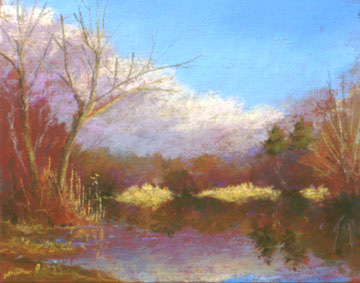
(Jeff Eff’s Lily Pond Transit)
He declares hidden sets for me, pastel passage, same seat I have sat,
though different set of eyes, wondering where the spring, summer
and winter’s at. The hidden fires of fall have declined, flame without
smoke, though fire’s heart was born in stem, stalk and sprig in spring;
fall leaf and limb all flame, so cindered. Summer brazier on sunlit girl,
a sylph from diving board, who October wears a soft yellow sweater,
a skirt to match, who when the fire’s lit, thinks the fall’s the end of it.
Not sparks we hit, old ice houses in sheets of flame, wild sparks due
a mile away, heat enough for spring. Oh, yes, that’s it. Back to spring.
He thinks perhaps I see canoes slipping off pickerel-like from LeHavre
or New London’s watered pit, or a skater’s pond-wide whitened trail
on year’s first ice, twice black thunder leaping up the shore, and more,
the core of unheard music from olden noisy Odin’s Valkyrie with baton
underfoot, a blade honed by youth got on. Younger you and your crew
have followed arcs and marks leave visible the volts of thundering bolts.
Oh, Lily Pond’s never the same, takes aim for becoming done and gone
in seasonal’s phenomenon. Yet Jeff tells me what it is, how he recollects
his past from where he paints beside the pond, and mine, for all of that.
Painting by Jeff Fioravanti; poem and reading by Tom Sheehan
Process notes
Tom: I’ve been thinking of collaborating. Take a peek at Qarrtsiluni. Perhaps a Lily Pond scene, our first common ground, might realize something nice.
Jeff: Let me see what I can develop. We’re on a short porch, submissions due by January 15th. Something of Lily Pond would be interesting. Let me see what comes.
Tom: I’ll keep a log of messages to support the effort, a piece of the submission. There’s free rein on the type of art. I wasn’t thinking of drawing you away from your work, but thought a pass at some graphic image or painting would do. It would take both sides of the coin to get what might be acceptable.
Jeff: I went to the pond yesterday, walking in from Central Street along the river, to get some reference material. Will continue to search and see what develops.
Tom: Much of what I remember is in the attached, “Diamond-faced Lily Pond.” When you have some time, take a look at it. Perhaps it’ll touch something in you.
Jeff: We share the same sentiments. Yesterday, as I walked past the river and the bridge no longer there, I remembered walking the woods to Billy Mitchell’s house or listening to highway traffic or staring at a winter evening’s sky. I tried to imagine my mother’s stories. The striking one is the Prentice boys saving her after a fall through the ice. I remember playing army with other kids, walking through after a football game, much later hiking to Martignetti Liquors and sharing a brew under the summer sky. I’ve watched the pond shrink and yet remain a treasure. Now I search for the right image for those thoughts.
Tom: (Saw Jeff’s pastel painting today, Lily Pond in fall colors, from below John Burns’s house. He will send me a pix. Lovely.)
Jeff: I shoot all my artwork with slide film, liking the way it captures images. Some background here: the painting was done in “en plein air” and is a pastel painting on watercolor board, toned to burnt sienna, of the area by the swing sets. I removed the houses in the background, trying for an original look. Rolling clouds were a challenge, occasionally blotting out the sun, playing havoc with the color scheme. This piece was created during the morning. The submission page doesn’t say what DPI or format the image should be. I’ve made this 300 dpi. The size of the piece is 7×9.
Tom: (Received email with the painting and was transported.)
Jeff: You’ve captured my thoughts, what I tried to catch in my painting, same seat, same scene, different but intertwined. I thought of trodden leaf, faded footsteps, seasons gone by, solitude, visiting old friends, sounds of hockey, plop of fishing lures, rustle of leaves, how we all eventually pass on, but still the seat and the place remain. I thought how you and I share a thread, tied together to this place. I thought of loneliness sitting there, like leaves lost from the trees. I think in many ways you’ve captured what I tried to capture. Different memories, different dreams, same place. I sit here grinning warmly, satisfied.
Winding
If you can’t see the video, you need to download Flash.
The river gave no sign
of where she might have drifted.
It carried the sky and trees like roots.
Leaves traced hieroglyphics
along the snaking spine of a gravel path
that led to the road. Cars passed
in transit, unwilling to stop
for a vine-draped shadow glimpsed
at the edge of light.
Arney’s girl was seen
near the rubble at the old quarry,
pale limbs twined with weeds,
curls of ivy on crumbling stone.
A fusion of need and air,
we reached for her like
drowning victims emerging
wild to claw the sun.
When the search parties stopped,
the land was changed.
We returned to the river,
its flux her blood.
by Jo Hemmant, Michelle McGrane and Christine Swint
Process notes
We started with a raw video of clips Christine shot while running errands in her town. After Michelle and Jo viewed the video, Michelle suggested a theme of ‘disappearance,’ and came up with a rough outline for a narrative that we all liked. There were a few images and scenes that Jo felt didn’t quite go with our intended poem, which we later deleted. We didn’t know how the lines would turn out, but we did have an idea of where we were going from the start.
Writing line by line, we alternated between the three of us via Facebook, a convenient option since Jo lives in England, Michelle is in South Africa, and Christine is in the US. At times we disclosed what was in our minds as we wrote — this particular aspect of our collaboration is important, because we did not write blindly. The poem is more a result of a merging of minds rather than a serendipitous creation.
Whoever said “three’s a crowd” never collaborated on a poem. Although having three different poets weighing in on each word was at times unwieldy, we came to an agreement about the success of each line fairly quickly.
After brainstorming for titles and reaching a consensus about closing the poem, we recorded the voice, and completed the video.
(Watch more qarrtsiluni videos here. —Eds.)
Found Photo
When you live with something long enough I guess you get used to the odor and then it’s no odor at all, it’s part of the room, maybe it’s just a dead mouse behind the wall and there’s nothing to be done unless you want to take a hammer to the wall one hot, grey afternoon when it feels like ants are crawling up and down your legs, getting right into your underpants.
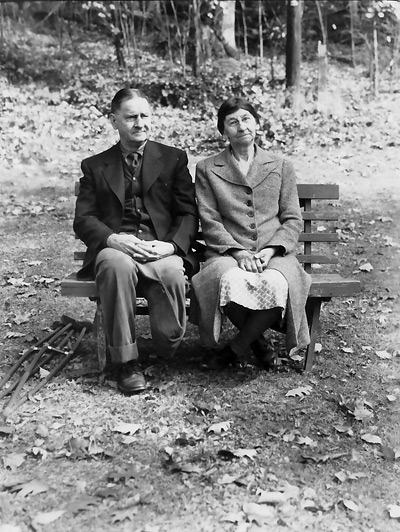
So here we are, all dressed up and left all alone in the shaking woods. Why did they leave us out here like this, all alone? Drive away in that brand new automobile we helped them to buy? Sure, Pop’s lost a bit of his left leg, the diabetes chewed his foot right up to the shinbone, but that’s no reason to throw us out here without so much as a drink of water. A smell, sure, but not a stink. And weren’t they the ones always pushing sugary things at him anyway? He never was one to say no.
When you live with something long enough it’s really no odor at all.
We knew it had to come off when even the dogs wouldn’t go near him.
Thinking helps to pass the time.
He never did talk much, and it’s especially hard to be sitting here on a bench in the absolute dead center of nowhere with a one and a half-legged man who won’t say a word. Thank the Lord they didn’t drive off with the crutches.
When you live with something long enough I guess you get used to it.
So here we are, left alone in the woods by our own children, and not a soul to help us, and not a drop to drink. My mouth must look like a flattened mattress by now. Or an old and faded photograph.
It’s all part of life, I guess. You bring them into this world, you do your best to make a life for them, and then they have to up and leave you one day, go off on their own. I just never thought it would be like this! It’s like there’s a dead mouse behind the wall and there’s nothing to be done unless you want to take a hammer to the wall one hot, grey afternoon when it feels like ants are crawling up and down your legs, getting right into your underpants, out in the woods, all alone, thinking to pass the time, sitting on a bench with a one and a half-legged man who won’t say a word.
An old and faded photograph has an odor, but not a stench.
by Peter Cherches and Holly Anderson
Process notes
They had collaborated once before, about eighteen years earlier, but the piece they wrote then was published for the first time only recently. That publication led to an invitation to submit to the present collection. They agreed that it would be nice to work together again, and they started tossing ideas back and forth via email. Time constraints wouldn’t allow the two of them to get together in a room and compose a piece from scratch through give and take, as they had done before. They’d have to work differently this time. One of them suggested that they each write independent sections of a prose piece, or intertwined sentences, with different typefaces to differentiate the two voices (though they would not identify which typeface matched which contributor). The other wasn’t happy with that idea, didn’t want the individual contributions to be so clearly delineated. This one suggested a process whereby each would submit a piece to the other, a piece the first writer felt was unfinished, perhaps, or just not up to snuff, and the second would work with it: edit it, change it, complete it, rewrite it, whatever seemed appropriate, whatever seemed in order. The version completed by the second writer would be the final version. The writer who started the piece would have no veto power and no rights to further edit or rework it. The writer who suggested this method saw this as an exercise in trust. Two writers with different but compatible voices and visions would have their way with each other’s pieces. They would not reveal which of them started which piece. The other writer was skeptical at first, felt that their individual voices would be flattened or neutralized by the process. But the writer who suggested this method didn’t see it that way at all. This writer believed that the process could unleash a compelling third (or third and fourth) voice, a product of the two. The other ultimately agreed to this approach. The two writers submitted old, long-abandoned (or shunted aside) pieces to each other, and they went to work. Two pieces, by two writers. (Look for the second piece to appear later in this issue. —Eds.)
Giver of Givens
No longer am I drawn to speak in simple diagrams
as my father’s notebooks travel with me to the endpoints
of a tangle he labeled every operation and eased
with friendly question every knot pretty much
in line with the finish which appears to travel westward
to the wilds of theory where phrases like rotations are simply turns
last modified momentarily by brilliant sun on new snow:
he said years of flying in the far north
gave him a touch of snowblindness
and something else he kept back
as he traveled westward in his small plane
through the wilds and toward evening.
by K. Alma Peterson and Kathleen Jesme
Download the MP3 (reading by K. Alma Peterson)
Process notes
We decided to try this collaboration because we are both sound-oriented poets, and we wanted to try a dialog in which we listened to each other and let the sound lead us. We each started a thread, and responded to each other’s additions on a daily basis, each adding a new thread each day. Eventually, we were responding to six threads every day. We kept this going for two weeks. It was a madhouse! There was no time to evaluate what we were writing — the idea was to push ourselves to produce a large body of material. Then we got together and read everything, and picked out threads and sequences we liked. We did more work on them, mostly editing, and arrived at the three collaborative poetic dialogs that we are submitting to Qarrtsiluni. (Look for the other two dialogs in the coming weeks. —Eds.)
Dear Seven: A Circle of Epistles (1)
Part 1 in a series of 7
Dear Mike,
a man walks into a bar and finds a good view.
How are you?
his words rest heavy on the table.
I feel self-conscious as if I’m thinking this under a bright light.
he wonders how the light found parking on such a dark night.
Right now it’s pouring rain, really pouring, rolling thunder and crashes of lightning which feels out of place for November. I just got back from an appointment with my acupuncturist. While I was on the table I thought about this poem. How awkward it felt until joy broke through and I realized I could use your help lifting heavy things. A man! Between you and me, lately I have been tiring of being a strong woman. Strong like a man and strong like a woman. Chopping wood. Carrying water. Shopping for candles. Working to feed the babies and the wife. She’s starting her own business you know.
he’s been saying this for years.
Thunder and lightning are shaking the house at this moment. The animals are jumpy but I am sitting in the window writing this and enjoying myself very much. Have you ever noticed I have large hands? I prefer to keep them empty but it’s been a struggle these past few months. I want to fill them with air I have brought back from our land in Wisconsin. Did I tell you I am a landowner? Maybe that’s why I crave mud. The color. The smell. The weight. My acupuncturist said it’s understandable why some women want to eat dirt and I wish I had a big plate of it because I can taste the rich earth and I can feel my bones getting stronger. I can feel everything about me lengthening into the ground.
What do men crave?
Sincerely,
cin
by cin salach
Process notes
The authors are, in order: cin salach, Mike Puican, Alice George, Mary Hawley, Cecilia Pinto, Chris Green, and Eileen Favorite. They write:
We — the seven poets whose work will appear here under the title of “Dear Seven: A Circle of Epistles” — have been meeting regularly for two years to challenge ourselves in the writing of forms and various other poetic adventures. Each month a new form or project is proposed; the following month we share our efforts. The resulting work offers us a chance to compare and contrast how we each approach each month’s “assignment.” The creation of “Dear Seven” was a defining moment for the group as we adapted the collaborative surrealist concept of “Exquisite Corpse” to the epistolary form. Over a month, a chain of letters was created, in which each poet only saw the letter they received, and the one they created in response. Then we assembled and read them in order, enjoying the surprising echoes and themes which emerged.
From a 2005 (and on-going) collaboration of poem-sculptures and text-poems
The collaboration between Nick Carbó and Eileen R. Tabios unfolded through snailmail, with each sending a sculpture that generates a poem:
1) Nick sends a sculpture comprised of a toilet regulator painted with the following words:
Can you regulate
The flow of desire
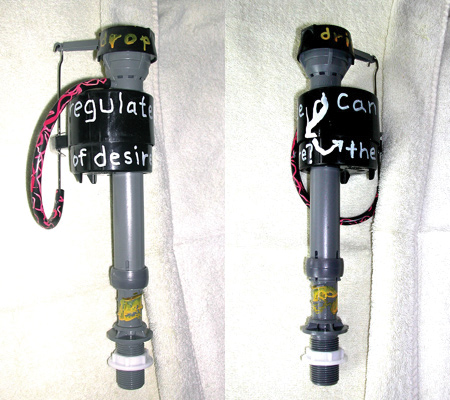
2) Eileen responds by sending a wooden box recycled from once containing wine bottles of Screaming Eagle. The phrase “Screaming Eagle” is emblazoned, along with the image of an eagle in flight, against the box. The box contains long ribbons designed to spill forth when the box is opened. Attached to the side of a box is a toilet’s flusher mechanism. The accompanying poem:
Trap the intangible
to release
Desire most beautiful
when unleashed
3) Nick replies by sending a blue box containing Alka Selzer tablets upon which are incribed letters. When the box is opened, the tablets spell out the following poem:
Take one Saussarian pill 3X daily to induce / Desire
This is how the cerulean curve
of her spine presents pink
ideas at four in the afternoon
where words become
arbitrary trees, cones
intangible blues
This is how the
release feels at the tip
of the tongue when pressed
against his wet
red frenulum slippery
with meaning
4) Eileen responds by sending four stacking boxes, correlated to four stanzas of a poem. Each stanza written on the inside cover of a box. Boxes are colored blue and white. Stacked atop each other with a white ribbon tying them together. All must be unwrapped in order to go through sculpture. Eileen very much wanted to include (the bodies of) the audience (reader/viewer) into the sculpture by having their involvement through the process of unwrapping the boxes.
The first box contains a pearl necklace cellophane-wrapped in its middle so that it’s not possible to wear it. The second box contains an American Red Cross pin referencing breast cancer. The third box contains used ribbons from unwrapped gifts. The fourth box contains a grey sports bra overlaid with a pretty lacey bra.
Inside the fourth box, the stanza is encompassed within a circle, as formed by a “Filipino poet” symbol’s belly (from an earlier project by Eileen Tabios entitled “Poems Form/From The Six Directions“). The bras are “convex with concave.” The accompanying poem:
Untitled
Surely we
Never wish
To stray
From bodies
Those curves
Offering possibilities
For
“the convex with the concave”
by Nick Carbó and Eileen R. Tabios
Vanishing Biography
Buddha smiles because nothing is
static, so why label and hammer
a story on someone’s grave?
There’s always that backdrop
of the next frame
even when it’s empty,
even when filled with Edith Piaf
singing, whose heart stoked every note,
whose voice knew nothing could stop
the locomotive bend of a willow.
Conditions move on —
that’s why mountains don’t grow on clouds
like the human mind does, projecting
motives onto the wind, wanting to know
whether it prefers east or west.
by Greta Aart and Sally Molini
Process notes
Collaboration in any form of artistic endeavour is not exactly about working together. It is more about trust — trusting each partner’s instincts. The phrase “working together,” so often overused, implies a measured and controlled working process. In reality, any collaboration must always fall short of such idealistic harmony before it is truly a collaborative effort. Once an effort involves more than one person, unknown factors arise, and should arise. We like to think that what makes collaboration intriguing is this element of seemingly open-ended obscurity, an inability to know exactly what the other artist or writer is thinking. Precisely because of such uncertainty, an intuitive trust can grow even stronger.
Writing poetry, like any form of writing, is quinessentially a solitary activity. When we collaborated in making a poem, the entire process was a combination of two solitudes. Each of us first began the creation of two unfinished poems; sometimes it was just jotting down some lines or a stanza or two, with the deliberate intention of leaving ample room for the other party’s creativity. Both of us needed to be sensitive towards each other’s line aesthetics, poetic “breath,” imagist modes, as well as preferred word choice and colors. Collaboration was obviously in the back of each of our minds from the start, yet we were in our own solitudes, so there also existed a space that belonged to Sally and to Greta. On “Vanishing Biography,” for instance, Greta wrote it as a compilation of five koan-like verses, each finished and complete. At the same time, she tried to have every image or line open to new narrative or lyrical voices, wrote without thinking of “controlling” each verse, and to a certain degree, did not worry about a fixed context. As we each wrote our two poems, we both realised that there was not much point in wondering how the other would respond to them, unless each of us wanted to control her response, which, of course, was not the point of our collaboration. As it turned out, Sally wove in new, accompanying images or circumstance, so that an additional layer of narrative could thread through the collage. Theme still remains, but there was now a new story, and a different energy. This surprise was exhilarating.
Greta lives in Paris, France, and Sally lives in Omaha, Nebraska, so they corresponded by email. There was some “hazing” of our “signatures” in terms of polishing, cutting, altering and re-writing, but a crucial part of the process, and what made it so meaningful, was realizing the unexpected range and creativity of two imaginations instead of one.
dance

(Click on image to view at larger size.)
by Andrew Topel and Paul Brandt
Process notes
Paul writes:
All I can really say about this collaboration is that I was trying to do my part in this extension of our friendship.
Evolution of the Signature
When I was young I used to sit and write my name over and over.
More often I would trace the names of enemies and their histories.
Their names always seemed much more interesting, more beautiful,
than mine and with only twenty-six letters to play with I forgave them
their fallacies, that my letters were dull, lacking in exotica, that this reflected
something about myself. It was so simple, the act of writing, yet
the repercussions linger. I have scrawled this name thousands of times,
on checks, birthday cards, love letters, and it has taken years for my name
to become my identity, each letter irrevocably mine but also part of something
larger, unnamed, unwieldy, like a forged and forgotten sword
that cuts to the truth: history is composed of letters like mine.
History is proud and permanent, unable to transcend itself
and become more than words on a page. History is the high school jock
who concerns himself only with practical jokes and petite blondes
all his life, and one day finds himself forty years old, still
living in his parents’ basement, no relationship lasting longer
than a six pack or a football game, his purpose lost in the past.
History is like that: devolved from a true story into memory,
sagging and tired, but history allows astute lovers to search out
the foreign. Fingers trace a different alphabet, Cyrillic or Arabic or
Greek, an exchange between two lovers who communicate only by touch;
fingers say the unsayable, run across skin, support the arch
of the spine, dance over the flat perfection between breasts, and the gentle slope
of stomach. I can touch every desire and its corresponding part. Hold me
closer than you think you should. Let me in to the lowest register,
dip your pen below the blue line, deep enough that we know this is real,
but not painful to the point of childhood. I used to sit alone
and write my name, my future unmet but anticipated. If I would have known
that all things come to this, I would not have wasted so much time
tracing patterns that mean nothing. I will keep you and hide letters in pockets.
by Emily May Anderson and Samantha Meyers
Process notes
Emily writes:
Sam and I wrote this poem line-by-line, in American Sentences. It was an interesting experience because we both came in to the project with our own ideas, and writing one line at a time forced each of us to work with the other’s ideas as well as our own. It was frustrating at times because when I would hand her the notebook, I would have no idea where her line would take the poem. By the end, we had worked in ideas from both of us. I did a first revision, and chose not to keep the poem in seventeen syllable lines. She supported that decision, and we then did a second revision together, and realized we both liked where the poem had gone.
Let’s Mess It Up Again

Cover art by Peregrine Honig (watercolor) and Drew Padrutt (design) — click
on image to see a larger version
“Let’s Mess It Up Again,” from Last Callers and Losers, by The King Canutes
It was cold for spring I pulled my coat around me as I walked you to your car
whistling a kiss is just a kiss, well, is that just what they are?
I would kiss you if I thought you thought that I could stand the strain
Do you really want another chance to mess things up again?
I was sleeping when you said hello, I thought it was a dream
about a ghost that I used to know back from the foreign war
Said you’d come to make it up to me, would I make it up to you?
You can smile all you want but it won’t count for yesterday no, no
It’s all right, I’m the same,
it’s all right, just the good remains,
I cried away the shame
Maybe days spent apart have done us good though I never thought they would
but the strings it took me years to untangle now I pull around me like a long lost favorite shirt
I remember staying up all night when your perfume made me drunk
Now, whose idea was it to leave,
I don’t recall (it’s all right)
and I don’t mind, it’s all right,
yeah it’s only time, it’s all right
Have we always known
that this time would come and go?
It was cold for spring I pulled my coat around me as I walked you to your car
Whistling a kiss is just a kiss, well, is that just what they are?
And I never will forget it, it’s like a picture, your face lit up in the neighbor’s headlights
he just sat there as you held me and we leaned against your car
I would kiss you if I thought you thought that I could stand the strain
Do you really want another chance
Let’s mess it up again, let’s mess it up again
and even if the finer things are behind us now,
the brighter days, you know
That it’s all right, I don’t mind,
let’s mess it up again, it’s all right
The King Canutes are: Richard Alwyn Fisher (vocals, acoustic and baritone guitars, writer) and Keir Woods (omnichord, backing vocals), with a shifting cast of other musicians. On this track: Scott Johnson (drums, percussion and slide guitar), Seryn Potter (vocals), Dana Kletter (vocals), Alex Cox (bass), Margaret White (violins), Anna Callner (cello), Jim Bentley (recording and mixing), and Scott Easterday (string arrangement).
Process notes
Richard and Keir had recorded the entire album in 2006, but their digital masters were stolen just before Keir left the States. They have spent the past two years re-creating Last Callers and Losers, with Richard in New York and Keir in Paris. Richard writes:
There were collaborations between Keir Woods and me initially on the arrangements. Scott Easterday did the string arrangements. The cover was a collaboration between Peregrine Honig and the designer Drew Padrutt, after Peregrine and I went back and forth on what it was going to be a picture of. Jim Bentley and I sent versions of mixes back and forth to Keir in Paris trying to get it sorted out to where we were all happy. It’s crazy collaboration all over this record.
We also can’t resist, in this time of interregnum in the U.S., quoting from the album description at CD Baby:
The band takes its name from King Canute, ancient king of England, legendary for failing to halt the onrushing tide. Two apocryphal stories exist for his motivations: One claims his arrogance propelled him to have his throne set up in the surf, where the unyielding waves famously swept him away. Others suggest his true motivation lay in proving to a sycophantic court the limit of a king’s power.
Alwyn and Woods trade in such dichotomies and ambiguities within their songs, where characters struggle with the ramifications of their decisions.
 qarrtsiluni