Archive
While Sitting in Church
by James Brush
Watch at Vimeo – watch at YouTube
James Brush lives in Austin, Texas and teaches English in a juvenile correctional facility. You can find him online at Coyote Mercury, where he keeps a full list of publications.
About the Laying-On of Bricks Not Hands
by Nancy Flynn
Forty years after my bricklayer grandfather died, age sixty,
fatal heart attack during the fabled Ali-Frazier fight,
I am on hands, on knees that seem, at fifty-five,
to have lost all cushion of cartilage. I am cleaning
these bricks, this heart-shaped garden path,
wire-brushing moss—my grandmother’s maiden name—
scraping away mold that may hearken back to 1938,
the year this house was built. I try to fill in the blanks,
measure my measly chinks beside the seeming immutability
of such clinkers, once the ones they threw away.
My hands span wide enough to play an octave, would make it easy
to finger-splay each paver then set it before I’d trowel-slather
and join with lime/sand/water/cement. Crossways header,
meet longways stretcher. Mortared, you could stack
every transgression baked in this life’s kiln of shame.
Oh, these more-than-halfway days—of harpy meets hector,
letting the gray grow, letting the estrogen peter out.
While the wind’s forever missing the top notes, breezing
through sheers as if my house were a sloop in the nautical
church of testify, praise-to-glory the shores of Lake Cayuga,
promised lands even rivers—my Susquehanna home one, too
the mighty Columbia barely a mile or two down the street.
I bike to see it, seek its tiniest poem. Watch the delta turn
birds to slough it, dive for suet in spite of their off-song
chitter and screech. Fleeing, fleeting, omnia mors aequat—
yet again, it’s death that equals all things. Worship,
my altar can only be this spreader-root tilt, more heave.
These thousand imperfect, vitrified bricks I scrub of mud
and burn and still the residue from their ages-ago
firing glazes, stubborn as vine, insistent as rot.
Nancy Flynn (website) hails from the anthracite coal country of northeastern Pennsylvania and somehow, at an early age, fell in love with words instead of into a sinkhole or the then-polluted Susquehanna River. She was involved with all things literary back in the dark ages of high school, writing bad haiku and meandering vers libre that included the words mystical and entwined. Her writing has since received a James Jones First Novel Fellowship and an Oregon Literary Fellowship. Her 2007 poetry chapbook, The Hours of Us, was nominated for an Oregon Book Award; a second chapbook, Eternity a Coal’s Throw, is forthcoming from Burning River in 2012. A former university administrator, she now writes creatively and edits carefully from her sea-green house near lovely Alberta Park in Portland, Oregon.
Beatitude
Blessed be parts of my body I cannot reach in the shower—out of sight, out of mind.
Blessed be aluminum, without it we are all sadder and unadorned.
Blessed be infinity and its children, particles of stretched color and light moving through a pixelated sky.
Blessed, all blessed.
Blessed be the cats moving among cheap office furniture; theirs is the kingdom of smarty.
Blessed be the frangible, for they know not a thing about it, skipping as they do down streets strewn with bottle caps and pizza slices falling from the so blessed sky.
Bless us in the shopping center, cabbages and our carriage with the one stuck wheel.
Bless the electricians, for they shall know pivot and burst. Blessed the lemon cake, the beautiful nerve, the bedspring and the radio voice.
Blessed be emptiness and the severalness of what a day!
Blessed be the office furniture with the fake wood grain: some things come close
and that’s enough.
Blessed be the open window; let the late bees come on in.
Bless the fortuneteller and the barber; for they shall inherit the kingdom of downtown boogie-
woogie.
Blessed be the extended family and the lightning rod and the butter softening in the ceramic dish on the counter.
Blessed be cyberskin and serranos.
Bless us in our verisimilitude; bless your best party dress, sybaritic blue.
Blessed be the lunch-makers, the sweepers and the stuffers.
Blessed the Tupperware filled with yesterday’s Bolognese, the splintering wood
and they who hesitate, for they shall be ratified, shall be outright expressed.
Blessed be the leopard print chaise and the women everywhere in purposed
repose.
Blessed be the unruly hair and the mole in the middle of my back, unwashable!
Bless linen and silk and particleboard.
Blessed be the numerator’s glorious variance; it tends to get the short end. Blessed be the radius and ulna and humorous elusive, for they shall move the meat of my arm.
Blessed be the arms.
Blessed the stomach and the sclera; they have ideas all their own.
Blessed be sparkle and sinew.
Blessed smarten and clutter and understudy.
Blessed be the compilers, for they shall know
the nervous yellow bloom.
Sheila Squillante (blog) has had work in No Tell Motel, MiPOesias, Brevity, Waccamaw, Phoebe and elsewhere. She teaches writing at Penn State.
Praise
by Sheila Black
(for Walker)
For the hand that did not shake when they cut into
him as into a side of pork. for the mask the nurse smeared
with blueberry-flavored chap-stick so he would not
smell the latex. for the latex
gloves
the sixteen screws they screwed
into his fibula his tibia the width of his femur for his
femur like an adze or the keel of a boat the anesthetic
injected around the bore hole and into each bone the stitches
which melted the white gauze pads they taped over
for the sterile theatre for the extra
lights
like mercury for the mirrors which bounced the light around
the room for when he asked the anesthesiologist for a drug
that would not put him
so far under he became to himself unknown for her
reply that this could not be done that we must move
as into the mirrors which is to say
as into silver light.
Sheila Black is the author of two poetry collections, House of Bone and Love/Iraq (both CW Books), and two chapbooks, How to be a Maquiladora (Main Street Rag) and Continental Drift with painter Michele Marcoux (Patriothall, Edinburgh UK). With Jennifer Bartlett and Mike Northen, she recently edited Beauty is a Verb: The New Poetry of Disability, just out from Cinco Puntos Press. She lives in Las Cruces, New Mexico.
Hamburger Jesus
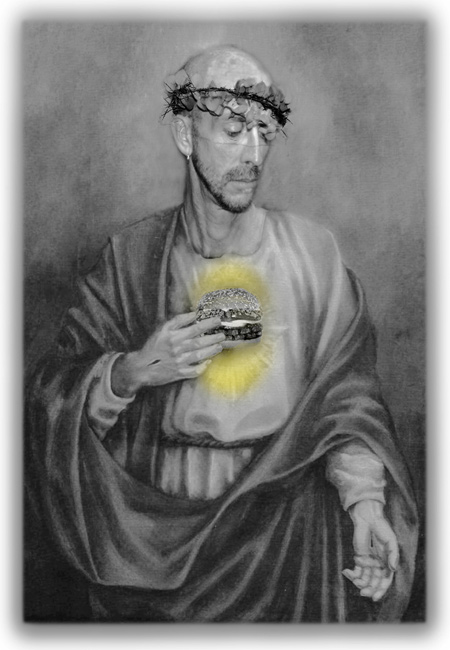
John Sherman Lathram III is a mixed-media artist whose work incorporates many aspects of technology: digital photography, video, robotics, biological systems and computer software. His work incorporates and exaggerates the poetic juxtaposition of the social expectations between perceived reality and “real” reality, one that exists and one we are taught or have faith in its notion. His photographic studies explore perceived body image of fringe subcultures as defined by historical essays and articles as well as current socio-political events. His photo-essay book, The “Ladies” of Ohio – Digital Divas, documents the female illusion culture in Columbus, Ohio. His works have appeared in New York, with well-received reviews in the New York Times, as well as several Columbus venues. Lathram graduated from The Ohio State University in 2004 with an MFA in Art and Technology. He has been an adjunct professor at The Ohio State University and Columbus State Community College. He has served as youth lecturer for the Wexner Center Summer Youth Art Series and is a member of several local and national Arts organizations.
A Morning of Orange Hands
Only the shag of birds in the dark
green corn or his own footfalls
on the dirt berm of the road, edging
his way close to cover. On the far
side he could imagine a car
rattling by on Pottershop Road,
but the dust it raised might have set
the distance he needed,
a separate life. Beyond there,
there is an opaque but lived nothing,
a blankness he cannot fill out,
not even luminous when his sister,
much later, tells him what happened.
Just to get away for a few hours,
then on, the boy my father was
went out walking on Sundays—
Baptist singing, Methodist, Deutsch
hymns in United Brethren houses.
Nazarenes left their seats, clapped
and sang exuberant prayers.
He’d hang about in the steeple yard
or when no one seemed to care
slip in to the back pews near the door
as adults lost their minds—
a solace in their reenactment,
practiced scenes of being taken,
familiar strickening, not overcome
though he was nor withheld,
but unbelonging. Men the size of his
father crumpled in sobs,
but were helped to their feet
by older quieter men who led them
to the altar to be saved, hands
on shoulders. He lingered in that
exhausted hush, aroused by—
a second sense in dropped voices,
the flutter across women’s shoulders,
sweaty dark hair curled by an ear,
in the instant men’s hands got restless.
And behind him, or he was ahead
always, was his father:
He beat the boy for being gone
whole afternoons or for saying
other people’s prayers,
if he thought of it, against him,
first in one place, then another,
that howling and the savaged,
savaging god. In their speechless
waiting, the Quakers felt caught,
or was it paused, culled, contained
when he wanted to be loose?
The plainness of that regard
from which no one ran
but was stripped—hands flushed
orange in the streaming light,
the vacant center circle lit up,
a gulf of tall windows,
and not raised but in their laps,
at rest—and from which no one hid
but was sheltered: in their sight
the heart he wanted was the one
whose absence made his father
fly into a rage. And while there
was no explanation for this—
no one stood to say it—
he would have to grieve for both
one day—his father’s wreck
of a heart and his own—before
he’d find the fields he skirted
were mere fields that quavered
with bird, the heart scarcely more
in the murky August air.
Lawrence Wray’s poems have appeared in Cider Press Review, Dark Horse Review, and Sentence 7. Online, they are available at Prime Number Magazine, Frostwriting, Blood Lotus, and Emprise Review. He is involved in homeschooling two young daughters, and has begun a collaborative memoir project with and about the child-prodigy pianist Dr. Charles Brindis.
Remedies For A Long Winter
When my feet become rubber tires
spinning between seconds, I repent.
Sing the human measurements of time:
dusk, a jiffy, a teacup of fallen oranges.
As soon as my knees squawk
like winter’s arthritic branches,
I rise and dance the green-shooted
onion or the white-fuzzed pears.
After I no longer feel the warmth
of fluorescent light bulbs or laptop glow,
I kiss bugs and their small homes:
driveway cracks & candy wrappers.
When my blood cannot hear the sweet
spider call, I walk outside, dip my finger
into frozen dirt, drink the worms sieving
through the earth’s brown cake.
Once I mistake the rush of late November
for the smell of bathroom cleaner, I play
the loamy musk of millipede, Jerusalem
artichokes, atmosphere, ashes, pinecones.
After I darken windows & draw blinds,
I taste the maple’s electric green circuits,
pull hair from the brush, finger tomato
seeds and garlic skin opaque as milk.
When I taste callused hand and cold
dust on my tongue, I sing drops of sweat
round as an ocean wave and warm
as the white mouth of the moon.
Laura E. Davis was born and raised in Pittsburgh, the City of Champions, where she earned her MFA from Chatham University. Her poems have been featured on the radio show Prosody, hosted by Jan Beatty, and published in print and online journals including Pear Noir!, Redactions, Splinter Generation, Rougarou, and The Ante Review, among others. She is the Founding Editor of Weave Magazine and she blogs at Dear Outer Space. She lives in San Francisco with her partner, Sal.
Ghost Money
Found poem based on Wikipedia’s article on Joss paper
The dead dwell in the natural world,
influencing fortunes and fates of the living.
Business owners burn spirit money
in red braziers and set out offering tables
on the sidewalk for gods and ghosts.
Relatives ensure ancestors’ well-being,
and positive disposition of the deceased:
folding and stacking paper money
of outrageous denominations into gold ingots,
elaborate pagodas and lotuses.
Precise distinctions are important
to prevent confusion or insult of spirits:
cash monies to the newly deceased,
silver to ancestral spirits,
river money to unrelated ghosts.
Jenni B. Baker (website) is the editor-in-chief of The Found Poetry Review and currently works as a nonprofit writer and editor in the Washington, D.C. area. Her works have appeared in a dozen publications including InDigest Magazine, The Newport Review and BluePrintReview.
Teeth in my hands
from The Second Book of Muwadi
Through love, I dropped God in a deep grave and covered him with salt and sand. My mouth spilled forth an assortment of smirking wolves. But the sun flowed over the water into the horizon and God rose. He sealed the cavern of my mouth with an enormous tombstone.
Only my teeth escaped this reckoning and I clenched them as a fever in my hands, helpless to speak of my devotion.
But I could rattle my teeth in a pleasing rhythm and I went from stranger to stranger, shaking my fists. Some allowed the music in my fingers to enter the house of their heart, but many favored the copper clink of coins.
In the temple, a priest presented a basket. I extended my teeth in silence, but he moved his face from side to side and backed away from my benediction.
Victor David Sandiego was the winner of the 1st WordStorm Poetry Competition held on Vancouver Island in British Columbia, a winner of the 2008 Jeanne Lohmann Poetry Prize, and the winner of the 2009 Crab Creek Review poetry contest. His work appears in various journals and on public radio. He lives in the high desert of central México. For more, see his website, VictorDavid.com.
Call for Submissions: Worship
We’re very pleased to announce that submissions are open for a new theme: Worship, edited by Kaspalita and Fiona Robyn. The deadline is August 31, and we hope to begin serializing the issue in mid to late September, after the conclusion of the current Imprisonment issue and a ten-day feature of this year’s chapbook contest finalists.
Please make all submissions through our submissions manager — scroll to the bottom and click “submit” (and remember that you can return to Submishmash at any time to check on the status of your submissions). We continue to strongly support the use of Duotrope’s Digest as well as Submishmash: two great, free services that help authors and publishers alike.
Theme description
Walter Harrelson in the Encyclopaedia Britannica writes that worship is “…the response to the appearance of that which is accepted as the holy — that is, to a sacred, transcendent power or being.”
Harrelson is talking about religious worship, and perhaps that’s usually how we think of the word. However I would suggest that we all worship all the time, either consciously or unconsciously, and that what we worship might be something we usually think as holy, or sacred, or it might not be.
What is it at the centre of someone’s life? What is it that we are reaching for? What is it that we create rituals around? From high church services to the pre-match antics of big football games there are many kinds of ritual, each pointing at a different object of worship.
When I watch my neighbour washing his expensive sports car I wonder if he is worshipping the car itself, its exquisite lines and engineering, or the social status that it provides.
We’d love to hear accounts that are in worship of something, sacred or profane, or that are accounts of worship, as well as pieces that are critical of worship – when does praise become obsession? How do power dynamics play out between the worshipped and the worshipper? When does ordinary love turn into worship?
We’re looking for satirical and humorous pieces as well as serious essays, stories, and poems. And, as usual, we encourage you to submit images and multimedia works relating to the theme.
The Editors
Kaspalita is a Buddhist Priest in the Pureland Tradition. He is co-founder of Writing Our Way Home with Fiona. He runs the e-course Eastern Therapeutic Writing, co-wrote The Art of Paying Attention with Fiona, and co-edited pay attention: a river of stones. He is currently studying Buddhist Psychotherapy with the Amida Trust. He is still learning to play the ukulele. Follow him on Twitter: @kaspalita.
Fiona Robyn has been having a love affair with words all her life. She has published three novels, and other books including A Year of Questions: How to slow down and fall in love with life. At Writing Our Way Home she runs e-courses including Writing Ourselves Alive. She also works as a creativity coach and as a therapist in private practice. In 2007, she edited qarrtsiluni’s Come Outside issue. She is fond of Earl Grey tea and homemade cake. Follow her on Twitter: @fiona_robyn.
 qarrtsiluni