Archive
Nikolaikirche
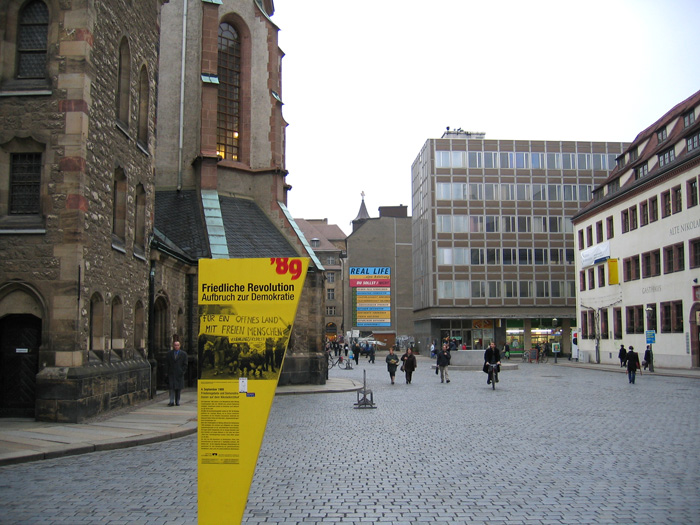
Click on image to view a larger version.
Nikolaikirche in Leipzig was the centre of the peaceful public revolt against the communist system in East Germany. Beginning in 1980, people gathered in the church every Monday for prayer. First just a few met, then more, until in 1989, thousands came together there every week for Monday mass, which was followed by a walk of protest.
It’s still moving to walk across the church square, and to see the photo that was taken during one of the Monday walks. The banner says “Friedliche Revolution — Aufbruch zur Demokratie” / “Peaceful Revolution — Rise for Democracy.”
Dorothee Lang is a writer, web freelancer and traveller. She lives in Germany and edits BluePrintReview and Daily s-Press. Recent publications include HA&L, YB, elimae, Referential, a handful of stones, eclectica, and for a silly reason, The New Yorker. For more about her, visit her website.
The Student Wars
by James Toupin
Were we playing? Spring opened
with the softness of the lotus.
Our politics emerged outdoors.
That year fate, enrolling soldiers
as numbers from a barrel, at last
spoke frankly. For those made fortunate,
death was launched elsewhere, at others,
and all the more must be opposed.
Someone said we ought to close
the road. Surely it carried convoys.
Our riot wound its way through groves
to mill out on the thoroughfare.
I maintained the periphery.
The megaphone came as called. The girl
whose glances were to me more vital
than war or peace, having come
with someone else, was carted off.
Talking taoism, she had not noticed
the line of cops begin to move.
A flashing cruiser, screeching, chased
me ring around a tree until
its spinout made space for me to run.
Such was our battle. Backpage news.
No trouble. A wisp of April risk.
James Toupin is a retired lawyer living in Washington, DC. His poems have appeared in the last couple of years in numerous print and online journals, including Loch Raven Review, The Guardian Poetry Workshop, Infinity’s Kitchen, Flutter, Umbrella, Four and Twenty, The Centrifugal Eye and Bumbershoot.
Return to the Old Town
To live with more than recall
of a latent happiness
that almost drove me
twelve years ago
to a drab hill town
and a woman who smiled at strangers
as they passed her window
never smiling back
I renounced contingency
and hiked the high track.
The people gathered in the square
to celebrate the slow roasting
of a single fish.
I matched its stare and felt certain
we had met before in better days.
Rob A. Mackenzie lives and works in Edinburgh. His first full collection, The Opposite of Cabbage, was published by Salt in 2009. He blogs at Surroundings, and is an associate editor with Magma.
No getting away
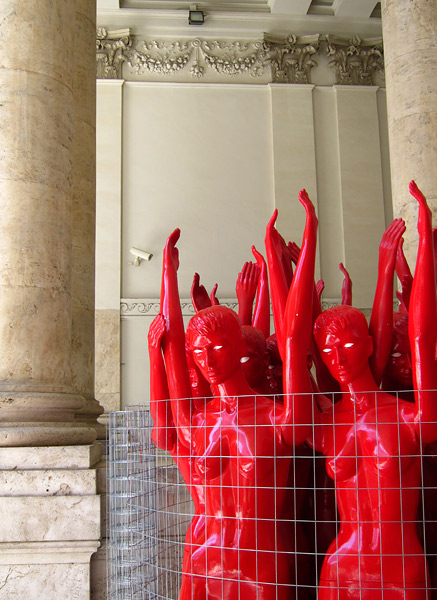
Nathalie Boisard-Beudin is a French lawyer having way too much fun with words, pictures and food. Her published works are listed — and linked to — in the sidebars of both her blogs.
Strays
So you know how a stray dog will dip its face into any dirty bit of puddle? Well, when Taller began doing the very same to Smaller people screamed real loud that they were out to swindle us somehow or bring the railing wrath upon us. Take your pick.
And didn’t we all think they looked suspicious and shifty, walking right up to our triple-strand razor-wired barrier with their swollen lips and sun-damaged eyes. No Identity card, no permanent address, not even vaccination or gender verification marks. No acceptable explanation for where they could have been. We’re looking to share something so valuable with all of you. Their wild eyes blinked slowly as we gathered in the center of our compound, unable to decide should we beat them straight up, or immediately banish them or be the audience they seemed to want. We were bored and the Pheedwagon was still hours away from arrival. They praised something out there in the murky blue beyond the furthest gate when we said we’d watch.
First we’ll lay down the golden ground said Smaller as she unfurled a moth infested length of yellow colored, old style fiber blanket. They paced it out in half-steps, then stood dead still and both of them went into a wheezing, winding story about a roaring comet of flying trash they’d been hit by out on some unnamed plain. They said they’d been plastered in torn or burnt pages and read many of the old words that had been eliminated by a series of court orders.
We’d sold off our names for credit vouchers long ago in the earliest days of The Curtailment but we had our assigned logos and we had the might. So then we roared in unison start it now as the swarms of black flies chewed us and left their trail of poisonous Braille across our faces and tattooed limbs.
It was right about then that Smaller took Taller into her arms and started rubbing against her in a shape like a wagging tail.
We looked hard at each other and some of us were falling to our knees, throwing our arms up high and begging forgiveness. Contact of any sort was routinely forbidden. Every one of us knew that.
After all the talking they pressed their mouths together tight. We heard some humming, then some moaning sounds. They stripped right down to their smallest, barest gestures even though the wind was scrubbing all of us raw. Taller made that Smaller shake real hard when she slipped one thin as a new moon hand between Smaller’s legs. It was then that the dogs started howling like they always do on days when the sun doesn’t come up and stay pasted tight right there in the sky.
By this time the very last of their strange words had stopped. There was a sound from somewhere we couldn’t see like that long drawn out sigh before a dust storm gathers itself up into a high, spinning mass. Our eyes lost their focus but our fists knew the way.
The dogs tore their filthy tongues out first. The dry ground was soon dimpled with dark spots like rain. It hasn’t rained here in memory.
But now green things grow where we laid them out.
Some of Holly Anderson’s most recent work can be heard on Peg Simone’s 2010 record Secrets From the Storm (Table of the Elements/Radium), or visit her at SmokeMusic.tv.
The Storm
by Mark W. Kidd
Thunder can peal twice, or three times,
or not at all
when the storms come
and sound bounds between some towers and into others.
I turn a corner and hear
the steel rattle of a dying blast.
My legs catch the quickening tempo of the street,
the sure-charged pace that speeds your feet
and leaves bag strap grip-dents in your palms.
Windhovers scatter above,
rushes of wind pushing on the warp and weft
of their high haunt,
mass-flapping of wings.
Cold light on my face and hands.
Crescendo magnetic click echoes—
waves of windows sealing themselves,
pressure dropping
throughout the city,
and those who linger outside with me
witness the thunderheads as they finally
cover the city as far as I can see.
Mark W. Kidd lives in Whitesburg, Kentucky, USA where he pursues creative and professional interests.
Sparrow’s, Poet’s Deaths
Competing News Stories, November 2005
|
Number on number— over four million dominoes, one hapless flight through an open window. Praise the protective system, deliberate gaps that limit the toppling— no problem to reassemble “Domino Theatre of Eternal Stories” once the rifle was aimed into the rafters. The sparrow will be displayed in a Dutch natural history museum, feathers realigned, body hollowed, perched atop a box of dominoes— “Traditional Matching Game.” Dead bird has triggered protests… a spokesman’s lament, I only wish we could channel the energy for this house sparrow into saving the species… |
Hundreds at her funeral, girlfriend remembering their Golden Needle Sewing School, line of burqas, hunger for air, Shakespeare hidden in straw baskets, the Taliban overlooking fabric, thread. Her poems, rippled with sorrow, I am caged in this corner… My wings are closed and I cannot fly… Nadia Anjuman, twenty-five years old, her words bringing shame to the family— I am an Afghan woman and so must wail. Husband admits beating her. He claims she took poison, doesn’t allow an autopsy, wants to protect infant son. Smokey Flower, first book, just published— If you are looking for stars in my eyes, that is a tale that does not exist. |
Note: In November of 2005, there were very few news reports about Nadia Anjuman’s death and the brave crowd at her funeral. At the same time, news stories about the domino world record attempt and the sparrow were abundant, in part because the killing of the sparrow launched several street protests in The Netherlands. The disparity in the levels of both media coverage and criminal investigation prompted this contrapuntal poem. More information about Nadia Anjuman is available at UniVerse: A United Nations of Poetry.
Christine Rhein is the author of Wild Flight, winner of the Walt McDonald First Book Prize in Poetry (Texas Tech University Press, 2008). Her work has appeared widely in literary journals and has been selected for Poetry Daily, Verse Daily, The Writer’s Almanac (2008, 2009), the Laurence Goldstein Poetry Prize, and Best New Poets 2007. A former automotive engineer, Christine is at work on a new poetry manuscript in Brighton, Michigan. More information and links to other online poems are available at her website.
Balcony View of a Prairie Dog Colony
You don’t see a one at first.
Then, one becomes two, five, twenty,
a hoard of dirt-colored dogs.
A bird caws. You don’t see it either.
Are you missing multitudes
lurking like weeds in the field?
It caws again, and dozens of dogs
disguised by brush and dust
scatter like seeds into the ground,
mounds like tiny volcanic burps,
dozens, you now observe.
Prairie dogs pop back up,
jack-in-the-boxes, brown sock puppets
poking scrawny bodies about.
Three stand, sentinels at one burrow,
tails like clipped wicks;
a pair at another, a set of souvenir-stand
salt-and-pepper shakers
with ears like afterthoughts.
The field fills with scurrying.
An hour goes by. Another.
You can’t keep up.
How much else
has escaped your notice?
Scott Wiggerman (website) is the author of two books of poetry, Vegetables and Other Relationships and Presence, forthcoming from Pecan Grove Press. A frequent workshop instructor, he is also an editor for Dos Gatos Press, publisher of the annual Texas Poetry Calendar, now in its thirteenth year.
Waiting to March

Click on image to view a larger version.
Cambridge Carnival. Central Square, Cambridge, Massachusetts. August 2003.
Monica Raymond won the Castillo Prize in political theater for her play The Owl Girl, which is about two families in an unnamed Middle Eastern country who both have keys to the same house. She was a Jerome Fellow for 2008-09 at the Playwrights’ Center in Minneapolis, among many other honors and awards. Her poetry has been published in the Colorado Review, the Iowa Review, and the Village Voice.
Standing Room Only
by Tony Press
It was on December 1st that Jacob and 100% of his floor-mates, sixty college freshmen, plus the R.A., the upper-classman who had his own room, and in return the responsibility for holding their hands when needed, packed the television room to watch the lottery. The lottery. Five years ago, at fourteen, he’d read Shirley Jackson’s chilling story, “The Lottery.” As he maneuvered into a niche near the back, he massaged his head to rid it of Jackson’s tale. By wordless consent the young men pushed the furniture to the walls and stood for the entire show. “The show” was an odd term for what they were about to see, yet that’s what had been on flyers in the dining hall and the elevators: “The show: Be there: Get Lucky or Kiss Your Ass Goodbye.”
Fall quarter thundered toward finals and he had barely kissed a girl, much less “get lucky” in the way everyone else seemed to be doing. Every weekend another friend boldly or shyly bragged about sex, real sex, and all he did was read about it. He wasn’t sure he could stand four years of this if fiction was the closest he’d ever get.
The boys who would be men were scared. They hadn’t done this before. Nobody had done this before, not since the dinosaur days of 1942. In minutes somebody was going to pluck little cylinders out of a drum. Inside were all the possible birth dates to be matched to a list of the numbers from 1 to 366 on the wall — they didn’t forget Leap Year. The date that matched with number one, every nineteen year old boy in the country with that birthday would be first in line to be drafted. The dream date would be number three hundred and sixty-six; those guys wouldn’t see a drill sergeant until the Red Army marched from San Francisco to and across the Mississippi River. The story was if your number was in the first third, you were cooked. If you were in the last third, you were golden. If you drew an in-between number, roughly one-twenty to two-forty, you hadn’t learned a thing. You were still stuck in the middle with little clue how to plan your life. That was the whole idea, they said, that by giving young men this information, they could in fact plan their lives without the uncertainty of the current stunningly random draft system.
It was true that as long as they were in college, taking and passing a full load of classes, they were safe. Safe until they graduated, or dropped out, or sneezed in the wrong place. No, that latter happenstance, the sneezing in the wrong place, was the sort of thing that was no longer a factor. As long as you or your parents could afford college, okay. Of course, the sweeping changes had no effect on the upper class — even in the chaos of 1969, some things remained sacred. Nobody had any illusions that a rich kid couldn’t avoid the whole deal, and nobody had a single illusion that ninety-nine percent of them wouldn’t do exactly that.
Safe, then, until they graduated, or dropped out. Jacob had no clue what his own plans might be, even apart from the threat of Vietnam. School was okay but it was no passion. Was he where he belonged? Six high school friends were on their way to Vietnam. Another, two years older, had burned his draft card and was in prison. Still another was feigning homosexuality, but also applying to divinity school, covering all bets. Jacob didn’t know anyone in Canada but he knew people who did.
The room was usually noisy, to watch football games — this was different. Jacob thought he knew everyone at least on a some-name basis. One guy everybody called “Cowboy.” Several others were last-name guys, like Grauman and Preston and Rippinger, and Jacob couldn’t have said their first names on a bet. In September he had nudged his own name from Jacob to Jake, but sometimes he forgot that it was him they were calling. He knew he would always be Jacob at home.
Street performers had hit campus earlier in the week:
Join the army, see the world: Kill a gook, screw a girl.
Get the clap, a purple heart: Some penicillin, a brand new start.
He didn’t want any of that, not that way, and he certainly wasn’t a killer, of “gooks” or anybody else. Was he lucky or unlucky? He couldn’t say. Maybe his luck was waiting for something really important, like this lottery.
One of Cowboy’s big hats perched on the television and everyone had dropped a dollar into it. The money was a consolation prize for the sucker whose birthday was drawn first. Jacob never wished ill on anyone but he implored the gods of fate to spare him that one.
He was nineteen. Somebody thought he was a man. Who was he to plan his life? Washington’s good intentions, if that’s what they were, were wasted on him.
This morning his US History professor told a story: Just before World War One, the Great War, “remember, the war to end all wars until the next one came along,” the famous Washington D.C. cherry trees were planted, thanks to the Japanese Ambassador, who brought cuttings from the even more famous Tokyo cherry trees. The trees, thousands of them, were the gifts of the Japanese people. Then in World War Two, the United States bombed the hell out of Tokyo, wiping out the trees, and a large amount of people, too, so after the war, the U.S. sent cuttings of the Washington trees back to Tokyo. Nothing to replace the people.
The crowd crept even closer to the television to hear the first date. Jacob saw guys holding hands. He heard someone praying. He heard his own heartbeat.
“September Fourteen.” Dave Rippinger — that was his name, Dave! — cursed and kicked the table, sending television, hat and cash flying to the floor, before storming out.
Fifty-nine remained.
If he walks one block west and 78 steps up, Tony Press can see the Pacific, if he’s home. His fiction appears in Rio Grande Review, Menda City Review (also here), Foundling Review, Temenos, MacGuffin, The Shine Journal, Lichen, Boston Literary Magazine, and in the UK anthology Crab Lines off the Pier. Poetry appears in the UK anthology Heart as Origami, as well as 34th Parallel, Contemporary Verse 2, Spitball, The Aurorean, and Turning Wheel.
 qarrtsiluni