Archive
Welcome to Mussel Rock Dump
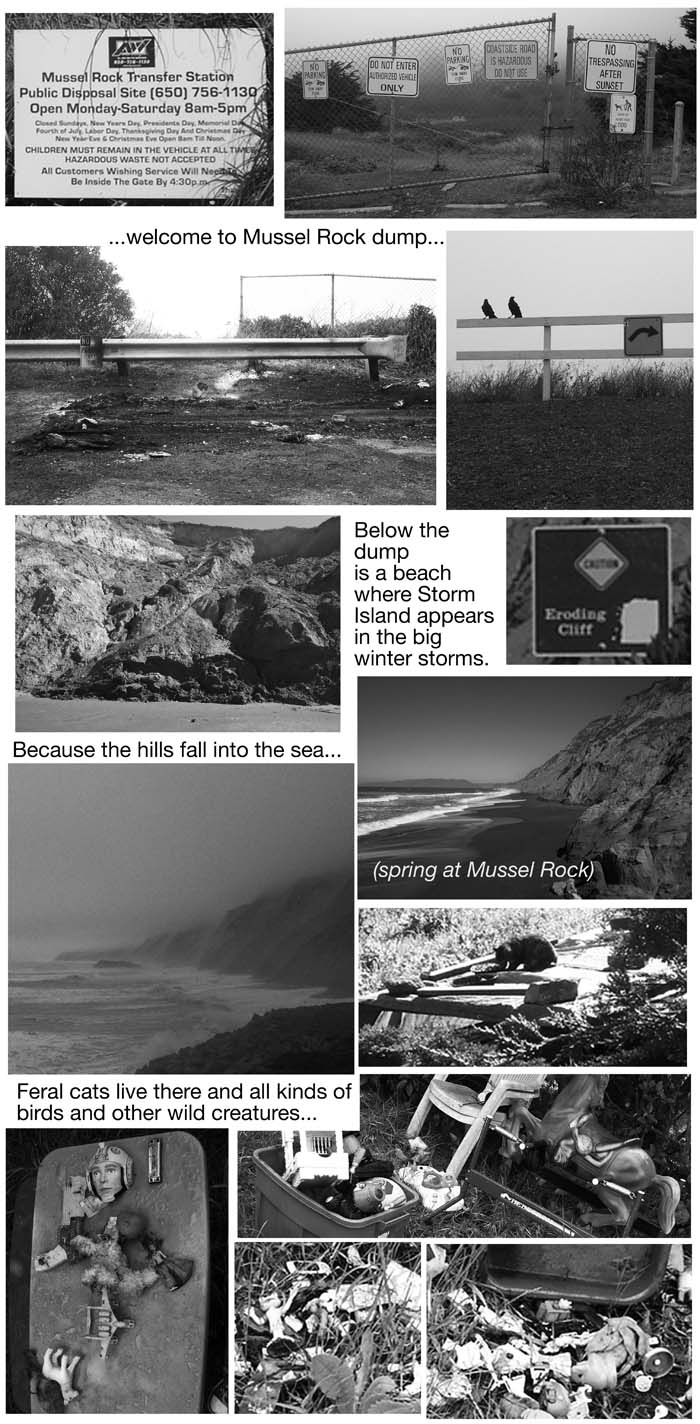
(Click on image to view full-sized file, which also requires an extra click to magnify.)
 ::
::  ::
::  ::
::  ::
::  ::
::  ::
::  ::
::  ::
::  ::
::  ::
:: 
Snails
Annie Dillard wrote
about them once, how they followed
a circular trail of slime
for weeks without changing
direction, their reluctance to alter
course almost killing them off,
the need of sustenance reaching the critical
before any would deviate,
even the slightest, to survive.
I know how that feels — a process
ancestral, intestinal, ingrained;
fleshy and dense as a slow organ
producing its juices, leaving a scrawl
across my front porch thick
and tremulous as an old widow’s signature
on a bad check, or a trail of relatives
honing in for Christmas dinner.
by Cynthia Cox
:: :: :: :: :: :: :: :: :: ::
Emergence
Rivers in the winds and overcast greys focus into doves,
condense out of sighs and pearl dust.
Pool chairs loll out their pillows, blue tongues,
evidence that energy organizes new life
as water braids above rocks out of speed and enthusiasm:
new forms from eagerness and rush, just as history
preserves a name. Wallingford says there was a river
where oxygen and wagons might pass.
Nothing dishevels a thing like water.
It makes and unmakes innumerable existences.
Dustbirds and skyscrapers reconvene when the wind lessens
and water remembers homesick by its arroyos.
We too become bones and dry channels, eyes washed away.
White fossil swirls like limestone scoured to femurs, hands gravel,
the remembrance of water by rock, graceful, erosive,
severely delivered.
by Allan Peterson
:: :: :: :: :: :: :: :: :: ::
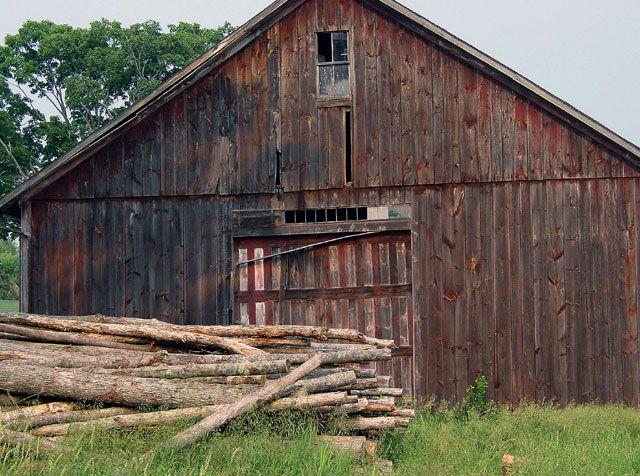
Pain(t) Flaking
There was this old building I used to haunt as a child and that would haunt me right back, some type of technical construction, with all sorts of strange rooms to explore and to play hide and seek in and out of. I remember its stained walls, peeled papers, the grimy windows showing shards of teeth to marauders. There was even a strange hopscotch-like drawing painted on the floor in one of the corridors, which I never failed to storm through on my way from the offices to the workshops.
Sometimes I would lick its old and massive cast iron heaters for a taste and a fleeting impression of gone-by days, trying to picture the persons that would have spend their working time in the place, their dreams, assumptions and delusions still tainting the walls.
I would lose myself in musings, trying to fathom why they would have drawn a child’s game on the floor, and while I imagined alternative uses for the diagram, some enticingly sinister, the flavour of metal in my mouth became that of blood. Was this red stain just flaking paint on the rusty tubes or a sign left by some gruesome rite of passage? Would the dirt and rot on the wall speak a different tale than that of an obvious abandon, forgotten tears being spilt in vain? Such contemplations occupied many a rainy day I spent in this edifice.
Another favourite pastime of mine was also to sit on the dusty floors for hours, allowing myself to get mesmerised by the walls dappled with mildew, broken windows and decayed paint and imagining the building trying to shake its pretense of civilisation to return to a primal stage, a tree creature that, once freed of veneer, would take roots in the place and start sprouting greens and weird typewriter-shaped fruits. Or a brick truant ghost that would un-moor its foundations and take to marauding in the woods, a rampaging being that would take me along as a stowed-away passenger. I would pray for it to let me get under its skin and to cart me off towards genuine adventures, offering to strip away layers of coating to speed its way to recovery, planning all sorts of mischief for our escapade, that I would then whisper into the walls, splinters of paint embedding themselves in my lips.
:: :: :: :: :: :: :: :: :: ::

Lucky
On waking I think of death, or rather decay—my hands
are violently folded in towards my wrists, they like to bend
that way, a fox curled up in the snow, the flesh covering
my veins bunched up into ridges. I imagine the joints—
a door flung the wrong way, tendons stretched too far and fraying,
and apologise, straighten them out, hoping these small kindnesses
might pay one day, remembering to keep my back hoisted straight,
to take my vitamins… and my body tries its best, washing away
the broken bits, spitting out the waste, but nevertheless
pieces are breaking off my bones, muscles are slackening like perished
elastic bands, skin is crinkling like a peach too long in the bowl.
A million microscopic deaths a second. I straighten out
my wrists, knowing tomorrow morning I’ll do the same,
hoping I’ll be lucky enough to wear like a leather sofa, softening
over time, keeping hold of my creases, my old frame bending
and cracking in places. Lucky enough not to be stopped
by a bang in my chest, felled by a terrible blooming of cells
in my breast. Lucky enough to feel the years in my wrists.
by Fiona Robyn
:: :: :: :: :: :: :: :: :: ::
The Dead Alive and Busy
—Henry Vaughan, “To His Books”
On an Adirondack path
near Fall Lake my dog
halts to puzzle over
a glossy black mass
of what was once
a squirrel, perhaps,
or a day-shy mink—
no way to tell which,
the stink so far advanced
all that’s left is a few gobs
of flesh dark as leaf rot,
a couple tufts of fur,
so the shock of shocks
comes when, bending
to tug at my dog’s collar,
I see the heap suddenly
shift, that horror-flesh
somehow alive, dissolved
muscles still seething
in rank air, a vanished
leg twitching,
and though it takes but
a moment for reason
to suggest the truth,
a beetle colony busy
in that corpse, their shells
shiny with bright yellow
strips—color of warning
now rising amidst the awful
jelly, then sinking again—
though the moment passes
and earth resumes
its laws, it is time enough
to smell the horrid stench
that cannot fade even
in sweetest air.
by David Graham
:: :: :: :: :: :: :: :: :: ::
Call for Submissions: Nature in the Cracks
Spring is almost here in many parts of the northern hemisphere, though you might not know it from the fresh snow blanketing much of the northeastern U.S. this morning. Here at qarrtsiluni, we are once again sitting in the darkness, waiting for submissions to an intriguing new theme: Nature in the Cracks. The guest editors write:
We’re seeking prose, poetry, and artwork that celebrates the nature of the world revealed by time, weather, decay, cycle, and neglect. It’s the understated beauty of the stain inside a teacup, not the ornate pattern decorating the porcelain. It’s a sadness for old barns slouching in fog, the branch you accidentally break that turns the owl’s moon face your direction. It’s the liver spots on your grandmother’s forearm, the crooked curl of her fingers over the rocker arm. It’s the well-worn patch of wood stain faded smooth there.
“Nature in the Cracks” also celebrates the patience and necessity of cycles. Water from a warm season must seep into an invisible fissure along the boulder before freezing and expanding to open the crack wider. Leaf litter collects there and moss takes hold before any errant maple seed helicopters in. How many seasons must this cycle repeat before enough decay has collected to sprout a seed?
It’s in the cracks where nature adjusts, changes, and teems, a marginal place that exists without borders, physical or theoretical, a place where something new might evolve out of the muck. “Nature in the Cracks” seeks writing about wildness found in strange places — from landfills to prisons, sidewalk cracks to salad crispers.
As always, see the How to Contribute page for more details. The suggested word limit for text contributions is 2000 words, and the deadline for submissions is March 31.
The editors for this issue hail from opposite ends of the United States, but they share a strong affinity for wildernesses both real and figurative. Brent Goodman — who just made his qarrtsiluni debut with two poems in the last issue — lives in northern Wisconsin, and goes fishing and kayaking every chance he gets. His poetry has appeared in a number of print and online magazines, from Poetry to Rattle to The Cortland Review, and he’s published two chapbooks. His first full-length collection, The Brother Swimming Beneath Me, was recently accepted for publication by Black Lawrence Press. Ken Lamberton is based in Tucson, Arizona, but is spending an extended weekend in the Mojave Desert as this announcement goes to virtual press. Ken has published more than 100 nature articles and essays — including two in qarrtsiluni — and four books, including Wilderness and Razor Wire, which won the coveted John Borroughs Medal for outstanding nature writing in 2002. Ken won a 2007 Soros Justice Fellowship from the Open Society Institute to complete and promote his latest book, Time of Grace: Thoughts on Nature, Family, and the Politics of Crime and Punishment. We are pleased and honored to have two such accomplished writers on board as we thread a course through this great turning of the year.
— Dave Bonta and Beth Adams
:: :: :: :: :: :: :: :: :: ::
 qarrtsiluni