Archive
Driving to Muskogee
Enroute to my daughter’s house
and about twenty miles distant,
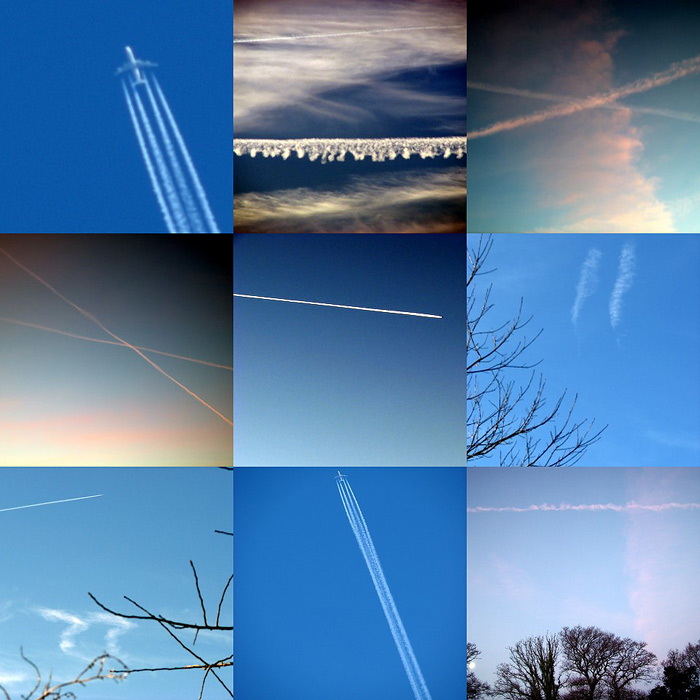
a colossal gaseous mass appears
above the little city of Muskogee.
From my turnpike point of view
it looks as if it is emanating from
the O G & E electric power plant.
Maybe it’s the men in white coats.
My daughter and grandchildren
reside beneath that faux cumulus:
specter of coelacanth, of dinosaur,
of Mesozoic fern and tiny trilobite
we study while in grammar school
and depict in those dreaded essays.
by Richard Brown
 ::
::  ::
::  ::
::  ::
::  ::
::  ::
::  ::
::  ::
::  ::
::  ::
:: 
Sleepers
Today, in Ohio, my mother
will have a small procedure.
Rejecting technicians’ equivocations,
she seeks a second opinion.
Sometimes the stranger comes so close
she can almost make out his face,
but then a sound—the dog’s nails
tapping the floorboards
in sleep, a branch at the window—
tugs her mind from that dream into
another, the way the Congo tetras, glinting
like silver dollars in the tank’s bluish light,
shimmied suddenly from one zone
to the next, then drifted, suspended,
eyes ticking as if in thought… But this is not
her memory. The fish were mine. I can’t
remember where they ended up. A pet store
on South Shepherd, I think, the year
we moved from Houston. Beautiful fish,
raised from small nothings. Long dorsal fins
trailing like undulant veils. Shimmer
of blue in their silver. I’d linger
to watch them hover and drift,
their bodies’ slow turning, shifting
like sleepers. The world the glass contained
was like the sanctuary I imagined
my house to be: I could not enter one,
nor bear to leave the other. This phone
folded closed in my hand, the same silver
as those fish, contains, impossibly, my mother:
her voice, or its approximation,
digitally rendered. I am my mother’s son.
I’ve always been. If there is another world
beyond this one, and if nothing I’ve imagined
will be there, does it not follow that somehow
we’re dreaming in its belly even now?
by Ron Mohring
:: :: :: :: :: :: :: :: :: ::
New Year’s Eve, 1913
Many apocalyptic sects believed the world would end in 1914. Some taught that possessing pictures, “graven images,” violated the second commandment, the punishment: burning in hell rather than enjoying the millennial peace of the righteous. Thus my grandmother’s dilemma.
The other graven images they burned
Thanksgiving Day, buffet of frames and silver
plate drifts God-ward, mercuric vapors, sepia
fragments rising. But Oskar, she keeps back,
he’s featured only when she grips
his sailor-knickered pose—stilted shade
of a first-born, dead and quick to evanesce.
She soothes a finger down the outline
of his jaw, strokes bones where baby softness
scarcely keeps the round. It feels abandon
not to conjure him, blue-eyed. Although she
dreads the certitude of hell, without the
children living now, she’d make millennial
trade-off for clear sight of him.
Last night again the dream of altar rock
so sharp it slices through her swollen gut.
“Ma, where is the lamb for the holocaust?”
In torture she lays him on the pyre—
hope against hope for a ram—
but only the ash of this photograph
she paid for with chickens floats back.
:: :: :: :: :: :: :: :: :: ::
US Army Base

Vicenza, Italy
(Click on image to view at larger size.)
:: :: :: :: :: :: :: :: :: ::
After Greensboro
At the dance
we garnered glares
from white boys, black girls
as the mirrored ball distorted
everyone’s color.
When we kissed,
the fullness of your mouth
was a surprise to mine
(the exoticism of race).
Since we sensed
our connection was taboo,
we would retreat to the movies
(ticket taker’s tariff of a stare)
and sink
into the receiving arms
of the slightly rocking chairs.
The dark claimed us for a couple hours
before we would emerge vulnerably into the daze-bright day.
When I think of you now
I wonder at how we were unaware
of the Greensboro massacre.
How we thought
white sheets suggested only love.
by Kimberly L. Becker
:: :: :: :: :: :: :: :: :: ::
Depth of Field
A cement porch with a vinyl-cushioned metal glider and posts with diagonally cut wood slats for decoration. There are several arborvitae clustered around the porch, green against white paint. The temporal address: 7420 Piedmont Street, Detroit, Michigan.
An indeterminate year. An unknown season.
Cousin Tony is standing behind Sophia who is sitting on the green glider holding the tiny Christmas 1944 baby. Walter is seated beside her. Everyone is just as they had been when they died. Tony has a Marine buzz cut, mud on his camouflage fatigues from some unnamed jungle in Vietnam. And blood. The insignia of his rank did not stop the bullets. Sophia and Walter are wizened apple dolls. She died of a fast-growing cancer and he was killed in a house fire. The baby in Sophia’s withered lap has a blue face because of the umbilical cord that had been wrapped around his neck when he was born dead into a world at war.
Richard Walter is sitting on the cement steps. Doreen Marie is beside him. Brother and sister. He died alone from a stroke or a heart attack, who knows? She died of an overdose of prescription methadone. Each of them is too young to die but they are dead just the same. Like Tony and the baby. Like Sophia and Walter, both in their early seventies. Too soon to say goodbye.
Fred Brown is there by the door, grinning his signature big grin. He is not in the bits and pieces, what was left of him after he was murdered, but the young man he’d been, only a week or so from his seventeenth birthday, just before he is killed. Buried on his birthday like it was a present or a surprise wake someone had given him. He is African-American and some might argue, not a member of this family, on this porch in the Polack working class ghetto where everyone else came from.
Since this is a portrait of my beloved dead, Fred is most definitely among them. He is saying out loud to anyone who will listen, “Christina isn’t white, she’s Polish.” My mother smiles her crooked smile and my dad barks a laugh like he knows a lot more about something but he isn’t telling. Richard and Doreen invite Fred to sit down on the steps with them. The Christmas Baby is happy to be with everyone at last.
The shutter snaps — this is not a digital phone dammit but a real camera — and I shoot picture after picture convinced that the light is exactly right, the moment too good to be true.
Like stepping into the same river twice — not the River Styx but another river — Missouri Vistula San Ganges Danube Tigris Euphrates Yukon Orinoco Amazon Nile Mekong Mississippi Detroit — these beloved dead aren’t easily gathered again.
by Christina Pacosz
:: :: :: :: :: :: :: :: :: ::
black & white
October 22, 1962
When President Kennedy spoke on TV everyone in Kearney NE, population 14210, was watching and listening. Closely and silently. It is an unsettling time of year. The ten foot wall of field corn that had grown up over the hot summer to surround our town in every compass direction has been harvested away. The flat fields of dirt and stubble hold neither hope nor promise; hide nothing. Nothing is all you see in any direction this time of year.
President Kennedy said the Russian A-bomb rockets in Cuba were a threat to our country and had to be removed, even if it meant war. When the President finished speaking the adults were still pretty quiet. Later there was quiet talk on porches up and down the block. Bedtime that night was like bedtime when there were tornado warnings on the TV weather report. Don’t worry the adults told us. Everything will be okay.
Don’t eat the snow, they told us that winter. A-bomb and H-bomb tests had thrown up an invisible cloud of radioactive particles circling around the earth. These bits of dust might possibly attach to earth-bound snowflakes falling through the radiation cloud. It is dangerous we were told and the warnings made us hesitate; we believed what they said on TV just like we believed our teachers at public school and Sunday school. But we still ate the snow.
The invisible radiation was like the dots of radium on the hands and numbers of my cheap wind-up wrist watch. Except the dots on the watch weren’t really radium, they were phosphorescent — they trapped radiated energy and leaked it slowly back out as light. The radiation was really like the fluoroscope machine at the shoe store. We’d stick our feet in special slots, then look through viewfinders and watch our green phosphorescent toes wiggle visibly through the layers of shoe leather.
October / November 1956
One afternoon when we got back from a trip to town our family’s first TV was sitting in the middle of the living room. It was big, in a wooden cabinet with a swiveling base, like furniture. That TV stayed with us for a long time, eventually ending up with my mostly German grandmother. She was still using it in the mid 1980’s.
Some of my first TV memories are of the Hungarian Freedom Fighters. The grainy and snowy pictures on the black and white TV showed rows of big undistinguished urban buildings, people darting in and out of doorways and windows, guns and gunfire. Later the streets were empty except for tanks; the Russians had invaded. The Hungarians lost their freedom to the communist Russians.
Those Hungarian cityscapes looked especially gray, large expanses of faceless gray buildings full of empty shadows of windows.
early 1960s
We visit uncles and aunts and cousins in Kansas City. The 350-mile drive takes most of the day, two lane blacktop all the way. Kansas City has shopping centers and major league baseball and suburbs where our relatives live. Their TV has more channels and stays on later than ours. On Saturday night one of the Kansas City stations runs horror movies. We kids stay up late and watch House of Dracula (1945) starring Lon Chaney. Terrifying as it is we fall asleep before the end when the forces of good put down the terrible trio of Dracula, Frankenstein’s monster, and the Wolf Man.
Later, back in Kearney, none of us kids will go alone down into the basement at night. The fear of the darkness at the bottom of the stairs is with us past Christmas and well into the New Year.
October 1982
Driving eastbound on I-80 along the impossibly flat Platte River valley near Grand Island NE, it’s a lovely autumn evening just turning to night. It is uncharacteristically calm and peaceful, a quiet time of day and a quiet time of the year. I’ve been out of school for a while now but my internal calendar still follows a lesson plan blocked into semesters and vacations. School folk have settled into their Fall classes with football games on the weekends. We’re a good bit of the way between end of summer and Thanksgiving break.
The ball of orange I see through the windshield, peeking up just above the eastern far horizon freezes every neuron in my brain. For a moment the universe is black, I see nothing though my eyes continue to function perfectly. Am I dreaming? No. Do I see an orange mushroom cloud way off in the distance? Yes. Sight returns. It is a long way off, just a bit north of due east. About where Omaha might be. Or the Strategic Air Command headquarters in Bellevue.
Brain function rushes back. “The bastards,” I think, but oddly feel no anger. I’m probably safe for the moment. Most of the closest strategic targets are in the eastern part of the state. Prevailing winds will keep radioactive fallout away from here. I should probably turn around and go back to Kearney. The orange mushroom shaped cloud hangs there, still and oddly beautiful. It is slowly getting bigger, spreading out at its base. The orange is not quite as intense as full night falls on the corn fields, on the interstate median, on the ribbon of trees defining the Platte River. The atomic fireball now looks just like an impossibly big impossibly full moon, rising peacefully over our impossibly flat state.
I continue driving east, another hour or so of interstate cruise control before I’m home.
sunday, 28 september 2008
:: :: :: :: :: :: :: :: :: ::
Oak Ridge, Tennessee
We lived five miles downwind of Oak Ridge.
Its towers contained multitudes, shaded by the stubby
knuckles of oak leaves. My father’s Geiger counter
click-clicked its swaying tongue at me. Thirty years later,
thyroids of local children start acting up — cancers, syndromes, tumors.
(Dairy cows, asparagus and strawberry plants,
fruit in my mouth, snow in my hands.)
My mother as a child sprayed with pesticides
when she played in the fields. My father grew up
while men wrestled atoms. He learned to cap
contaminated soil, clay and concrete with their brittle grasp.
The reactor clasped in graphite inside a black building.
It was here they built bombs, or the beginnings of bombs,
electricity crackling through the oak woods.
Once, in the twenties, a madman jailed for prophesying the site,
saying “here would be built…” I don’t know if he died in jail.
In my backyard the skeletons of snails trapped in lime.
(Red clay, lilacs, daffodils, black bears and mockingbirds.
Vines of honeysuckle and morning glory, children chewing red clover.)
Always things hovering over us: mountains, thunderstorms, dark arms
of oak, a poisoned valley. Lightning bouncing across our yard,
bees swarming a horse. My father strode off to work
with government-issue TLD cards and a black suit. How much
radiation today, the card would tell him, but he knew it lied.
:: :: :: :: :: :: :: :: :: ::
Reasons for the Mass Destruction of Pigeons in Venice
We are outnumbered by the pigeons.
We need to preserve our cultural background.
We have statues to protect. And churches. And clothes that require dry-cleaning.
We have been buying signature handbags from the street peddlers.
We have been fined by the local police for our fake Gucci.
We flush our shit into the lagoon.
We are afraid of getting filthier.
We have consulted a therapist for our personality problems.
We believe in the canonical power of a supreme being.
We have kept white rats in cages and electrical shocks.
We have failed to eliminate the bird-feeding instinct from tourists.
We can’t tell the difference between pigeon shit and vanilla ice cream.
We never know when to stop drinking.
We never learned to swim.
We have sunk 24 centimeters in the last 100 years.
We could be wrong and it’s just the sea level going up, like male pattern baldness.
We could catch some kind of disease or preoccupation with mating procedures.
We were born in the wrong century.
We should be speaking the Venetian dialect instead of English.
We are concerned about stopping time.
We can’t sit all day waiting for the pigeon soup to be ready.
We skinned cats during the last war and ate them, too.
We can acquire a taste for anything.
We can find reasons to exterminate any species if we set our hearts to it.
We have experienced high water in St. Mark’s Square.
We have had to put our feet in garbage bags to save our shoes.
We have taken pictures of those less fortunate.
We have been assaulted by birds and people who look exactly like us.
by Arlene Ang
:: :: :: :: :: :: :: :: :: ::
 qarrtsiluni