Archive
Rust
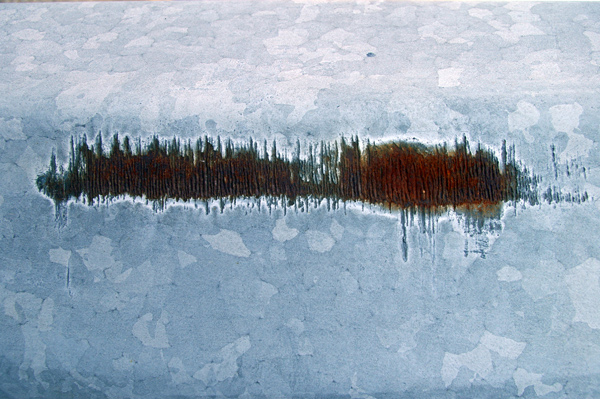
(Click on image to view at larger size.)
A subtle oxidation
The world burning away
One molecule at a time
Water and air
Setting slow fire
To the earth
I inhale, ground
My wet mammalian body
The Age of Iron
Is returning.
Photo and poem by Rachel D. Shaw
Download the MP3
 ::
::  ::
::  ::
::  ::
::  ::
::  ::
::  ::
::  ::
::  ::
::  ::
:: 
Elegy for the Newborn
The librarian doesn’t care
as she once might have
that the books I’m returning
are missing some words.
Then I come to a forest,
dark, mossy clouds
like morbid thoughts
not even drugs can dispel.
A yellow cab, its engine running,
is always waiting at the curb
for a messiah to appear.
It’s the difference between
a democracy and a republic,
and though there’s no wind,
the puddles shiver.
My face reminds most people
of someone they knew long ago,
before the assassinations
and roadside bombings.
I stop to rest with the newborn
on the border of shrill gulls.
by Howie Good
:: :: :: :: :: :: :: :: :: ::
Lest the Last Light Flee Also
Lest the last light flee also,
and all shadows resort to themselves
in the vast but starless night,
we fed pine knots to the campfire,
miniature sparklers leaping red
parabolas and blue tangibles.
Though those small fires eyed up
in the pockets of our faces,
and each could tell the posture
and the bent of his comrades,
more by eye level and fire acceptance
than by any of a thousand words,
we felt that ghostly closeness
the old cave-drawn hunters knew,
the brace of union, solidarity’s
slow motion moving under skin,
a brothering darkness holding camp
like a briefcase about a document.
We fed stories to the faulting fire,
reams of stories, great breads
of stories a slice at a time,
thick, slabby, crusty mouthfuls
of what had brought us here,
our whole lives loafed up.
When a sound happened outside of us,
the owl’s calling attention, a croaker’s
voice setting up tent in the night
hawking his dominion of the pond,
a loon’s soliloquy sliding over hills,
the sad songs saxophones loose;
we accepted it as punctuation,
proper pause, the best of caesura.
We understood the leaf, knew the tree
hanging fire above our heads, the span
of it touching different days.
Even darkness can’t hide a tree.
But daylight, we knew, and white
water’s rapid turmoil can hide
the silver and red of trout,
can hide the mouth bitter for worms,
the string and foil of manufactured
flies and bare metal strikers.
Daylight hides the reddest fox,
the darkest owl, and campfire dreamers.
As we talk, red lights in our eyes,
dawn bulging behind timid leaves
like a poorly kept secret, we understand
there are only so many visits allowed.
This visit will be the last for one
or more, the odds having their say,
the threats as fluid as the stream
we dare bend our ankles in.
As we trespass, camped inland above
the water’s constant flowing,
we are reminded by earth’s quiet
of what the pause of being means,
we are merely a small glow here,
stars set off in a widening sky.
by Tom Sheehan
:: :: :: :: :: :: :: :: :: ::
Call for Submissions: Journaling the Apocalypse
But we have speech, to chill the angry day,
And speech, to dull the roses’ cruel scent,
We spell away the overhanging night,
We spell away the soldiers and the fright.
—Robert Graves, “The Cool Web”
Autumn is upon us here in Quebec and central Pennsylvania. With it comes the third anniversary of qarrtsiluni, launched in late August 2005 originally as a place for literary and other bloggers to slow down and together try to create something of lasting value. We hesitated to call this bloggish, continuously published collection of themed anthologies a magazine at first, since it didn’t much resemble the established online literary magazines. Three years later, some of the early contributors have moved on, but many more have joined us — poets, writers, photographers, videographers, and artists of every description — to the point where our guest editors struggle to keep up with the influx of astonishingly high-quality submissions every two months. Things have changed a lot since the last time either one of us has been part of an editorial team, so we decided we’d better reacquaint ourselves with the process. What better way to mark the anniversary than for Beth and Dave to step out from behind the curtain and handle all the editing ourselves for the space of an issue?
The theme this time is Journaling the Apocalypse. Submissions are open now through the 6th of October, and we expect to begin posting around the beginning of October, after the present issue has concluded. (We are slowly adjusting to the idea that issues may need two and a half or three months to unfold, instead of just two.)
Our theme choice is a bit of a nod to qarrtsiluni’s roots in the literary/personal blog world, where journaling and journalism often merge. We’re used to thinking of apocalypse in terms of an indefinitely delayed doom, a Ragnarok. But in its original Christian milieu, it may have meant something far more immediate: Yeshua ben Yosef was apparently fond of saying that “the Kingdom of Heaven is at hand,” and the New Testament Greek word apokalypsis meant simply the uncovering of a pre-existent truth or state of being. Francis Ford Copolla canonized this notion for a secular age in his reimagining of Heart of Darkness: Apocalypse Now. Especially in the last hundred years, apocalypses of one sort or another — war, genocide, ecocide, nuclear armageddon — have been woven into the fabric of our common nightmares, and now, faced with the evidence of accelerating global climate change, we sense that even our gloomiest prophecies may have been too optimistic.
If humanity — and the earth — survive the next hundred years, people will wonder: how could we have lived like this? How could we have borne the knowledge that we were bringing disaster upon ourselves and still continued to consume? What was it like to live through a slow-motion cataclysm? For this issue, we’re soliciting original writing, video, music, art and photography created in response to this self-destructive prophetic fire at the heart of our civilization — or any civilization (and there are many) with end-of-time myths. We’re not looking for grand syntheses, but concrete and intimate portraits of the earth’s inhabitants and landscapes as they approach ground zero. We hasten to add that light-hearted submissions are welcome too: sometimes humor is the quickest way to unveil unpleasant truths, and it can be a good survival mechanism, too.
Please limit submissions of poetry to five poems, and keep prose below 3000 words per essay or story. We encourage artists and photographers to send submissions of a half-dozen or more still images, since those don’t take nearly as long for us to evaluate.
Presuming the CERN supercollider doesn’t create a black hole that swallows the earth when it starts up the day after tomorrow, we’re planning to branch out into some exciting new ventures over the next year. We hope you’ll stick around.
—Dave Bonta and Beth Adams
:: :: :: :: :: :: :: :: :: ::
 qarrtsiluni