Archive
Bruised
For Middlesex County Academy in New Brunswick, NJ — Alternative School
and Damon House — Alcohol & Drug Treatment Facility
They banter back and forth like boys do:
You charcoal, son. You so black you purple.
I tell them, hol’up in defense of my mahogany skin
and the boy they’re putting down. I say,
You know what they say? In cue as if we rehearsed it,
we both chime, the darker the berry, the sweeter the juice.
We flash twin smiles. There’s a moment when the air
gets less complicated in the room. The space is large enough
for me to ask, why y’all hate on each other so hard?
Oh, he? He my boy. See, that’s how we show love.
They crush so hard I want to weep —
I’m so tired of everybody being gangsta hard,
but they are being real. I know ‘cause I got brothers
and growin up I never saw them show love,
except in that one on one — man on man dunk in yo face.
Call you ignant ten times a day kind of way.
Their talk swags like their walk.
I follow the conversation as it dips and drags.
We end up talking about how we were punished as kids.
I lead with, I’m from the South and ya’ll don’t know
nothin about a switch — havin to go ‘round back
fetch your own hickory, the same stick use to beat you.
I say these words and I still feel the sting of the switch.
See welts raising into an angry language of graffiti on my skin.
One says, don’t bring back no skinny one neither.
I shake my head in solidarity—the blood we’ve spilled makes us kin.
Another boys says, what about those belts?
I hear my mama’s beating cadence,
a belt whip with every word, I—told—you—not — to…
Another says, extension cord.
I’m brought fully awake, cause
I don’t know nothing ‘bout that kind of whippin.
We only heard of Cedric down the street gettin beat like that.
Then, we did not know the word, Abuse
or the phrase Child Protective Services.
We just said his mama was MEAN.
Jicante, another says, I say huh? Rice.
You kneel on raw rice for hours.
We walk down alleys; I listen as they go deeper
into the shadows farther than I have ever been,
but we don’t skip a beat. We laugh —
joke about our beatings and nobody mentions
the pain, but it’s all understood — we are all battered.
We bump up against each other’s wounds before we brainstorm.
I pick up the marker and they bicker blue versus red.
I read between the gang signs. It is not lost on me,
that when these colors mingle, they make purple.
I muse in my mind how violence for them still continues.
I come back to the poem, that we are here to write;
the ones that saved my life. I know this detour we took
down old roads is a place we had to go,
places where we have been loved so hard it hurts,
so hard we are still bruised.
We bear our scars,
then we pick up our pens
and write.
Glenis Redmond is a native of Greenville, South Carolina. She resides in Asheville, North Carolina. She graduated from Erskine College and obtained her M.F.A at Warren Wilson College. She is a full-time performance poet and published in literary journals across the nation.
At IGI Airport, New Delhi
by June Nandy
Prison alters; different appearances
for the same thing. Chains translate
gravity. Align with its tinsel-thread, you
will resurface in a cage, washed in honey;
whisperings of promises. A promise is
a choice, a path to bind, in the duty-
free shops before you can fly.
Choices are tucked into shelves. The
sign: A wine, never seen so fallible,
will soon be shoved in a duffel bag
by a spent traveller. A seaweed mask,
for an exhausted face peers out of
the mirror; it will pull a woman. But
first, she’ll kneel, to pick up the brittle
bergamot leaf that slips out of
the book of no-exit.
And that little girl, staring at the vending-
machine. What would it mean to stand
beside her, teach her to feed a code, of
what she wants, to pay the price, wait
for the meanings locked inside to tumble
out. If you were really there, would you
draw on the glass-cage, a bird, set to
take a flight, beyond bounds.
June Nandy’s recent works have appeared in Commonline Zine, Certain Circuits, Up The Staircase Quarterly, and elsewhere. She has an award-winning poem in the open poetry contest, 2009 with Prakriti Foundation, Chennai. Her novel Ideospheres of Pain, which advocates for an ideology-free world, has been released in India. She has been nominated for the best of the Net Anthology 2010 and best of Dzanc Books Web Anthology 2011. Her new poetry collection, The lines must die, has recently been released by Cyberwit.net, India. Her poetry and other details can be accessed at her website.
The Stick
Chief complaint: fever. History of present illness: 49-year-old HIV-positive African-American woman, tested HIV-positive five years previously to admission, currently undomiciled. Presented to the psychiatric emergency department at admission with delirium and fevers and was then transferred to Adult Emergency Services. Physical findings on arrival on the Medicine service: fever to 102F, tachycardia, tachypnea, hypotension, crackles about halfway up the lungs bilaterally, and oxygen saturation of 89%. Blood cultures and arterial blood gases were drawn.
When you finally got blood from the hard stick
You spotted the backflash of red
And said Thank God. The woman’s legs and arms
Were everywhere, and you were in the middle
Holding her down with one hand while wielding
A butterfly in the other. You stuck her and she bled.
You thank the Rock of Moses that she bled
And not you. Moses took a stick
To strike the rock, unwilling
To try his luck with more persuasion. God read
This as rebellion. Here the test of mettle
Is not getting stuck. Fuck! you cry, and hold her arms
Again. Can she please quit moving her arms?
She’s used and used. Most of her life she’s bled
High, or been sick, or in the middle
Of other people’s lives. Now she’s screaming. Stick
It out or shut up, you could say. It’s for your own good. Red
Is what you want from her. Would you help us? Are you willing?
You promise her a Snickers and she’s willing.
Her drugs are stamped on her arms.
Her lips and nails are painted careful red.
Her AIDS showed on a blot of what she bled.
Moses lashed out with his stick
When he wasn’t out front, but in the middle.
But that wasn’t what you were thinking in the middle
Of multiple stabbings and wheedlings.
You’ll send the labs. You’ll treat. Will it stick?
Is Bellevue just another scar on her arm?
I’m sorry if you want suspense: you stuck, she bled,
She shrieked and thrashed, the gauze turned red.
Moses, stick in hand, didn’t know he erred
Till God denied him. Force: it feels like meddling
To those on divine peaks away from blood.
But we down here see in the scars and whealing
Proof indirect that what we teach our arms
Is strength, not just intention. A stick
Read as a resting staff is idle; wielded
With strong arms is a try at mettle.
We bled her to cure. She was a hard stick.
Zackary Sholem Berger (website) is a Baltimore-based poet and translator writing in Yiddish and English. His first book of poetry came out in 2011. Titled Not in the Same Breath, it’s 1/3 Yiddish, 1/3 English, and 2/3 pretty pictures, and can be purchased here.
Marielito
by Nancy Scott
When Tomas boarded the rickety craft
in Mariel, deck swarming with strangers,
no life jackets, sun flirting
with incoming clouds, the teenager
already missed his girlfriend
pregnant with his child.
I’ll bring you both to America, he’d said
—words that haunt him still.
Decades later, in a neat bungalow
in South Amboy, Santeria candles burn
in a small shrine surrounded
with flowers. On the stove, pungent
arroz con pollo simmers.
Tomas explains after the boat landed,
he was forced to give up his passport;
in return, ten bucks and a bus ticket.
Stateless, no papers, he’s raised
three children born here—
their mother’s in prison.
Always one question away
from deportation, but to where?
Castro doesn’t want me either, he says,
and who would care for my children?
Tomas supports his family
in a shadow economy.
In his driveway, a derelict car
he’s fixing up to swap.
He shows me photos of a son
he’s never met—his first-born—
a captain in the Cuban army,
and another photo of his mother
cradling his only grandchild.
I pray to see my mother before she dies.
Author’s note: In the 1980s, 125,000 Cubans left from the port of Mariel in what was called the Freedom Flotilla.
Download the podcast
Nancy Scott (website) who is from Lawrenceville, New Jersey, is the author of two full-length books of poetry, Down to the Quick (2007) and One Stands Guard, One Sleeps (2009), both published by Plain View Press, and two chapbooks, A Siege of Raptors (Finishing Line Press, 2010) and Detours & Diversions (Main Street Rag, 2011). She is also the managing editor of U.S. 1 Worksheets, the journal of the U.S. 1 Poet’s Cooperative. She began her foray into the art world in 2010, and has begun exhibiting her work and publishing her collages online.
Objects of Desire and Their Wrapping

January 2010, Stuttgart City (click on image to view a larger version)
Dorothee Lang (website) is a writer, web freelancer and traveller, and the editor of BluePrintReview. She lives in Germany, and always was fascinated by languages, roads and the world, themes that reflect in her own work. She keeps a sky diary, is still captured by the possibilities of the web, and currently is focusing on collaborate projects.
Fire Escape
by Nancy Devine
She’s been relegated to this: a group of boys on the third floor, each has a hand down his pants, through an unzipped zipper, an index finger sticking out. With the other hand, each pitches quarters at her when she passes. Oh and the boys wiggle those fingers—the pointers, little pig tails trying to straighten out. However, if they could get what she reportedly gave on a fire escape during an assembly, they would take it. I know they would. They’re fourteen and fifteen, easily sprung, short to last, oblivious to foreplay.
But this throwing of money, exaggerated and deliberate, is designed to demonstrate that not a one of them would stoop, would deign to be in any position with her, let alone on the metal stairs outside our school, his jeans at his ankles, his most unpredictable part in a girl’s mouth… literally the skin of her teeth. And those fingers, small and pink, because the boys flap and wag them so unabashedly, are meant to say, “I’m so confident about my size and shape that I will stick out my finger which is certainly the opposite of what I’ve really got in my pants.”
And she’s an ugly girl, her face bird-like, the features concentrated in a place too small—the nose sharply hooked, her eyes tiny and easy to forget. Her skin is pale, lighter than the wall color around us and her hair is nearly as light, a bleach job run amok. It’s thin and flyaway like a swimmer’s during season; you can hear in your mind, the sound that hair would make if it were touched. A small and brutal crunch. I should befriend her, be kind and humane to this girl the boys call “BJ,” after all no girl with any measure of self-esteem performs fellatio on some kid on a stoop while the rest of us at a pep rally are cheering our boys to victory… as if the two are completely different acts. (The word “humane” stops me. Isn’t that how you are nice to animals?)
The guy? The recipient? No one seems to know who he is, or if someone does, there’s no divulging; he’s the spectral victim in this story, the one wronged, the one who shall remain nameless in this high school lore. Is he one step above the girl’s class? Two? Maybe he’s even among the boys on the third floor, making fun of a girl who probably gave him pleasure, albeit, brief? Right now, mouths are closed; lips are sealed… oh unless you’re going to say, after coins land on carpet, “Hey, BJ. Take this.”
Where am I? At the entrance to the school library, my left hip and hand pushing one of the big double doors open, a bundle of books cradled in my left arm, all sorts of unease in my mouth. I did what I could in there. A geometry proof due in an hour, a bland history worksheet on some country I’ll never visit. In my next class, that boy I like; sallow complexion, dark hair in intriguing disarray, a star debater. He’s smart; he wants to write his sophomore paper on theories of time. And he’s never lined up with those boys and I have looked for him there since it all happened two weeks ago. But then that sound blasts through. It’s like the taking in, when an air compressor sucks in more to increase the pressure in the tank, a rattle tumultuous at the elbows and the shins, as if the psi in my body has been jacked up, too. But it’s not that. It’s the fire alarm, that full-throttle blare that assaults you in the ribs, that means get out. Flee. Escape. Now.
I push the library door open where it sticks so we can get out. I round the corner and head down the stairs, where it feels as though every student is, as if there were no other stairways in the school, a single path from top to bottom, like an alimentary canal. We wend around the corner at the landing and take on the next flight, my hand sliding along the rail, smooth as bone. After a couple of steps, the crowd of us settles in and finds a rhythm to our exiting; we’re one being… one hurrying student at ease.
When we get to the door that gets us outside, the girl from the fire escape comes up from the basement and pushes through. She is perennially awful looking, someone stripped of color, an utter wash-out, except for blemishes collecting around her chin.
She keeps pushing and when she gets right next to me, her push knocks me off balance and I bump into the wall.
“Move over, bitch,” she says and she opens the door. We have never spoken; I’m pretty sure she doesn’t know me at all. For a moment, I’m trapped behind the door until she gets outside and some boy grabs my arm. “Be careful. You gotta get outside,” he says. I don’t get much of a look at him, and I don’t recognize his voice and then I’m outside, students everywhere on the sidewalk north of the school. Some lean against “No Parking” signs; others stand in clusters at the curb, hoods up. Is it possible that the boy I like is standing near her, condensed breath like language issuing from their mouths?
Fire engines take over our ears. But that doesn’t necessarily mean there’s a fire. They show up even if it’s only a drill. And really, we try to escape no matter what.
Nancy Devine (blog) teaches high school English in Grand Forks, North Dakota where she lives. She co-directs the Red River Valley Writing Project, a local site of the National Writing Project. Her poetry, short fiction and essays have appeared in online and print journals.
Joseph Palmer’s Journal
by Diane Kendig
It’s only a photocopy, so maybe
these liney shadows have been cast up
from the reverse side,
when the machine lit on them
one hundred sixty-five years later,
but I believe that Palmer,
on his way to prison, couldn’t imagine
using so much paper,
and after months recounting
his defense to the judge
(as long as his face were no uglier
than his horse’s, he’d keep his beard)
and his prison privations,
teaching him what inmates mean
by hard time versus flat time,
he looked at the book,
his careful farmer accounts
of plantings and harvestings,
how much he could say then
with catalogues, now interwoven
with the relation of his imprisonment,
appearing not chronologically
but wherever there was space,
and right here he erased
to continue the text, as critics call
the drafting, x-ing, and rewording,
the sudden appearance of syntax
which he had never employed
to convey the natural order of his life
before sentencing.
Author’s note: Joseph Palmer, a self-educated farmer, was imprisoned for over a year in 1830, much of that time in solitary confinement without sufficient food, for refusing to shave his beard.
Diane Kendig’s recent chapbook is The Places We Find Ourselves. Her prose and poetry may be found in J Journal, Minnesota Review, Wordgathering, and Seventh Quarry, among others. A recipient of two Ohio Arts Council Fellowships in Poetry and a Fulbright lectureship in translation, Diane currently lives “out of place” near Boston. She spent four months in medium security spread across 18 years.
The Winter I Went to Two Al-Anon Meetings, Realized I Didn’t Have What It Took to Love Your Version of Alcoholic
by Nancy Flynn
You crashed but never
burned and Six Mile Creek
froze for weeks. The stores
sold out of shovels; I chipped
and scraped with a hoe.
New Year’s Eve we walked,
ice all the way to town
a horizontal fish tank,
miniature minnows
our Pied Piper underneath.
Ice plugged the gorge,
slicked the bridge
over Ithaca Falls,
the one desperate
students died to leap.
Jumping wasn’t your style,
not enough slo-mo in that.
All January, our bed
had turned sleety
the fitted sheet stretched out.
You were working your way
through a suicide primer,
redacting the lists—first this,
then that, if all else fails,
eventually this again.
Cases of wine arrived
weekly from FedEx,
giant bags of empties
I dragged to the curb,
how they bangled, chains.
February was a blur,
an ankle cracked as well—
you said you lost your balance.
What weren’t you thinking,
gutters in that squall?
March on the ward
in group, they made you talk.
You told me how you quoted
Weldon Kees: The spangled
riddle is twitter and purr.
Because otherwise?
Solitary and no cigarettes
in that room, empty
but for a single,
sheetless bed with stains.
On April’s banks, the thaw,
and forsythia struggling to bud,
I turned runoff from
your mind’s residue vain-
violent. Never trickled back.
Tim the astrologer said:
You can always find
something to love—a dog,
a hummingbird, a pear.
End-of-winter, psychic
meteorologist, you were
the one, insistent whisper:
Dream on, bingo boots.
How soon the night turns
frost, bitten to the quick.
Note: The line “a mind’s residue vain/violent” plays on Weldon Kees’s line in “Corsage”: “your mind vein-violet.”
Nancy Flynn (website) hails from the coal country of northeastern Pennsylvania. Her writing has received the James Jones First Novel Fellowship and an Oregon Literary Fellowship. Her poetry chapbook, The Hours of Us, was published in 2007. A former university administrator, she now writes creatively and edits carefully from her sea-green (according to Crayola) house near lovely Alberta Park in Portland, Oregon.
Eleven Times A Loser, he said.
by Rina Terry
He counted them off,
conviction by conviction,
bid after bid, by fingers, thumbs,
his body drawing itself up
straight and tight
and stiff
and then for that final one
formed his hand into the shape
of a gun and pointed it
at his right temple
and held it there
a very, very long time
“Eleven,” he said,
and his eyes, as he turned to salt
before my gaze, held a blankness
that brought no tear of sympathy
but a shortness of breath,
as though this steel and concrete
world no longer lived by oxygen.
In whatever co-existing valence
we dwelt for those moments, the Shift
Change meant resuming normal
posture that could not be construed
as anything more than sitting
in a chair, in the chaplain’s office
for a one-on-one…
he recollected himself
slid into the his usual pose:
shoulders back and down,
chin dropped
to unclench the jaw
(just the faintest hint
of muscle spasm at the side
of the face where things hinge),
one leg stretched out long
and wide apart from the other.
The even wider, wider smile
as the officer tells him
his time is up.
Rina Terry lives, writes and works in Cape May, New Jersey.
How the Other Side…
by Stephen Mead
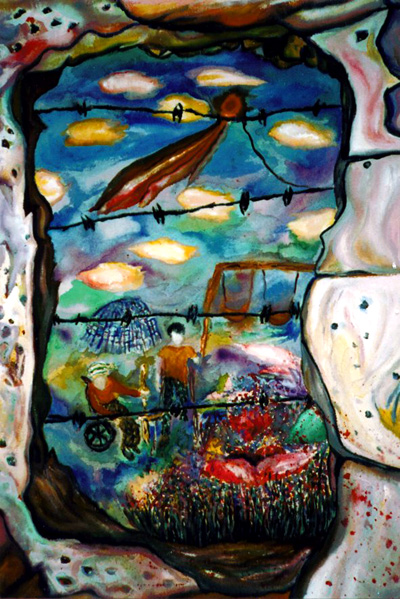
Film still from the film “Mercy, Mercy, Mercy” (watch on YouTube).
Click image to see a larger version.
A resident of Albany, New York, Stephen Mead is a published artist, writer, and maker of short collage films. His latest project, “Whispers of Arias,” is a collaborate piece with Kevin MacLeod, setting some of his more narrative poems to music. Tracks from this can be heard at stephenmeadart on SoundCloud.
 qarrtsiluni