Archive
Final Notations: Extramarital
after Adrienne Rich
it will not be a marriage, it will not be short
it will feel timeless, it will consume your mind
it will peel you to the core, it will find you
it will be winged, it will not be a marriage
it will be the air between your bones, it will steal your breath
it will not be short, it will consume your thought
as Jesus consumed death, as flame consumes grass
it will take all your heart, it will not be a marriage
You are walking onto water that will spill you
you are walking onto water that could never hold you
you are taking others into drowning you will live
you are going through your days with two hearts
it will be winged, it will find you
it will not be a marriage, it will become your one desire
Marilyn Annucci won the 2012 Sunken Garden Poetry Prize, selected by Tony Hoagland, with a chapbook forthcoming from Hill-Stead Museum in June. She is the author of the chapbook Luck, from Parallel Press, and has had work in various journals online and in print. She was raised in Worcester, Massachusetts, and she worked for many years as an editor/writer before earning an MFA from the University of Pittsburgh, where she began her teaching career. She is now an associate professor in the Department of Languages and Literatures at the University of Wisconsin-Whitewater. She is currently working on a manuscript of poems called After Her that draws on the literary tradition of imitatio.
not a Bukowski poem
by Jim Murdoch
I am not Bukowski
but I am the kind of person
he would have written about
if he had lived in Glasgow
or I had lived in L. A..
he would have sat at his desk
with his shirt off,
watched me
and decided what kind of man
I was.
it’s uncomfortable having the shoe
on the other foot.
Jim Murdoch writes, “I was sitting in a cold classroom on a dreich Tuesday afternoon. Our teacher handed out roneoed copies of Philip Larkin’s poem ‘Mr. Bleaney.’ There were no similes, no metaphors, no alliteration, no onomatopoeia, no babbling brooks, no blokes sitting in fields full of daisies: suddenly I realised what poetry was and all the rest was window-dressing. That was forty years ago and I have been writing and publishing ever since. You can read further examples of my poetry and prose on my website (I’m also a novelist) and there are links too on my blog, The Truth About Lies.”
The Hive: A Parody
by Robbi Nester
I heard a Beehive in the wall
When I was trying to sleep—
Incessant Buzzing at all hours
Precluded counting Sheep.
My swollen eyes were red and sore—
The clock said 2 AM—
I wished the Sun would break his bonds—
Ushering Morning in.
I took a Hatchet from the hutch
and hefted it awhile.
Though it might make an awful Mess
I’d end this thing in style.
The first stroke broke the paper cells—
The second set them free—
And now I’m wrapped up in the rug
And cannot see to See.
Robbi Nester lives and does yoga in Southern California and blogs at Shadow Knows. She has a chapbook, Balance, forthcoming from White Violet Press with illustrations by Nina Canal. Her manuscript A Likely Story is currently in search of a publisher. Robbi writes, “I am very interested in parody in a theoretical way, and indeed a number of years ago wrote a dissertation about Nabokov, focusing on this very element of his work. I wanted to think about the nature of the relationship among texts in a parody and what they mean, as well as investigating other kinds of literary play.”
The Love Song of J. Alfred Proofreader
(With apologies to T.S. Eliot)
“What do I think about the way most people dress? Most people are not something one thinks about.”—Diana Vreeland
Let us go then, you and I,
To our desks at Vogue against the sky.
On the thirteenth floor you caption clothes:
Go-the-distance cotton
Punctuated with sexy sheer hose.
I insist on commas
And tell you what you say;
I am the Copy Production Chief by night and by day.
At Vogue the women come and go
Talking of Giorgio di Sant’Angelo.
For you there will be time
For a hundred visions and revisions
For you are not the one
To wait until midnight for the new repro
To come down from being typeset.
Indeed there will be time
To prepare a face to meet the faces that you meet;
You’ll duck into the beauty closet
For all the Bobbi Brown Essentials
You can apply.
And as you run through my office
On your way to dinner you’ll say,
“Look at this cute little passageway!”
So how should I presume?
At Vogue the women come and go
Talking of Giorgio di Sant’Angelo.
I have known the eyes already, known them all:—
At the elevator,
Locking on my Chanel knockoff,
My Snickers bar,
My Duane Reade discount drugstore bag,
Sprawling on a pin
They know I got from the giveaway bin.
Was it worthwhile,
Throwing off my shawl,
Turning toward the writers to say:
“That is not it at all,
That is not what you meant, at all”?
They thought me
Full of high sentence, but a bit obtuse.
They just wanted to dish about
Johnny Depp on the loose.
I grow old…I grow old…
But my friends are all at magazines that could fold.
Shall I part my hair behind? Do I dare to eat a peach?
I see a young fashion assistant reach,
But then decline—
“Too much sugar,”
I have heard the mermaids singing, each to each.
We have lingered in the hallways at Vogue
By beauties so afraid of lines they never frown
Till Vanity Fair calls, and we go to work for Tina Brown.
Donna Levine Gershon’s poetry has appeared in storySouth, Literary Mama, and Kakalak 2007: Anthology of Carolina Poets, among other publications. She was first runner-up for the 2007 South Carolina Poetry Initiative’s Single Poem Contest. She now lives in Oxford, Mississippi, where she works as a freelance editor.
Imitation Self
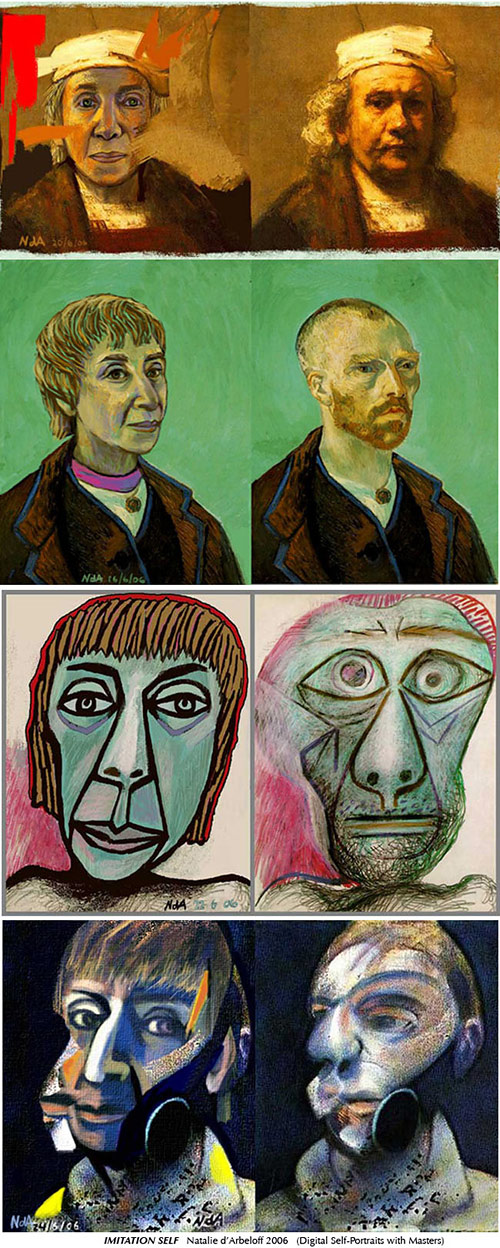
Click on image to see a larger version
Four self-portraits, more or less in the manner of four Old and New Masters I admire and envy for all the ways in which they are unlike me: Rembrandt, Van Gogh, Picasso, Bacon — all burning with single-minded dedication to their work while I flicker and flit.
Painted digitally in 2006 on my Wacom graphic tablet as part of a series posted on my blog, Blaugustine.
*
Born in Paris, raised in South America, USA and Europe, Natalie d’Arbeloff lives in London and has dual nationality, British-American. Her father was Russian, her mother French. Her alter ego is the cartoon character Augustine and her blog is Blaugustine where she sometimes interviews God, among other celebrities. See her website for more about her work as a painter, printmaker, book-artist and cartoonist.
Lucasta Responds to Richard
by Janet McCann
after Richard Lovelace
My breast is no chaste nunnery
unless you fondle nuns.
I thought you’d passed on gunnery
for thighs, and breasts, and buns.
Don’t tell me honor is your goal.
You’re out for blood, of course.
I do regret the hours you stole.
Dick, go kiss a horse.
Journals publishing Janet’s poetry include Kansas Quarterly, Parnassus, Nimrod, Sou’wester, New York Quarterly, Tendril and Poetry Australia. A 1989 NEA Creative Writing Fellowship winner, she has taught at Texas A&M University since 1969. She has co-edited two anthologies, Odd Angles of Heaven: Contemporary Poetry by People of Faith and Place of Passage: Contemporary Catholic Poetry and is the author of The Celestial Possible: Wallace Stevens Revisited. Her most recent poetry collection is Emily’s Dress (2004, Pecan Grove Press).
Pyrenees 1996
by Maude Larke
with apologies to James Agee
Now we have come to the long descent that takes possession of the green slope nestled in the amethyst icebergs of peaks through the repeated Zs of the path where dust rises, plays, settles, repeating in rhythm to the successive passing feet. A lingering yellow winks sparsely from the scattered gentians wandering and searching in the angled meadow, neither flocking to us nor fleeing. Our feet walk through shadows, clouds surveying, until they follow one, a red kite, wings in circumflex, two eyebrows raised in a question for what the prairie will produce. Voices are silent; the click of the nailed tip of a hiking staff on a rock, the soft, muffled tide of a canteen; the tin ticking of the loose buckles of a backpack. Dusty patches of path; muddy patches of path, chocolate and greedy for our boots.
We imitate the dance of skiers, drifting down in their balletic diagonals with our one pole to balance, to turn us. The kite finds its mouse; the shadow shrinks and corners of eyes see the eyebrows frown. The mouse searches a hole, a log, in the instants before the talons fold. Then the mouse meets the feel of flight for the very first time. The gentians nod complacently and gaze. The mouse’s tail flicks, twice, thrice, as the kite’s tail fans, flinches it delicately back into its gyre. The silence salves anew. The sun bathes us as if we were babies and the blue that it climbs, sliding its round back along the vault, between or along the missing ribs of implied arches, fondles the eyes when the eyes rise to it. They scan the narrow tan track as well to navigate the root, the stone, the lacing elbow. The navigation sometimes slips: a boot thuds, a cleat grates. But yet no words are spoken as we wind back downward into the world: the leader, still hoisting the shoulders of an army career, braking at each step; the sisters, one mostly silent, one mostly talkative, both quiet now; my good friend’s nephew, too mischievous for a slope so far from base; my love, dark hair reaching to red from a week of the sun’s reiterated rays. And I am winding too, down to laundry and schooldays and books, and try to take my eyes to all the amethyst icebergs as they roll backward behind the green slope, the beeches joining branches and marking the vertical, the Zs that hum as they cradle our feet, the winking gentian. But they search elsewhere also: for the kite gone to its banquet, for the sharp crest separating Spain from France by a worm’s slime track, the mist gathering in like a hungry flock, gleaming white right then; for the designation with the thump of a staff of the arrival at altitude, the huge cirque opening just beneath it and the northern wheatear scolding us for interrupting; for the herd of Pyrenean chamois, grazing to our left as we rose, anxious for their sanctuary, to our right, muffled urgent thunder arrowing down one meadow slope to leap the frigid coursing brook and paw intently up the other, the babies’ double-time hooves keeping up with the mothers’; the utter, present, cottony quiet of the globe once the tents were closed; the stiff swinging of the tent flaps on mornings when frost still defied day.
I break from trailing the new memories as we break from the trail and settle in the last corner of the green blanket before we tuck ourselves into the gathering woods. Our mats are spread, our last provisions are spread, we perform the vanishing of final traces of sustenance and offer the cheese, the semolina, the doses of powdered milk, the carefully treasured chocolate bar. I boil the water and drink the tea carefully; the metal cup jabs at my lips as malignly as it can. I drink slowly, in little sips, knowing that the last sip leads to washing, the washing to packing, the packing to taking up the load, lighter though it is. Not knowing yet about the last gems I will also pack: a grey donkey nuzzled to an old black horse with white whiskers; a glimpse of a curious but reticent fox; a nightingale deciding to rehearse after hours; beeches ceding to pines and footfalls like perfumed sounds of harvesting.
Oh, of course, we do crave it, the base, the laying of the loads, the coffee beans ground and drowned, cooking smells caressing our nostrils from an oven. But the sinking from the ridge is also a shrinking from the true trajectory of cleansing and an acquiescence in personal pollution. I sigh against the return to the too-complex, too unmigratory me waiting on the other side of a door with a lock on it that I will be soon to unlock and step through, that I will still know to unlock and step through despite the stiffness of the tent flap marquetried with frost and its swing welcoming out.
Maude Larke lives in France. She has come back to creative writing after years in the university system, analyzing others’ texts, and to classical music as an ardent amateur, after fifteen years of piano and voice in her youth. Publications include Naugatuck River Review, Oberon, Cyclamens and Swords, riverbabble, 52|250, and Sketchbook.
In the Middle of the Bench
by Joe Zealberg
After Carlos Drummond de Andrade
In the middle of the bench there was a black patch and cane
there was a black patch and cane in the middle of the bench
there was a black patch and cane
in the middle of the bench there was a black patch and cane.
I’ll never forget that young veteran
clenched in my unblinking eyes.
I’ll never forget that in the middle of the bench
there was a black patch and cane
in the middle of the bench there was a black patch and cane.
Joe Zealberg, MD attends an ongoing poetry workshop in Charleston, South Carolina with a group known as “The Long Table Poets,” under the direction of Richard Garcia. This is his second appearance in qarrtsiluni.
Call for Submissions: Imitation
Submissions are now open for the Imitation issue. The deadline is November 30, and we expect the issue to begin serializing here sometime in January, after the conclusion of the current Worship issue.
Theme description
Imitation — that sincerest form! — is in art all too often maligned. “Better to fail in originality than succeed in imitation,” no less a writer than Melville once sneered. For Emerson, imitation was “suicide.” Especially since the Romantic revolt, writers and artists in the West have taken for granted that originality is the soul of creation.
Originality, though, is crippled without discipline, and imitation is an uncompromising practice. The Great Masters of the past knew this well, and would apprentice for years to gain fluency of form; the literature of earlier eras, too, was woven with both homage and parody. Poetry in particular has lent itself to the game: both John Keats and William Blake published An Imitation of Spenser, while Spenser, in turn, openly mimicked a more antique verse. Robert Lowell’s Imitations is humbling in its breadth, and how many countless poets have affixed an italicized “after xx” beneath a title?
We believe there’s plenty to be gained from reviving the imitative tradition — be it in jest, out of reverence, or somewhere in between — and so, for the next issue of qarrtsiluni, we’re asking you for your greatest imitations. Whether you’ve always dreamed of being Faulkner (or Milosz or O’Keefe or Banksy or Bresson), or just want to try your hand at highbrow fanfic, here’s your opportunity.
Submissions will be evaluated not only on their own merits but by how well they evoke the style or approach of another. Though it’s up to you whether or how to acknowledge the model in the submission itself, we do ask that you spell it out in your cover letter. (Where appropriate, you might include a copy of the work being emulated — or spoofed.)
Submission details
Our limits this time are three poems, five images or videos, and/or 1000 words of prose per submission. All submissions must go through the submissions manager (which also includes our general guidelines). If you’ve submitted to other publications that use this system, Submishmash, you’ll need to log in with the same username and password. Otherwise, you’ll create a new account as part of the submission process.
As always, we consider contributions of nonfiction, poetry, short fiction, photographs, digitized artwork, short films, original musical compositions, spoken word recordings, translations and collaborative works.
The editors
Siona van Dijk is an entrepreneur, writer, and graduate student in Depth Psychology. Prior to qarrtsiluni, Siona has served on the editorial staff of The Amherst Review, Circus, and A Further Room. Her favorite mimic is the lyre bird.
Dave Bonta handles most of the day-to-day operations at qarrtsiluni, but once a year he likes to don the hat of an issue editor, too. Some of his other online projects include the videopoetry collection Moving Poems and a daily microblog of observations from his front porch. His most recent print publication is in The Book of Ystwyth: Six poets on the art of Clive Hicks-Jenkins.
 qarrtsiluni