Archive
List, Pre-Word, Pre-Poem
we have a narrative about the future
medium
portent
foreboding
presentiment
harbinger
herald
precursor
envision
it will be black and white
it will be like madness to us
clairvoyance
I ching
chromancy
sortilege
sciomancy
haruspication
it will emerge from a darkened room
it will need us to hold hands
oneiromancy
bibliomancy
pyromancy
auspice
ornithoscopy
the light we see it by is no stronger than a candle flame
we feel weak in the future and strong in the present
divination
augury
soothsaying
scrying
we depend too much on that narrative
Claire Crowther has published two collections from Shearsman. The first, Stretch of Closures, was short-listed for the Aldeburgh Best First Collection Prize. Claire’s poetry and reviews can be found currently in Poetry Review, Poetry Wales and Poetry London.
war nights
by Farideh Hassanzadeh-Mostafavi
I feel night by night more real
and old
so old and real that in the mirror
I see nothing anymore
but a range of empty chairs.
Download the podcast (reading by Wendy Vardaman)
Farideh Hassanzadeh-Mostafavi writes, “It was wartime between Iran and Iraq. One night, as every night, the bombs began to fall, and this time they destroyed an elementary school. It was very close to our home. When we went to see what happened, we saw empty chairs fallen on the ground like dead children. They were surrounded by pieces of broken windows, doors, and ceiling.
“Since that night, whenever I look into the mirror, I can see nothing but a range of empty chairs. I wrote the above as a fragment in my notebook. Many years later, I used it in a poem about war.”
The sky today
When I was four or five I was standing in our gravel driveway on Marlborough Avenue. The sun was shining like a good example and at the same time it began to rain, but only on the half of the driveway where I stood. In answer to my perplexity, my mother said this was a called a sunshower. And I said, Ok, now I’ve seen everything.
Sarah J. Sloat lives in Germany, where she works in news. Her poems have appeared in Barn Owl Review, DMQ, Bateau and Fraglit, and her chapbook Homebodies will be published by Hyacinth Girl Press this summer.
The Travelling Bride
Sign says tiny grass is dreaming. Do not disturb.
To whom have you given your warm cloak?
Mother’s spirit whispers to me
A fallen flower crushed
Imprint of a warm hand on glass, fleeting,
My income solely depends on the angles of my face,
The curve and swell of my body.
Concrete and dead tree bone white as his skin,
Blinding light
The place I do not recognize
is where I make a home,
May Dy
30-05-91
Zeny May Dy Recidoro is taking up Art Studies, majoring in Art History at the University of the Philippines-Diliman. Sometimes, she rids her name of its beginning and end and writes as May Dy.
The Saint of Lost Causes
by Alice Driver
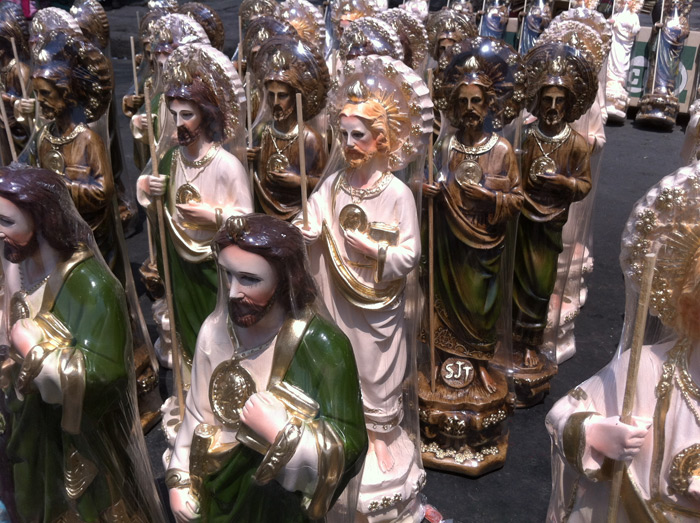
(Click image to see a larger version)
There are things you can say over a cold michelada and a pile of chicharrón, things you can confide in beer, lime, salt and crackly pig skin drenched in hot sauce. You can say “I might be pregnant” or “I want to be a filmmaker” as you lick grains of salt from your lips. The fatty chicharrón fills you up and makes you bold enough to tell the truth, to let it seep through your pores. You can lament boyfriends who tell you, “You wrote my report for work, but there were muchísimos spelling errors. It made me look bad.” You can talk of the cult of the Saint of Death — la Santísima and her followers. They are the children of prostitutes, street vendors who hawk fayuca (black market goods likely made in China), petty thieves, and homeless children. “La Santísima,” they say, “is the only equality we know.” In death, they see some measure of justice, a fate that no one can escape.
With the michelada you do not cry. It is not a drink for tears. There is already enough salt. You wonder why you are twenty-five and you still don’t know what you are doing with your life. How is it that you were sick last week and you did not have enough money to go to the doctor? At one time, you thought you could live on pure belief in something. Now you are not so sure. Why did that boyfriend say, “The condom broke, but I didn’t tell you, because I didn’t want you to worry.” And when you share this tragic quote with a stranger, she understands immediately, instinctively. She buys you a single cigarette from the waiter. You offer her a piece of pork skin soaked through with lime and salt. She takes the transparent shell of an offering in her palm, as if it were sacred.
She reaches over and sips your michelada and tells you to go see San Judas Tadeo, the Saint of Lost Causes. On the 28th of every month, at the church of Santo Domingo near metro Hidalgo, you will find distraction. Youth with shaved heads, blue mohawks, and miles of ink on their arms carry, like a baby, statues of San Judas Tadeo. Across their midsection are slung cloth bags with the Saint’s image. And you think of lost causes, of lost people, and imagine yourself buying a statue and joining the tribe of outcasts.
Alice Driver is a writer and translator based in Mexico City. The photo was taken when she participated in the monthly worship of San Judas, “The Saint of Lost Causes,” in Mexico City. She recently published “Ciudad Juárez as a Palimpsest: Searching for Ecotestimonios” in Pushing the Boundaries of Latin American Testimony: Meta-morphoses and Migrations (Palgrave Macmillan, 2012). Her interview with author Charles Bowden is featured in the August 2011 edition of the Hispanic Research Journal. She is also a contributor at Gloria Steinem’s Women’s Media Center.
Quartet
by Howie Good
1
I had just turned six. The universal symbol for handicapped hadn’t been invented yet. Birds dragging broken wings left their black footprints on the stairs.
2
My parents made me take piano lessons. The piano hated me. I spent Hanukkah watching Christmas lights blink on and off on the house across the street.
3
My shadow walked ahead. It seemed odd that the stairs that went up were the same stairs that went down.
4
A man stood washing an apple at the sink. All the windows facing the other side of the world were open. Veiled women beckoned him into the Kasbah. The X on the sidewalk marks the spot where he landed.
Howie Good (website), a journalism professor at SUNY New Paltz, is the author of the new poetry collection, Dreaming in Red, from Right Hand Pointing. All proceeds from the sale of the book go to a crisis center, which you can read about here. He is also the author of numerous chapbooks, including most recently The Devil’s Fuzzy Slippers from Flutter Press and Personal Myths from Writing Knights Press. He has two other chapbooks forthcoming, Fog Area from Dog on a Chain Press and The Death of Me from Pig Ear Press.
The Book of Forgetting
Those chimes—
I remember wind, but this music is new
***
Your face—hello, old friend.
That name I knew you by?
***
How I spend my days?
sparrow, sparrow—and now the squirrel, leaping
***
I open my mouth—saxophone elbows sousaphone,
the closet of musical instruments a jumble
***
Such a short distance to walk.
Falling? I never fall.
***
Immense space beyond quiet—
was this what the Buddha knew?
***
What I did yesterday—
a blank page
Robin Chapman’s poems have appeared recently in Alaska Quarterly Review, Prairie Schooner, Wilderness, and Valparaiso Poetry Review. She is author of seven books of poetry, most recently Abundance and the eelgrass meadow.
Three Fragments
by Eric Burke
A medium-sized Cooper’s hawk
rests on the fence behind our garbage cans.
I continue to set out seeds,
continue to clean the bath.
*
Before moving in
I salted the yard with vinegar.
Still, they grew.
My wife wanted a landscape artist
to harmonize the colors and scents.
I demurred.
We settled
for randomness.
*
Familiar objects (furnace, fridge) begin to shudder
each time they shut down.
I brace myself for the inevitability of reproach.
Eric Burke works as a computer programmer in Columbus, Ohio. More of his work can be found in elimae, decomP, Camroc Press Review, qarrtsiluni, A cappella Zoo, and Weave Magazine. You can read his blog at anomalocrinus.blogspot.com.
Call for submissions: Fragments
Submissions are now open for the Fragments issue, with a deadline of just one month from now: June 20, the solstice. The issue editors are Olivia Dresher and Catherine Ednie. All submissions must be sent through our submissions manager.
Theme description
The theme for this issue is fragments: writing “in the wild.” Overly crafted pieces can feel less honest, less real, even boring… whereas fragments are illuminations, a flash of lightning, a light turned on for just a second. Shards, torn pages, unstrung beads, homeless paragraphs, scraps, brevities, miniatures… brief excerpts from notebooks… writings that may be aphoristic or simply wordplay, meditative or emotionally raw… unpredictable, probing, urgent, spontaneous. We love writing that contains an element of surprise, reflecting a commitment to fragments as a literary genre.
Send us your pieces that stand alone or consist of a series of short fragments. Optionally, we’d also like to receive (as an introduction or postscript) your thoughts on the mystery of fragments… or simply submit fragments about fragments. We have a preference for fragments that can be read on the screen without much scrolling, roughly 500 words or less. We’re also seeking art work and photography on this theme, as well as audio and video recordings. Please note that audio recordings for the podcast will be voluntary for this issue, due to the challenges of recording fragmentary material.
To read about fragments as a literary genre, we recommend the Introduction to In Pieces: An Anthology of Fragmentary Writing, which can be found in the book description online. And to explore fragmentary writing in more depth, visit FragLit Magazine, where you will find many fragments, as well as bibliographies of fragmentary writing.
Editors
Olivia Dresher is a publisher, editor, anthologist, and writer of poetic fragments and aphorisms. She is the publisher of Impassio Press, and was editor of FragLit Magazine until it was suspended in 2010. She is also co-founder and director of the Life Writing Connection. Her poetry, fragments, and essays have appeared in anthologies and in a variety of online and in-print literary magazines. She is the editor of In Pieces: An Anthology of Fragmentary Writing and co-editor of Darkness and Light: Private Writing as Art: An Anthology of Contemporary Journals, Diaries, and Notebooks. She has written thousands of poetic fragments at Twitter (@OliviaDresher), spontaneously, and plans to select some of these for two print collections.
Catherine Ednie is a writer of fragments who is happy to have found a home for her work at FragLit, qarrtsiluni, and the In Pieces anthology. She also has been exploring the possibilities of fragmentary writing at Twitter (@cednie). She is a proud member of her local poetry community, Poem Alley at Curley’s Diner, Stamford, Connecticut, and has edited and contributed to a number of their publications. She writes: “My writing is deeply rooted in keeping a personal journal, a regular practice for 40+ years. At some point, I became disenchanted with traveling what felt like the same old territory in my journal. Using techniques from poetry — rhyme, rhythm, metaphor, detail, narrative — I found I could go to new places in my notebook. From reading and studying poetry, I learned ways to keep writing meaningful yet mysterious, and engaged with both emotion and language. I’ve explored automatic writing, prose poetry, constraint-based writing (OuLiPo), and visual poetry. I like to surprise myself when I reread what I have written. Thanks to Olivia Dresher, I found out I was a writer of fragments.”
 qarrtsiluni