Archive
Six Months
by Mark Roberts
December 1981
marguerite lives in a room with a juliette balcony. the door to the balcony is nailed shut.
marguerite announces she is moving out, she is travelling to london to write and model.
marguerite starts spending more and more time with david and kate.
then i notice marguerite spending more and more time with david while kate is at work.
it all comes to a head at marguerite’s going away party. there are tears, bottles are thrown. the house is trashed and marguerite disappears to london without saying goodbye.
there is a crisis in poland and a huge snowstorm sweeps over eastern europe.
Xmas 1981
xmas night feeling sick. i lie down in your old room and remember your cat getting stuck trying to squeeze through a window that was only open a few inches.
later, alone and back at horden street i am suddenly awake. it is the middle of the night.
helen has come back late and she and john are fucking loudly downstairs. their room is directly below mine and it seems as though the sound is echoing around newtown.
Jan 1982
listening to an old cassette of joni mitchell on a battery powered player in the back hills of upper thora. the batteries are dying and joni is speeding up and slowing down.
it is almost 10 a.m. and the mist is starting to lift.
at night I can hear cattle bellowing in the night.
April 1982
life in leichhardt – reading, writing and getting drunk. we are on the flight path and every few minutes a jet roars over the house on its final approach.
May 1982
a surprise birthday party for me and i buy a new fountain pen. i write poems on white paper with faint blue lines and then type it up on a desk overlooking the city lights.
Mary has bought me a present – for the first time since I’ve known her.
Mark Roberts is a Sydney based writer and critic. He is currently editor of Rochford Street Review and P76 magazine. He was widely published in Australian literary magazines and journals during the 1980s and 90s and has recently emerged from a long hibernation. His book Stepping Out of Line was published in 1985.
I started near the far north. Ran.
by Nancy Flynn
Cowardice to woo exposure most permanent.
The full scatter of scanty toward heaven.
Certainties annulled: object, verb, noun.
Shroud over sense. Strange less lenient.
Fire and weep—the raiment for all nights.
So many truths gathered and within each yes.
Illicitness the final occupation.
I started near the far north. Ran.
Nancy Flynn hails from the coal country of northeastern Pennsylvania where somehow, at an early age, she fell in love with words instead of into a sinkhole or the then-polluted Susquehanna River. She spent many years living on a downtown creek in Ithaca, New York. In 1998, she married the scientist whose house once hosted parties where Vladimir Nabokov chain-smoked cigarettes. They packed up their Conestoga Volvo 850 and headed for the foothills of the Oregon Coast Range, finally settling in Portland in 2007. More about her past lives, awards, and publications can be found at nancyflynn.com.
Untitled Fragments
by Mark W. Kidd
Whirling sweetheart,
flash of color on the wheel —
violins and fittings,
tailpieces, pegs, chinrests, bridges and bows,
softly: “how like you this?” in summer cotton
tiny wires
crackling braided taut
Honey moons,
her toes curl around the stone,
kick —
the man is stooped,
sore arms full of marigolds
our guests check out,
chaise lounge propped
against eucalyptus:
red gum sap, the tiny cut.
Mark W. Kidd lives at the base of Pine Mountain in East Kentucky, where he pursues broad interests in community media, regional arts, social justice, and the natural and built environments. His poems have appeared in Still, the Clinch Mountain Review, and the Crowd issue of qarrtsiluni.
here there where
day in the park
a cat eats weed flowers. my dog sits on the bird bath. a mom spreads a picnic blanket for baby’s feeding bottles. three crows swoop in on my bag of popcorn. a weed flower sticks to my dress.
the baby drools. on her blue bib. the sky turns golden.
i gather my crumbs under the blooming junipers. i pull up a heather. a squirrel flies over my head on a twig.
chippers chatter.
my heather turns blue. the baby picks a dandelion. the sun slides down. over skies a swarm of snowbirds fly home. i have no wings.
silence
silence is not the absence of sound. a sheer wall in the mind perhaps. a blockade for the heart. one cannot hear a heartbeat. the whooshing of blood in and out of ventricles. blubbering air in the lungs. a grumbling emptiness in guts. random complaints from muscles trapped in passions.
silence as gaping space traps what fills air waves. winds that fissures slurp. secrets blossoms share. coughing of uncouth machines. grating wheels those dumpsters edging out magpies. the cawing of crows to be understood. marble chirps colliding with fresh acorns among the pines. sonatas on toes around the rim of dreams.
births are seeded in silence. in secret. the first cry is a child of silence. wakefulness its gender.
new calendar
first day of the year. just another grey day. a pall on the new calendar. as if what makes a difference really doesn’t.
the ticking clock. a distant squawking of a crow or better yet, complaint. deep sigh of engines passing by. the trudge goes on.
i look on the cypress with a creeping sense of sorrow. the deep cold dark in its twigs. holiday gifts piled beside it now debris.
a black garbage bag rests folded in the bin.
i gather the cards. wishes slide off my fingers. a bag of pebbles waits to be planted in the vase. like wishes that might take root, i would have to water them each day.
blue notes waver in the light. as if there’s something i should know.
death still
death still on the shore. no breath lapping sand. the bay water clear as eyes. a selvage edge of secrets. a quiet suspiration under a translucent film of air. a shimmer that wavers underneath over shell shards.
emptied mollusks. spawning stones. furry algae. fibrous weeds.
dead still but not sealed. only walled in. like your eyes, when you stare within. an absent look. a vacant thought. like i’m not there.
Alegria Imperial (jornales) won a Commended Award, traditional category, in The Haiku Foundation 2012 Haiku Now Contest, and has published haiku, tanka, haibun and haiga in eucalypt, GUSTS, LYNX online, The Heron’s Nest, Notes from the Gean and Sketchbook. One of her haiku was included in The Haiku Foundation’s daily feature “Per Diem” while two of her free verses can be read in Magnapoets 2011 anthologies 1 and 2.
White Pelicans
by Jed Myers
Your exit’s approaching—time
to downshift.
White pelicans congregate
on the lip of the dam.
How long ago now? She drove,
I looked at the river.
They glide in and out of shadow,
looking judicious at rest,
urgent in flight.
I was the one who knew this town.
Foam collects behind the rocks.
I found the bar. She discovered
the tiny theater.
Slow down. You’re almost there.
The pelicans are the judges.
*
Jed Myers has been writing poems for many years, but only in the last decade or so has he sought publication. during this period, his work has appeared in many journals, including Prairie Schooner, Fugue, Golden Handcuffs Review, Nimrod, Quiddity, Summerset Review, The Monarch Review, Palooka, Diverse Voices Quarterly, Tawdry Bawdry, Talking River, and the Journal of the American Medical Association.
Bokeh
And when I take off my glasses, everything turns bokeh. The beauty is the out-of-focus at times. I am wearing a woolen cap made in Iceland. What are you doing? The blur is a beautiful thing, you know. It tells us we are there somewhere, just not close enough. People look like thumbprints from here, but you must be there. I will tell you about all the books I’ve read and lost, things that didn’t last, and films I still haven’t found on torrent. Oh, it’s okay. There is time. There always is. I know you will like Adventures of Neznaika. Let me buy a copy in the meantime. It’s difficult to find them these days. But I remember a store I found with an old boyfriend. An entire childhood in a dusty room. It’s like too much water in water colour… every shade blurs into another and I know I will be another blur but when you see me finally… don’t kiss me, turn into a salt flake. I will eat you with my mulberry.
Saudamini Deo, a literature student, is an amateur photographer and writer (of sorts).
Two fragmented poems
What the Spider Said
I carry no memories, only silk.
I had a mother and father once, I know this
because I have created hundreds of children.
My willingness to abide comforts on long nights
and in dark corners.
Of course breath sustains me, along
with the million fragments of color,
the shape of everything multiplied.
Agoraphobia
Change the music little girl;
call the notes from your diaphragm
inside the honeycomb nest.
Find some beautiful shades of naples yellow.
See? Even the buzzing bees
tingle with symphonies, electricity.
There can be no fear where notes
ring true. The cello’s clear G after an A
will overshadow your tears, the audience
will swell in the current of the melody.
Sway with your eyes shut tight
and everything will disappear. Call
the music to you like the bee keeper
spins honey—golden, sticky, sweet.
Author’s note: I write very narrative poems most of the time: poems that have stories, clear speakers with intentions. These two poems feel fragmented to me for that reason. They stopped giving me words very quickly, and I was moved to revise them into shorter and shorter versions, even removing the second “speaker” in the first poem. While they are still somewhat narrative, they are abstract, unfinished. More could be said, clarified, detailed, but I kept feeling them ask, “What need?”
Kristin LaTour has poems forthcoming in The Adroit Journal, Adanna and dirtcakes. Her most recent online publication is at Protest Poems. Readers can hear her read her work at her website, kristinlatour.com. She lives in Aurora, Illinois with her husband and two dogitos.
7 Fragments
by Peter Newton
my dead friend / she would also like / how I refer to her now
*
wind-whipped leaves / part of me / too tender for this
*
I row out / to see how / life looks from here
*
second day of June / birds unbothered / by numbers
*
a few things / left to tell you– / the hummingbird’s perch
*
Monday morning / shaving off / my clown face
*
a road-trip heart / in a hermit’s body / we each say a few words
A graduate of the University of Michigan and Middlebury College’s The Bread Loaf School of English, Peter Newton is the author of the poetry collection What We Find, published in 2011 by Imaginary Press. His short poems appear in a variety of print and online journals, including the forthcoming definitive haiku anthology Haiku in English: The First Hundred Years, due out in May 2013 from W.W. Norton & Company. You can read his poetry updates and more of his recent work on Twitter @ThePeterNewton.
Homing
by Anna Dickie
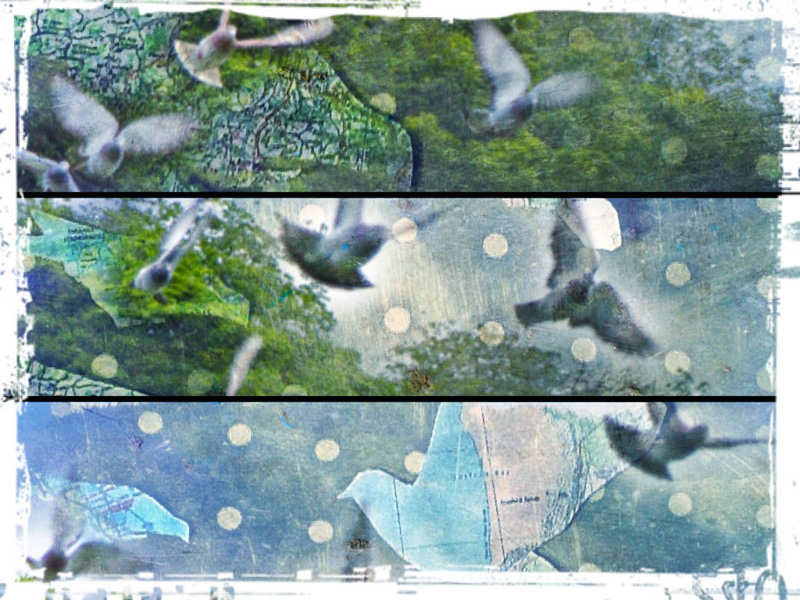
Click image to see a larger version.
A layering of photographic fragments of homing pigeons being released and pigeons cut out from ordnance survey maps, the idea of getting one’s bearings being a momentary thing that we do constantly at a subconscious level. These maps are of places I traveled to with my partner of thirty years.
*
Anna Dickie started writing poetry in her late forties and has been published widely. Her first pamphlet Heart Notes was published by Calder Wood Press, and last autumn Imprint, a collaboration with fellow poet Irene Brown, was published by jaggnath press. Her poem “Snow” has been anthologised in Not Only the Dark, a book in aid of Shelterbox, a charity providing worldwide disaster relief, and she recently took part in BBC Radio 4’s Poetry Workshop with the poet, writer and broadcaster Ruth Padel. She also performs with a poetry group called Poetrio.
Road Notes
(taking our father back to Arkansas, June 2011)
Razorback oak box,
the bristles on the boar’s back
lie flat, its eyes dull.
*
Bring your swim suit. Make
sure your dad’s ashes
are in the van.
*
Mother asks about
the route more than my niece, six,
says, are we there yet?
*
Cracker Barrel. Fried
okra. Dumplings. Rocking chairs,
shirts, flags, sticky stuff.
*
Now when we come back,
if we go up through Marblehead,
we’ll miss all this.
*
Just curious. Which road
are you taking now? My niece
asks, Are we there yet?
*
Mom stabs at the map
over continental
breakfast, shakes with rage.
*
I have a horror
of getting to Arkansas
without him, she says.
I have a horror
of fast planes…masked intruders…
high speed trains…Chinese
hackers…stolen
passwords…Zombie socialists…
high speed trains…
I have a horror
of the house at night, the black
night, the house, the horror.
*
Oreos. Movie.
Chips. Movie. Sprite. Such a good
little traveler.
*
MacDonald’s drive through.
Another movie. Dual
screens. Highway ahead.
*
Walgreen’s. KFC.
Shell. 3.55. Can you
believe what we pay?
*
MacDonald’s. DQ.
World Bird Sanctuary Next
Right. Wal-Mart. Wal-Mart.
*
Springfield. Another
tank, highways bursting with trucks,
the way to Joplin.
*
George Washington Carver
National Monument. Speed
past, GPS warning.
*
We look for collapse.
For smash. For twisted. Whipped. Hot.
Ding. Ding. Ding. Ding. Ding.
The malls, shredded,
even Wal-Mart pulverized,
trees, houses, signs, sighs:
Did they ever find
that baby? Cars pounded, boat
wrapped around a tree top.
Slumberland saved, the
Mattress store next door? Shorn. Wake-
up America.
*
Arkansas state line:
highway blasted through limestone
layers, golf courses, strip mall.
Bentonville traffic
jam. 5:45. Shift change
at the Wal-Mart mines.
*
Remember that mess
with the Koreans? she asks.
You mean Vietnamese.
*
We lived on Roosevelt
Road, on Victoria Drive.
On empires eroding.
*
Your house, over there?
Well, now there’s black folks living
in that house. Shoot—
*
The borders move North,
East: Thriftway’s an Asian Market,
Safeway, Latino.
*
You got some color
at the pool. It’s nice to have
a little color.
*
Half of Clarksville, torn
to bits, last month’s tornado,
careful with matches.
*
birches bend left straight
dark boy swinging that doesn’t
stay ice-storms do
*
We take care of our
own, says a cousin I never
met who looks like me.
*
They wore Bermuda
shorts, rode bicycles. Your
parents were so cool.
*
At our mom’s oldest
cousin’s, sipping iced tea: wide
porch, wide mountain view.
*
They still say how well
their great-grands treated the slaves,
let them stay post-War.
*
The house of flags takes
everyone back, among them
hangs a KKK.
*
100 degree
walk: me, some students, all the
Latino workers.
*
Wal-Mart, Wal-Mart. Flower
shop. Drug store. Mall. Mall. We load
the hold, then head home.
*
Our oceans & our
ice are dying. So are we:
good bye, good buys.
Author’s Note: I collected these fragments on a trip from Wisconsin to Arkansas last summer, using the haiku form to help shape the description and observations, but also to create some of the disjunction that I felt and observed during the trip. The cultural gaps, the racism, visiting a place I hadn’t been for 35 years, the beauty of the natural landscape against the ugliness of development and ideology, the distance between us in spite of larger problems that we all face, were so overwhelming that the fragment was the only way I could find to write. Originally, I considered these notes a prewriting exercise and planned to make them into a different poem, series of poems, or essay, but they insisted on their current form, both disjointed and also unified. In my revising I have rearranged and sometimes eliminated notes, but I haven’t added anything new, and I have left their original, observational character intact.
Wendy Vardaman (website) is the author of Obstructed View (Fireweed Press), co-editor/webmaster of Verse Wisconsin, and co-founder/co-editor of Cowfeather Press. She is one of Madison, Wisconsin’s two Poets Laureate (2012-2015).
 qarrtsiluni