Archive
Our Rowdy Pack Song
a hay(na)ku*
dented
moon, wheeling
just like me.
synaptic trash
caught sweet
in blue-violet mercies
roaring,
glory-headed girl,
smashed diamond skies
tilt,
tilt a-whirl,
twist and all-fall-down.
dry
river coursing
bloodstream’s ancient dreams
sashay
into beatitude
unravelling like me,
glistering
somersault into
infinity’s unformed matter
—is
that fire-
eating the open door?
or
peat-y fingers
down my throat?
i’m-a-ring-’round-rosie-girl,
a hot-blue-star
unhitched and free-wheeling
one-of-seven-sisters,
a pleiade,
bartering my soul.
unbolt
this cage
of inkblue heaven
drown
my mercies,
fill my mouth,
cast-me
deep beyond
the oh-so-watchful stars,
deepsky,
non-stellar objects
wheeling lopsided within.
by Holly Anderson and Caroline Beasley-Baker
Download the MP3
__________
*Hay(na)ku is a 21st century verse form invented by poet and publisher Eileen Tabios, who launched the first Hay(na)ku challenge to the world at large via the web on June 12, 2003 (Philippine Independence Day). The “traditional” form of a hay(na)ku entails:
- A tercet: 3 lines.
- A total of 6 words: 1 in the first line, 2 in the second line, and 3 in the third line.
- There is no restriction on syllables, stresses, or rhymes.
Then, in 2007, Tabios issued an online invitation to poets to join in groups of three or more to create “chain” hay(na)ku with each tercet moving between voices as in a conversation or a traditional “parts” song. “Our Rowdy Pack Song” is a poetic duet that loosely interprets the form.
From Earth Records
You sign your name, and live, as long-term guest,
the economics of the domicile:
the highest prices start where views are best.
Light has status. One pays for space and style.
Descending from these peaks, the roofs begin
to terrace out across each marked-off plot.
The postcode scores the loss or draw or win.
Sometimes the height is shared, and sometimes not.
You’ll find the horizontal villa, or
the block of income worry, standing tall.
A bench in central London costs no more
than dangerous nights, a policeman’s wake-up call.
In any case, the place that’s always free
is where the land breathes out, becoming sea.
*
A different kind of music sprays the pavements
in the summers of economic booms:
trained violinists play for unit payments;
grandmothers, graduates amortize rooms.
The raising of the GDP includes
sales of Sleeping Beauty by teenage boys
in stations; seminars that teach the moods
suited to business, the interview ploys.
Private coaches are the sleeker design,
the comfier; brighter the books and shops.
The local film moves quickly into line —
the new heroes: brick-faced boxers and cops.
The higher prices crush the ticket crush,
and chums count less. The new pavements are flush.
The Steel

Entrance, Bethlehem Steel Plant (click photos to view at larger size)
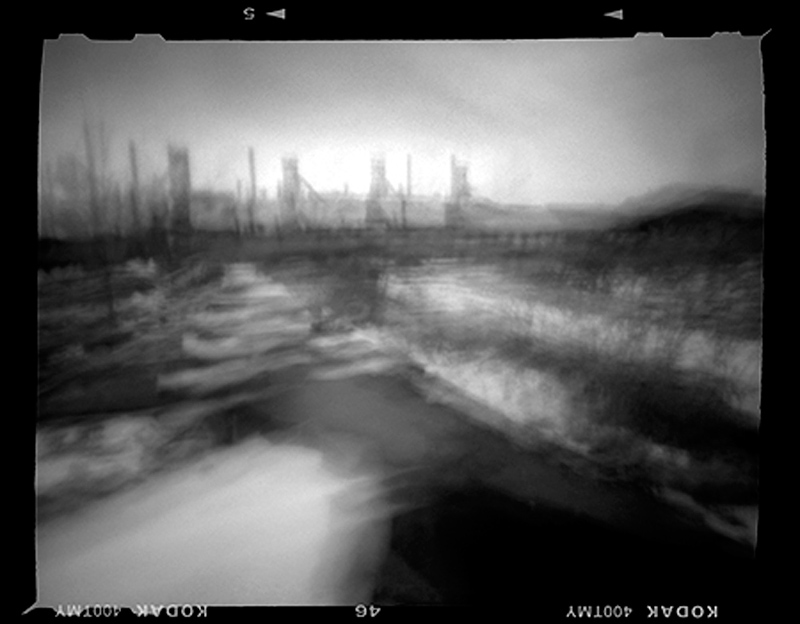
Empty Lot and Towers, Bethlehem Plant
These black-and-white pinhole photographs show how the iconic Bethlehem (Pennsylvania) steel plant — “The Steel” to those who worked there — appeared in 2005. The sprawling complex sat dark, rusting and abandoned behind chain link fencing.
The plant, which closed in 1998, had fueled the economic engines of the 20th Century, providing the ribs for battleships, skyscrapers, bridges and the interstate highway system. This year, part of the historic site has been developed into a Sands Casino and Resort.
While some of the lesser buildings have been bulldozed, the blast furnaces and several other core components remain. The Sands has said the tall furnaces will be repainted and illuminated with “architectural lighting.”
by Steve Rago
The New Economy
The rattling cans fell silent and the rattlers
stiffened to attention, equidistant,
as if on military display.
On the clearing’s far side, a massive hangar,
slabbed together with corrugated iron,
stewed in the sun’s gut.
One door, no windows. “You live there?”
Laughter churned through the ranks.
One woman spoke,
“This building is the last hope for Speckland,
a hut of refuge for its people,
a slim dignity.
Here, those forced into tiny squats in Leith,
twelve to a room, with only Speckish
supermarkets
for nutrition, can now find fulfilment
and five-minute toilet breaks
while studying
the language of Shakespeare and Thatcher
by selling off last year’s mobile
phone technology.”
At that moment, the door opened and a shock
of ragged men, women and children
tumbled out,
sharing cigarettes, pulling open Kraft lunch boxes
and cans of Coke Zero, setting
alarms to vibrate.
“For six pounds a month, you can feed
a child a week of recycled meat.
For twelve,
a family can be trucked out from the city.
For five hundred, your name
will be immortalised
in Speck City on a plaque of solid aluminium.
Please give generously, we rely
on your gifts.”
Patty-Cake
The moment she knew she’d conceived she made two decisions: no doctors, no birth.
“Baby,” she said to the cluster of 15 cells adhering to her uterine wall. “Forgive me. It’s a harsh world. I can only think of one way out.”
Every cell of their collective body agreed. At the end of nine months there were no contractions, no birth.
By the end of the first in utero year he slept through the night and drummed on her lower left rib if he wanted a shot of caffeine. He liked reruns of Myron Floren on the Lawrence Welk Show and did not care for Chinese food.
She filled with song. He learned to crack his thumbs in time to her voice, a double-jointedness which ran through the family on her father’s side.
By the third year she began to thin. Lying nude in the backyard dosing them both with Vitamin D, she noticed how translucent her flesh had become, the centerline full of white striations pulling and stretching like a seam coming undone.
In the dome of her belly, two small hands pressed, and then between them, a face. Even pale and waterlogged, his hair a floating nimbus, he looked exactly like her uncle Vinnie. She smiled. The boy smiled back.
His finger with its long curled nail followed the path of a crow over the dome of his world, leaving a flush of pink in the fluid.
She called her sister, said she was leaving a present in the backyard. The sister said she’d be right over.
When the sister arrived, the boy, sitting upright in the pelvic girdle, was playing patty-cake in a small puddle of amniotic fluid, tears streaming down his face from the pure brilliance of the day.
by Karen Stromberg
Download the MP3 (reading by Beth Adams)
Sojourn
Saint Alphonsus instructed his followers:
“Take only what you need.” Retreating into
the desert, he lived for three weeks eating
volcanic ash, waiting on Uriel’s command.
After twenty days he was flame, his mind,
the arc of sky. He no longer felt his toes
scraping hot sands. He walked unharmed
past rattlesnakes, blended into copper hillsides,
drank from arid sage plants. The ascetic turned
into wind, moving effortlessly over mountains,
branches of tall cypress. Years later, clerics
found his rotted sandals, placed them as a relic
amid hair and purported bones of local saints.
Believers still come to place their hands
on the worn insteps where Alphonsus stood
looking into the archangel’s eyes. Supplicants
touch desert dust to tongues, reverently bow,
attempt to cast off everything but their marrow.
The New Poetry
He wrote his verse in smileys:
expressive punctuation, soul laid bare
in variations on the colon and parenthesis,
a kiss to make up with an asterisk,
collusion in a semi-colon wink,
sleep with one stroke, sickness with another,
death dealt with his two fingers —
the keyboard skull and crossbones,
using eight and X.
He excelled at concrete imagery:
roses made from ats and brackets,
percentages for clover.
He made the most of metaphors
on cows and monkeys,
pigs and chickens.
That year he swept the board
at all the major competitions
despite complaints from purists,
and the old guard raging
that symbols couldn’t rhyme.
But others got the point:
anything to lift the art
from dusty books and droning readings
can’t be bad. His limelight period
didn’t last, though: there were queries
about his methods, he made a hash
of his defence. Quotes
in the papers spoke of scandal —
he lost the next year’s smiley slam,
and his career just…
by Ray Templeton
Tilting
Tilting is a remote village on Fogo Island, eight miles off the Newfoundland shore. I discovered its existence recently after hearing extracts from Robert Mellin’s study of the place as part of an edition of Something Understood, produced by Falling Tree Productions for BBC Radio 4.
Mellin, an architect and professor of architecture at McGill University in Montreal, purchased a house in Tilting after falling in love with the area. That led to his extraordinary work recording the vernacular architecture of the village, and indeed the area, and capturing the voice and spirit of a fast disappearing way of life. Tilting, one of 11 communities on the island, has seen its population decline from about 500 hundred residents to about 300 in the past few years.
In his study, Mellin trains his architect’s eye on wooden houses, sheds, fishing platforms, fences, root stores and tools. His quest for knowledge of the particular depicts the essence of a remote community that lives and works with the grain of the land, the sea and the weather. Mellins book, Tilting: House Launching, Slide Hauling, Potato Trenching, and Other Tales from a Newfoundland Fishing Village, was published by Princeton Architectural Press in New York, and won the Winterset Literary Award in 2003.
In preparing for this edition of qarrtsiluni it seemed appropriate to feature something on Tilting. Thanks to the wonderful economy of communication that is the Internet, I was able to contact Robert Mellin, who has kindly allowed us to include four photographs of Tilting. He also helped us secure the necessary permissions from Falling Tree Productions and Rick Boland, who reads the piece, to present an audio clip titled, “Ted Burke on Hospitality.”
—Anna Dickie, May 2009

Cyril McGrath taking his sheep to Pigeon Island in Tilting (click all images to see larger versions)
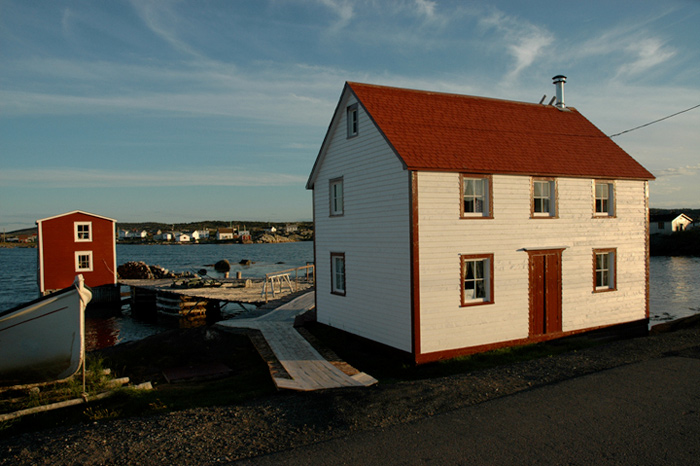
Restored Albert Dwyer Premises, Tilting, Fogo Island, Newfoundland
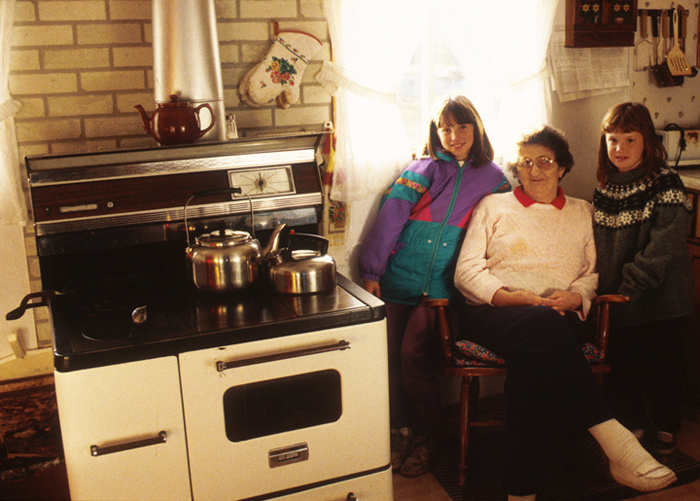
Gladys McGrath with two of her grandchildren in her kitchen in Tilting
Photos by Robert Mellin
Call for Submissions: Economy
Happy May Day! We’re pleased to announce that submissions are open for a new qarrtsiluni issue: Economy. The guest editors this time are Anna Dickie and Pamela Hart, and we’ll let them explain.
Economy has its roots in Greek — oikos and nomos — meaning the principles necessary to maintain the household. It’s a thoughtful word. The study of economics, until the 18th century, was a branch of philosophy.
And it’s the word of the moment. It dominates the evening news. It’s determining how we spend or save; whether we remain in our homes, keep our jobs. It has governments around the globe cutting, bailing and re-thinking spending plans. It’s full of associations: think Wall Street bull or bear or greed. Think sub prime mortgage. Then there’s the technical jargon: quantitative easing, collateralized debt obligation and the fallacy of composition all seem ready for metaphor.
With this in mind, we urge you to think broadly, associatively and imaginatively about this touchstone word. Consider economy of movement, expression or effort. Think fuel, cash or gift economy. In your investigation, remember the epigram and the epitaph, both concerned with the economics of composition. Think about how the subject might inform style, as well as content.
However, don’t be burdened by the word’s current negative connotations. For Hannah More, a 19th century British religious writer and philanthropist, the word resounded with hope. She described “the economy of the heart, which saves the expense of anger, the cost of hatred, the waste of spirits.”
Whatever medium you choose to work in, be it words, photography, music or video, make economy earn its keep to deliver a piece that nails thought, character, place or plot. As Anne Carson wrote in Economy of the Unlost, “Economy is a trope of intellectual, aesthetic and moral value.”
The deadline for submissions will be May 31, and the issue will begin appearing on the site in June. Please limit submissions of poetry to five poems, and keep essays and stories below 1,000 words. See our How to Contribute page for guidelines.
The editors are, as usual, both past contributors to qarrtsiluni (click on their names to view their contributions here). Anna Dickie is a photographer based in East Lothian, Scotland. In the last three years she’s won or been short-listed in a number of competitions, including having a shot hung in the Scottish Parliament as part of a touring exhibition on the theme of coastal erosion. She also writes poetry, and has had two chapbooks published: Peeling Onions, a series poem about coming through a cancer diagnosis, and Heart Notes, just published by Calder Wood Press. She blogs at My (Elastic) Gap Year.
Pamela Hart is a former journalist. Her chapbook The End of the Body was recently published by toadlily press. Her work has been nominated for a Pushcart Prize and has appeared in journals such as BigCityLit.com, Rattapallax, Lumina and Kalliope. She is writer in residence at the Katonah Museum of Art and teaches writing at Long Island University’s Graduate School of Education. She blogs at A Walk Around the Lake.
***
In other news, we’re just wrapping up Mutating the Signature, our longest and most stylistically diverse issue to date. If you haven’t yet taken the time to browse through this marvelously varied showcase of collaborative writing and artwork, you have a real treat in store for you. And you’ll have some time to do it, now, because we don’t expect to start publishing the next issue until June 1. In the meantime, we’ll be hard at work on the Mutating podcast and print edition, so look for those as well. And we hope you’ll take advantage of this brief hiatus in your daily qarrtsiluni reading to prepare a submission for Economy — and maybe finish up an economy-sized collection of poems for our chapbook contest, too!
—Beth Adams and Dave Bonta
 qarrtsiluni