Archive
The Economic Heart
Boris married Maria, the butcher’s widow, on a bright day last December. It was a small affair. Although the villagers were respectful of Boris’s profession many were still reeling from the butcher’s death at thirty-two. He was too young for a heart-attack, although Boris had signed the death certificate himself.
Maria had married the butcher on a chilly day last May. It was a grand affair. The ladies adored the butcher for his nutritious sweet sausages and the men were grateful for his unrelenting generosity during the recession. Women had deprived their families of breakfast eggs for months, in order to present the happy couple with a giant cake. Men had gone willingly without ale for a week.
On the night of their honeymoon, the butcher urged his young wife to consider starting a family. Maria pulled the candlewick bedspread over her shoulders and looked at him with such child-like intensity that he felt ashamed.
The next day Maria cut her hair short, locked away her treasured make-up and took to wearing ankle socks. The butcher came back that evening to no supper, and finding her curled on the sofa like a stray kitten, gasped, ‘My god Maria!’
When Boris arrived and had thoroughly examined Maria in the privacy of the marital bed, he reassured the butcher that ‘such regressions into childhood were not uncommon in young brides,’ and ‘that Maria needed only daily counselling sessions with him to resolve the matter.’ The butcher wept as Boris shrugged and said, ‘six months’.
After the first session Maria improved. She discarded the socks, glossed her lips, and her cheeks took on a healthy glow. She began to cook her husband the hearty meals she had promised before they were married, and at night she would whisper ‘soon, my love, soon.’
by Maureen Jivani
Isles and Lakes
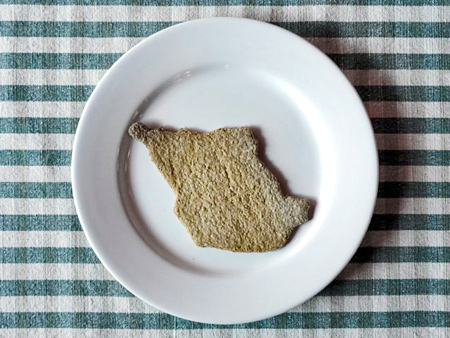
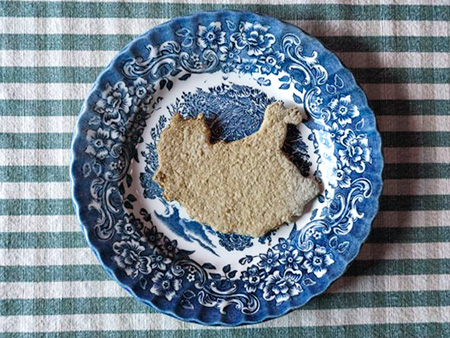


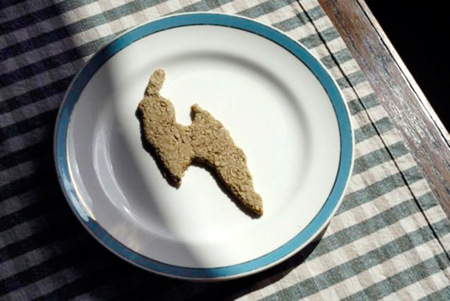
Six oatcakes in the forms of isles and lakes, by Alec Finlay
Alec explains the piece as follows:
“I often work with simple forms and I conceived this piece from my occasional habit of making oatcakes — the outlines always look geographical, often northerly. I chose isles and lakes as the positive and negative, here united in one idiom, and as they are the Romantic destinations par excellence. Some choices were autobiographical, some for the sake of predecessor poets or artists, some for form alone.”
The Isles and Lakes are: the Isle of Sado, Walden Pond, Cythera, Aral Sea, White Lake and Derwent Water. Alec leaves it to the reader to guess or imagine which is which. (The original piece won Alec the 2006 International Edible Art Award. Caroline Smith baked the oatcakes here. The Village Bakery commissioned the cutters. Photographs by Alexander Maris.)
Oatmeal became the staple grain of Scotland because it is better suited than wheat to the country’s short, wet growing season. It therefore has a long culinary history going back many centuries, so much so that Scotland’s ancient universities had a holiday called Meal Monday, to permit students to return to their homes to collect more oats for food.
Scottish oatmeal is created by grinding oats into a coarse powder. Various grades are available depending on the thoroughness of the grinding, including coarse, pin (head) and fine oatmeal. It has many uses, including being the main ingredient of bannocks or oatcakes.
In celebration of Alec’s project, and the oatcake, we thought it might be good idea to provide an oatcake recipe, and this one comes with the kind permission of Wendy Harrison at A Wee Bit of Cooking, a Scottish food blog:
Oatcakes
225g oats
60g whole wheat flour
30g butter
30g lard or vegetable fat
1 tspn salt
1/2 tspn bicarbonate of soda
50 ml boiling water
- Mix together the oats, flour and bi-carb.
- Add the butter and lard and rub together until the fats are incorporated and look like big breadcrumbs (this took the full length of Meatloaf’s “Bat Out of Hell” when I last did it).
- Add the boiling water little by little and combine until thick, stiff dough is formed.
- Scatter extra flour and oats on a surface and roll out the dough until 1/2 cm thick (or thinner if you prefer daintier biscuits). Use cutter to cut out shapes.
- Reroll dough and cut again until dough is used up.
- Place shapes on baking tray and bake in 190oC oven for 20-30 mins until brown and crisp around the edges.
- Remove from oven when golden and crisp around the edges.
—Anna Dickie and Pamela Hart, eds.
Melons
I like to believe things are what they are.
Tap on a melon, it tells you it’s a melon.
Ripeness resonates, you listen with both ears:
already you can hear it snap and fracture
into pieces that you’ll later contemplate, then eat.
The melon will be what it is, nothing more
and nothing less than what it is, and that means
ready to sacrifice itself for a job well done.
Not everything is melons. Not everything will
talk to you, divulging secrets of its seeds,
obliging you to look for fertile ground,
guaranteeing their progression from simple to complex.
No matter which fruit you choose to sample,
you’ll sense oblique connections between the simple
and the complex, the hidden kinship that they share.
You’ll want to find a melon and go home.
This is no easy task. The field you tend
is bounded on all sides by razor wire.
Your hands know this as a deep, hard fact,
and know that scars, like melons are what they are.
No, not everything is melons. Some fractures
that you’ll hear will be your bones. Snapping
and marking painful changes, changes
making you wish that life just went tap-tap.
by Richard Spuler
The Core of a Woman
One cold tomato on a white plate.
Taut skin. Beads of moisture.
The bitter stem. Leaves, serrated.
Quartered.
Pulp. Juice.
Suspended seeds.
Waiting to be salted.
by Pia Taavila
Sustenance
An excerpt from Imaginary Loves
I am loved by someone so well that I never doubt it, Bettany says, as the nurse puts the IV into her arm. Do you know what that’s like?
This is what it’s like, the nurse answers, jabbing unnecessarily, when you refuse to eat.
The nurse’s sister died of anorexia.
She is very angry.
Bettany floats in the gray-white haze of zero blood sugar, way down below weakness and well risen to euphoria. Sooner or later, they will leave the room. She will take out the IV. They will come and put it back. She will wait, take it out; a perfection of passive resistance.
He meets me in the middle, she says.
If you take this out again, the nurse answers, you’re going into restraints.
Bettany considers the blue-black hair of the nurse. Like raven feathers, she says aloud. What is your name?
Sucking up to me isn’t going to help.
I’m not. I want to know your name.
My name doesn’t matter, says the nurse. I’m the nurse.
It matters to me, says Bettany.
No, it doesn’t, says the nurse. What matters to you is getting a grip on reality.
I have one, Bettany says. I am loved. It feeds me.
The nurse finishes taping the IV, cleans up a line of blood dripped down the girl’s emaciated arm. Leave it this time, she says, or restraints. I mean it.
Did I tell you about the letter he sent me?
You can’t eat letters, the nurse says.
Oh, yes, says Bettany, rising to one elbow with quaking effort. Yes you can.
Quick Brew
Monday morning’s a three-minute brew, a click
at every turn in the kitchen to quicken
the oncoming hour. Fix a rushed breakfast
and down it doing slapdash dance steps,
only to be caught unaware by a sudden splash
of sunlight on pink tiles, how it warms and slows
the ankles back to sultry Sunday’s drift.
Still, it’s time to run and get the spreadsheet glowing
between bites and steps, to dive into an analytical grid,
square and tuck in diamonds of fact
while surreptitiously opening a blank page
to gleam behind apparent logic.
This one. No warmth here until I lay it in,
but the prodding intellect can’t divine
what makes skin leap to sun as soul to music.
Sneak a poem between the cells. Sip an image lightly,
quickly, leaning one shoulder back
toward slower rhythms, while facing
forward and typing smart into the glare.
by Rachel Dacus
Rio Hondo Crossroads
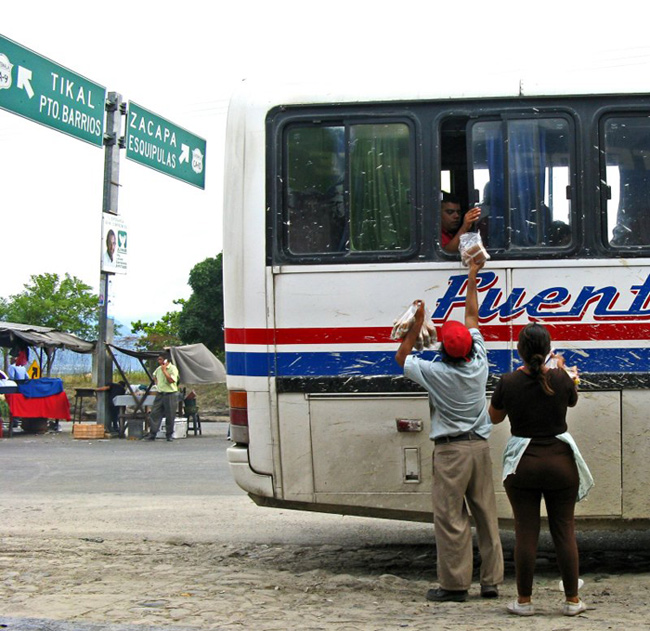
(Click to view at larger size.)
by Steve Wing
Seasoning
In spring,
some sprinkle lamb with a seasoning of sea salt, with garlic, bay and rosemary, and spit-roast the meat, for a festive gathering in Genoa or Crete, but I don’t; for my gathering is of petals of my damask roses, a gathering of thousands in the uplands of Iran.
In summer,
some swim at leisure in the salt Aegean or play on crowded beach. Such opportunities are not within my reach, as I sort out the figures for the tax to be paid, on export orders for attar of roses, superior grade.
In summer too,
I receive the almonds from my bowing trees, buying sea salt from Brittany, to season a proportion of the crop, which is roasted to perfection and tied up prettily, in bags that I have made from patterned cloth. The remainder of the produce of my sheltered orchard, I shell and grind and sell for use in fine confections.
In autumn,
when the crocus corm, salt of the earth and worth the wait, comes into bloom, I take no rest. The precision extraction of splinters of stigma is an endurance test. The task is barely done, before I weigh and pack and label the insubstantial wisps, which have been set to dry, and seal each little box with wax, red for première qualité, pricing them according to the tax that will be levied and the value of the labour that has gone into the production of every gram of saffron.
In winter,
in Stockholm, some bake saffron bread for the welcoming of visitors. In Brussels, others, when dining in company, proffer pastel-tinted macaroons with after-dinner coffee. In Edinburgh, others still, invite invited guests to drink a dram and nibble salted offerings and cake of brandied fruit with, concealed beneath the icing, a layer of marzipan. In Lombardy, my stigma gild saffron risotto, for those who meet and greet in the restaurants of Milan.
Meanwhile, everywhere, glassy cubes of loukoum waft their rosy perfume, redolent of breathless days of May, bewitching children with their alchemy and getting faces sticky.
Thus the yield my harvest brings will take me to Morocco, where they lay lemons down in salt, to make a piquant condiment, added as ingredient, together with some whispered strands of stigma plucked by my own hands, to suffuse a lamb tagine with taste beyond imagining, renewing bonds with kith and kin.
For the very act of sharing a repast in rich conviviality is, itself, a seasoning, without price and tax-free.
by Rachel Woolf
The Mystic in the Basement
for Ronald Rowe
He descends
with me
and carries
up
lumps of
cement
and splintery
old boards
and sweeps
the broken glass
the heaps,
the hoards
of half-finished,
never-read, never-sent
abandoned-
but-not
abandoned-
enough
the torn,
worn
frustrated
garments
fraying, moth-eaten—
when
that is done
he goes
for lunch
and writes
a poem
about the sapphire
crystalline sphere,
split
facings of
the star dome
the infinite
at Hi-Fi
Pizza over a
slice
then goes
to McDonald’s
for
coffee.
by Monica Raymond
chicken little considers the sky again
oh, sure i’m still running around like a heads-up/off/prophet/profit/fit trying to cut off my very own de/(con)instruction and all other sordid a•void•able & available/a-Babel towers of post &toastmodern doom/daze re(altho)guarding our economy in/ex/&/anterior terror of too sometimes•always all afright with me henish-looking like some diminutive Kali only i’m in a bantam suit looking all-a-fright in a head&heedless moreorless banshee keen/for/keening. shrill before the sky’s death knell noi•some or just can’t write-it-off darkest noir over•us•all! or to be exact, that is, of man/woman/chicken/child/everyone. really. so youbetcha any/old/witching/way this omen•amen•ahem of mine assures our sky will will will is falling tumbling twisting howling hellish as in all Kansas gone rumbling under black-cloud vengeance of truly veritas-verily.
ok, eerily also or/and get this: just-adjust-for black fright dust thrown/up in our frail•fray•feckless fey faces like dark death//aces-of-ominous. yup, inspades Dorothy’s frightmare of immense downer over/under/all-around. so these scaly-scrambling hen’s feet of mine scratching caw-clawings while carrying/crying/ cravening on in my fumble feeble way past every damned/doomed Mcdonalds, Jack-in-the-BoohooedBox, KFSeeeee those damn chicken killers! well, ok we all are box(ed) up/ended in disheveled feather-ruffled time for our very own apocalyptic downtheriver•plucked•soooofucked.
but as usual i’m running around here/everywhere rear/guarding this dumbstate of doom.
by Ed Higgins
 qarrtsiluni