Archive
Irises
by Rose Hunter
Work hard that’s
all I did before, and then all I did
was drink; I’m boring,
in front of the razor wire
the man who says
no one has ever commented
on his eyes — how so?
they are blue and yellow
irises tumbling
a torrential garden
at Saint-Rémy
to prove it, I took his picture
but the eaves turned them black
but no problem, the man
who fixed doors for thirty years:
perhaps you need the Mexican sun
to see them? — steps out, smiling.
Links to Rose Hunter’s published writing can be found at her website, Whoever Brought Me Here Will Have To Take Me Home. Her book of poetry, to the river, was published by Artistically Declined Press (2010). She edits YB, an online poetry journal, and lives in Puerto Vallarta, Mexico.
Prague Prisoner
by Bruce Dodson
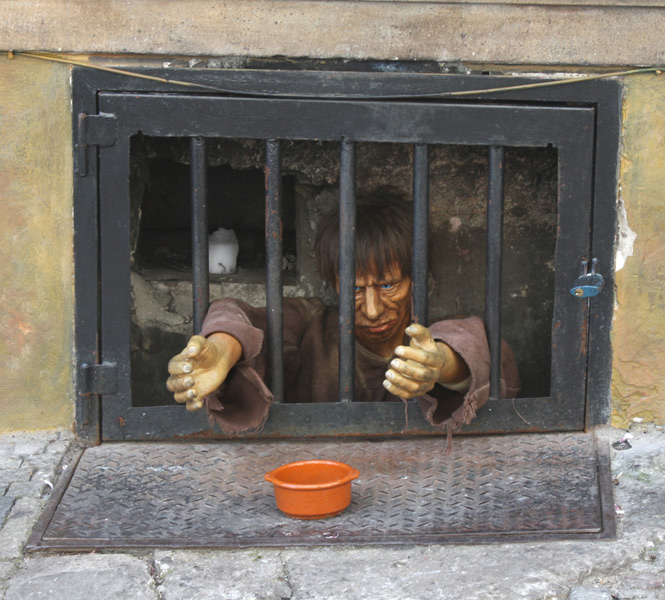
Click image to enlarge.
Bruce Dodson is a photojournalist and writer of fiction and poetry in Seattle, Washington. Some of his recent work has appeared in Sein und Werden, Kerouac’s Dog Magazine, Breadline Press West Coast Poetry Anthology, Blue Collar Review, Chantarelle’s Notebook, Struggle and Pearl Literary Magazine. He took the above photo on a sidewalk in Prague last year.
I Shall Not Kill This Symbol
I.
Three ChemLawn® men pace off
my neighbor’s lawn, planting yellow
warning flags to supplant the Dandelions.
The Eliminator™ will eradicate the weed—
until precipitation washes away the post-emergent
industrial strength herbicide
and another application is required,
despite the corporate promise to last all season
against so-called good-for-nothing Taraxacum officinale
Next door the run-off gets away with crime.
II.
But not in my backyard, where
wishes still spring on seed wings
puffed by child-breath
and are borne to eternity on summer breezes.
The young-at-heart have such giddy hope.
Not in my backyard, where
wine spurts from broad-leafed rings
in a basal circle to be picked
and transformed by my grandmother’s recipe
into gentle dirt-cheap intoxication.
Not in my backyard, where
the Priest’s Crown, Swine’s Snout proliferate;
where the Clock Flower tells me it’s time
to mow my field of dreams; where
the Rustic Oracle foresees He loves me.
Not in my backyard, where
thrives the makings of an herbal remedy,
a female’s tonic to gently balance
my post-menopausal hormones.
O sweet elixir, o for a good night’s sleep!
Not in my backyard, where
the Piss-a-Bed and Pissenlit yields
a medicinal quality to be steeped
into a mild diuretic tea—the relief of leaves.
Even experts agree the plant can be beneficial.
Not in my backyard, where
folklore’s barometer blooms abundantly,
and when wet weather approaches,
they shut like umbrellas; they prophesize:
Rain is a good thing.
III.
In my backyard, I leave them be because
I know at least one Aster Sister grows
in a maximum-security prison yard
at the Auburn Correctional Facility. Gold has broken
through the gray constraints of concrete.
On the property east of mine
redemption withers and dies in an easy spray,
while I hold out no nozzle to my quarter acre
of bright, rampant belief:
A Dandelion is also forgiveness.
for Michael Rhynes, DIN #85c0181
Award-winning poet, National Park Artist-in-Residence, and assistant editor of The Centrifugal Eye, Karla Linn Merrifield has had work published in dozens of journals and anthologies. She has six books to her credit, including Godwit: Poems of Canada, which received the 2009 Andrew Eiseman Writers Award for Poetry, and her new chapbook, The Urn, from Finishing Line Press. Forthcoming from Salmon Press is her full-length collection Athabaskan Fractal and Other Poems of the Far North. You can read more about her and sample her poems and photographs at Vagabond Poet.
Goldfish Blues
by Greg Weiss
Brown leaves and dried-out pods dab at the erupted sidewalk in front of the ruins.
The water-heater kettle-drums the only tune he knows—it’s a nice one,
but songs get rote like everything else, without exception.
Time is nothing to total resignation.
Prince, Tupac, and two other faces—James Brown
and Madonna?—mural the walls, forlorn since the roof’s ascension
or dissolution, and clouds hang like land over the canyon.
Nobody in Hattiesburg gives a fuck about the Parthenon
but Herculaneum is a horseradish on the city-bus,
a French-pressed carcass on a pimply, sunburned cross,
like bronzed baby-Keds, our face
in the lava, the rote air, but there’s a chance, however slim—that’s chance.
Two-liters in the weeds, there’s a sanctuary in piss, and I’ll run away from all of this.
Tupac’s young and all eyes and cheeks, like Bambi sniffing a patch of forest grass.
Greg Weiss’ work has previously appeared or is forthcoming in Boston Review, African American Review, Now Culture, and others. He is currently pursuing a PhD in English (Creative Writing) at the University of Southern Mississippi.
If You Want Me
by Ruth Foley
You can find me in the swale between
exits 4 and 5, the radio on too loud,
Tom Ashbrook asking a guest some
question he already has the answer to,
or the local college station—even
louder—playing something harder
than I could bear to live outside of, guitars
like jackhammers and drums like nail guns,
some barely post-pubescent riveter
of lyrics building, lifting, joining.
And if you find it strange—the wheels
spinning, all struts and suspension and
gray, unidentified mechanics—
it’s just as odd to me, upside-down
in the seatbelt, the sunroof open
to the ground the radio changing channels
on its own while I try to work the handles,
try to open the buckle or the buckled metal,
wanting nothing more than to tumble
out onto the wet spring grass and last
year’s leaves, someone’s empty crumple
of fast food. If you want me, I’ll be
the one with the acrid silk of gasoline
mixing with blood on my skin, the strangers’
hands, the swiftly spinning sky.
Ruth Foley lives in Massachusetts, where she teaches English for Wheaton College. Her recent work is appearing or forthcoming in River Styx, Measure, The Ghazal Page and Umbrella, which just nominated one of her poems for a Pushcart Prize. She also serves as Associate Poetry Editor for Cider Press Review.
Lafcadio Hearn Leaving Kobudera
by Diane Kendig
Before he spoke Japanese, English, and before English,
Greek—not to mention all the cockney, pidgin,
Creole (his favorite saying causer cé manger
zoreîes, conversation is food for the ears),
and even so new to one, and even though
no one around him spoke the others and
he could no longer see from his one bulging,
Cyclopean eye, the simple words he needed
continued to come to him.
Near the Kobudera temple and its graveyard
with a hill of cedars to walk each day,
he had his home and marriage which he called
a haven from where he watched “dangerous
sea currents, running like violet bands,”
out of sight. For his sons, he’d built
a gym set where he’d hang upside down
a long time, smoking a cigar.
But the temple parish for the money
cut down the cedars one by one till the hill
was bare, sold the hillside off for house lots.
And just about the time he lost his place
at the university and two best friends,
a nearby prison began marching
manacled inmates past his house
twice each day.
Hearn said they’d move to the Oki Islands,
but though he had traveled the world,
he could no longer get so far, only
to the other side of Tokyo, leaving at least
the hack of axes and cedar crashing
on the ancient tombs, the chonking
of chains he’d escaped other places,
like his flight from Cincinnati’s miscegenation.
He didn’t need to hear them coming back again.
Diane Kendig’s recent chapbook is The Places We Find Ourselves. Her prose and poetry may be found in J Journal, Minnesota Review, Wordgathering, and Seventh Quarry, among others. A recipient of two Ohio Arts Council Fellowships in Poetry and a Fulbright lectureship in translation, Diane currently lives “out of place” near Boston. She spent four months in medium security spread across 18 years.
Martin Luther King envelope

Chris Barnett’s art work is exhibited with the Prisons Foundation. “The Day the Music Died” (pencil and graphite shavings, merged portrait of murdered artists Big, Tupac and Jam Master Jay) was published in Art of Prison Survival, Sept.-Oct. 2006. He is currently incarcerated at Green Haven Correctional Facility, P.O. Box 4000, Stormville, New York 12582-4000, Chris Barnett 96A3659
Thanks to Robin Martin for help with the submission. —Eds.
Petite Morte, a Verse Dance with Captions
At the shadowy back of the stage, you can just make out the captivating figures of six black-clad women, hands folded over their wide skirts, while they watch, perfectly still and expressionless, six saber-rattling men leap, spin, lean into their blades.
You wonder which holds up the other, fabric or flesh. And then they appear in front of their clothes—abandon their stiffness—come to life, legs exposed.
The dresses, it turns out, neither alive nor inanimate, remain upright, uninhabited by their former prisoners; each bell-shaped skirt, a black glass jar or bird’s cage covered by black cloth to quiet inconvenient singing, awaits its captive’s return.
They run in circles on the stage—men and women, hard to tell who’s chasing whom, no signs of capitulation from either side. Without their skirt-cages to hold them, the women keep up, but the dresses creep closer, too, sidle this way and that, looking for the right moment, for signs of weakness, fatigue, inattention, to launch a recapture.
Wendy Vardaman (website) has a Ph.D. from University of Pennsylvania. Co-editor of Verse Wisconsin and the author of Obstructed View (Fireweed Press, 2009), she works for a children’s theater, The Young Shakespeare Players, in Madison, Wisconsin. Her essays & interviews have appeared in Poetry Daily and Poets.org, among others.
Real Sorry
by LeAnne Ray
Inspired by Aileen Wuornos, executed in 2002 by the State of Florida. Wuornos, homeless most of her life, admitted to killing six men for their money.
you listen. we’re going into these woods together.
slow down. turn left.
anything you want to ask God
ask now and good luck.
he’s a bastard.
all you men are the same.
I do realize how decent you look —
don’t worry about your car
— in your special, little world.
all you golfer-grampa types
turned my life into a real situation,
cruising the interstate in your big boats,
just asking to be ripped off.
if they find you out here someday,
it won’t be your fault:
you were the good citizen,
man of gold.
wrong place, wrong time.
don’t worry, no one’s going to tie you to me.
you understand what I’m saying. cheer up.
it aint like it’s the highlight of my day.
stealing’s work.
rings, watches, crucifix necklaces
(they do catch me: my ass is grass)
metal detectors, golf clubs, cameras.
keep going. slow. good boy.
this little gun off one —
watch that hole there
— shit I stash or pawn,
wheels, cash, booze.
I got a good eye
for you: rich,
lonely, air-conditioned.
you want to save my soul
then fuck me, kill me,
hide me in the bushes.
why else’d you pick up a stranger?
was it worth it? not really asking.
funny,
it’s always your word against mine
out there.
most I ever jackpotted: four hundred bucks.
gave it to my wife.
you heard me. one big wad.
now slow down. stop.
I’m real sorry I have to do it
but witnesses just don’t
shut the fuck up.
LeAnne Ray holds an MFA in Writing from the School of the Art Institute of Chicago where she apprenticed under Elise Paschen. LeAnne writes poetry and fiction.
At Home in Hell
by Rina Terry
Lifers understand me best
these days, they say, apartment, not cell,
and the jitterbugs, the gladiators,
make us both twitch. There’s no point
in trying to explain it all, unless you appreciate
the perfected rhythmic sway of a shackled walk
and the dignity of the thick leather belt that holds it
all together at the wrists. Except for those beat down
one too many times, some toothless because
they can’t get fillings here, only extractions
and there’s the art of being extracted—specialty
training at the Academy. Darth Vader gear a tip-
off—there’s trouble on the tier. Someone tripped
and fell through a third-tier window, into the yard,
gets 172 stitches and disappears North for
Ad Seg. Later you hear the rumor he’s dead
or worse. Got himself a woman on the inside,
then you know, his last appeal was one turn down
too many, parole, just one hit after another,
he tells his lady to fa’get about it. Move on
with her life. Now Juan’s back, his lady will phone me. Beg me
to call him out and talk to him. She’ll tell me about the kids,
how they are crying to go see their papi, how she truly loves
him. She will wait as long as it takes. Juan, he’s usin’ again;
I see the junkie sweat, even though he cleaned up, used oils
for our date and put his khaki’s between Mass Movement’s
mattresses, to press a crease in his pants. I have hot water, a rule
I break every day, and offer him herbal tea. He gave up caffeine
two bids ago, says it makes him mind when they push up
and that’s dangerous. We remember how he slit Chico’s throat
with a box cutter, though neither of us mentions it today;
we talk about my publication and he nods in approval, Mi
Reverenda, he says, gruff with affection. High praise; I blush.
Rina Terry lives, writes and works in Cape May, New Jersey. She is a United Methodist Minister and spent seven years as Supervisor of Relgious Services at an adult male population state prison.
 qarrtsiluni