Archive
Two picture-poem combinations
by Tatiana Burghenn-Arsénie and Irina Moga
Knaackstraße — A Balcony

(Click images to see larger versions.)
Frail hours in the shadow of the Water Tower.
Muffled clouds, mixed with grains of sun
scattered under the traces of your steps on
Knaackstraße.
Sidewalks. Closed cafés at dawn
when tree branches are almost silenced,
caught
in the tapestry of whistling blackbirds and the sirens’ choir.
Bicycle spokes, empty tables and — ahead —
cathedral eyes gazing at me
through stained-glass flutter.
My love for you — a secret hymn, which I proclaim
from the balcony of a crystal whisper
on this day.
*
Knaackstraße — Un balcon
Des heures fragiles dans l’ombre de la Tour de l’Eau.
Nuages en sourdine, immiscés avec des graines de soleil,
éparpillées sous la trace des tes pas sur Knaackstraße.
Trottoirs. Cafés fermées à l’aube
quand les branches des arbres se taisent à peu près
dans l’arrière-plan tissu de chants de merle et sirènes.
Rayons des bicyclettes, tables désertes, et en face,
les yeux de cathédrale qui me regardent maussades
à travers des couleurs brisées par les vitraux.
Mon amour pour toi – hymne secret, que je proclame
sous le balcon d’un chuchotement en cristal.
* * *
The Former Stern Radio Building, Berlin-Weißensee

(Drawing from the series “gezeichnet.Weißensee” by Kulturring in Berlin e.V)
Walls — brick over brick layered in gusts of light, doors askance
— a wax monument to the hour.
On narrow windows, glass shards cut out jittery clouds.
I have stepped inside its rooms, bided my time on its terms,
listened to strange laws of symmetry under its roof,
as if an occult point of fugue, narrowed down by rubble
floated towards the equinox.
On a cornice of mildew, the ear strains to distinguish the laughter,
and the music trapped in odors of burnt wire.
Muffled voices sift down from the ceilings.
All is oval in the building’s lifted top, doggedly challenging the sky.
The seconds melt, fluid, tracing a flight of birds over sunken sundials.
*
L’Ancien Bâtiment de Stern Radio, Berlin Weißensee
Des murs — brique sur brique dans un frisson de lumière,
portes entrebâillées — un monument en cire dédié à l’heure.
Sur des fenêtres étroites, des tessons découpent les nuages las.
J’ai franchi son seuil, je me suis tue à ses termes,
écouté les lois de la symétrie étrange de ses toits,
comme si un point de fugue, occulte, étréci par les décombres
s’affaissait vers l’équinoxe.
Sur une corniche en moisissure, l’oreille s’apprête à déchiffrer
les rires, la musique prisonnière et l’odeur de câble déchiqueté.
Des voix muettes descendent, incrustés dans les plafonds.
Tout est ovale dans la rébellion de la tour qui se dresse vers le haut, dans son
affrontement avec les cieux.
Les secondes passent, et se fondent, fluides.
En vol d’oiseau, je retrace les bras d’un cadran solaire, enseveli
par la flamme de la dernière bougie.
Dr. Tatiana Burghenn-Arsénie is an artist living in Berlin, Germany. Tatiana has participated in numerous individual and group exhibitions and her art is held in private collections in Germany and Romania. She was recently part of the exhibition “Die Kunst Der Krise” (July 2010). Her latest exhibition of graphics, icons and paintings was at Brose Haus, Berlin through January.
Irina Moga (blog) lives in Ontario, Canada and writes poetry in English and French. She recently published poetry in The Chaffin Journal (2009) and Rockhurst Review (2010). Her two books of poetry, Limita Vizibilitatii (Limit of Visibility, 1982) and Poemul Continuu (The Continuous Poem, 1986) were published by the publishing house Editura Dacia in Cluj-Napoca under the pen name Irina Sturza. In 1981, Irina was awarded the awarded the prize for poetry debut by the magazine Tribuna in Cluj-Napoca, Romania.
Two Contemporary Mongolian Poets
translated by Simon Wickham-Smith and Lyn Coffin
1. G. Mend-Oyoo, translated by Simon Wickham-Smith
Чулууны аялгуу
(уугаан аялгуу)
Бумбан бор манхан наранд щарагдаж намайж
Бургих булнийн усөлмий юугий нь сүрчин сэрүүцүүлнэ.
Ерөөлөөр учирсан биз ээ, үйрмэг зөөлөн элсэн дунд
Ембүү хэдэн чулуу усны амь бараадна.
Онгон их элсэнд чулуу ховортойнх ч юм уу даа
Оргилох булгийн хэдэн чулуугаар тоглохын хорхой хөдлөөд
Аваачиж, адуу мал болгон наадсан өдөр
Аабын щилбүүрийн хуйв аянга цахилгаан щиг тачигнаж билээ.
“Булгийн хэдэн чулууг булааж авсан уу, та нар!
Бурхны нэрийг дуудаж буруугаа хүлээж гуй!
Чихээ дэвсэж байнаад урсгал чагна, та нар!
Чимээ аялгууг нь аргидан дуудаж авчир!”
Эрх цовоо булгийн урсгал сатааран намхраад
Эл хулийн дунд дуугаа хулжаасан байж билээ.
Хоёр өвдөнд хоорондоо толгойгоо хавчуулаад
Хорвоон учрыг сүүмэн ухаарч гэмщиж билээ.
Цоносон халуун тэр өдөр тоглоомон гэрээ нүүлгэж
Цолхийтэл булгийн уснаа буцаан тавиж билээ.
Булт чулууг зөөн зөөсөөр буруугаа засахад чинь
Булгийн аялгуу нь ирээд ход ход хоржигнож билээ
*
The Melody of Stones
(the original melody)
Gilded by the hazy sun which fills the ritual urn,
The waters of good fortune shower into air.
Amid tears and suffering, this is a benediction.
And how many silver pieces are there in those living waters?
And are stones rare on the vast sands of Ongon?
There are insects squirming among these lucky stones.
They take the stones away, excite the horses,
And father’s whip crashes like lightning and thunder.
“Have you stolen our lucky stones?
Call upon the Buddha and request forgiveness!
Keep your ears open, the current is strong!
Bring on the melody, call it forth!”
The flow of bright fortitude fades away,
The voices frightened off from these fawn-colored horses.
They tuck in their heads where the two old people are,
They regret how little they understand the world.
This blazing day moving the agreement of games,
The splashing water is taken back.
Returning all the stones, I repair my mistakes
The melody of the gifts comes gurgling.
* * *
2. Bavuudorj Tsogdorj, translated by Lyn Coffin
НАВЧ
Намрын залуу модод
Навчаа шидэлнэ
Гэнэн гал навчис
Гишгэсэн мөртэй минь адил
*
Leaf
Young trees in autumn
Throw down their leaves.
The incredible fiery leaves are
The same as my footprints.
* * *
ЗОХИРОЛТ САРНАА
Чи миний аглагийн аглагт суух юм
Чингэвч чамд ер очмооргүй нэгэн шалтгаан байна
Цаглашгүй ариун,таалшгүй эрхэмсэг
Залуу насыг чинь л би булаамааргүй байна
Зөвхөн чамтай,зөвхөн сартай
Зөрөг зам дээр би удмааргүй байна
Царай чинь харагдам,хөл чинь үзэгдэм
Сарны тунгалагт би гунигламааргүй байна
Гэгээн учрал,ариун тавилангаа
Гэргийнхээ өмнө,гэрийнхээ хойморьт
Өрж орхиод
Цаст уулынхаа чулуугаар
Өөрийгөө зодож сууна би
Чи миний аглагийн аглагт суух юм
Чингэвч чамд одоохон очмоор нэгэн шалтгаан байна
*
Under the Harmonious Moon
You exist so far from my world
But I have reason to want never to come to you.
I want not to hold aloft your youth
which is infinitely sacred and cannot be touched.
Alone with you and the moon
I want not to linger on the path.
And I want not to be sad in the moonlight
which reveals your face and legs.
So I offer my blessed meeting and my sacred fate
to my wife waiting at home.
Now I am pushing myself
through the stones of my snowy mountains.
You exist so far from my world
But I have reason to want to come to you right now.
* * *
ЭНЭ ЦЭЦЭГ ҮНЭРТСЭН САЛХИ…
Энэ амгалан цэнхэр үдшид хайр хүрнэм
Дорно зүгийн шилтгээн энэ яг л мөн
Энэ алтан дэлт үүлсэд хайр хүрнэм
Дорно зүгийн дэнлүү энэ яг л мөн
Энэ цэцэг үнэртсэн салхинд хайр хүрнэм
Дорно зүгийн аяс энэ яг л мөн
Энэ цэцэн ногоон царцаанд хайр хүрнэм
Дорно зүгийн амраг энэ яг л мөн
Энэ мэлмэрээ цагаан саранд хайр хүрнэм
Дорно зүгийн жүнз энэ яг л мөн
Энэ мэлтрэх бүлээн нулимсанд хайр хүрнэм
Дорно зүгийн шүлэг энэ яг л мөн
*
The Wind with its Smell of Flowers
I love this peaceful blue evening
It is absolutely a castle of the East
I love this cloud with its golden mane
It is absolutely a lantern of the East
I love this wind with its smell of flowers
It is absolutely the fragrance of the East
I love this sagacious green locust
It is absolutely a darling of the East
I love this moon in the white waves
absolutely the mirror of the East
I love these lukewarm falling tears
absolutely a poem of the East
This wind with its smell of flowers.
* * *
G. Mend-Oyoo is the Poet Laureate of Mongolia. Under his editorship, an anthology of American poetry in Mongolian translation has been recently published in Ulaanbaatar by the Mongolian Academy of Culture and Poetry. A tribute to him by David Lehman appeared recently on the Best American Poetry blog.
Bavuudorj Tsogdorj wrote his first poem when he was 11. He is married, has two boys and lives in Ulaanbaatar, where he serves as general editor of the ‘New Era’ radio station. He is currently at work on an epic poem about Vajrapani mountain, at 4060 meters the highest in Mongolia. He is a Nyingma Buddhist. An anthology of some of Bavuudorj’s poems and some of Lyn Coffin’s poems was recently published in Mongolia under the title Eastern and Western Poems.
Simon Wickham-Smith has translated the work of many contemporary Mongolian writers, and is the translator of The Hidden Life of the Sixth Dalai Lama (2011, Lexington Books). He is curently pursuing doctoral studies at the University of Seattle, his dissertation being on the Mongolian poet G. Mend-Ooyo’s novel Altan Ovoo. In 2007 he was honored by the Mongolian government as an Honored Cultural Worker, and in the same year he was the recipient of a PEN International Translator’s Grant.
Lyn Coffin is a widely published poet, fiction writer, and playwright. Eight of her books have been published, three of her own work, five of translation. A ninth book, translations from the Czech of Jiri Orten, is forthcoming from Gazoobitales Press, under the able stewardship of Thomas Hubbard. Lyn has an honorary doctorate from the World Academy of Arts and Culture (UNICEF) for “poetic excellence and her efforts on behalf of world peace. As a graduate student, she was Joseph Brodsky’s teaching assistant the two years he taught Comparative Literature at the University of Michigan. Poems of hers have been published in many languages, including Spanish, French, Belgian, and Mongolian. Her story appeared in Best American Stories 1969, edited by Joyce Carol Oates. Lyn is teaching at Ilia University in Tbilisi this spring, lecturing on English and American Literature while translating modern Georgian poets with her esteemed email friend and colleague, Professor Gia Jokhadze.
Two homophonic translations from Old French and Provençal
Ballad of Dames in Jaded Time
after Villon
Tell me where, in what country
does Flora ring her bell of romaine,
encyclopaedic Thais
play footsy with cousin Germaine,
Echo, burbling like the Maine
rivers rushing over stone—
Beauty crows its human moan—
Whose song? Negligees Downtown…
Where’s sage Eloise (once called Lui)
for whose love, chastened, stripped to skin,
Peter Abelard of St. Denis,
poor son, made monk where man had been?
Some blah blah, mine—oh, where’s the queen
who commanded Buridan
into a sack thrown in the Seine?
Whose song? Negligees Downtown…
Queen Blanche, white as a sheet or lily
chanting “why,” that voice a siren;
Bigfoot Bertha, Beatrice, Ally,
harem babes with tongues of men;
Joan, the good witch of Lorraine
who the English broiled at Rouen:
Where are they, weird sober wren?
Whose song? Negligees Downtown…
Prince, don’t ask this week, this year
why they ventured, where they’ve gone—.
Tunes rise up and disappear:
Whose song? Negligees Downtown…
* * *
Aubade
from the Provençal
Wake up, friend, you dormouse of a fried banana,
totally birds of the world speak of our love—
Leda, me and you.
Wake up, friend, who sleeps till freezing tomorrow
totally birds of the word, dizzy with our love—
Leda, me and you.
Totally birds do muddle the love, dizzy it,
do my love and do boss ‘em, my lying birds
Leda, me and you.
Totally birds do muddle the love caravan,
do my love and do vacillate and lie
Leda, me and you.
Do my love and do si do love, end and life,
you who tortures bones, rams ‘em to Siam
Leda, me and you.
Do my love and do vaseline emendations
which you told, tested, ram most of ‘em who push
Leda, me and you.
You tortured this bone, rammed it to Siam
and this forecasts these bevies of fountains—
Leda, me and you.
You tortured this bone, me who pushes—
as this seacoast, a fountain, is to the Bahamas—
Leda, me and you.
* * *
These are homophonic renditions. While they are ruled by the form and rhythms of the original, and to a certain extent by the content of the original as well, my choice of words is governed as much by sound as by sense.
The first is of a widely translated poem by Francois Villon, “Ballade des dames du temps jadis,” the refrain of which is usually rendered as: “Where are the snows of yesteryear?” I have long wanted to do my own, slightly cockeyed, version, which qarrtsiluni’s call for submissions gave me impetus to attempt.
The second poem I wrote about fifteen years ago while taking a course in the Provençal (Occitan) lyric in graduate school. I haven’t yet re-located the original of Aubade, though believe me, it has one — I could never have come up with those dizzying rhythms and surreal juxtapositions without a source!
*
Monica Raymond is a poet, playwright, sometime essayist and photographer, general artist/teacher type, currently based in Cambridge, Massachusetts. She’s published all of the above genres (except plays) in previous issues of qarrtsiluni.
Alfonso D’Aquino: Two poems from contemporary Mexico
translated by Forrest Gander
de Astro Labio
Pez vertical / grafitti
trazado con un dedo en la superficie salitrosa de un muro
con la vejiga llena de sangre seca flota en la roca el esqueleto de fuera
pez anzuelo del pez redondo hueco
cosido con alambres azules a una boca de trapo
a través de la piel absorbe el agua a través de la piel expulsa el agua
fósil sin párpados ni nombre flota a la deriva ardiente y ocre
radiografía del pez en las alturas su radiante espuma
rupestre cuando las cuevas estaban todavía llenas de un agua inmóvil
fosforesce en la piedra envuelto en vaho
la espina oculta entre las comisuras de la risa
denso verde vaho en cada hueco suyo de carne o agua cruda
hace un nido de saliva en la pared de enfrente
lítico pez punzón pez hacha pez cuchillo del pez que corta el agua
pez de vidrio volcánico en los albores de la animalidad
*oscuro imán en el hueco craneal extinto pez sin lengua
supraceleste desnudo inamovible fusiforme esférico cilíndrico rojo
quien distingue entre las aguas pluviales y las aguas residuales
las aletas dorsales atrofiadas en el juego de los peces cruzados
columna y agujero
indistinto entre la multitud de ceros a la izquierda del erizo negro
oye por el cráneo a través del yeso la pared de adentro
entre las piedras llenas de animales pintados que nada ilumina
pez afuera del pez cuando ya su esqueleto no es su jaula
la saliva dorada y la música oculta
quien no distingue la pudrición del suelo de los nuevos tallos de la cola
pez colgante
por un sesgo imprevisto regresa al agua amarga debajo de la lengua
la líquida tortura de la sal en los abismos que ilumina
pez anzuelo del pez redondo hueso
espina de la luna atravesada en la garganta
el esqueleto interno disolviéndose en el azgue de su espejo
sol verde fosforece entre las aguas negras
fosa del pez sediento que otro pez imagina en su desierto
hileras de espinas irisadas bajo las estrellas
bajo el lodo del tiempo pez come pez es la verdad más honda
las escamas violetas en las profundidades de la tierra
la sal rojiza relumbra en sus escamas vidrios rotos
la hembra con la aleta caudal en media luna desova el primer huevo
pez uña el tragaluz desdobla
a través de la piel absorbe el agua a través de la piel expulsa el agua
grito del pez babeante mortificado en su lecho de hojas
canta en silencio como un ramo de sal en la cabeza
*
from Star Lip
Vertical Fish / graffiti
traced with a finger on the salty surface of a wall
with a bladder of dry blood it floats in rock its skeleton outside it
fish fish hook round hole
its feather-duster mouth stitched with blue wires
through skin water sucks in through skin water is expelled
lidless nameless fossil adrift hot and ocher
x-ray of the fish at its peak its radiant spume
mineralized when caves were still filled with tranquil water
phosphorescing into the foggy stone
thorn hidden in the corners of laughter
a dense green mist in each pocket of flesh or primal water
forms a nest of saliva on the facing wall
lytic fish hatchetfish awl fish fish knifing through water
volcanic glass fish in the dawn of animality
dark magnetism in the cranial hollow extinct fish before language
cerulean naked fixed spherical spindle-shaped cylindrical red
discerning stormwater from wastewater
dorsal fins atrophied in the genetic play of crossbreeding fish
column and hole
indistinguishable from crowded zeros to the left of black sea urchins
it hears through the plaster to the interior wall
between stones chock-full with painted animals that nothing illuminates
the fish emerging from the fish when its skeleton isn’t any longer a cage
golden saliva and fugitive music
unable to sense the putrefaction of new tail-stems on the ground
hanging fish
unimaginably distorted returned to the bitter water under the tongue
the salt-tortured liquid in abysses that illumine
fish fish hook round hole
the moon’s thorn piercing its throat
its internal skeleton dissolving in the quicksilver of a mirror
a green sun phosphorescing under black water
fossa of the thirsting fish imagined by another fish in its desert
rows of iridescent thorns below the stars
below the mud of time fish eating fish the surest verity
violet scales throughout all the earth’s layers
red salt lustrous on the broken glass scales
the female whose caudal fin stiffens as she spawns the first egg
fingernail fish the skylight opened
through skin water sucks in through skin water expelled
scream of a fish drooling mortified in its leafy bed
in silence it sings in silence like a bouquet of salt in the mind
* * *
Fronda
|
No tiene ninguna forma Las hojas no son el aile Y una copa cabe en otra Movimiento de la fronda Y una en otra se transforma Invisible rama loca Si una hoja y otra hoja |
Veo por dentro de las hojas Todo el árbol una hoja Apariencia de la fronda Veo por dentro de las formas Y el filoma se transflora El estilo y la corola Desde la rama no vista |
*
Frond
|
It’s formless Leaves aren’t the alder And trees drink each other in Gesticulation of the frond And each moves into the other Wild invisible branch If one leaf and another leaf |
From within the leaves I see All the tree a leaf And a frond emerges From within its patterns I see And the phylum transfloresces The stalk and the corolla From the unseen branch |
Born in Mexico City in 1959, Alfonso D’Aquino is the author of many books, including Vibora breve (Small Viper) and Piedra no piedra (Rock No Rock). At the age of 22, D’Aquino was awarded the prestigious Carlos Pellicer Poetry Prize. He makes his living now as an editor and he teaches occasional poetry workshops that have become as renowned and influential as those “Poetry as Magic” sessions that Jack Spicer conducted at the start of the San Francisco Renaissance. Forrest Gander has recently finished a translation of his Fungus Skull Eye Wing: Selected Poems of Alfonso D’Aquino.
Forrest Gander’s forthcoming books of translation include Watchword, a translation of Pura López Colomé’s Villaurrutia Prize-winning poetry (Wesleyan, 2011), Spectacle & Pigsty, co-translated with Kyoko Yoshida (OmniDawn, 2011), and Panic Cure: 10 Innovative Contemporary Poets from Spain. Visit his website: ForrestGander.com.
Three Filipino poems: John Iremil Teodoro and Rebecca T. Añonuevo
translated by Luisa A. Igloria
Umaga, Sa Puerto del Mar, Isla Guimaras
by John Iremil Teodoro
Palaging may nakatagong dalampasigan
Sa aking dibdib
Kung saan buong taon ay tag-araw
At iniimbitahan lamang
Ang tag-ulan kapag ako’y nalulungkot.
Subalit ngayong umaga
Nasa totoong tagong dalampasigan ako,
Lumalangoy mag-isa sa tubig-dagat
Na may linis ng pinakamagandang binalaybay.
Siguro ang tarangkahan ng langit
Ay isang dalampasigan
Na simputi ng mahahabang damit ng mga anghel.
Siguro ang koro ng mga anghel
Ay sinlamig pakinggan
Katulad ng dalisay na lagaslas
Ng maliliit na alon.
Kaysarap sigurong malagutan ng hininga
Habang nakahiga ako sa dagat
At ninanamnam ang yakap
Ng kasisikat pa lamang na araw.
Ang kaso maraming tula pa akong
Dapat sulatin.
Mga tula ng pag-ibig.
Pag-ibig na katulad ng dagat,
Makulay at malalim
Ang mga misteryong iniingatan.
*
Morning, Puerto del Mar, Isla Guimaras
Always, there is a hidden cove
in my heart
where all year it is summer
and the rain visits
only when I am desolate.
But this morning,
I am truly at the sea,
swimming by myself in waters
whose lines are clean as a poem.
Perhaps, heaven’s jetway is a shore
with sand as fine and white as the long dresses of angels.
Perhaps the chorus of their voices
is cool and pure as the lapping tongues
of the smallest waves.
How blissful it would be to take my last breath
reclining in the arms of the sea,
wrapped in the warm rays
of a just-risen sun.
But I have many more poems
that I must write.
Poems of love.
Love like the sea,
deep and color-changing,
custodian of such mysteries.
* * *
Simbang Gabi
by Rebecca T. Añonuevo
Si Nanay talaga.
Ipinaalala niya kagabi na simula na ulit
Ng siyam araw na nobena ngayong adbiyento,
At kung mabubuo ko raw iyon ay matutupad
Ang anumang hihilingin ko sa Diyos.
Alam ko ang gusto niyang hilingin ko
Na hinihiling niya para sa akin kahit mangitim
Ang tuhod niya sa pagkakaluhod
Araw-araw kahit hindi Pasko.
Simple lang ang sagot ko, pigil ang pagsinghal,
Habang pinaiikot-ikot ang bilog sa mata:
Kung ibibigay ng Diyos, ibibigay Niya. Sa isip ko’y
Hanggang ngayon ba’y kaliwaan ang areglo sa langit?
Ang totoo’y di sinasadyang sinasadyang buuin ko
Ang simbang gabi ngayong taon nang di inaamin sa ina.
Hindi ko alam kung ang mundong kasabay ko
Ay dumadagsa dahil may mga hinihiling din sila
Katulad ni Nanay para sa hindi nag-aasawang anak,
O may ipinagdarasal na maysakit, kaaway, kapatid,
Lumubog na negosyo, petisyon para sa Canada o Australia,
Pagtama sa lotto, o kahit man lang sa cake raffle sa parokya
Na nagpapamigay ng pulang scooter at mga bentilador.
Sa pugad ng mga Heswita ay nahabag ako
Sa puto bumbong dahil ang pinipilahan ng mga bihis na bihis
Ay ang churros con tsokolate at donut sa magkabilang tabi.
Gusto kong sabihin kay Nanay na ang pagsisimbang gabi ko
Ay tulad ng panalangin ng puto bumbong habang sumasagitsit
Sa nagtatanod na buwan: salamat, ulit-ulit na munting salamat
Sa pagkakataong maging payak, walang inaalalang pagkalugi
O pagtatamasa sa tangkilik ng iba, walang paghahangad
Na ipagpalit ang kapalaran pati ang kasawian sa kanila.
Salamat sa panahon ng tila matumal na grasya,
Sa sukal ng karimlan, sa budbod ng asukal ay husto na,
Ang di pagbalik ng malagkit na puhunan
Sa kabila ng matapat na paninilbihan at paghahanda
Sa anino ng Wala, luwalhating kay rikit! Tikom-bibig.
*
Simbang Gabi
You’ve got to hand it to my mother.
Last night she reminded me
that the nine-day simbang gabi masses begin this advent,
and that if I manage to do the whole thing,
any wish I have will be granted by God.
I know what it is she wants me to pray for—
It’s what she constantly implores,
not caring that her knees have darkened from
her daily supplications, and not just at Christmas time.
I held my tongue and rolled my eyes
but answered simply:
If God means to give me something, He will. Could it be
that after all this time, slanted deals are still made in heaven?
To tell the truth, I did not mean to complete
the nine-day masses this year without eventually letting Mother know.
Could it have been because I felt in the crush
of people around me, the weight of a whole world’s
requests: including Mother’s prayer for her still
unmarried daughter to please find someone, including those
praying for the sick, for their enemies, their siblings,
for a business gone bankrupt, for petitions to migrate to Canada or Australia;
prayers to win the lottery, to win even just the parish cake raffle
(which also gives away red scooters and electric fans as door prizes).
But then, in the Jesuit compound my heart went out
to the lowly puto bumbong, because well-dressed churchgoers
were making a beeline for the stands selling churros con chocálate and donuts.
I wanted to tell Mother that my going to simbang gabi
was like the little puffs of steam exuding heavenward from the puto bumbong,
as the moon, austere, kept perfect watch: manifold in even its smallest aspect,
such gratitude as the chance to feel part of the whole, without thought
of having been short-changed, without regret for the concern that others did not show,
without wishing to swap fortunes or even the pains one has been given.
I give thanks for such finitudes that are nevertheless imbued with grace,
for the powdery cone of darkness and its just-enough dusting of sugar,
for the succulent body that will soon disappear.
Faithfully we serve, preparing the feast presided over
by the shadow of Death. And yet, how beguiling! The promise of fullness cupped
and brimful in the mouth.
*
Translator’s notes: Simbang gabi (literal trans., “night masses”): in the Philippines, nine-day masses celebrated at dawn, preceding Christmas. Puto Bumbong: a rice cake traditionally prepared at Christmas time, associated with simbang gabi. People coming from the dawn masses buy them to eat from vendors who set up makeshift stands by the church. The rice cakes are steamed in cones or tubes of bamboo over hot coals; they are dusted with a mixture of coconut flakes and sugar, or sugar alone.
* * *
Anumang Leksiyon
by Rebecca T. Añonuevo
Nagpapantay ang araw at dilim
sa pangangalumata ng isip—
ano’t may di-inaasahang panauhing
dumadalaw at pumapasok sa mga sulok
na kahon-kahong salansan ng mga mortal
na pangarap at paninimdim.
Wala iyon sa layo o lamig na nakabalot
sa paligid. Wala sa pagtigil o pagtakbo
ng oras. Wala sa pagkapagod ng katawan.
Wala sa pag-iisa o dahil naliligid
tayo ng mga bata at halaman, o may babala
ang hangin, o umaalimuom ang lupa.
May panauhin pagkat nakikinig
ang labi ng mga rosas, buko sa buko;
nabubuhay ang pagkain sa mesa,
halos magsayaw ang mga kutsara at plato;
nililinis ng huni ng butiki ang agiw sa bintana;
sumisigid ang ulan sa mata ng buong bahay.
Maaari nga nating hamunin ang tadhana
para magbiro sa tulad nating parating lango
at sala-salabid ang hakbang sa pagsuyo:
dagdag na mga tanong na walang kasagutan,
kaliwa o kanan, munti o labis, isa-isa,
sabay-sabay, sa bakuran ba o kusina.
Magpapantay pa rin ang dilim at araw.
Gigising ang liwanag na bagong hangong tinapay.
Mag-aantanda ng pasasalamat, susuong sa siyudad.
Muli, uuwi sa tahanan, maghahain para sa hapunan.
Ang panauhin ay nakabantay at nangungusap
sa kanyang katahimikan. Gayon ang kagalakan.
*
Whatever Abides
Consider how the mind holds
daylight and darkness now with the same
regard, ever since the unexpected guest’s
arrival, its unbetokened entrance– How
it’s come to take up residence in your inner
life, its series of boxes nested and full
of such mortal longings and fears.
None of this is an effect of distance, or the cold
that begins to enfold everything in the landscape in its embrace.
It has nothing to do with the stasis or movement of the hours, nothing
to do with the body’s arrival, exhausted, at the limits of anything
it has had to endure. It has nothing to do with being alone, or being
surrounded by the clamor of children and growing things, or whether or
not the wind is listing its warnings, or the earth its humid and dark
glimmerings.
You know the Beloved has arrived, because even the mouths
of roses are shaped to listening, moving from epiphany
to epiphany. As if miraculously, food appears on the table,
and the cutlery and dishes could just as well dance, suffused
with a sense of grace. The lizard’s tiny call is enough to banish
cobwebs from the windows, and rain washes clean the house’s many eyes.
It’s true, we tempt the fates to take
a capricious delight in the ways we are so bent on walking,
magnetized, in the wake of our own longings. Mumbling our endless
questions without answers, how do we know whether to go right
or left, take smaller or larger steps, take one step at a time, or rush
headlong, all at once, into the yard or back into the kitchen?
There is a moment when even darkness and light are allowed to touch
at their edges. Then light breaks new like warmly risen bread, offering
itself like gratitude or a blessing over the whole city, only to return
home at evening, as if obeying the call to prepare the evening
meal. And between this passing, night and day, the Beloved waits
patiently, speaks to you even in the silence which is its gift,
mysterious joy.
John Iremil E. Teodoro is a Filipino writer, university professor and freelance journalist. He is also a multi-awarded poet and playwright, one of the country’s leading pioneers in gay literature and the most published author in the Karay-a dialect to date. Born to a middle class family in the province of Antique, among Teodoro’s first distinctions were the Literature Grant of the Cultural Center of the Philippines and Gawad Ka Amado in 1993 for his early attempts in Filipino poetry. His first full-length play in Filipino Ang Unang Ulan ng Mayo (The First Rain of May) won 2nd Place in the 1997 Don Carlos Palanca Memorial Awards for Literature. He writes in four languages, English, Filipino, Hiligaynon and Karay-a. He is a member of the Alon Collective and the Tabig/Hubon Manunulat Antique. His poetry book Kung ang Tula ay Pwedeng Pambili ng Lalake (If Poems Could Buy Men) was shortlisted for the 2007 Manila Critics Circle National Book Award.
Rebecca T. Añonuevo is a poet and author of five collections of poetry, the latest being Kalahati at Umpisa (UST Publishing House, 2008). Other titles are Saulado (UP Press, 2005), Nakatanim na Granada ang Diyos (UST Publishing House, 2001), Pananahan (Talingdao Publishing House, 1999) and Bago ang Babae (Institute of Women’s Studies, 1996). All collections have won numerous awards for poetry from the Don Carlos Palanca Memorial Awards for Literature. Her study on Philippine literature titled Talinghaga ng Gana: Ang Banal sa mga Piling Tulang Tagalog ng Ika-20 Siglo (UST Publishing House, 2003) won the Gold Medal for Outstanding Dissertation at De La Salle University-Manila and the National Book Award for Literary Criticism from the Manila Critics Circle. She also writes children’s fiction, essays, and reviews. She teaches literature and writing in English, and chairs the Filipino Department at Miriam College in Quezon City. She resides in Pasig City.
Luisa A. Igloria (website) is the author of Juan Luan’s Revolver (2009 Ernest Sandeen Prize, University of Notre Dame, Trill & Mordent (WordTech Editions, 2005) and eight other books. Luisa has degrees from the University of the Philippines, Ateneo de Manila University, and the University of Illinois at Chicago, where she was a Fulbright Fellow from 1992-1995. Originally from Baguio City, she teaches on the faculty of Old Dominion University, where she currently directs the MFA Creative Writing Program. She keeps her radar tuned for cool lizard sightings.
The Man in the Yellow Coat/L’Homme au Pardessus Jaune
by M.J. Fievre
The Man in the Yellow Coat
For years, her grandmother had warned her: They will take your money; you will give them your soul. Now, as she waited for the man, Mathilde’s muscles ached with weariness, and the monotonous tick-tock of the massive mahogany clock raised her tension to the point of panic. Strange designs were drawn on the walls and a hideous sculpture of Jesus hung upside down beside an altar laden with dozens of talismans and potions. On a small table stood grotesque figurines made out of cloth scraps and dots of paint on old wood.
“I’m here,” a voice suddenly said.
It belonged to a man with an oblong face and mutable eyes. At times, they looked colorless but, more often than not, his pupils took on a golden, almost reddish shade. He wore a big yellow overcoat that contrasted with his dark skin, a gray hat that obscured his forehead, and grimy boots.
As he lit the enormous pipe that hung from his mouth, Mathilde’s throat swelled tightly, her heartbeat drowning out the ticking of the clock. She felt slightly numb as apprehension crept over her.
“Well,” the man said, a devilish smile spreading across his face. He held out his hand to her without taking off his gloves, and the handshake felt like quicksand. “You can call me Maître Octave.”
I could run, she thought. And yet, she stayed. No one else would help her. All I need is one friend, she thought. Just one friend. One. Mathilde’s feverish hands grabbed her necklace as she thought again about her grandmother’s warning, about stories of houngan and mambos bringing good fortune and healing through their “white” magic.
“Be careful,” Grandma had cautioned. “If the voodoo doctor that you visit is a bòkò who performs evil sorcery, he will steal your soul.”
With a shiver, Mathilde positioned herself in the armchair that was the most distant from her host. She saw her reflection in a mirror — her brown hair was dull; her jeans and tee-shirt worn and unclean. No wonder no one wants to be my friend. A furious wind burst the window open and whistled on a threatening note through the foliage of the trees.
Mathilde’s lips were dry as she thought about the way the other ninth graders at school laughed at her, sticking “kick me” signs on her back. Once, at lunch time, a girl had poured chocolate milk on her uniform.
“I’m new in the neighborhood — and I feel very lonely. I need friends. Jenny has lots of them. You must help me. Please, help me.” One friend, that’s all I need. To laugh and hang out with and talk to and do normal things with.
As flashes of electric blue ignited the sky, Maître Octave took off his hat and scanned the room around him with strangely piercing eyes. In a forbidding painting, Baron Samedi, Guardian of the Grave, was portrayed in his traditional garb-top hat, undertaker’s coat, bow tie, cane, and dark glasses with right lens missing. There was no electric switch. Only black wax candles, laid out in every nook and cranny of the room; their flames danced like rubbery snakes in the gloom. The rain moaned and whispered to Mathilde who was engulfed by a disgusting odor. She could not pinpoint the source, but it was both nauseating and familiar.
Maître Octave spoke, and for a moment she caught a glimpse of the strange gleam that shined occasionally in his eyes.
“Who is Jenny?” he asked.
“She’s my twin sister, but we’re not very close. We’ve been living with our grandmother since our parents died.”
While Jenny was going to parties and school dances, and hanging out with friends, Mathilde stayed home and watched TV. She just didn’t belong.
“Jenny is ashamed of me,” Mathilde said. “She ridicules me in front of her friends. I would like it to be different. I do like her even though she’s shallow. I don’t exactly want to be as popular as she is. I just wish I had more friends; that’s it.”
“Does she really have that many friends?” the houngan asked.
“Oh, yes!” Mathilde exclaimed. “She is quite popular. She drives all the boys crazy! She couldn’t wish for more. If I had only one tenth of Jenny’s friends, I would have everything I could wish for. Her best friend, Francesca, is devoted to her.”
Maître Octave relit his pipe. Mathilde’s glances kept returning to the sorcerer’s hands. The man was wearing gloves, Mathilde thought, just like a murderer. Her head rang with anguish. She’d sneaked out of the house. Nobody knew where she was.
Maître Octave was smiling again. “You are rather reasonable. You’re only asking for one tenth of Jenny’s friends. To satisfy you will be child’s play for me.”
How could one doubt the words of a man with that diabolic glance? It seemed to Mathilde that nothing could resist Maître Octave.
“What do you want in return?” she asked.
He looked acquisitively at her neck. “Give me your necklace.”
Mathilde’s chest tightened and she struggled to draw a breath. Her right hand reached for her necklace. It was a memento. She had received it from her mother, only a few weeks before the terrible car accident. It was made of brass and copper and shaped like a hexagram with triple acorns.
“My necklace?”
The man stared at her, waiting. How far was she willing to go? The wind opened the window with rage and drops of rain lashed her face. Mathilde jumped at the dull rumbling of the storm. She shivered violently. It’s worth it, she thought. And as she gave him the necklace, she imagined the name-calling that would stop in the hallways. No more ketchup in her book bag.
He extended his gloved hand to her once more, and again the devilish fire in his eyes left Mathilde startled. “My dear child, your dreams will soon become reality.”
She stood up, careful not to knock the candles over. A wooden bird with a hooked beak stared at her with gloomy eyes. She looked away, but the sculptures were everywhere, scoffing at her.
He did not walk Mathilde back to the door but, with each step she took, she felt his eyes on her.
“You will hear from me soon,” Maître Octave said.
She left the house in a hurry, running in the blinding rain, the wind ripping through her clothes, the earth grabbing her feet. She felt hollow inside.
The next day, when she sat in front of her breakfast, it seemed that the ham and eggs were giving out a strange smell… That smell… It was the smell of the morgue when she had been asked to identify her parents the previous year… The smell of the hougan’s house. Mathilde pushed back the plate abruptly, knocking over her glass of milk. She soon realized that her imagination was playing dirty tricks on her. The food was just fine.
When the doorbell rang, long and insistent, she hastened to the door.
She shuddered when she saw the yellow overcoat, the hat and gray boots. What was he doing here?
“Ma’am?” a reedy voice said.
She realized that she was staring at a young man. He was wearing a yellow overcoat, but it was not Maître Octave. It was simply a delivery boy.
“I have a package for Miss Mathilde Rochas.”
“I’m Mathilde,” she said.
The boy handed her an envelope that she tore open hastily. She took out a small piece of paper and read the meticulous writing: “My very dear Mathilde, your wish is now reality. Real friends are rare and difficult to find.”
Mathilde signed and grabbed the package. The box was extremely long and rather heavy. The girl had difficulty carrying it into her room. It seemed to her that she could smell that horrible odor again… She was going to open the package when she heard sobs coming from Jenny’s room. Mathilde put the box down and ran to her sister.
“Jenny?”
After a brief hesitation, she entered the room, sat beside Jenny and wrapped comforting arms around her. Surprisingly, Jenny did not push her back.
“What’s the matter, Jenny?” Mathilde asked.
“It’s Francesca,” Jenny said with a strained voice. “She’s dead. I just got the phone call. She was killed last night. A dreadful crime. She was cut in pieces. The police say that her legs are missing.”
Jenny grabbed Mathilde’s hand. “You know, Francesca was my only true friend.”
Suddenly, snatches of sentences jostled together in Mathilde’s head: “You are a reasonable girl… You wish for only one tenth of your sister’s friends… She was cut in pieces… The police say that her legs are missing…”
Horrified, Mathilde thought about the oblong box left on the bed, and also about the horrible smell it was releasing.
*
L’Homme au Pardessus Jaune
Mathilde frissonna, lançant un regard anxieux vers la grande horloge en acajou. Le tic-tac monocorde ne faisait qu’accentuer cette sourde angoisse qui l’avait assaillie au moment même où elle avait franchi la grille de la vieille maison. Elle se mit à arpenter la pièce de long en large pour essayer de se calmer. Il y avait cette horrible odeur… Mathilde n’aurait pu dire de quoi il s’agissait. Elle en avait simplement la nausée. Et puis ces curieuses statuettes qu’elle n’osait approcher de trop près… Dans la pénombre, elles semblaient lui lancer quelque défi. Aucun interrupteur électrique. Seule des bougies de cire noire, disposées dans tous les recoins de la pièce, dansaient dans le clair-obscur.
« Je suis là, » fit soudain une voix qui fit sursauter Mathilde. Il lui sembla un moment que les battements accélérés de son cœur couvraient de loin le tic-tac de l’horloge.
Elle ne l’avait pas entendu arriver et Maître Octave, décidément, était loin de lui plaire. Le visage oblong, les pupilles d’une couleur indéfinissable… Par instants, ils semblaient gris mais le plus souvent, les yeux de l’homme prenaient une teinte dorée, presque rouge. La jeune fille eut un mouvement de recul lorsqu’il s’approcha d’elle. Il portait un énorme pardessus de plastique jaune qui contrastait avec sa peau d’ébène. Un chapeau gris et des bottes de la même couleur complétaient sa tenue.
Il alluma l’énorme pipe qui pendait à sa bouche puis tendit la main à Mathilde sans prendre la peine d’enlever ses gants. Après avoir hésité, Mathilde lui tendit la sienne, réprimant tant bien que mal son envie de s’enfuir. Ce n’était guère le moment de reculer. Il lui fallait aller jusqu’au bout.
Mathilde se rongeait nerveusement les ongles. Agée de dix-sept ans, elle n’était pas jolie. Loin de là! Ses cheveux bruns étaient ternes, son teint fade, son nez un peu trop retroussé. De plus, Mathilde ne semblait accorder aucune importance à sa tenue vestimentaire. Son jean et son T-shirt, tous deux élimés, étaient d’une propreté fort douteuse.
Après un long moment, la jeune fille sortit enfin de son mutisme. «Je me sens très seule, » expliqua-t-elle. « J’ai besoin… d’amis. » Elle respira un bon coup avant de reprendre: «Ma cousine Serena… elle en a plein!»
Maître Octave hocha la tête. Un vent furieux entrait par la fenêtre ouverte. Il sifflait dans le feuillage des arbres sur une note menaçante.
La tristesse de Mathilde prenait le pas sur sa peur. « On m’a dit que vous étiez un magicien… Vous devez m’aider. Je vous en prie, aidez-moi! »
Maître Octave ne répondit pas tout de suite. Il enleva son chapeau qu’il se mit à caresser du bout des doigts. Il promenait autour de lui son regard perçant lorsque l’orage éclata. Des éclairs d’un bleu électrique zébraient le ciel. La pluie semblait déchaînée. Une véritable rafale. Maître Octave ferma les fenêtres. Lorsqu’il prit place sur son canapé, sa voix n’était plus qu’un désagréable murmure. Mathilde dut se pencher en avant pour entendre ses paroles. Elle crut entrevoir cette étrange lueur qui brillait par moments dans ses yeux.
« Je suis prêt à vous venir en aide, » dit l’homme. « Mais ce travail que vous attendez de moi n’est pas des plus simples. Qui est Serena?»
La pluie frappait violemment contre les carreaux de la fenêtre. Fuis cet homme! Fuis cet homme! semblait-elle crier.
« Serena? » balbutia-t-elle. « C’est ma cousine. J’habite chez elle depuis la mort de mes parents. Nous fréquentons la même école, nous avons le même âge. Néanmoins, nous ne sommes pas très proches l’une de l’autre. » Mathilde hésita avant de continuer: « En fait, elle n’arrête pas de me traiter de tous les noms et de me ridiculiser devant ses amis. Je l’aime bien, moi. Elle est tellement jolie! Franchement, je l’envie. Elle a un tas d’amis! »
Maître Octave gardait un air impassible, hochant la tête pour montrer à son interlocutrice qu’il l’écoutait attentivement. « Etes-vous sûre qu’il ne s’agirait pas plutôt de simples camarades de classe? Les amis—dans toute l’acception du terme—sont rares, vous savez. »
«Elle est très populaire! Grâce à sa grande beauté, elle possède une cour étendue d’admirateurs, tous prêts à risquer leur vie pour elle! Que désirer de plus? Si je possédais seulement le dixième des amis de Serena, je serais une fille comblée. Sa meilleure amie, Francesca, lui est toute dévouée… »
Maître Octave ralluma sa pipe. Le regard de Mathilde revenait sans cesse aux mains du sorcier. Elle tremblait de peur. Des gants… Pourquoi des gants? Cela lui faisait penser à un meurtrier. Et si quelque chose lui arrivait? Personne ne savait où elle était, ni ce qu’elle faisait. La tête de Mathilde bourdonnait. Une terrible angoisse la tenaillait. La pluie était loin de s’être calmée. Fuis cet homme! Fuis cet homme! sifflait-elle.
Maître Octave avait recommencé à sourire. Ses yeux étaient presque tout à fait rouges.
« Vous êtes plutôt raisonnable, » fit-il. « Vous ne demandez que le dixième des amis de votre cousine Serena. Remettez-en vous à moi.»
Comment pourrait-on douter des paroles de cet homme au regard diabolique? Il semblait à Mathilde que rien ne pouvait résister à Maître Octave.
« Comment devrais-je payer? » demande-t-elle.
« Ne vous en faites pas pour l’instant, » dit-il.
Elle se sentit soulagée. Elle se demandait de quelle manière Maître Octave allait s’y prendre pour lui procurer ce bonheur tant convoité lorsque le vent ouvrit la fenêtre avec rage. Fuis cet homme! Fuis cet homme! Elle sursauta au grondement sourd de l’orage.
Maître Octave lui tendit sa main gantée: « Ma chère enfant, vos rêves seront bientôt réalité. »
Encore cette étrange lueur dans son regard. Mathilde tressaillit. Une statuette représentant un oiseau au bec crochu paraissait la fixer de ses horribles yeux jaunes. La jeune fille détourna le regard, mais les sculptures étaient partout autour d’elle. Toutes semblaient la narguer.
Quand elle quitta la maison, il pleuvait des cordes et un épais brouillard enveloppait Port-au-Prince. Des ombres surgissaient de nulle part. Les mots de Maître Octave la poursuivirent: Vous avez frappé à la bonne porte… Vous êtes une fille raisonnable… Vous aurez un dixième des amis de Serena. Sa voix résonnait, tel un écho: Un dixième… Un dixième…
Au petit jour, une peur inexpliquée assaillit Mathilde et quand elle s’installa devant son petit déjeuner, on aurait dit… On aurait dit qu’une étrange odeur émanait des œufs au jambon. Cette odeur… L’odeur que dégageait la morgue de l’hôpital général lorsqu’elle avait dû aller identifier ses parents l’année dernière… L’odeur du vestibule de la maison du sorcier. Mathilde repoussa l’assiette d’un geste brusque, renversant son verre de lait. Au même moment, la sonnette de la porte d’entrée retentit.
Mathilde tressaillit en découvrant le visiteur. Un pardessus de plastique jaune… Un chapeau et des bottes grises… Elle claqua la porte avec un petit cri et se laissa glisser le long du mur. Que venait-il faire ici? La sonnerie retentit de nouveau, longue et insistante.
Puis la jeune fille vit avec horreur que l’homme tournait la poignée de la porte.
« Je suis pressé, mademoiselle, » fit une voix fluette.
Mathilde dévisagea le garçon qui venait d’entrer. Il portait un pardessus jaune, mais ce n’était pas Maître Octave. Il s’agissait simplement d’un garçon-livreur.
« J’ai un paquet pour mademoiselle Mathilde Bicho. »
Le garçon lui tendit une enveloppe qu’elle déchira précipitamment. Elle en sortit un petit bout de papier sur lequel se lisait une écriture méticuleuse: Très chère Mathilde, votre vœu est désormais réalité. Vous possédez un dixième des amis de votre cousine Serena Bicho.
« Je suis pressé, mademoiselle, » fit de nouveau le garçon-livreur.
Lorsque Mathilde leva les yeux vers lui, elle se rendit compte qu’il tenait une énorme boîte dans les bras. Curieuse, elle signa et s’empara du lourd paquet.
Elle eut quelques difficultés à la transporter jusqu’à sa chambre. Il lui semblait de nouveau prendre l’horrible odeur… Elle allait ouvrir le paquet lorsque des sanglots lui parvinrent de la chambre de Serena. Mathilde déposa la boîte et courut à la pièce voisine.
« Serena? »
Elle n’avait jamais vu Serena dans un état pareil. De grosses larmes coulaient sur son visage rouge.
« Que se passe-t-il, Serena? » lui demanda-t-elle.
Elle ne répondit pas tout de suite. Mathilde dut beaucoup insister.
« C’est Francesca…, » dit-elle enfin d’une voix étranglée. « Elle est morte. Elle a été assassinée la nuit dernière. Un crime affreux. On l’a découpée en morceaux. Les policiers avancent que ses deux jambes ont été emportées. »
Mathilde en fut bouleversée.
« Qu’est-ce que je vais devenir? » ne cessait de répéter Serena. « Francesca était ma seule véritable amie. »
A ces mots, Mathilde resta interdite. Des bribes de phrases s’entrechoquèrent dans sa tête: Vous êtes une fille raisonnable… Vous ne désirez que le dixième des amis de votre cousine… Comme prévu, vous possédez désormais un dixième des amis de votre cousine Serena Bicho. On l’a découpée en morceaux… Les policiers ne retrouvent même plus ses deux jambes…
Une expression horrifiée que Serena, aveuglée par les larmes, ne remarqua pas, se peignit sur le visage de Mathilde. La jeune fille pensait à la boîte oblongue posée sur le lit, et à l’horrible odeur qui s’en dégageait.
*
The Place of Audience in the Translation of One’s Own Work
I first started working as a translator when I moved from Port-au-Prince, Haiti, to Miami, Florida, in 2002. At twenty-one, I was fluent in four languages and, as a full time student pursuing a Bachelor’s degree in Education, I needed the extra cash. Once or twice a week, after my field experience hours in some of Miami’s toughest public schools, I offered my services at lawyers and car insurance offices, interpreting in French, Haitian Creole, and English. At home, once my college assignments completed, I spent tedious hours translating audio files from the Broward County Police Department, listening to suspects claiming their innocence in child sexual abuses cases. The file usually ended with these men breaking down and confessing their vicious crimes.
After a while, I grew weary of the macabre aspect of the job and considered quitting translation altogether. That is, until I got the opportunity to translate a few literary pieces. As a writer myself, I enjoyed the task of carefully rendering the meaning of intricate stories. I decided to revisit L’Homme au Pardessus Jaune, one of my short stories, which had been workshopped and edited while I was still living in Port-au-Prince. My translation would be addressed to an American audience.
During the translation, my writer’s instincts kicked in and The Man in Yellow Coat took a life of its own, primarily because it aimed at entertaining a different audience.
Reader’s Openness to the Supernatural. Take the first line of the story, for instance. In Haiti, the supernatural is always lurking in the back of people’s minds and the intent of a fantastical story easily grasped. Because life in Haiti is laced with mystery and superstitions, only a few words were needed to draw the Haitian audience into the magic world of Maître Octave in the original piece. In the English version of the story, however, I felt the need to add the grandmother’s warning in order to help with the set-up and cater to the American audience, which is more matter-of-fact and doesn’t expect the supernatural, unless hints are given in that direction.
P.O.V. Audience also affected the point of view of the narration. While the omniscient P.O.V is admissible in Haiti, a country known for its oral tradition, it was frowned upon in American literature. For this reason, omniscience wasn’t used in the English version. I opted, for instance, to use the old mirror trick to introduce Lily’s physical appearance (Third person attached).
Specific Details. A different audience justifies other choices throughout the translation. Some of the details have been changed. An example: While the gloves are mentioned right away in the French version because it is peculiar to wear gloves in Haiti, they are only mentioned later in the English version. Also, to help build on the urgency of Lily’s request, examples of bullying were added in The Man in Yellow Coat.
Characterization. In the French version, the other female character is Lily’s cousin. Her name is Serena, which I found suited a character who was idolized and envied. In the English version, Serena became Lily’s sister Jenny. Because she’s meaner in that version (there are actual images of the bullying of Lily), I felt that somehow the name Serena was no longer fitting. The fact that Jenny is Lily’s sister makes her behavior even more despicable. As for the character of Maître Octave, just because he is a sorcerer, he’s automatically seen as evil by a Haitian audience. In the American version, though, I decided that Maître Octave would not accept money, but something much more valuable to Lily, which helps set him up as even nastier character once we reach the denouement and learn of the request’s outcome.
I’ve enjoyed the translation of L’Homme au Pardessus Jaune tremendously, particularly because of the liberties I was able to take. I’ve never had one of my own stories translated by someone else. I would be very interested to see what the final product would look like.
*
Born in Port-au-Prince, M.J. Fievre (website) is an expat whose short stories and poems have appeared in numerous publications, including Haiti Noir (Akashic Books), The Southeast Review, The Caribbean Writer and The Mom Egg. She is currently a regular contributor for The Nervous Breakdown and a graduate student in the Creative Writing program at Florida International University. She loves coconut shrimp, piña coladas, her dog Wiskee, and a good story. Anton Chekhov is one of her favorite writers.
Two erotic poems by Carlos Drummond de Andrade
translated with original music by Tim Kahl
The Girl Reveals a Thigh
The girl reveals a thigh,
the girl reveals an ass cheek,
only she doesn’t show me that thing
— conch shell, beryl, emerald —
which blossoms, with four petals,
and contains the most sumptuous
pleasure, that hyperboreal zone,
a mixture of honey and asphalt,
a door sealed at the hinges
with a giddiness held captive,
a sacrificial altar without
the blood of the rite, the girl
doesn’t show me that thing.
And she is torturing me, this virgin
with her modesty making me dizzy
from the sudden blow struck
by a vision of her luminous breasts,
her pink and black beauty
that winds itself into a ball,
wrinkled, intact, inaccessible,
that opens, then closes, then takes flight
and this female animal, by laughing,
dismisses what I might have asked her about,
about what should be given and even beyond
given, what should be eaten.
Oh, how the girl kills me,
turns my life into one in which
all hope is consumed
by shadow and sparkle.
Rubbing up against her leg. The fingers
discover the slow, curving,
animal-like secrets, yet
they are the greatest mystery,
always crude, nocturnal,
the three-pronged key to the urn,
this concealed craziness, it doesn’t
give me anything to go on at all.
Before it never would have provoked me.
Living didn’t have a purpose,
the feelings walked around lost,
time wasn’t set loose
nor did death come to subject me
to the light of the morningstar,
which at this hour is already the first star,
violent, rising up like nausea
in the wild beasts at the zoo.
How I might know her skin,
where it is concave and convex,
her pores, the golden skin
of her belly! But her sex
has been kept a secret of the state.
How I might know the cold, dewy
meadow of her flesh,
where a snake rouses from sleep
and traces its path
back and forth, among all the tremors!
But what perfume would there be
in an unseen cave? what enchantment
what tightness, what sweetness,
what pure, pristine line
calls me and leads me away?
It might offer me all its beauty
and I would kiss or bite
and draw blood: I would.
But her pubis refuses me.
In the burning night, in the day
her thighs come together.
Like a deserted inn
closed on the inside by a latch,
her thighs seal themselves,
seclude themselves, save themselves,
and who said that
I could make her my slave?
I could debate this possibility
without a glimmer of hope for victory,
already her body erases itself,
already its glory tarnishes,
already I am made different by that thing
which wounds me on the inside,
and now I don’t know for certain
if my thirst was more ferocious because of
that thing of hers that I might have possessed.
There are other fountains, other hungers,
other thighs of other animals: the world is
vast and the forgetting profound.
Maybe today the girl in the daylight . . .
Maybe. For certain it never will be.
And if it hides itself away
with such fugues and arabesques
and such stubborn secrecy,
on what day will it open?
What would need to change for it to offer
itself to me on an already cold night,
its pink and black blossom in the snow,
never visited by me,
that boat carrying incense that I can’t board?
Or is there no boat carrying incense at all . . .
* * *
In the Sentimental Little Museum
In the sentimental little museum
the strands of hair are tied up again
in very slight knots of ribbon;
they are all that remains of the mounds
visited by me, the mounds of Venus.
I examine by touch, I fondle the dark flower
and the darkness continues into the complete
whiteness of time that is lost forever
in which I, poor shepherd, used to herd
perfumed curls of hair, the dark locks,
and the serpents of Christ’s Passion, brought together in
the mirror, well-suited for each other beneath this clear sky.
The lively movements in the past
get tangled in these strands that I spoke about
of those who are lost, panting,
born again with kisses that glide over
the abyss of flowers and resins.
I will be kissing the memories of these kisses.
Editors’ note: We were unable to contact the current copyright holders of the Brazilian Portuguese originals, “A Moça Mostrava A Coxa” and “No Pequeno Museu Sentimental”. We will of course be happy to accommodate their wishes should they ever decide to contact us.

Carlos Drummond de Andrade statue in Itabira, Minas Gerais (public domain photo)
*
Tim Kahl (website) is the author of Possessing Yourself (Word Tech, 2009). His work has been published in Prairie Schooner, Indiana Review, Ninth Letter, Notre Dame Review, The Journal, Parthenon West Review, and many other journals in the U.S. He appears as Victor Schnickelfritz at the poetry and poetics blog The Great American Pinup and the poetry video blog Linebreak Studios. He is also editor of Bald Trickster Press and is the vice president of The Sacramento Poetry Center. He currently teaches at The University of the Pacific.
The Spoken Glyph
by Steve Wing
Click on images to see larger versions.
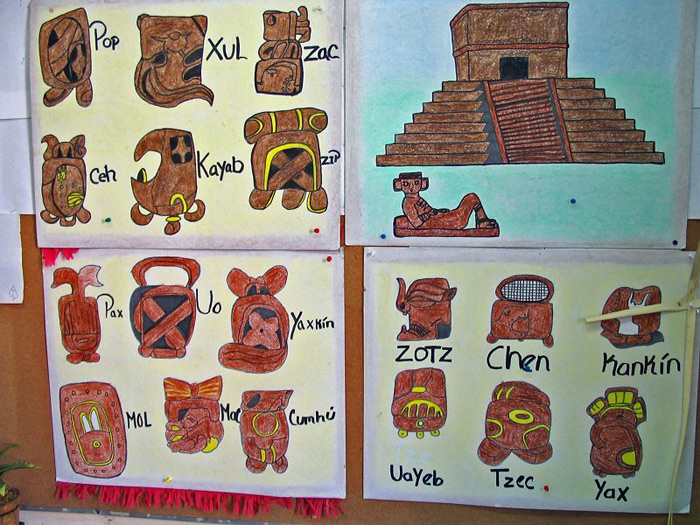
Poster for heiroglyph translation at the Academia Municipal de Lengua Maya in Merida, Yucatán
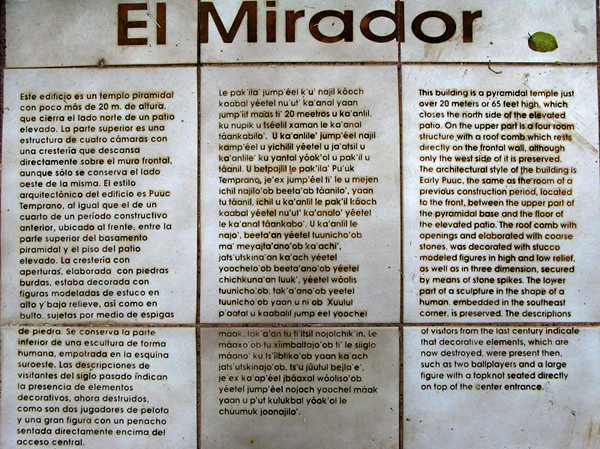
Translation Spanish / Mayan / English at Labná, Yucatán
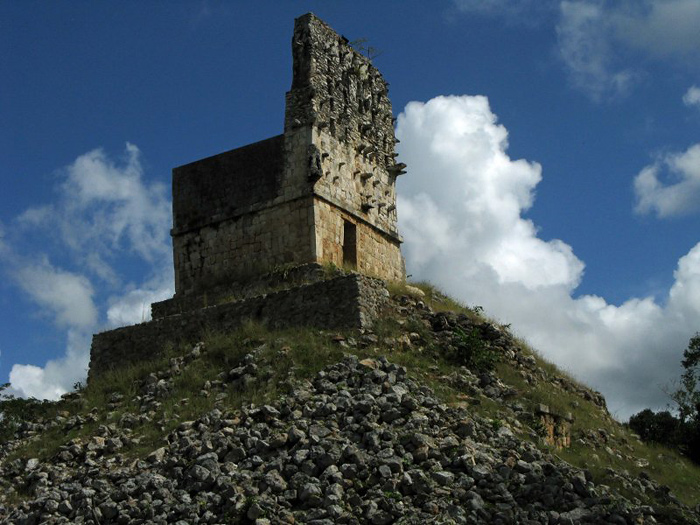
The Mirador, Labná, Yucatán
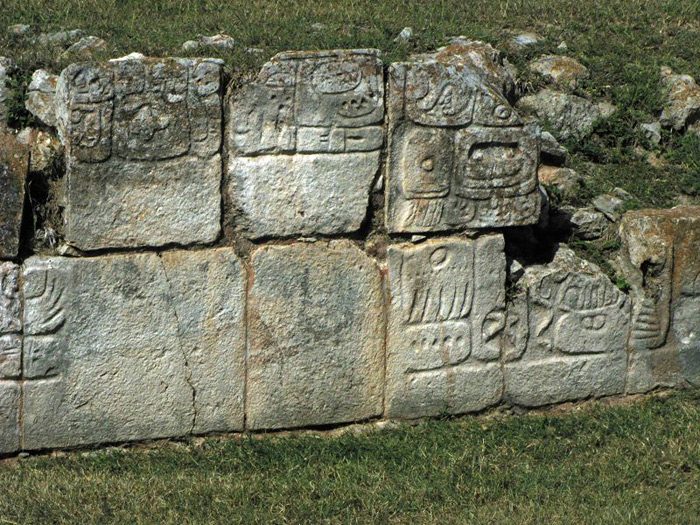
glyphs from Kabah, Yucatán
In my travels in Guatemala and the Mexican states of Yucatan, Tabasco, and Chiapas, while visiting the Mayan ruins I have been struck by the silent omnipresence of glyphs. These ghosts are reminders of a once vast and now seemingly vanished civilization, and yet there are Mayans living everywhere in the region. And in many places the culture is so strongly preserved and felt that it is like a nation (many nations really) within a nation. The guidebooks tell you that in some villages Spanish is not the predominant spoken language. It is a living and highly visible culture. Many, even most, of the places still bear their Mayan names. It seems impossibly contradictory that the Mayan cities were abandoned and yet the culture remains. That is what one experiences in these places. There is a sort of mental disconnect; how to understand that these builders of mighty cities have transitioned and yet are same as the people living today?
Walking in Merida one day, wandering into a neighborhood, I was attracted by a very old looking church there. Opposite it was a Mayan language school. Seeing the poster at the entrance to the school was as a Eureka! to me. There it was, a connection between the mysterious ancient Maya and the largely colonial Spanish city of today, and the young students learning to read the glyphs that they may translate the old symbols into a spoken language, themselves the concrete sign that the Mayan culture remains vibrant today, their heritage a direct connection to the the pyramids.
*
Steve Wing is a visual artist and writer whose work reflects his appreciation for the extraordinary elements in ordinary days and places. He lives in Florida, where he works at an academic institution. A regular contributor to BluePrintReview and qarrtsiluni, his images also have appared in Cha, Lantern Review, Melusine, and Counterexample Poetics.
Two Ukranian poems by Yuri Andrukhovych
translated by Sarah Luczaj
Life is a Long Song
“Дивіться! А цей таки визнав,
що боїться смерті”, –
показав на мене пальцем
один розумаха з нетиповим блиском в очах.
Зрештою, то могли бути скельця.
Останнім часом мене люблять публічно запитувати
про найінтимніше.
Наприклад, який мій найтяжчий гріх.
Що мені снилося із середи на п’ятницю.
Чи подобається мені найвище керівництво країни.
Чи хотів би я бути сумлінням нації.
І чого я боюся.
Відповідаю переважно так,
як можу.
Коли розмова при чарці або з похмілля,
то значно відвертіше. Коли
на тверезу голову – то вигадливіше
й химерніше переважно.
Того разу я сказав,
що боюся смерті
близьких людей.
Головним чином від нещасного випадку.
Хоч насправді наше життя довге,
ніби пісня про Довбуша,
і смерть мусить сприйматися,
ніби розв’язка,
давно очікувана через те, що стомлюєшся співати.
Але в цитуванні найважливіше — це
своєчасно поставити крапку,
про що розумаха
знає ще від батьків-наставників.
І поставивши крапку де хоче, самостверджується як може:
“Він визнав! Дивіться всі на його
страх!”
Так, я справді не боюся сказати, чого я боюся.
Так, я справді боюся нічних телефонних дзвінків
та і-мейлів із записом sad news у суб’єкті.
Дивіться всі на мій страх:
от як я боюся.
В усьому ж іншому це просто пісня,
довга прекрасна пісня про шлях до прірви
чи, скажімо, не менш прекрасна –
про кулю в потилиці.
*
Life is a Long Song
“Look! One guy admitted
that he’s scared of death!” –
he pointed at me
a certain wise-guy with an unusual glint in his eye.
I suppose it could have been glasses.
These days they like to ask me in public
about the most intimate things.
For example, my greatest sin.
What I dreamt of from Wednesday to Friday.
If I’m happy with the leaders of the country.
If I would like to be the conscience of the nation.
And what I’m scared of.
I usually answer
as best I can.
When the conversation is accompanied by a drink, or after one,
much more openly. When
sober – in a mercurial
and capricious way. Usually.
This time I said
I was scared of the death
of those close to me.
Mainly through accidents.
Although really, our life is long
as a song about Dovbush and death should be seen
as a resolution
long awaited, because you became tired of singing.
But most important when quoting –
is putting the full stop in the right place,
which the wise-guy
still remembers from his masters.
And, putting the full stop where he pleases, he justifies himself as best he can:
“He admitted it! Look everybody, look at his
terror!”
No, I am really not scared to say what I’m scared of.
Yes, I am really scared of the phone ringing in the night
and emails with sad news in the subject line.
Look, everybody, look at my terror:
this is how afraid I am.
But apart from that, it is just a song,
a gorgeous, long song about the way to the abyss
or, and no less beautiful, let’s say,
about a bullet in the head.
* * *
Familiya Hruzina
Кікабідзе, твердо сказала вона,
єво фамілія Кікабідзе.
Що за дурна ідея – частувати пивом повію
о другій ночі,
видаючи себе за бізнесмена з Прибалтики
у київському відрядженні!
І все ж – яка нагода
почути, що собі знає тутешній народ
про країну, в якій живе,
про тих, кому вже ніколи в ній не жити,
про тих, кому не жити зовсім.
Єво убілі, розповідає вона,
он слішком много копал,
он бил самий лучший журналіст
нашей страни.
Я не можу виправляти її помилок,
я не можу знати, як усе було насправді,
яка насправді в нього фамілія.
Просто хочеться вірити власній брехні:
я – бізнесмен з Прибалтики
(так, бізнесмен з Прибалтики!),
і мені вже з раннього ранку
у цій країні
підписувати угоди, обмивати їх,
жлуктити каву, коньяк, ковтати атенобене,
слати факси і есемеси
і звалювати пошвидше до своєї Риги,
а вона
все повторює і повторює:
Кікабідзе,
Кікабідзе єво фамілія.
*
Heorgian Family
Kikabidze, she said, firmly,
His name was Kikabidze.
What a ridiculous idea – to buy a prostitute a beer
at 2 a.m.,
pretending to be a businessman from the Baltic States
on delegation in Kiev!
On the other hand – what a chance
to listen to what these people know
about the country they live in,
about those who will never live in it,
about those who won’t be able to live at all.
They killed him, she tells me,
he stuck his nose into lots of things,
he was the best journalist
in our country.
I can’t correct her mistake,
I can’t know how it really was,
what his name really was.
I just want to believe in my own lie:
I am a businessman from the Baltic States
(yes, a businessman from the Baltic States!),
and all day long
in this country
I’ve got to sign contracts, drink to them,
down coffee, Cognac, sip Atenol,
send faxes and text messages
to get out of here all the sooner
and back to my Riga.
And she
repeats and repeats:
Kikabidze,
Kikabidze was his name.
Translator’s Note: The original title is “Familya Hruzina”: “Georgian Family” with an “H” instead of a “G” to reflect a rural Ukrainian dialect. Georgij Gongadze is the name of the young Ukrainian journalist killed, presumably by security forces, in 2001. Kikabidze is the name of an elderly, popular Georgian singer, famous in Russia.
Yuri Andrukhovych was born in 1960 in Ivano-Frankivsk, Ukraine. In 1985, together with Viktor Neborak and Oleksandr Irvanets, he founded the popular literary performance group “Bu-Ba-Bu” (Burlesque-Bluster-Buffoonery). He has published four poetry books: Sky and Squares, Downtown, Exotic Birds and Plants and The Songs for A Dead Rooster. Andrukhovych’s prose works, the novels Recreations, Moscoviada, Perverzion, 12 Rings and Mystery, have had a great impact on readers in Ukraine. Andrukhovych also writes literary essays, and together with Polish writer Andrzej Stasiuk, published My Europe. Translations of his books have been published in Poland, Germany, Canada, USA, Hungary, Finland, Russia, Serbia, Italy, Slovakia, Spain, Switzerland and Croatia.
Sarah Luczaj is an English poet and translator who has been living in rural south-east Poland since 1997 with her husband and daughters. Her first chapbook, An Urgent Request, was published by Fortunate Daughter Press in 2009, and her poems and translations have been widely published in journals in the States and the UK, including The American Poetry Review, The New Statesman and Modern Poetry in Translation, and online in The Other Voices International Project, Pedestal magazine, and The Drunken Boat, among others. Sarah leads occasional creative writing workshop sessions, and has been known to carve her poems in walls (Zero Meridian installation exhibition, Krakow, 1992). She works as a psychotherapist.
Azalais
by Kit Fryatt
from “Erscotz,” a cycle of translations from Old Occitan into a synthetic and artificial dialect using elements of Scots and Middle English
& we hae cam tae the cauld.
snaw, haar & sleet
wee brids mute
sang unheard
buss bare nu
unbud there nu
nae jug-jug saul-reveille
as aince in May.
Ma hert’s deranged
estranged from ilka mate
we are in retreat
rather than we advanced
true words fail me
dreich pains assail me
frae nations adjacent
nae comfort.
I ca hir misled
whaes cap is set
at sic as a magnate,
unco daft, gey unred.
We say at hame
luve for meed is shame
a gowddigger
founds hir ain dishonour.
Ma leman is a canny lad
hicher than maist o em.
He does me nae trahaison
& the boss o ma bodie gud.
Ma luve is his o richt
& whae woud contradict
draws doon malhaison
I’m siccar neuth his blazon.
Bels amics, in aa dutie
I’m yirs i treuth, at ilka turn
couthy, & sheenen lik the mune
gin ye dae naething ootrie.
We’ll pit ye tae question;
I’ll tak yir protectioun.
Ye’ve gien yir promise
tae dae naught amiss.
Dryhten keep Beauregard
& he that int resides
& aa the bastides
o his laird
whae fares nu weel?
honour whummlt─
he’s deid, maikless make:
his saul save, min take.
Gleg makar, gie this rattle,
this scrip o rime tae hir
whae’s gouerned oor
by wheteir’s kittle.
*
untitled poem by Azalais de Porcairagues (fl. c.1175)
Ar em al freg temps vengut
que-l gels e-l neus e la fanha
e l’auzelet estan mut
qu’us de chantar non s’afranha
e son sec li ram pels plais
que flors ni folha no-i nais
ni rossinhols no-i crida
que am s’en mai me reissida.
Tant ai lo cor deceubut
per qu’eu soi a totz estranha
e sai que l’om a perdut
mout plus tost que non gazanha
e s’eu falh ab motz verais
d’Aurenga me moc l’esglais
per qu’eu m’estauc esbaida
e-n pert solatz en partida.
Domna met mout mal s’amor
que ab ric ome plaideia
ab plus aut de vavassor
e s’ilh o fai ilh foleia
car so ditz om en Velai
que ges per ricor non vai
e domna que n’es chauzida
en tenc per envilanida.
Amic ai de gran valor
que sobre totz senhoreia
e non a cor trichador
vas me que s’amor m’autreia
eu dic que m’amors l’eschai
e cel que dis que non fai
Deus li don mal’escarida
qu’eu m’en tenh fort per guerida.
Bels amics de bon talan
som ab vos totz jors en gatge
cortez’e de bel semblan
sol no-m demandetz outratge
tost en veirem a l’essai
qu’en vostre merce-m metrai
vos m’avetz la fe plevida
que no-m demandetz falhida.
A Deu coman Bel Esgar
e plus la ciutat d’Aurenga
e Gloriet’e-l Caslar
e lo senhor de Proensa
e tot quan vol mon ben lai
e l’arc on son fag l’assai
celui perdei qu’a ma vida
e-n serai totz jorns marrida.
Joglar que avetz cor gai
ves Narbona portatz lai
ma chanson ab la fenida
lei cui jois e jovens guida.

Azalais as depicted in a 13th-century illuminated manuscript
*
Kit Fryatt lectures in English at Mater Dei Institute of Education, Dublin. With colleagues there she co-ordinates the activities of the Irish Centre for Poetry Studies. She also runs the Wurm im apfel series of poetry readings and its associated small press, Wurm Press.
 qarrtsiluni