Archive
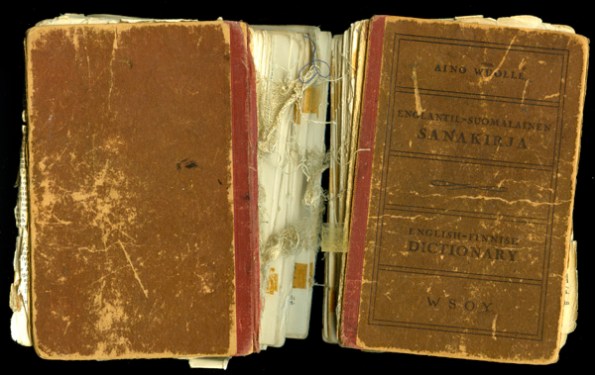
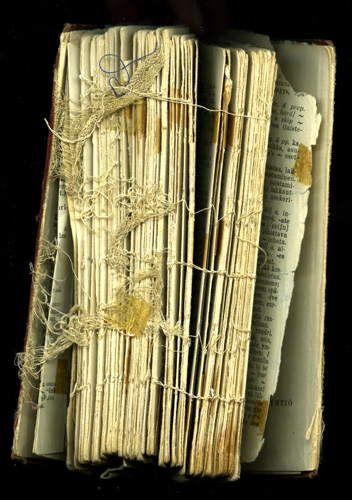
An English-Finnish dictionary
This is the dictionary that was used by my parents and family when we immigrated to Canada in the early 50s: an immigrant’s tool, an almost-bible, a book of days.

Marja-Leena Rathje is a Finnish-Canadian artist-printmaker and photographer who lives and works in Vancouver, BC. She has exhibited internationally and locally. She writes about her many interests including a fascination with archaeology, rocks and learning about her Finnish roots at her eponymous blog.
Three poems in French and English
Hölderlin à la tour / Hölderlin in the tower
(from Seule enfance, 1978)
|
Les oiseaux intermittents À partir d’un moment d’une extrême simpilicité |
Birds sometimes After a moment of extreme simplicity |
* * *
Manawydan’s Glass Door (d’après David Jones, 1931)
(from Pages aquarelles, 1989)
|
Ici rien ne se passe |
Here nothing happens |
* * *
Suite
(from Le Dit des couleurs, 2003)
|
c’est bien d’avoir l’impossible dans sa vie * le difficile * il y a des vitres * comme la marée montante * marcher sur ses pas * la mer est profonde * les fleurs viennent |
It is good to have the impossible in one’s life * the difficulty * there are window-panes * as the rising tide diminishes the island * to walk in one’s steps * the sea is deep * the flowers come |
Heather Dohollau was born in 1925 in South Wales. She moved to France, to Brittany, permanently in 1950, and has written in French since the 1960s. Her books include: Un Regard d’ambre (2008), Une Suite de matins (2005), Le Dit des couleurs (2003), Le Point de rosée (1999), Les Cinq Jardins et autres textes (1996), Seule Enfance suivi de La Venelle des Portes (réed., 1996), La Terre âgée (1996), Les Portes d’en bas (1992), Pages aquarellées (1989), L’Adret du jour (1989; Prix Claude Sernet), Dans l’île (1985), Matière de lumière (1985), La Réponse (1982), and La Venelle des portes (1981), all from the publisher Folle Avoine, and Seule enfance (1978), from éditions Solaire. Of recent years Heather Dohollau has begun writing again in English, and translating her poems in French into English. A selection of these is being considered for publication with Folle Avoine; the poems here are in advance of this.
Two poems with cello accompaniment
by Sheila Packa with Kathy McTavish
in translation
the name of the river
has fallen into another river
Zambini-nimi
names are buried by falling leaves
as the next rise from the roots
in your words, another people
the settlers displaced
in violence is a silence
a river only has its mouth
never saves itself
we know the boundary
the harbor in each breath
the shores but not between
in the currents
journey is erased
we carry a map and a book
say these are the stones
cross a bridge into memory
everything here
will be pulled down by gravity
near the high water mark
the voice and music
of a river gone
Note: “Zambini-nimi” is the Ojibwe name of what is now known as the Sucker River.
*
I SAID I
but I meant
the lonely road where I walk
in the forest
not lost but passing through
boundaries
cold that receded into seasons
before berries
I meant the stones broken and carried
by glacier
that came and left
I meant morning’s heavy mist
rising from the deep lake
to climb the headlands
from the direction of the sun
where hawks fly overhead
where we all come
the place of hidden roots
I put my weight
look for the way
one wild stem of columbine rising
with its bud
opens into a tiny lantern made from sunset
and unborn strawberries
I meant the fox who meanders from this side
to the other
following the scent
not hungry but taken into another
appetite
Note: This poem was written in response to a line from Argentinian poet, Alejandra Pizarnik: “Algo caía en el silencio. Mi última palabra fue yo pero me refería al alba luminosa.” (Something was falling in silence. My last word was I but I was referring to the luminous dawn.) On the podcast, Cecilia Ramón reads the Pizarnik quote, as well as her translation of Sheila’s poem into Spanish.
Sheila Packa (website, blog) is Poet Laureate of Duluth, Minnesota (2010-12). She has two books, The Mother Tongue and Echo & Lightning. She has had her work featured by Garrison Keillor on Writer’s Almanac. Her four poetry and cello CDs with accompaniment by Kathy McTavish may be ordered from her website.
Kathy McTavish (website) is a composer/free-style cellist who uses chance and generative/organic forms to create everything from sparse, minimalist spaces to dense, orchestral landscapes and performs in venues ranging from streetscapes to concert halls. Her work has been used behind spoken word, theater, visual art/sound installations, and film.
Permutations: A Translational Odyssey from Visual to Musical Systems
Watch on Vimeo (HTML5 version available for Chrome and Safari browsers).
A little over two years ago, I started working on possibilities for visual art using simple permutation operations: ways of reordering sets of information. These possibilities multiplied until a black, hardbound, gridded notebook was about half full and bursting with ideas and sketches. One day I took the notebook out to lunch with me and left it — astoundingly — on a park bench! Despite frantic efforts, I never recovered it. The same day I bought a new notebook and began where I left off, but never quite regained the momentum I had established with the original notebook.
But all was not lost with the (admittedly, somewhat deflating) loss of the notebook. I began to focus more on translating these same ideas into sound. This past summer, I decided to attempt to compose a suite of compositions for solo guitar, which happens to be my instrument. I had recently been alerted to the Fibonacci sequence, which is somewhat famous as the mathematical basis for spiral mapping, but I used it in a simpler way, merely as a sequencing method. Starting with certain scales, I constructed generative sequences of notes using the Fibonacci structure. These constituted the originating material, or sets, for the permutations. Next, I used something called a “latin square”* permutation technique to generate re-orderings of the original sequences. This is how the final sequences of pitches were made. I also created sets of rhythms which were reordered in every possible way.
The results of all the above work formed the melody, or as I think of it, the top line of the five solo guitar pieces. Immediately, I realized the pieces could accommodate — and in fact needed — a counterpoint, or “bottom line,” which I created in a traditional, intuitive artistic method involving choices that reflect my taste and sensibilities. Each piece ends with a different chordal flourish that displays the notes of the scale. The top line represents the main substance of the concept: to construct a system which in turn generates music outside my imagination. The bottom line is a concession to taste and volition.
Originally I had wanted to compose very simple solo guitar music for myself to play, as I am not a virtuoso guitarist. As it happens, the music that emerged is extremely difficult, at least for me. The suite consists of five “movements,” called cycles. On the audio/visual presentation above, my rendition of the First Cycle is heard, followed by the Third Cycle played by the computer, and finally the Second Cycle played again by me. The visuals show some of the pages from the second notebook, some finished art pieces, and the scores for the solo guitar suite, titled “Permutation No. 1,” so that this work may more precisely be called “A Translational Odyssey from Numerically-based Visual Art to Musical Systems.”
*Latin square permutation:
1 2 3 4
2 4 3 1
4 1 3 2
1 2 3 4
—James Ty Cumbie
December 2010
Recording by Atom Fellows
James Ty Cumbie has performed with Lukas Ligeti, Daniel Carter, Ned Rothenberg, Samir Chatterjee, Butch Morris, Walter Thopson, and many others. His compositions have been performed at New Languages Festival ‘09, The Vision Festival Series, Detour Jazz, and other NYC venues. He even once performed samba percussion for Lula, President of Brazil! From 2003-08 he produced and presented the Freezone Music Series, which showcased many of the most important avant-jazz artists from NYC, other parts of the US, and Europe. He has written jazz criticism for All About Jazz and worked as a graphic designer for nearly 30 years. He currently resides in Washington Heights where he is focussing on visual art and music composition. Both his art and music are strongly informed by minimalism, conceptualism, mathematics and serial/modular systems.
Le Chat/The Cat by Charles Baudelaire
translated by Florence Major
Viens, mon beau chat, sur mon coeur amoureux;
Retiens les griffes de ta patte,
Et laisse-moi plonger dans tes beaux yeux,
Mêlés de métal et d’agate.
Lorsque mes doigts caressent à loisir
Ta tête et ton dos élastique,
Et que ma main s’enivre du plaisir
De palper ton corps électrique,
Je vois ma femme en esprit. Son regard,
Comme le tien, aimable bête
Profond et froid, coupe et fend comme un dard,
Et, des pieds jusques à la tête,
Un air subtil, un dangereux parfum
Nagent autour de son corps brun.
*
Come my beautiful cat, rest on my amorous heart.
Restrain the sharp claws of your passage;
I will plunge into the hearth
Where your agate eyes burn with savage
Metal. While my fingers move lazily
To stroke your head and yielding spine,
My hands pulse with a frisson that fills me
And guides me; I remember my divine
Mistress. I see her in essence, her look
Just like yours, dear personable beast.
Profound and cold, it pierced and shook
Me, a captive from her head to her feet.
What perilous perfume her dusky body gives;
The brown opium of my desire still lives.
 Charles Baudelaire (1821-1867) was a poet, art critic, essayist and a pioneering translator of Edgar Allen Poe. He is famous for Les Fleurs du mal (The Flowers Of Evil) from which he gained both notoriety and acclaim. Like Edouard Manet, the painter who was a close friend of Baudelaire, his work was a transition from the romanticism and classical idioms of the day. Baudelaire brought a sensual realism into poetry, and urban settings that were far from the bucolic or mythological allegories so prevalent in the poetry and painting of the time.
Florence Major is an artist and poet born in Montreal, Quebec, and living in New York City. She has poems in The Chaffey Review and Cerise Press. See her Rilke translations earlier in the issue for a note on her approach to translation.
זענעפט (Zeneft)
That’s not how the word is pronounced, I hissed.
But the damage was done:
You tore the tongue out from every martyr
because you could not say the word for mustard
I taught you a week ago.
Torturing them over again
when we tell jokes about old men and fish
or different words for penis.
Am I wholly serious here? I’m not
serious enough. Reread the page.
Learn my name in the language
I want to speak. Silence
is the deadest tongue.
Zackary Sholem Berger (English blog, Yiddish blog) is a poet and translator in Baltimore who writes in Yiddish and English. His bilingual Yiddish and English book of poetry, Not in the Same Breath/Zog Khotsh Lehavdl, will be published in 2011. He and his wife, Celeste Sollod, are the forces behind Yiddish House LLC, which publishes Yiddish translations of classic English-language children’s books.
Meditation on the Road: Chinese Wartime Sonnets by Feng Zhi
translated by Huiwen (Helen) Zhang
冯至:十四行集(二十七首)十五看这一队队的驮马 风从千万里外也会 仿佛鸟飞翔在空中, 什么是我们的实在? |
from the Collection of 27 Sonnets (1941)No. 15Look at the horde of loaded horses Wind from a thousand miles away Like a bird flying in the sky, In what consists our being? |
* * *
二什么能从我们身上脱落, 把树叶和些过迟的花朵 把残壳都丢在泥里土里; 歌声从音乐的身上脱落, |
No. 2What might fall from our bodies, Handing leaves and late blossoms Cast all old skins into the mud; From the body of the music the sound falls. |
Download the podcast
(thanks to Vic Udwin for the English reading)
Feng Zhi 冯至 (1905-1993) was a modernist poet and the founder of German Studies at Peking University. During his wartime exile, he perceived and approached the exceptional situation of 1940s China from a reflective and introspective distance. His poetry not only conveys his curiosity and concern about each individual being’s existence at a critical moment, but also exemplifies the uncanny sense of hope and despair, bewilderment and determination characteristic of the Chinese “lost generation” of intellectuals.
Huiwen (Helen) Zhang 张慧文 (website, blog) is a curious mind wandering in search of every possible experience and adventure from China through Germany to the United States; a limber voice rendering Chinese, German, and English into one another in quest of the seemingly unattainable congenial; an unyielding spirit striving in the wilderness of philosophy and poetry; and a faithful soul writing under the sign of blue flower and red coral. Her translation series, “Meditation on the Road,” concentrates on Feng Zhi’s Collection of 27 Sonnets (Shisihang Ji, 1941).
The Ruin
translated with commentary by Jesse Glass
Wrætlic is þes wealstan, wyrde gebræcon;
burgstede burston, brosnað enta geweorc.
Hrofas sind gehrorene, hreorge torras,
hrungeat berofen, hrim on lime,
scearde scurbeorge scorene, gedrorene,
ældo undereotone. Eorðgrap hafað
waldend wyrhtan forweorone, geleorene,
heardgripe hrusan, oþ hund cnea
werþeoda gewitan. Oft þæs wag gebad
ræghar ond readfah rice æfter oþrum,
ofstonden under stormum; steap geap gedreas.
Wonað giet se …num geheapen,
fel on
grimme gegrunden
scan heo…
…g orþonc ærsceaft
…g lamrindum beag
mod mo… …yne swiftne gebrægd
hwætred in hringas, hygerof gebond
weallwalan wirum wundrum togædre.
Beorht wæron burgræced, burnsele monige,
heah horngestreon, heresweg micel,
meodoheall monig mondreama full,
oþþæt þæt onwende wyrd seo swiþe.
Crungon walo wide, cwoman woldagas,
swylt eall fornom secgrofra wera;
wurdon hyra wigsteal westen staþolas,
brosnade burgsteall. Betend crungon
hergas to hrusan. Forþon þas hofu dreorgiað,
ond þæs teaforgeapa tigelum sceadeð
hrostbeages hrof. Hryre wong gecrong
gebrocen to beorgum, þær iu beorn monig
glædmod ond goldbeorht gleoma gefrætwed,
wlonc ond wingal wighyrstum scan;
seah on sinc, on sylfor, on searogimmas,
on ead, on æht, on eorcanstan,
on þas beorhtan burg bradan rices.
Stanhofu stodan, stream hate wearp
widan wylme; weal eall befeng
beorhtan bosme, þær þa baþu wæron,
hat on hreþre. þæt wæs hyðelic.
Leton þonne geotan
ofer harne stan hate streamas
un…
…þþæt hringmere hate
þær þa baþu wæron.
þonne is
…re; þæt is cynelic þing,
huse …… burg….
*
Wondrous this masonry, broken by fate:
Racked courtyards, giants’ work canting.
Roof tiles wrecked, stone towers leaning
Rime-scored gates agape, frost upon mortar.
These storm-protectors, caved-in, collapsed,
Undone by the ages. Grasp of the earth holds
The legendary Builders, long perished, passed away
In fierce grave-grip, 100 generations lost
To mortal life. Often these walls
Red-stained, gray with lichens, stood stalwart
Storm-stressed, for Kingdom upon Kingdom
While airy structures fell, yet still this masonry
Endures hard winds … thresholds gullied
Struck through ……………………………e
Deeply gashed ………………………
…………………shines
Ingenious monuments, anciently constructed
Dry mud crusts them.
A cunning mind paced out these circles
Edged rock for resolute ends, foundations
Held wonderfully together by metal means.
Here was a fine city hall, streets of bath houses,
Martial music; mead halls where men drank,
Dreamed together. Fate changed all that.
Pestilence slaughtered good and valiant men.
This place fell apart, its rebuilders
Trooped into clay. Therefore
The halls are broken, red tiles curve on nothing,
All is open: the inner roof arch visible,
Ruins canted on earth, fallen
To stone mounds. Here in former days
Warriors laughed, splendidly adorned,
Laved with gold luster. Proud and wine
Wise in glinting armor, they gazed
On silver, treasure stones, jewelry
Land-gifts, wealth, within this spacious
Kingdom of lights.
Stone building: hot gushing steam,
A broad surge walled within a painted
Enclosure; there the pools filled by themselves
From the earth aboil; that was convenient;
To allow them to pour th…
Scalding streams over gray stone
And…
Until that circular pool. Hot
………………………………there the baths were
There is…
………………………re; that is a noble thing
How that b…………burg.
*
Commentary
Scholars believe that “The Ruin” describes the city of Bath, England, four hundred or more years after the Roman withdrawal. As with all things having to do with Old English literature, we’re never quite sure who is speaking about what, though sometimes as in “Deor” and “Wulf and Eadwacer” — also from the Exeter Book — it appears that a single human voice commenting on loss, exile, and change is doing the talking. The learned debates are endless, however, and continue to rage on.
So a caution is in order for anyone attempting to read, and virtually everyone attempting to translate, Old English: things appear to be what they may not be. We simply do not have sufficient context to come to more than provisional conclusions concerning these texts. Were they songs? Riddles? There is a distinctly Romantic feeling about the poem, as in Shelley’s great “Ozymandias” that could easily fit the sentiment of “The Ruin,” yet this interpretation — we are cautioned by scholars — would be as mistaken as those unfamiliar with the late 18th century “Balloon Craze” misinterpreting accounts of balloonists lost among the Continental clouds as flying saucer reports. Surely “The Ruin” could be situated within a moralizing tradition that may be traced all the way back to Sumer and Ur; others would say that the idea of Fate and change is distinctly Anglo-Saxon and pre-Christian, while the same case could be made as it is with Beowulf of a late gilding of Christianity imposed when the pagan text was first written down from its oral sources — we can guess, but we don’t know for sure.
On a more particular level, the words themselves seem to resemble the small change of linguistic give and take that we use in our modern lives, yet most of the original Anglo Saxon is freighted with something distinctly Other. Begin with that first word wraetlic, in the first line of “The Ruin,” which the Anglo-Saxon dictionary tells us means “wonderful,” or “wondrous”; yet there is another feeling that apparently edges this word as a black border frames a Victorian death notice, and that is the chill of the “uncanny.” Peter Ackroyd, a writer I sincerely enjoy, in a recent collection of “true” ghost stories* tells us that wraetlic means “wraith-like” or ghostly. I have not seen this reading of the word in any dictionary that I’ve consulted, though that does not mean the reading is necessarily a false one. Though I don’t quite see how ancient stone-work could be ghost-like, I do understand that another dimension, a frisson, which the word “wondrous” does not quite catch, could exist in its Anglo-Saxon ancestor. Perhaps that tingling, hair-raising, dimension is what the original Anglo-Saxon of “The Ruin” contains in its depths — a feeling that words like wyrde “Fate” and enta “giants” does not quite communicate to us anymore in these sophisticated, post-post-modern times. Therefore, with this small observation in mind, one might see that a translation of “The Ruin” into modern English — even one attempting to give an illusion of the prosody of the original as this one does — could miss out on conveying what might be a whole different level of understanding.
I’m reminded of another experience I had of translating a famous poem by the Japanese experimental haiku master Santoka. The poem goes like this: Wake itte mo, wake itte mo, aoi yama. It’s very simple and it means quite literally: “Push apart/ Enter/ Push apart/ Enter/ Blue-green mountain.” In Japanese it is even more minimal than that, if it’s possible — yet it is very specific. It gives just enough information, and it works in an extraordinary manner. In English one has to answer some basic questions in order to do a successful translation. Who is pushing apart what and going where? So quickly you realize that to translate this — or any — poem, is a matter of choices and interpretations. When I had finally gotten to the point where I thought I could translate Santoka’s great haiku, my class of older Japanese ladies informed me that there was yet one other level to the push apart sequence, and that was the sound. Sound? I said. Indeed — the sound of a work-song, they told me. How incredible that I had missed it! If something as simple as Santoka’s handful of phonemes could hold within it this “ghost” of connotation, imagine all that could be missed in translating a text as fragmentary and multivalent — indeed as “wraith-like” — as “The Ruin.”
Yet a final note regarding this poem concerning sound. Please say this poem aloud as you read it, because that’s exactly how the original was written — as an approximation of something originally spoken, chanted, sung. Something for the ear.
*The English Ghost. London: Chatto & Windus, 2010. Pg. 2.
Jesse Glass (Wikipedia page) lives near Tokyo with his wife and family. He is the co-founder and general editor of Ahadada Books and the journal Eklesographia, and is currently translating the great O.E. poem “The Wanderer.”
Ground Zero

Click on image to see a larger version.
Dominique James (webpage) is an experienced commercial and fine art photographer currently based in New York City. For more than 25 years, he has worked on a variety of film and digital imaging projects, and has presented more than 50 one-man and group photography exhibits. While he is best known for his celebrity portraits, and is proficient as well in fashion, product, food, travel, landscape, architectural, interior, and adventure photography, an ongoing series of personal works explores the many aspects and dimensions of both black-and-white and color fine art photography.
Three Swedish poems by Eva Ström and Johanna Ekström
translated by Carol Berg
Dödssynder åtrår ni mig ännu?
by Eva Ström
Dödssynder åtrår ni mig ännu?
Vrede vill du blomma i mig?
Vill du driva blodet till mina kinder
och få mitt hjärta att accelerera.
Avundets korta sting,
vill du träffa mig,
låta mig fåfängt få rasa
efter ett annat liv.
Jag vill känna högmodet och gå
med högmodets vadderade ncacke,
jag vill känna den beska älskogens söta sting i min kropp,
och vila en stund på smickrarnas ockersålda mattor.
Jag vill känna hur slugheten får min hjärna att arbeta
och hur omåttligheten griper tag i mig i ett vällustigt begär.
Dödssynder åtrår ni mig?
Kan ni ännu verka i mig?
*
Deadly Sins, Do You Still Want Me?
Deadly sins, do you still want me?
Wrath, do you want to bloom in me?
Want to drive blood into my cheek
and make my heart accelerate.
Envy, short sting
do you want to smack me,
churn in me—vain rampages
after my next lonely life.
I want to feel pride and run
with pride’s stiff neck,
I want to feel the bitter sweet sting of sex in my body
and rest in the moment on flattery’s shaggy carpet.
I want to feel how cunning works in my brain
and how excess grips me and touches me with desire.
Deadly sins, do you still want me?
Can you still work in me?
* * *
Utan skicklighet men med förmåga
by Johanna Ekström
Utal skicklighet men med förmåga
lyfter du mig ur ledsnaden
Ytterst sakta
som visste du
att det som rycks upp
kan tappa något
på vägen
*
Without Skill But With Strength
Without skill but with strength
you lifted me out of my grief—
Utterly calm
as one who knew
that to snatch a thing up
allows little bits
to drop away
* * *
Vad händer minns
by Johanna Ekström
armarna längs sidorna
det kan se ut som om man väntar
de stora orden
sover under
handens flata
en karamell som sugs
till flisa
orden är som glas
en sticka under nageln
Vem har dött av kärlek
I fodret sover alla barnen
torkade om mun och ögon
de har ingen mun där mun skall vara
inte blick där blick skall vara
Vem har väl förlitat sig på själva skadan
Ur dessa händer kan eldar löpa
kännetecken brännas bort
Händer faller som tulpanblad
sveper bort ett anletsdrag
Som händer gör i sömnen
de minns sin ensamhet
Hon lägger bladen över barnen
täcker dem med handens flata
Ingen har dött av kärlek
Det finns en motvind som jag aldrig känt
*
What Hands Remember
arms at sides
appear as if they are waiting
the large words
sleep under
palms
a hard candy is sucked
till slivered
glass words like
splinters under fingernails
Who has died of love?
In the coffin lining all the children sleep
mouth and eye wiped dry
their mouths are not where mouths should be
don’t see what they should see
Who isn’t convinced of their own harm?
These empty hands flare
birthmarks burned away
Hands fall as tulip leaves
sweep away the face’s features
Hands jolt in sleep
remembering their loneliness
She lays a blossom over the children
covers them with the palm of her hand
No one has died of love
There is a storm like I have never felt.
Eva Ström was born in 1947 and lives in Kristianstad, in southern Sweden. She made her literary debut in 1977 with the poetry collection Den brinnande zeppelinaren. Ström trained as a physician and worked in the medical profession from 1974 to 1988 before becoming a full-time author. She has recently translated Shakespeare’s complete Sonnets into the Swedish language, which was reviewed in the Swedish newspaper, SvD.
Johanna Ekström was born in Stockholm in 1970. She is a writer and visual artist who has presented at galleries around Sweden. Her work includes a short story collection Vad vet jag om hållfasthet (What do I know of stability) and seven books of poetry.
Carol Berg’s poems have appeared or are forthcoming in Artifice, The Flea, Fifth Wednesday Journal, Pebble Lake Review, Rhino, blossombones, and elsewhere. She has an MFA from Stonecoast and an MA in English Literature.
 qarrtsiluni