Archive
Insulation
The man came in with a long black hose. I was elbow-deep in soap-water, and the baby was in her chair. “Mmm, mmm,” she was saying, “Elmo, Elmo.” Lucky Charms flew. More men came in after the first, stomping their dirty brown boots on the Welcome square, then walking onto the triangle of sunlight made by the open door.
“Who are they?” I yelled to my husband. He was only on the other side of the kitchen island but he might as well have been on the other side of the world because before we knew it, the men were drilling holes into the walls, and he couldn’t hear me. I couldn’t even hear me. Baby’s lips were moving. “More, more,” she was saying, but her words were drowned out by the thrum of saw into drywall.
I tore a packet of oatmeal and poured it into the bowl. The blades of the saws shone, and the muscles in the first man’s forearm popped; I imagined how blue the outside sky must be, all that light pouring in. My husband held up two fingers. I held up two too. “Peace,” I mouthed. I smiled. It seemed a perfect day for all to be forgiven. He shook his head, pointed to the oatmeal. “2,” he pressed into the air again. I tore open another packet and tapped it into the bowl.
The floor shook with sound. The neighbors must have thought the world was coming to an end; or that we were finally just tearing into each other — a couple of wild-eyed cats spinning in cartoon-dust; or maybe they thought that our home would rise right out off the block, shoot into the sky, rocket its way right into the depths of outer space. I imagined them running out into the street: Dmitri with his horse-hair bow and Gail with her bum-hip and JJ with his beard and his two boys, how they’d stand there watching us arc into the sky — me and husband and baby soaring into the heart of the closest black hole.
My husband held the spoon in his mouth and scribbled blue ink onto an old hotel pad. It always surprised me to see his handwriting — the closed o’s, stumpy f’s. Soundproofing, the note read.
“What?” I asked, and he underlined the word twice.
Baby had her hands over her ears. “No, no, no,” her mouth said.
My husband moved in Irish-Spring-close. I felt his breath on my neck and then he yelled in my ear. “They’re pumping shit into the walls.” He pointed at the word again.
“Oh,” I said. “Okay.” I gave a thumbs-up.
So no one can hear us? I wrote.
So we can’t hear them, he wrote back.
The drywall dust was beginning to settle, and the room grew quiet again. The man lifted his long black hose. “Sorry about all the racket,” he said. “Think of this as the last noise you’ll ever be subjected to.”
We laughed, and my husband tightened his tie, and baby blew him kisses, and I think that I was yammering about vitamins — about the Fish Oil and the D and how bad the burps are but how important it all is — but deep inside I was panicking; deep inside, I was terrified of what the night would bring — without the whine of Dmitri’s cello, or the click-click-click of Gail’s cane, or JJ’s sweet boys with their lilting, twinkling stars — of how silent it would be, of how lonely I would be in its silence.
Nicole Callihan’s poems, stories and essays have appeared or are forthcoming in Painted Bride Quarterly, Salt Hill, Washington Square, New York Quarterly, cream city review, and La Petite Zine. She was a finalist for the Iowa Review’s Award for Literary Nonfiction, and has most recently been named as Notable Reading for Best American Nonrequired Reading. She lives in Brooklyn and teaches at New York University, as well as in schools and hospitals throughout New York City.
Three Modern Iranian Poets
translated by Sholeh Wolpé
I See the Sea…
by Shams Langroodi
I see the sea shrink
then shrink again
until it fits in the palm of my hand.
And I
hear the sound of flying fish,
the dead sailors’ cough, the burning whales,
the shivering mermaids, the horses and the wind,
the sea’s white curls,
and the drowned strangers who have forgotten their human voice.
I see
the sea
shrink
then shrink even more
the oars’ hopeless beats,
the foam-circled boats,
the frozen shadows,
the salt encrusted stores,
the disheveled hopeless left on the shore…
Oh what strange mystery,
the sea!
I see your purple fingers
in the beakers of the dead,
and the shoulders of the wind
drenched with your mouth’s sweat,
and I see your bitter joy.
I see
the sea
shrink,
then shrink again,
and I
float farther
from the invisible shore.
Where is this familiar boat
whose oars’ solemn sound mingles
with the rain carrying us?
*
Shams Langroodi was born in 1951, in Langrood, a coastal town edging on the Caspian Sea. In 1981, he was arrested as a political activist and served a six month sentence due to his opposition. He has published six collections of poetry, including Notes for a Warden Nightingale and The Hidden Celebrations, a novel, a play, and an anthology of Iranian poetry. His four volume history of modern Iranian poetry, Analytical History of the New Poetry, was banned in Iran for many years.
My Hands Tremble Yet Again — A Soliloquy
by Sheida Mohammadi
When
the sky
pulls its coat tight over its head, and
the rain keeps nagging, and
my pink doll
misses the sun…
I become weary of you.
When
the teacup on the table
is a crow starring at me
my throat begins to taste like caw caw.
Black-beaked clock
until dawn
black-beaked clock
till dawn
Clock…
The telephone goes mad with silence,
and I, go blue with you.
Aromas quit the house.
Happiness ditches me.
And the dirty laundry
keep spinning, spinning…
My mother’s silver spoons drift and dash in the kitchen. Un-ironed shirts
lounge over cactus trees. I put on your dirty socks and waltz
with your black striped pants. The house spins around this washing
machine, round my head. Dirty dishes play games on the kitchen floor.
I yell at the flower pots and blow out the candles. Happy birthday to me!
I bang on the typewriter and am drenched in your hands’ dried up sweat.
I change the TV channel to coax a yawn into my swollen lids.
I hate the pink nail polish bottle I found on the piano.
Black-beaked clock
until dawn
black-beaked clock
till dawn
Clock…
Now
the sycamore’s yellow bluffs
and highway 118 …
do not pass me by.
Strawberries,
like your expressions of love,
make me want to barf.
This month,
that month,
I come to hate you.
I hate you.
*
Sheida Mohamadi was born in Tehran, Iran, and received her B.A. in Persian Language and Literature from Tehran University in 1999. Author of three books, she was recognized as one of the most notable contemporary Persian writers of 2010 by the Encyclopedia Britannica. Her third book, Aks-e Fowri-ye Eshqbazi (The Snapshot of Making Love) was published in 2007. Her Poems have been translated into various languages, including English, French, Turkish, Kurdish and Swedish.
Blood’s Voice
by Mohsen Emadi
If one day flood brings in a sad panther
and a shrine’s door,
if they sew up a shirt with the panther’s skin,
make a necklace with his teeth,
I know that whoever puts on the shirt
will disappear,
and whoever wears the necklace
would be obliged to carry
her own head under her arms.
I take the shrine’s door
install it on the threshold
of my house. It creaks open
to a circle of women,
heads on knees,
caressing their own hair.
Outside, body-less heads
surround a fire with songs.
I don’t recognize my own voice
and the door closes and opens
to the rhythm of the words I grunt.
It is raining.
A unclothed woman knocks on the door.
She carries a boat on her back.
I greet her between the panther’s roar
and the door’s groans.
Silently she unloads her boat in a corner,
climbs in and falls asleep.
The house is in water.
Water carries away corpses of women,
it carries away the door,
and my voice.
We paddle.
We row looking for the voice.
My legacy is a door through which
when a woman enters or leaves
my voice cracks,
and the house drowns in that alien sound.
Each time my bed is a boat
to attract the nudity of a woman.
A women’s nakedness is silent.
It is wet.
I uproot the door,
plant it on my rooftop.
The wind blows.
Guns appear on the threshold of the door.
They point themselves at my throat.
The wind blows
and a thousand wounded panthers
leap out from my mouth.
I am naked.
An unclothed woman,
wet,
draws herself out from among the guns,
kisses the door,
kneels before me.
Panthers leap out from her hair.
I caress your hair.
The door will shut,
voices and winds will pound on the door.
I will not open.
And the lost voice of the man
will become blood,
will flood through the cracks
and mingling with the rain
that will come pouring,
it will flow through the city’s gutters and veins.
I kiss you
and my blood leaps out with every breath,
out from my throat.
It becomes my voice.
You are silent.
You speak inside me.
There’s no one on the rooftop.
I stand there, collect all the photographs
the shirts, the photos of a thousand hands holding guns,
the portraits of women’s heads
and the narrow stream of blood
that flows on the paper’s edge.
I light a match,
throw into fire the shirts and the papers.
The fire has your shape.
I want to touch your hair.
I reach for you
and become a poet.
I pick up my pen
and blood flows from my hand.
The lines are your hair,
in every line a panther roars.
**
On the balcony
I fill my childhood cradle with soil,
plant roses inside it.
I water the roses,
rock the cradle.
The city is silent.
*
Mohsen Emadi was born in Sari, Iran in 1976. He is the author of a collection of poetry, translated into Spanish and published in Spain. He is the founder and manager of Ahmad Shamlu’s official website and The house of world poets website, a Persian anthology of world poetry that includes more than 100 modern poets.
Sholeh Wolpé (website) is the author of Rooftops of Tehran, The Scar Saloon, and Sin: Selected Poems of Forugh Farrokhzad for which she was awarded the Lois Roth Persian Translation Prize in 2010. Sholeh is a regional editor of Tablet & Pen: Literary Landscapes from the Modern Middle East edited by Reza Aslan (Norton), the guest editor of Atlanta Review (2010 Iran issue), and the editor of an upcoming anthology of Iranian poetry, The Forbidden: Poems from Iran and its exiles, due out from the University of Michigan State Press this year. Sholeh’s poems, translations, essays and reviews have appeared in scores of literary journals, periodicals and anthologies worldwide, and have been translated into several languages.
Nineteen years ago this summer
by Andy P.
BillRueben’s Inside, Ann Rueben glanced |
RuebenAndy had his I was just thankful no need to say |
AnnBill and Dad working in silence every polite word |
AndyDad had hair Dad’s hands reaching out, |
Andy P. is a recent graduate of St. Olaf College in Northfield, Minnesota with a degree in vocal music education. He currently works as a Tour Actor/Director with Missoula Children’s Theatre. Andy spends his free time writing music and poetry.
My Soul Speaks in Three Languages
tanka from English, to Spanish and Iluko
…tri-lingual in English, Spanish and Iluko, the language (dialect) I was born with but hardly spoke and never wrote with from my early teens, when I moved to the city for university, until two years ago when it reawoke, first in a Yahoo group and later in a website I stumbled upon. Iluko, a dialect of the northern-most edge of the Philippine archipelago, traces its roots to Austronesian languages. Like most of the major Philippine dialects (87 of them not counting sub-tongues), Iluko tends to be metaphorical and thus poetic. Melded in its spirit is Spanish, introduced by the colonizers 400 years ago — not only as a language but a culture and a soul, both of which we, Filipinos but specifically Ilokanos, can hardly discern on the conscious level. English sort of flowed in only in the past century, easily so because the Spaniards had by then changed our alphabet from what was believed to be Sanskrit to Roman. I believe that when I write I do so from three cultures uniquely one, uniquely mine. But I began explaining all three when one day, I took a break from the haiku that I usually post in my personal blog and in reply to someone who got to my blog, searching for the word willow in Pilipino, I wrote as follows.
Citing the absence of a Pilipino (or Iluko) word for willow tree demonstrates how language is deeply entrenched in culture: the totality of one’s being layered over by influences of earth, air, water, living things, language whispered, sung, murmured, chanted, stated, shouted, screamed, written for one to read under fluorescent light, Coleman light-flood, moonlight, candle light — how we whine and laugh and cuddle up wordless or word-full, with what flowers we offer our sighs, what trees we carve arrow-pierced hearts into, from what looming shadows we scamper away, what wings we shoot down, from what edges of cliffs we plunge off to get to our dreams.
In languages like mine born of life, a borrowed word — just one, say cry or sob — fails to bring out how anug-og in Iluko pictures a bent figure broken in grief, shaking with spasms of pain, sobbing an animal cry that escapes from the depth of caves. Or saning-i, one of my favorite words, portrays someone — usually a woman in a dark corner, splayed on the floor, propped on the wall, the neckline of her dress dropped, the hem of her dress carelessly gathered — deeply hurt, flayed in spirit, melting in helplessness, too enfeebled to even scream or sob, simply shaking with sorrow in what sounds like staccato coughing broken by wet sniffles. Saning-i is also the cry of a child suffering from chronic hunger pain, as in children whipped into living skeletons due to kwashiorkor, or a baby burning with fever.
Language is as mysterious as the spirit, indeed.
No, dear friend who’s asking if there is a translation of willow tree in Pilipino, there’s none I’m aware of. None of our trees have looked as sorrowful, sometimes sinister — under Philippine skies that stars perforate, crowns of mangoes and some other trees sparkle. No, nothing that does not belong can be a match, can be translated.
*
In these three tanka, I used all three languages my soul speaks with. The English translations are mine, as are the Spanish, but edited by Sr. Javier Galvan y Guijo, director of Instituto Cervantes in Oran, Algeria. The Spanish translations are more or less word-for-word except for particularities of Spanish in terms of number agreement.
1.
among the willows
the wind sometimes listens
to whispers
steals from ripples of the lake
our secret sighs
entre los sauces
el viento a veces oye
los susurros
roba de las ondas del lago
nuestros suspiros secretos
kadagiti kaykayo
no dadduma agan-aningas ti angin
kadagiti ar-arasaas
mangtakaw iti apges ti luok
dagiti limed a sen-senaayta
NOTES: In Iluko, there are no definite prepositions; kadigiti in the poem indicates “among.” Also, the present tense in the word “listen(s)” serves well enough to actively refer to the action of listening, but in Iluko is not enough, hence the use of the participle, as in agan-aningas (listening), compounding the first syllable. Also, the plural form in Iluko is not a suffix, but similar to the way a participle is formed, is made by compounding the first syllable, as in sen-senaayta (sighs). Again, while in both Spanish and English, “ours” is another word, it is a suffix, -ta, as in sen-sennaayta (whispers) in Iluko.
2.
any which way
leaves and sparrows flutter
even fall in the wind
so unlike downcast hearts
rooted among stones
de cualquier forma
las hojas y los gorriones revolotean
incluso los lleva el viento
a diferencia de los corazónes abatidos
arraigado entre las piedras
uray kasano
agampayag latta dagiti bulbulong ken bulilising
matnagda pay ketdi babaen ti angin
saan a kas dagiti nalimdo a puspuso
a nagramut kadigiti batbato
NOTE: The adverbial clause in the first line, “any which way,” translates in Iluko as uray kasano. The word uray has no equivalent in English and Spanish, though in this line, it is used to mean “whichever.” Also, the simple present tense in the verb agampayagda (they flutter) works here because it has a pair in matnagda (they fall) in the next line. “In the wind” would be directly translated as ti angin, but in Iluko, it makes better sense with the use of babaen (because) in the third line. Notice the suffix -da in the verb matnagda, cited above to indicate “them,” referring to the bulbulong (leaves) and bulilising (sparrows). In the last line, the past tense — “rooted” — is indicated with the prefix nag-.
3.
fallen leaf in the garden
only the wind can lift it up
or leave it to its fate
without the wind for thoughts
destiny ends each day
la hoja caida en el jardin
sólamente el viento lo puede levantar
o seguira su destino
si no viento por los pensamientos
estos destinos se fini cada dia
tinnag a bulong iti hardin
ti angin laeng ti makaipalais
wenno makaibati iti kapaayanna
no awan ti angin iti likud dagiti pampanunot
malpas ti gasgasat iti inaldaw
NOTES: The modal auxiliary verb “can” is a prefix makai-, as in makaiplais (can lift it up) and makaibati (leave it) in Iluko. Also, notice how agreement of numbers and verbs in Iluko follows the Spanish rule: los pensamientos/estos destinos translate as pampanunot (“thoughts,” with compounded first syllable) and gasgasat (destiny). To use the plural, “destinies,” in the English version to me would be awkward.
Alegria Imperial has had forty years of writing and media work, public relations and marketing from staff to managerial positions in government, educational and cultural institutions in the Philippines before she started to write poetry and fiction. She has won a few awards, and had been published in literary journals in print and online, including The Cortland Review, poeticdiversity.org, and LYNX. She now lives in Vancouver, BC. Read her essays on Philippine topics at Filipineses and her haiku at jornales.
Loquebantur variis linguis
by Teju Cole
Thomas Tallis (1505-1585) wrote his setting of “Loquebantur variis linguis” according to the account of the Day of Pentecost given in the second chapter of the Book of Acts. When the Holy Spirit descended on the Apostles, they began to “speak with other tongues, as the spirit gave them utterance.”
I have drawn five self-portraits on the theme, imagining a choir composed of myself in multiplicate. But I wish to evoke, too, my experience of Pentecostal Christianity, which included speaking in tongues. The preaching I received, and which I passed on to others, was that the purpose of these untranslated and mystical utterances was to sidestep the Devil and to reach God directly.
These drawings were made on the iPhone using the Sketchbook app. I value this technique especially for its immediacy: the artist’s finger serves as the pencil.

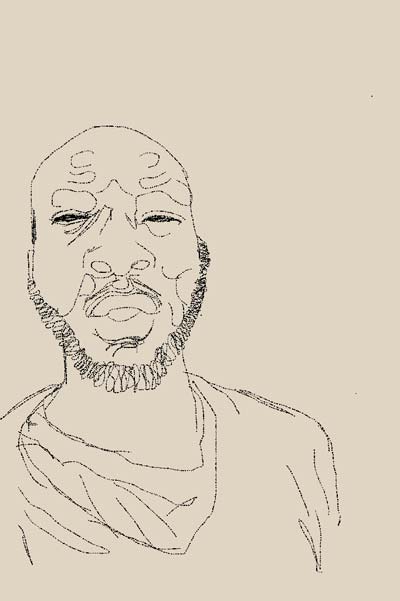


Teju Cole (website) is a Nigerian-American novelist, photographer, and historian of art. He is the author of Open City, which will be published by Random House in February 2011.
Three Poems: Sculpting Texts Through Japanese Poetics
by Desmond Kon Zhicheng-Mingdé
spatialism is a haiku’s negative space
burnished and sliding
the same war is fought over
you, like other books
hobble at a time
backward, no nomenclature
in front, a sharp comet
straying into night
its flippant tail a languor
soft gold, winnowing
to say this trust is ashen
to gather grain —
otherwise everything goes
invalidates into a hush
a kuhi and their double slit
it’s the orb, lit green
striking self-help pebbles like
flints, their light fire
us at bering’s pond
upper crucks in a full fence
how long, this narrative thread?
how long a chronology?
it’s the orb north of
possibility —
itself ornate, warm
fine balustrade lined
it’s the corrosive
possibility of hope
of a leash, release
stone becoming rust, red dawn
as with recitation and the loss of a kuhi
this thieving of love
tightrope against what it means —
to visit the past
who is good; who wrong?
which brittle, yellowing build?
of old, bluing tarpaulin?
uniform as points, squares, lined
instincts and numbers primed too
quiet eyes like dark opal
their squircle an open seat
under chestnut shade
as with basho on his mat
there he lays, small, crouched
under a low-lying cave
its long, empty lake
praetoria of ruins gone
fingers curled into his palm
unfurling, unclenched —
tired hope for newer days
Author’s note: I am currently working on a project that experiments with and deconstructs the haiku/kuhi/senryu/tanka form, an enterprise of hybridity and transformation that treks the lines of interpretation and translation. (For more on spatialism, see the Wikipedia. –Ed.)
Desmond Kon Zhicheng-Mingdé has edited more than 10 books and co-produced 3 audio books, several pro bono for non-profit organizations. Trained in publishing at Stanford, with a theology masters in world religions from Harvard and fine arts masters in creative writing from Notre Dame, Desmond is a recipient of the Singapore Internationale Grant and Dr Hiew Siew Nam Academic Award. He has recent or forthcoming work in Copper Nickel, Fence, FuseLit, Nano Fiction, Oral Tradition, Red Lion Square, and Wag’s Revue. Desmond also works in clay, his commemorative pieces housed in museums and private collections in India, the Netherlands, the UK and the US.
Organ Donor
What you don’t know when you sign the release form is that death isn’t the permanent void that nonbelievers swear it is, nor is it the tranquil bliss that the enraptured would lead you to believe.
The truth, as always, is somewhere in the middle. The truth is, they are your organs for a reason that seems to transcend the biological. Your eyes may now be transmitting patterns of light to someone else’s brain, but they are still your ticket to the world and, frankly, I don’t like what I see.
What I’m seeing at the moment is an old man’s spotty hands forcing an orange tabby into a ratty carrier. Then there’s a swoosh-like blur, like watching a movie where the camera moves from place to place without cutting. Now I’m looking up at a young woman in a doorway, who’s squinting back tears. The old man’s hand comes into the frame and pats her on the arm. She steps back. There’s a one shot of the open-mouthed cry of the child in her arms. It goes dark. The old man has shut his eyes.
What the woman won’t see is the man placing the carrier tenderly on the lap of his gray-faced wife, his accomplice, and several blocks away, stopping the faded beige Toyota and switching the cat to the trunk with all the others. That’s the worst part, when the trunk opens and all those cats look up, their eyes dilated from darkness and fear, their mouths open in long yowls.
He’s good at this. He crams in the carrier, slams down the trunk, cranks up the radio and off they go.
There’s not a lot of money in selling cats for medical research or zoology classes. It’s hard work. He has to read all the classifieds, be the earliest caller, cover the whole city. It takes a lot of first class acting — first on the phone and then in person.
I know this because he reads from a script, how they need another cat because they’ve just lost Old Jake, or little Molly, “the sweetest calico you’ve ever seen.”
Every morning I follow his arthritic finger through the same sad stories: owner divorcing, dead, allergic, called up, moving overseas. Once upon a time, one of these was mine. Perhaps this is why this has happened to me. I was done with domesticity: husband, house, pets. The feeling was mutual. We ran an ad.
Free to good homes. Cats!
I used the bait word: free, the one that brings cat sellers right to your door like raw chicken brings gators out of a swamp. An old couple showed up, not my current couple, but another old couple, just as gray, just as quiet, and what do you know! They took both cats, “To keep them together.” How wonderful for big fluffy-gray Furangela and little white, part-Siamese Celandine, those best friends, who always slept together, curled light and dark, like Yin and Yang.
I never knew what I’d done until I woke up seeing my sin played out daily through the cat man’s corneas.
There are no accidents. There’s stupidity, there’s indifference and there’s redemption; and I’m done with the first two.
The cat seller and I meet in the mornings as he lifts his razor and stares into the mirror, into his eyes, my eyes.
Repent, I say, sensing some long ago Baptist in his lineage.
He stares for a moment, frozen, the razor ear-high, like maybe he hears me, like maybe I’ve become a faint ersatz conscience.
He says something, always the same thing, before jabbing one finger into the slack flesh of his face and pulling it taut over the cheekbone.
“A man’s gotta eat.” I think that’s what he says just before the razor goes to work.
Repent! Damn it! Repent.
Karen Stromberg is the proud companion of three cats, and would like to believe that fiction can somehow, somewhat, atone for past cruelties, even those performed in blatant ignorance. Other flash fiction can be found at qarrtsiluni and Pedestal Magazine.
Two from Rilke
translated by Florence Major

Porträt des Rainer Maria Rilke (1906) by Paula Modersohn-Becker (public domain image courtesy of the Wikimedia Commons)
HerbsttagHerr: es ist Zeit. Der Sommer war sehr gross.
Leg deinen Schatten auf die Sonnenuhren,
und auf den Fluren lass die Winde los.
Befiehl den letzten Fruchten voll zu sein;
gieb innen noch zwei sudlichere Tage,
drange sie zur Vollendung hin und jage
die letzte Susse in den schweren Wein.
Wer jetzt kein Haus hat, baut sich keines mehr.
Wer jetzt allein ist, wird es lange bleiben,
wird wachen, lesen, lange Briefe schreiben
und wird in den Alleen hin und her
unruhig wandern, wenn die Blatter treiben.
|
Autumn DayLord: Approach. Summer was everywhere,
Lay your dark hands across the sundials,
And across the open fields, free the coursing air.
Compel the last bounty holding to the vine:
Engorge. Permit two more balmy days’ reprieve,
Then press them to fulfillment, drive
Crowning fragrance into the heady wine.
Those without homes are too late.
Those without company will remain alone,
With books, with pen in hand till night is gone
Or searching, in the city’s corridors, a state
Of mind, as dead leaves when they blow.
|
Sonnets to Orpheus, II. XV
|
O Brunnen-Mund, du gebender, du Mund, der unerschöpflich Eines, Reines, spricht,– du, vor des Wassers fließendem Gesicht, marmorne Maske. Und im Hintergrund der Aquädukte Herkunft. Weither an vorüberfällt in das Gefäß davor. Ein Ohr der Erde. Nur mit sich allein |
O fountain mouth, unceasing passage of eternal oneness, inviolate, your speech flows through the marble mask to reach across distant peaks; a timeless message brought descending from distant graves. and falls arising in your marble bowl Earth, it is you who speaks, the ear the soul |
Translator’s note: These translations are not literal, but true to the meaning of the poems as I read and experienced them. I find that when translations are dogmatically literal, the poem often falls flat as the essence of what one feels on reading the poem is no longer in evidence. How words are spaced and arranged creates timing as in music. Compulsive rhyming in translations creates “dead meter,” and eludes the inner musical resonance of a poem that was rhymed in the original. Tricky stuff, but as the French say, à chacun son goût (to each his own taste).
Rainer Maria Rilke (1875-1926) was a Bohemian/Austrian poet and art critic, famed for his critique of Auguste Rodin. He is considered to be one of the greatest lyric poets of the German language and in the lexicon of poetry. He is best known for the Duino Elegies, the Sonnets to Orpheus and a semi-autographical prose work, The Notebooks of Malte Laurids Brigge.
Florence Major is an artist and poet born in Montreal, Quebec, and living in New York City. She has poems in The Chaffey Review and Cerise Press.
Qavak Songs
translated by Nancy Campbell
During the 1950s the oral historian Maliaraq Vebæk collected stories from elderly speakers of the Qavak dialect in the settlements of Cape Farewell, South Greenland. These settlements have subsequently been abandoned and the Qavak dialect has become extinct. Song is a central element of Greenlandic culture, and many of the storytellers enhanced their narratives with lyric interludes. The following songs record the voices of three legendary female characters. The original versions were performed by Juliane Mouritzen, Martin Mouritzen and Therkel Petersen.
Song of a female shaman known as ‘The Robber of Men’s Intestines’
Nailikkaataak sapangall, sapangallin
qivaaqinngivani sapangall
sapangallin
My cunt is hung,
hung with sea urchins,
My cunt bursts,
bursts with bladderwrack,
My cunt drips,
wet as a walrus snout.
My cunt is hungry.
Song of a wicked woman whose knowledge knew no limit
Uvijera kiillugu mikkissavan!
Kiillugu mikikkikki,
taana imaats qarsernun naqqulijukkumaarpan,
suuvalijukkumaarpan.
Kiillugu mikissavan, aaverling toqussuunga.
Tassa taamaaligima, toquguma
ummasunu pinaveerlinga mateernijarimaarparma.
Atamijaa ooqattaarimaarpan arn qisivanik.
Tass taamaatimik qarsilijern’jassuuti
taana naqqulijullugu, aataa taamaal
taasuminnga sakkeqalerivin toqukkumaarpan.
There’s only one way to kill your enemy:
You must bite my clit off, pull it inside out,
and use it as an arrowhead.
Yes! Bite off my clit and pull it inside out,
but I warn you, I will bleed to death.
Hurry up! Blunt but hard,
it is the best blade for killing.
When I have bled to death,
cover me, for beasts will want to eat me.
Hold the head in soft driftwood
and fletch the shaft with folds of skin.
Yes, that’s the arrow you need!
Only my weapon can kill your enemy.
Song of Ukuamaat of Kakilisat, the mother who left fox prints in the snow
Ernera, ernilijarsivara
tuugaaning assaqqoruteqanngitserng
Ernera ernilijarsivara
tuugaani nijaqorutaasaqanngitserng
nulijaaning assaarmigakku
taamalli ajunnguvarminaan.
My son, the man I made myself,
has no tattoos on his bony arms.
My son, the man I made myself,
will never wear an ivory crown.
I’ve stolen his only wife —
that’s no mean feat for an old crone!
Nancy Campbell (website) has published a number of artist’s books, the most recent being Dinner and a Rose, a multimedia response to Patricia Highsmith’s Ripley quartet of novels, commissioned by Poetry Beyond Text, which was produced in collaboration with the artist Sarah Bodman. The Night Hunter, forthcoming from Z’roah Press, was composed last winter while writer-in-residence at Upernavik Museum, Greenland: the most northern museum in the world.
To the Empathetic Poet from the Aphasic
I am rising from bed and calling it
vineyard, I am washing my face
and calling it my kitten, I am preparing
for the day which is my wife’s birthday,
and all I can say to her is three chairs
and a rousing crown of thorns, for she’s
a jolly good pharaoh, and she cries
and I cry too, telling her don’t cosset,
my lanyard, don’t captain and she’s not sure
if I mean stop crying or snap out of it.
I see the look in your eye, less
pitying than, really, admiring: such
freedom with the signifier, such constant
newness. Yes, yes, I can see you also know
this reaction is inappropriate, but still,
you indulge it. When I declare
the morning a boulder or the night
a ribbon studded with birds, you
delight in my poetic insight, as when
that child in the kindergarten class
(prompted, mind you) declared purple
to be a triangle. You claim to be
empathetic — get inside this, then.
I want to give my wife a kiss but have lost
the word. I call it a cargo and she cries
harder. It’s a matter of choice — if you, poet,
describe this vase as a book, very well,
convinced of your lyric authority, I’ll leaf
my mind’s eye through the pages
of its millefiori Venetian glass. But if I
call the vase a tree, it’s not my intention
to take you into a forest of redwoods
or to a willow beside a stream. I wanted
the vase. Yes, I’m making it new, but you,
you can name it — vase, wife, love — for all
you protest that you’re transcribing the unsayable.
Lisken Van Pelt Dus is a poet, teacher, and martial artist living in Pittsfield, Massachusetts. Her work can be found in Conduit, Main Street Rag, The South Carolina Review, upstreet, and other journals and anthologies, and has earned awards from The Comstock Review and Atlanta Review. Her chapbook, Everywhere at Once, was published by Pudding House Press in 2009.
 qarrtsiluni