Archive
The Convert
by Eric Burke
In her new life, she was like a nation.
This was how she felt. She was beginning
to feel the responsibility of being many,
of having pasts
from which she could separate herself,
of having harmed many
but of being now innocent.
So, around her past, she stepped
carefully, with a hesitation
that felt like subtlety,
like nuance,
to her.
Eric Burke (blog) works as a computer programmer in Columbus, Ohio. Recent work can be found in elimae, Pank, A cappella Zoo, decomP and Bloody Bridge Review.
The Minor Leagues
by James Brush

Flying west over the diamond, egrets glow orange in the setting sun as they round second base and head over and beyond third, deep into foul ball territory. It’s good to watch the sky. You might see birds, perhaps an owl. You might see free-tail bats racing through the insect swarms around the stadium lights. You might even see that foul ball coming right at you. Hopefully you have a hat to use for a glove; otherwise, that ball will sting when it smashes into your palm.
The year Andy Pettitte came down from the Astros for some rehab work, the cars were an extension of the first base line, stretching down 79 all the way to the interstate. He stood above the opposition like Goliath facing 9 Davids, but wanting to give them hope, he let them stay in the game until sometime in the 6th when he decided it was over. Then, the only bats we heard were the ones hunting insects in the glow above.
In the minor leagues, we are ladies and gentlemen and respect the good play. Sure, things can get rowdy on Thursday nights when the beers and dogs go for a buck, but stout applause greets any man who plays well. Home runs, doubles, triples, we’ll cheer work well done whether by the home team or the visitors.
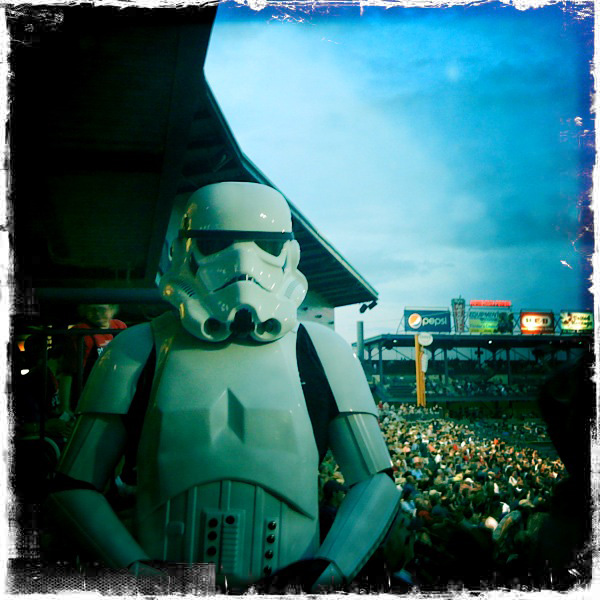
There are stormtroopers, Jedi knights and even Boba Fett wandering around the stadium. I don’t know why. There could be trouble. A stormtrooper stops near our section, pauses while everyone takes his picture. He looks so real, I worry that he’ll ask to see the papers for my droids and I’ll have to blast my way back to my ship — a real piece of junk, but she’ll make point-five past light speed. Made the Kessel Run in less than twelve parsecs, I tell anyone who will listen.
In the front of section 119 almost everyone has a radar gun, held toward home in steady hands, measuring each pitcher’s worth and tallying the results in worn notebooks. These radar guns are windows to the future flashing the potential greatness of up-and-comers in red digital miles-per-hour, but they are also portals to the past documenting the steady irreversible slowing of arms that once threw lightning in the big leagues.
There is a crack, and the crowd silences as the ball sails over the outfield. You can hear the prayers, the screams and cheers waiting on thousands of lips. If the ball falls short, the stadium will sigh. When it clears the wall, the crowd lets go. Did you see that? we all ask whoever’s closest, but they don’t answer because they’re asking the same question. Hats circulate through the crowd, collecting fives, tens (twenties on those one-dollar Thursdays), tips for the batter, that master of physics, who stopped and restarted time with nothing more complicated than a wooden stick.
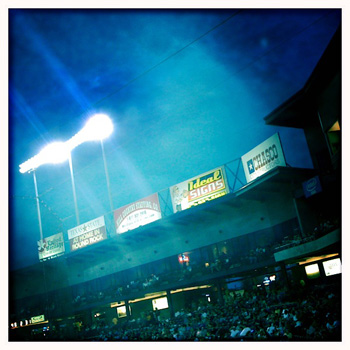
Some nights it all comes down to the bottom of the 9th. One more strike and the game is over. Or one good hit — it could go either way. There is nothing else in the world but the pitcher and the batter staring one another down. Even the players disappear as the pitch is released. All that remains is a small sphere hurtling through space toward the batter and a strangely silent crowd that breathes again only when the ball thumps into the catcher’s mitt. There are scattered cheers, and fireworks if it’s Friday, but everyone knows this series will continue tomorrow night.
Click on photos to see larger versions.
Download the podcast
James Brush lives in Austin, Texas with his wife, cat and two rescued greyhounds. He teaches English in a juvenile correctional facility. He doesn’t mind crowds if the music is good or the game is well-played. A list of publication credits and links can be found here. You can find him online at Coyote Mercury.
On Seeing “Envy Barn” in the Real Estate Listings
It is what we want, though
we’ve never even heard of one,
a barn of spectacle, maybe,
structure out back that holds
it all. So what if a property’s price
vaults six figures at least?
Worth it, yes, more than any cow-house
or mere hall of stalls, the envy barn
sets a place apart. Not just
in the sticks, we’re talking suburbia,
and it holds quadruple the cattle,
twenty-nine tractors,
un-nameable fields of hay.
Windowed, solar heated, flash
air-conditioned, Berber carpeted,
self-cleaning with three teak-walled lofts,
titanium piping, and the tools there
won’t rust. That it doesn’t
have a cellar makes no difference:
in the envy barn, it is all about
up. It rises above the ground,
the neighborhood, above any god
of a realtor that might even think
of selling short. It is
sheer impossibility meant
to stand on land, and it is gorgeous
and it is enormous,
and it is what we want.
Amy MacLennan has been published in Hayden’s Ferry Review, River Styx, Linebreak, Cimarron Review, Folio and Rattle. Her poems have appeared in the anthologies Not a Muse from Haven Books and Eating Her Wedding Dress: A Collection of Clothing Poems from Ragged Sky Press. One of her poems is available as a downloadable broadside from Broadsided Press.
Keating Road
What do we know
of dark places
that fill the spaces
between workshop
shelves and liquor
stores. the street
outside bears tyre
marks of tired lives
stretched like grime
under a fingernail.
Oiled hands beneath
dark machines
soil sheets in rooms
across the road, or
press rubber pieces
into deflated souls.
the city lies beyond
the gutter, a junkyard
heap of mangled trees
and skeletal houses.
What do we know
of dark places
that fill the faces
passing by in shuttered
light. the road outside
bears potholed longing,
it secretly deepens
with midnight feet
and wheels that turn
like bottle tops.
Janice Pariat (blog) is a freelance writer currently based in her hometown of Shillong, Meghalaya after many years of being away in Delhi and elsewhere. She is inspired by her mixed Portuguese, British and Khasi ancestry, literature, Shillong’s troubled history and folktales, everyday things, and travel. Her writing has been published in nthposition, Danse Macabre, Soundzine, tongues of the ocean, The Smoking Poet, Barnwood International Poetry Mag, The Caravan, Art India, Ultra Violet and Literati, among others.
Nikolaikirche
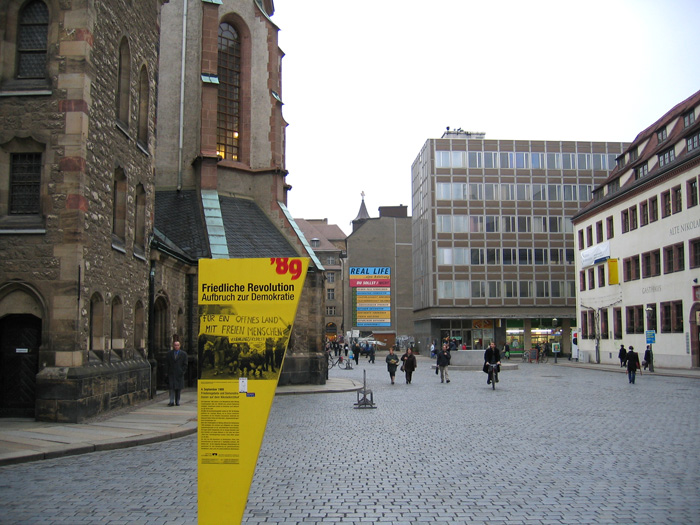
Click on image to view a larger version.
Nikolaikirche in Leipzig was the centre of the peaceful public revolt against the communist system in East Germany. Beginning in 1980, people gathered in the church every Monday for prayer. First just a few met, then more, until in 1989, thousands came together there every week for Monday mass, which was followed by a walk of protest.
It’s still moving to walk across the church square, and to see the photo that was taken during one of the Monday walks. The banner says “Friedliche Revolution — Aufbruch zur Demokratie” / “Peaceful Revolution — Rise for Democracy.”
Dorothee Lang is a writer, web freelancer and traveller. She lives in Germany and edits BluePrintReview and Daily s-Press. Recent publications include HA&L, YB, elimae, Referential, a handful of stones, eclectica, and for a silly reason, The New Yorker. For more about her, visit her website.
The Student Wars
by James Toupin
Were we playing? Spring opened
with the softness of the lotus.
Our politics emerged outdoors.
That year fate, enrolling soldiers
as numbers from a barrel, at last
spoke frankly. For those made fortunate,
death was launched elsewhere, at others,
and all the more must be opposed.
Someone said we ought to close
the road. Surely it carried convoys.
Our riot wound its way through groves
to mill out on the thoroughfare.
I maintained the periphery.
The megaphone came as called. The girl
whose glances were to me more vital
than war or peace, having come
with someone else, was carted off.
Talking taoism, she had not noticed
the line of cops begin to move.
A flashing cruiser, screeching, chased
me ring around a tree until
its spinout made space for me to run.
Such was our battle. Backpage news.
No trouble. A wisp of April risk.
James Toupin is a retired lawyer living in Washington, DC. His poems have appeared in the last couple of years in numerous print and online journals, including Loch Raven Review, The Guardian Poetry Workshop, Infinity’s Kitchen, Flutter, Umbrella, Four and Twenty, The Centrifugal Eye and Bumbershoot.
Return to the Old Town
To live with more than recall
of a latent happiness
that almost drove me
twelve years ago
to a drab hill town
and a woman who smiled at strangers
as they passed her window
never smiling back
I renounced contingency
and hiked the high track.
The people gathered in the square
to celebrate the slow roasting
of a single fish.
I matched its stare and felt certain
we had met before in better days.
Rob A. Mackenzie lives and works in Edinburgh. His first full collection, The Opposite of Cabbage, was published by Salt in 2009. He blogs at Surroundings, and is an associate editor with Magma.
No getting away
Nathalie Boisard-Beudin is a French lawyer having way too much fun with words, pictures and food. Her published works are listed — and linked to — in the sidebars of both her blogs.
Strays
So you know how a stray dog will dip its face into any dirty bit of puddle? Well, when Taller began doing the very same to Smaller people screamed real loud that they were out to swindle us somehow or bring the railing wrath upon us. Take your pick.
And didn’t we all think they looked suspicious and shifty, walking right up to our triple-strand razor-wired barrier with their swollen lips and sun-damaged eyes. No Identity card, no permanent address, not even vaccination or gender verification marks. No acceptable explanation for where they could have been. We’re looking to share something so valuable with all of you. Their wild eyes blinked slowly as we gathered in the center of our compound, unable to decide should we beat them straight up, or immediately banish them or be the audience they seemed to want. We were bored and the Pheedwagon was still hours away from arrival. They praised something out there in the murky blue beyond the furthest gate when we said we’d watch.
First we’ll lay down the golden ground said Smaller as she unfurled a moth infested length of yellow colored, old style fiber blanket. They paced it out in half-steps, then stood dead still and both of them went into a wheezing, winding story about a roaring comet of flying trash they’d been hit by out on some unnamed plain. They said they’d been plastered in torn or burnt pages and read many of the old words that had been eliminated by a series of court orders.
We’d sold off our names for credit vouchers long ago in the earliest days of The Curtailment but we had our assigned logos and we had the might. So then we roared in unison start it now as the swarms of black flies chewed us and left their trail of poisonous Braille across our faces and tattooed limbs.
It was right about then that Smaller took Taller into her arms and started rubbing against her in a shape like a wagging tail.
We looked hard at each other and some of us were falling to our knees, throwing our arms up high and begging forgiveness. Contact of any sort was routinely forbidden. Every one of us knew that.
After all the talking they pressed their mouths together tight. We heard some humming, then some moaning sounds. They stripped right down to their smallest, barest gestures even though the wind was scrubbing all of us raw. Taller made that Smaller shake real hard when she slipped one thin as a new moon hand between Smaller’s legs. It was then that the dogs started howling like they always do on days when the sun doesn’t come up and stay pasted tight right there in the sky.
By this time the very last of their strange words had stopped. There was a sound from somewhere we couldn’t see like that long drawn out sigh before a dust storm gathers itself up into a high, spinning mass. Our eyes lost their focus but our fists knew the way.
The dogs tore their filthy tongues out first. The dry ground was soon dimpled with dark spots like rain. It hasn’t rained here in memory.
But now green things grow where we laid them out.
Some of Holly Anderson’s most recent work can be heard on Peg Simone’s 2010 record Secrets From the Storm (Table of the Elements/Radium), or visit her at SmokeMusic.tv.
The Storm
by Mark W. Kidd
Thunder can peal twice, or three times,
or not at all
when the storms come
and sound bounds between some towers and into others.
I turn a corner and hear
the steel rattle of a dying blast.
My legs catch the quickening tempo of the street,
the sure-charged pace that speeds your feet
and leaves bag strap grip-dents in your palms.
Windhovers scatter above,
rushes of wind pushing on the warp and weft
of their high haunt,
mass-flapping of wings.
Cold light on my face and hands.
Crescendo magnetic click echoes—
waves of windows sealing themselves,
pressure dropping
throughout the city,
and those who linger outside with me
witness the thunderheads as they finally
cover the city as far as I can see.
Mark W. Kidd lives in Whitesburg, Kentucky, USA where he pursues creative and professional interests.
 qarrtsiluni