Archive
Balcony View of a Prairie Dog Colony
You don’t see a one at first.
Then, one becomes two, five, twenty,
a hoard of dirt-colored dogs.
A bird caws. You don’t see it either.
Are you missing multitudes
lurking like weeds in the field?
It caws again, and dozens of dogs
disguised by brush and dust
scatter like seeds into the ground,
mounds like tiny volcanic burps,
dozens, you now observe.
Prairie dogs pop back up,
jack-in-the-boxes, brown sock puppets
poking scrawny bodies about.
Three stand, sentinels at one burrow,
tails like clipped wicks;
a pair at another, a set of souvenir-stand
salt-and-pepper shakers
with ears like afterthoughts.
The field fills with scurrying.
An hour goes by. Another.
You can’t keep up.
How much else
has escaped your notice?
Scott Wiggerman (website) is the author of two books of poetry, Vegetables and Other Relationships and Presence, forthcoming from Pecan Grove Press. A frequent workshop instructor, he is also an editor for Dos Gatos Press, publisher of the annual Texas Poetry Calendar, now in its thirteenth year.
Waiting to March

Click on image to view a larger version.
Cambridge Carnival. Central Square, Cambridge, Massachusetts. August 2003.
Monica Raymond won the Castillo Prize in political theater for her play The Owl Girl, which is about two families in an unnamed Middle Eastern country who both have keys to the same house. She was a Jerome Fellow for 2008-09 at the Playwrights’ Center in Minneapolis, among many other honors and awards. Her poetry has been published in the Colorado Review, the Iowa Review, and the Village Voice.
Standing Room Only
by Tony Press
It was on December 1st that Jacob and 100% of his floor-mates, sixty college freshmen, plus the R.A., the upper-classman who had his own room, and in return the responsibility for holding their hands when needed, packed the television room to watch the lottery. The lottery. Five years ago, at fourteen, he’d read Shirley Jackson’s chilling story, “The Lottery.” As he maneuvered into a niche near the back, he massaged his head to rid it of Jackson’s tale. By wordless consent the young men pushed the furniture to the walls and stood for the entire show. “The show” was an odd term for what they were about to see, yet that’s what had been on flyers in the dining hall and the elevators: “The show: Be there: Get Lucky or Kiss Your Ass Goodbye.”
Fall quarter thundered toward finals and he had barely kissed a girl, much less “get lucky” in the way everyone else seemed to be doing. Every weekend another friend boldly or shyly bragged about sex, real sex, and all he did was read about it. He wasn’t sure he could stand four years of this if fiction was the closest he’d ever get.
The boys who would be men were scared. They hadn’t done this before. Nobody had done this before, not since the dinosaur days of 1942. In minutes somebody was going to pluck little cylinders out of a drum. Inside were all the possible birth dates to be matched to a list of the numbers from 1 to 366 on the wall — they didn’t forget Leap Year. The date that matched with number one, every nineteen year old boy in the country with that birthday would be first in line to be drafted. The dream date would be number three hundred and sixty-six; those guys wouldn’t see a drill sergeant until the Red Army marched from San Francisco to and across the Mississippi River. The story was if your number was in the first third, you were cooked. If you were in the last third, you were golden. If you drew an in-between number, roughly one-twenty to two-forty, you hadn’t learned a thing. You were still stuck in the middle with little clue how to plan your life. That was the whole idea, they said, that by giving young men this information, they could in fact plan their lives without the uncertainty of the current stunningly random draft system.
It was true that as long as they were in college, taking and passing a full load of classes, they were safe. Safe until they graduated, or dropped out, or sneezed in the wrong place. No, that latter happenstance, the sneezing in the wrong place, was the sort of thing that was no longer a factor. As long as you or your parents could afford college, okay. Of course, the sweeping changes had no effect on the upper class — even in the chaos of 1969, some things remained sacred. Nobody had any illusions that a rich kid couldn’t avoid the whole deal, and nobody had a single illusion that ninety-nine percent of them wouldn’t do exactly that.
Safe, then, until they graduated, or dropped out. Jacob had no clue what his own plans might be, even apart from the threat of Vietnam. School was okay but it was no passion. Was he where he belonged? Six high school friends were on their way to Vietnam. Another, two years older, had burned his draft card and was in prison. Still another was feigning homosexuality, but also applying to divinity school, covering all bets. Jacob didn’t know anyone in Canada but he knew people who did.
The room was usually noisy, to watch football games — this was different. Jacob thought he knew everyone at least on a some-name basis. One guy everybody called “Cowboy.” Several others were last-name guys, like Grauman and Preston and Rippinger, and Jacob couldn’t have said their first names on a bet. In September he had nudged his own name from Jacob to Jake, but sometimes he forgot that it was him they were calling. He knew he would always be Jacob at home.
Street performers had hit campus earlier in the week:
Join the army, see the world: Kill a gook, screw a girl.
Get the clap, a purple heart: Some penicillin, a brand new start.
He didn’t want any of that, not that way, and he certainly wasn’t a killer, of “gooks” or anybody else. Was he lucky or unlucky? He couldn’t say. Maybe his luck was waiting for something really important, like this lottery.
One of Cowboy’s big hats perched on the television and everyone had dropped a dollar into it. The money was a consolation prize for the sucker whose birthday was drawn first. Jacob never wished ill on anyone but he implored the gods of fate to spare him that one.
He was nineteen. Somebody thought he was a man. Who was he to plan his life? Washington’s good intentions, if that’s what they were, were wasted on him.
This morning his US History professor told a story: Just before World War One, the Great War, “remember, the war to end all wars until the next one came along,” the famous Washington D.C. cherry trees were planted, thanks to the Japanese Ambassador, who brought cuttings from the even more famous Tokyo cherry trees. The trees, thousands of them, were the gifts of the Japanese people. Then in World War Two, the United States bombed the hell out of Tokyo, wiping out the trees, and a large amount of people, too, so after the war, the U.S. sent cuttings of the Washington trees back to Tokyo. Nothing to replace the people.
The crowd crept even closer to the television to hear the first date. Jacob saw guys holding hands. He heard someone praying. He heard his own heartbeat.
“September Fourteen.” Dave Rippinger — that was his name, Dave! — cursed and kicked the table, sending television, hat and cash flying to the floor, before storming out.
Fifty-nine remained.
If he walks one block west and 78 steps up, Tony Press can see the Pacific, if he’s home. His fiction appears in Rio Grande Review, Menda City Review (also here), Foundling Review, Temenos, MacGuffin, The Shine Journal, Lichen, Boston Literary Magazine, and in the UK anthology Crab Lines off the Pier. Poetry appears in the UK anthology Heart as Origami, as well as 34th Parallel, Contemporary Verse 2, Spitball, The Aurorean, and Turning Wheel.
The World Is Ugly and the People Are Sad
by Karl Elder
The people have done wrong. They have impeached the president. Each night on airwaves he enters their homes, pounding a kind of gavel, his fist, from which partially extends a finger. They sit there and they take it. It is the finger the president uses. It is the finger he uses to push their button.
Karl Elder’s long poem The Houdini Monologues, with accompanying CD, is available from Word of Mouth Books, the imprint of his magazine Seems. Commentary from Elder on his poem “Ode in the Key of O” in Beloit Poetry Journal’s 60th anniversary chapbook, comprising new work from Chad Walsh Award recipients, appears in the journal’s blog, Poet’s Forum.
Acting Debut at the Roundhouse in London
by Nancy Scott
A children’s operetta—Cromwell’s having
a go at King Charles I and the Cavaliers.
Open call; any child who shows up
gets to be in the production, which is lucky
for ten-year-old Michael because he has a tin ear.
That Saturday afternoon, two tiers of scaffolding
had been erected on the bare stage; my son,
flag bearer for the Crown, at the top.
I admire Michael’s enthusiasm
for his adopted history; through all the speech-
making, intrigue, betrayal, my American
child waves the King’s standard
as a rallying cry for a dying cause.
In the final scene, Michael freezes.
The spotlight catches him, a wide-eyed kid
in tattered red tunic, peering down,
mesmerized. It’s 1648 and the flag has slipped
from his grasp. It flutters onto the stage
and gets trampled in a melee of bugles and swords.
Why didn’t you come down for the curtain call?
I asked Michael on the ride home.
After I dropped the flag, he said, I was afraid
what the King’s soldiers would do to me.
Nancy Scott (website) is the current managing editor of U.S. 1 Worksheets, the journal of the U.S. 1 Poets’ Cooperative in New Jersey. She is the author of two books of poetry, Down to the Quick (2007) and One Stands Guard, One Sleeps (2009) published by Plain View Press, and a chapbook, A Siege of Raptors (2010) published by Finishing Line Press.
The Crowd — a drypoint

Click on image to view a larger version.
Veils Suite: The Crowd (1990)
drypoint
59 x 90.5 cm (23″ x 36″)
Marja-Leena Rathje (website) is a Finnish-Canadian artist specializing in printmaking and photography. She is crazy about weathered rocks, prehistoric art and the archaeology of past, present and future. She lives and works near the sea and the mountains of Vancouver and has exhibited widely, both internationally and in her local region.
The Sweet Community
You show me the teeming hive
smoke-dulled into sluggishness,
magnetized—the framed comb
attracting the rapt attention
of all those hovering bodies.
This sweet community, you say,
absorbed in its constant task,
procreation, delivering and seeking,
sipping and sucking, hard at the work
of construction, regurgitating
what they know to raise
the next generation.
You say there is a dance that means food,
a dance for sex, a dance for “follow me.”
And when a virus enters the square,
stacked cities, all humming ceases,
empty shells litter the floor boards,
a spectacle of curled black legs—
they live and die together, collective
wisdom, you tell me: You,
their outsider in a wreath of smoke,
their mesh-masked god of plunder.
Poet, essayist, librettist and occasional radio commentator Ann E. Michael (website) is also a college educator/tutor in eastern Pennsylvania. She is the author of three chapbooks of poetry, an avid gardener, and an advocate for the arts. She co-edited the New Classics issue of qarrtisluni with Jessamyn Smyth.
In the Lab
We begin by laying carpets of rodent cells,
then rest the naïve human life on top.
Look at these heart cells clumped together,
watch how our science makes them dance.
We drop them nutrients once a day
and we divide each new growth
every week. Yes, there are occasional errors:
sporadic bone may grow in heart
but we progress: we can diminish overcrowding
and starvation, all non-productive masses die.
Maureen Jivani’s poems have appeared in the United Kingdom, the United States of America, New Zealand and Australia both online and in print magazines including Frogmore Papers, The Glasgow Review, Magma, nthposition, Orbis, The Rialto, Seam, Smiths Knoll, and The Wolf. Her first full collection of poems, Insensible Heart, is available from Mulfran Press. See’s also been featured at Peony Moon.
In the still forest heard from far away
by Alex Cigale
In the still forest
a noisome bellow
like a bull gator’s
a wild grunting sound
heard from far away
each grunter his own
particular timbre
hammering a stob
a short wooden stake
inches in the ground
with a heavy iron
shaft called the roop
drawing it back and
forth over the top
to send vibrations
into the mound
the tremors driving
crawlers to the surface
in trembling droves
swarming en masse
in prompt answer to some
indistinct instinct
escaping earthquakes
to breathe or to breed —
split down the middle
one worm becomes two
making either a head
or a tail of it
but species survival
is never a sure thing —
you don’t go worming
you don’t get to eat.
Note: See “Worm-Grunting: Luring Earthworms Out of the Ground” for a video of the practice. This poem is included in Collecting Life: Poets on Objects Known and Imagined, an anthology from HeartLodge.org in search of a publisher.
Alex Cigale’s poems recently appeared in The Cafe, Colorado, Global City, Green Mountains, and North American reviews, Gargoyle, Hanging Loose, Redactions, Tar River Poetry, 32 Poems, and Zoland Poetry, online in Contrary, Drunken Boat, H_ngm_n, McSweeney’s, and are forthcoming in Many Mountains Moving and St. Petersburg Review. His translations from the Russian can be found in Crossing Centuries: the New Generation in Russian Poetry, in The Manhattan, St. Ann’s, and Yellow Medicine reviews, online in OffCourse, Danse Macabre and Fiera Lingue, and forthcoming in Crab Creek Review and Modern Poetry in Translation. He was born in Chernovsty, Ukraine and lives in New York City.
Postcard from the migration
by Steve Wing
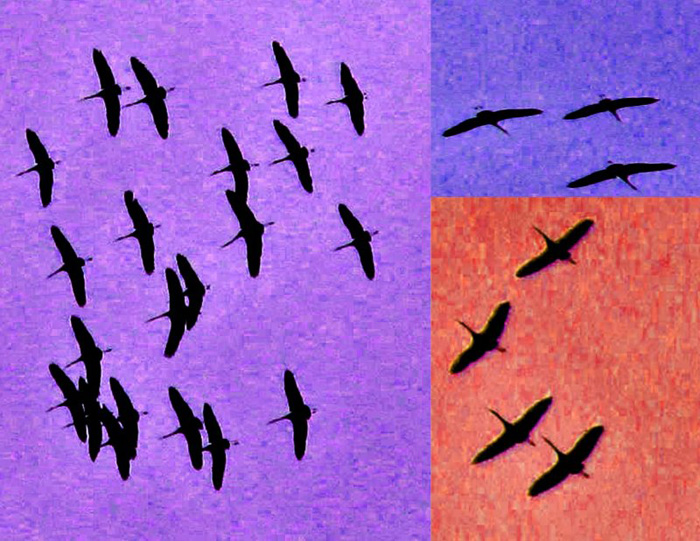
Click on image to see a larger version.
Steve Wing (PBase gallery) is a visual artist and writer whose work reflects his appreciation for the extraordinary in ordinary days and places. He lives in Florida, where he takes dawn photos on his way to work in an academic institution. He’s a regular contributor to qarrtsiluni, as well as to BluePrintReview, where he has a bio page with links to some of his other publications.
 qarrtsiluni