Archive
As I stand here folding
by Mara Mills
…Why don’t you write said my muse
as i folded his laundry.
…A poem a story why not a novel
my hands smoothed the creases
he came closer
i laid the boxer shorts atop the bleach whitened hill
…You don’t seem to write anymore.
i chose a tee shirt
closer still eyes solemnly questioning
caressing its front i tame the tides of fabric
…Remember when you used to write…
gently i shape the sculpture of its sleeves
…Those poems. he stretched out his arms for emphasis
upon them i laid my poem fresh and clean.
Mara Mills is a stage director, writer, and teacher. Her specialty is theatre in odd places and combining the arts in performance.
The Bitter, True Taste of the Human Heart
by Alex Cigale
After Samuel Beckett
I once knew a madman who thought the end
of the world had come. I would visit him
at the asylum, take him by the hand
and drag him to the window.
Corn rising,
and look there, the sails of the herring fleet.
What loveliness!
He’d snatch away his hand
and back into a corner, appalled. All
he saw was ashes, he alone was spared,
forgotten.
His case is not unusual.
There can be no ideas that do not seem
to us to represent objects. Descartes.
Perfection of mankind, God’s idea.
I am confident that the human mind
can know nothing with greater certainty.
Alex Cigale’s poems recently appeared in The Cafe, Colorado, Global City, Green Mountains, and North American reviews, Gargoyle, Hanging Loose, Redactions, Tar River Poetry, 32 Poems, and Zoland Poetry, online in Contrary, Drunken Boat, H_ngm_n, McSweeney’s, and are forthcoming in Many Mountains Moving and St. Petersburg Review. His translations from the Russian can be found in Crossing Centuries: the New Generation in Russian Poetry, in The Manhattan, St. Ann’s, and Yellow Medicine reviews, online in OffCourse, Danse Macabre and Fiera Lingue, and forthcoming in Crab Creek Review and Modern Poetry in Translation. He was born in Chernovsty, Ukraine and lives in New York City.
Postcard
by Nancy Gott
Outside the Plaza Hotel on the corner of Hollywood Boulevard and Vine, wearing a brand new suit, hair parted and carefully combed, he waits for her, his bride in an hour’s time. He carries a gift for her — a cobalt-blue ceramic water pitcher made exclusively for Westinghouse by Hall’s China, in 1938. She saunters past the KNX Studio toward him, sunlight dancing on her golden tiara, red and purple blooms nodding in her arms — a strumpet straight from heaven — stops and drops a postcard in the mailbox. Although he cannot read the scrawling script (“Hellow Mrs. Shellie, Hope you are through canning peaches by now. Will be seeing soon. Dora”), he will discover, after this golden afternoon has passed, what a terrible speller she is, not to mention grammarian. When it comes to beauty, though, she is peerless, and when she stands before him, he forgives her every flaw. Her hair, the color of a Kansas wheat field; her eyes, the Pacific; her lips, the Western sky at sunset, transfixes him. When she winks his legs tremble, and fearing he might drop the pitcher, he thrusts it toward her. She drops her bouquet, grabs the pitcher and yanks off the lid. A cloud of bees explode from the pitcher’s mouth, cursing them with poison, pestilence, and fervor. Dora clutches her gift, hands shaking. Clamps down the lid.
Nancy Gott grew up in Iowa and graduated with a B.A. in English from The University of Iowa where she studied fiction writing with Stuart Dybek and poetry writing with Chase Twichell. Currently, she lives in Las Vegas, Nevada, where she avoids casinos, gaming, and the sun.
Marina, La Malinche
I could fold my tongue into a hollow
reed, pretend I’m an amber butterfly
pressed into the neck of milkweed florets
dripping nectar through my waiting channel.
I could push my tongue to palate, swallow
like a wood thrush gathering sand grit, cry
evensongs until the skin-pale moon forgets
our Mexican sky for another continent.
I could roll my tongue like the snake below
the feathered body who struggles to taste dry
desert air; I could thread cactus spines to whet
native spirit or teach mother tongue to pray;
I would hold my tongue, but to survive must
speak. My father sold me destined to lie
with a man who crossed our oceans to let blood
and tongues mingle. Let me keen lullabies.
Katherine Durham Oldmixon (website) recently edited a special issue of Borderlands: Texas Poetry Review dedicated to ekphrastic poetry. Her chapbook Water Signs, a finalist for the New Women’s Voices Award, was released in January 2009 by Finishing Line Press. Katherine lives healthily and happily in Austin, Texas, with her husband, Arturo Lomas Garza.
Male Nude
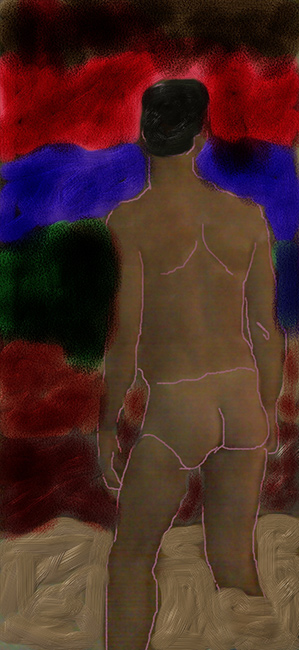
Limited edition digital print, November 2009
Image dimensions: 4 1/2 x 9 inches; paper: 8 1/2 x 11 inches
Anne-Marie Levine is a poet and painter who lives in New York City. Her work can be seen online at her website, her visual art at Saatchi Online, and her poetry at NYQ Poets.
Economy issue now in print
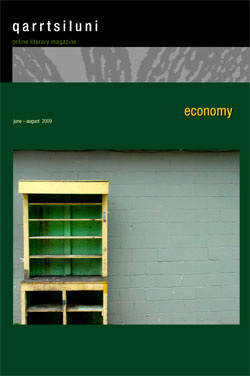
We’re happy to announce the publication of a print version of our Economy issue, edited by Anna Dickie and Pamela Hart.
As the editors wrote in their call for submissions, Economy has its roots in Greek — oikos and nomos — meaning the principles necessary to maintain the household. They called on contributors to go beyond the obvious and “think broadly, associatively and imaginatively about this touchstone word.” The result was one of the most consistently high-quality and creative collections qarrtsiluni has ever published. It includes work that explores not only the negative but the positive sides of “economy,” and does so in surprising ways. We’re proud to offer it as a printed edition, and timely commentary on the current state of our inner and outer worlds.
We hope many qarrtsiluni readers and contributors will want to own a copy — it’s one of the best ways you can support our ongoing volunteer efforts here. The book, designed and published by Phoenicia Publishing, has a full-color cover, 96 pages, and is available for $13.95, either through our online store or at Amazon. Please go to the Phoenicia site for full details and a look inside the book. Thanks!
***
Phoenicia is a small, independent press in Montreal publishing poetry, prose, photography, and music. Follow their publishing news, including special offers, on Facebook.
The image on the cover is “cupboard’s bare,” by Michael Aanji Crowley.
A Study in Setting
by Peg Duthie
At his workbench, Watson considers the jewel in front of him. It has accompanied many other gems across the years: a blue carbuncle, a black pearl, a queenly emerald. He has seen it resemble the flash of a blade and the wink of a hinge; the chime of its collision with a tiara is that of a violin string plucked by a spoon.
So many ways to see a stone: Watson knows that what he selects for its surroundings will infuse it with warmth or veil it in ice. Against silk, the stone radiates the ghost-heat of ashes; on a linen napkin, it is cool and slick to the touch as lab-clean glass.
Readjusting his loupe and reaching for his tweezers, Watson silently tastes these words on his tongue: You are the centre, I am the clasp.
Peg Duthie (website) is a member of the Organization for Transformative Works.
the wyndham sisters
by bl pawelek
within the white flowers and dresses
whiter skin and lounging
the three sisters rest
stretch their hands
wait for the drying paint
the dark mirror hangs and laughs
and the framed sister
guilty and forgotten
overlooks the smoke
a sliver away
mary holds her naked
baby in a blazing sun
burning through prism blue sky
pounding the last tree
joshua in bloom green and red
reaching for god
17 January 2010
bl pawelek (website) has been to a million places in life and has forgotten most of them. But he is here now and trying.
piobaireachd
i ùrlar
boy meets girl
girl bites boy
boy sees doctor
this is fact
we can verify this
ii siubhal
boy is intrigued
girl moves away
his curiosity unsatisfied
with its motives and suggestions
this is narrative
iii lemluath
boy works days
moonlights as a gumshoe to
earn enough money to
follow his girl to
oz
girl works too
without declaring whether she
is saving to move back
or move on
this is plot
notoriously wordy
seductive
a trap for the unwary
iv taorluath
boy is coming down with something
from a dark car
across the street from the house of a man
— his client —
whose fortune comes from vending machines
boy watches for indiscretion
the wife is home
her lover steers into the driveway
like the night before
light from the streetlamp
glints across his hatchet face
lover enters the house
boy is right behind him
i don’t need much he tells them
five hundred notes and I’m on my way
husband need never know
girl meets boy at the airport
i’m sick – he tells her – over you
she bites him like a flu jab
high on his arm
that’s — he bites her back — better
his bite drives a stake into the ground
her bite turns the boy into a man
the man into a meal
a meal she sends back to the kitchen
v crunluath
this is poetry
friendless
not a good listener
not to be trusted when there are
facts to be established
a story to tell
boy meets girl
they cannot kiss
except by locking teeth
they eat
but they do not eat from hunger
with or without her he cannot be well
she is a girl who likes to bite
Note: Piobaireachd is a classical music genre native to the Scottish Highlands and performed on the Great Highland Bagpipe. This poem came about when, at a ceilidh at the late Hugh MacDiarmid’s Brownsbank Cottage during the Biggar Little Festival in 2008, Ann Matheson challenged the writer to make a poem that imitates the musical structure of piobaireachd.
Andrew McCallum is a fat, middle-aged, married man with a dicky ticker and Nietzschean aspirations. When not striking classical poses on hilltops in the Scottish Southern Uplands, he writes deep into the night sustained by outrageous amounts of caffeine and tobacco.
In All Your Blinding Glory

Joaquin Ramon Herrera is a writer, illustrator, director, cinematographer and artist-activist. He blogs at The Unapologetic Mexican and you can read more bio here. Check out Scary: A Book of Horrible Things for Kids on Amazon.
 qarrtsiluni