Archive
There’s That Old Chestnut, Again
A hardy Bouche de Betizac, at prime,
begets a robust dozen to fifteen
castañas per pound; the Willamette
docks in one handful more
(eighteen to twenty-two). In Austen’s novel,
Fitzwilliam ponders Elizabeth’s dark brown curls,
good grosgrain ribbons ironed chaste against
her serviceable frock. Carriage rides or walks
in the woods were de rigueur back then. Time for verbal
jaunts mostly, then a curtsy and a bob. Meanwhile,
kestanecis in Istanbul scour the bottoms of iron vats,
ladling the hot goods to passersby. Under her veil,
Manouk desires more than this sweetmeat, this
nestled kernel housed head to toe, brown husk like a burkah.
Overhead, that lit-up, leafy canopy; on each side, avenues made
princely by rows of trees. The perfect set! Lovers have kissed,
quelled that thrashing business variously called compulsion, allure,
rapture, distress… What are its other names? Those old
saws rasp back and forth across the grain: Look before you leap,
think twice before you bribe a cop or make that hasty
u-turn, get a room in which to darn that stitch before its time…
Very, very crazy, say my daughters. The clicking in my ears
will not abate. It’s said that Spanish dancers’ castanets
excite the fleshy little heart caged in a wooden box.
You hear it rattling as the coals are stoked. Flambéed by
zealous, patient fire, the hardest shell does crack.
Originally from Baguio City, Luisa A. Igloria (website) is a poet on the faculty of Old Dominion University, where she currently directs the MFA Creative Writing Program. She has published Juan Luna’s Revolver (2009 Ernest Sandeen Prize in Poetry, University of Notre Dame), Trill & Mordent (WordTech Editions, 2005) and eight other books.
Gladiator (Rome 2009)

Click image to see a larger version.
Katherine Durham Oldmixon (website) recently edited a special issue of Borderlands: Texas Poetry Review dedicated to ekphrastic poetry. Her chapbook Water Signs, a finalist for the New Women’s Voices Award, was released in January 2009 by Finishing Line Press. Katherine lives healthily and happily in Austin, Texas, with her husband, Arturo Lomas Garza.
His Side
The broken rib
ripped from his
body has swollen
to ten times
its normal size.
The serpent whispers
a word,
Bind.
The man picks cotton
from the garden,
soaks it in the blood
of the creature
he calls pig.
He wraps the cotton
around the wound,
winding tighter
with each rotation.
The serpent whispers
a spell in the man’s ear,
I bind thee.
I bind thee.
I bind thee.
Three times
the man repeats.
He changes
the bandages daily,
kneads the skin
around the rib
to make her
more supple
than Eden’s soil.
The man and serpent
pray together,
We bind thee.
We bind thee.
We bind thee.
Until the rib shrivels,
a limb as crooked
as branches
from the Tree of Life.
The man believes
the serpent’s words,
You will be strong like your God.
You will be God of this world.
But when the man
walks with the rib
his steps come short
like the animal
he calls penguin.
He hobbles
through the garden,
his ungodly body
swaying from side
to side,
a serpent
learning how
to use two legs.
LaToya Jordan (website) is a poet from Brooklyn, NY and lives with her English-teacher husband and two cats in a tiny apartment with an infestation of books. She received an MFA in Creative Writing from Antioch University Los Angeles. Her poems have been published or are forthcoming in the Splinter Generation, the San Pedro River Review, and Mobius: The Journal of Social Change.
Bone
The bartender had a lover, a woman full of surprises, whose worst quality was to say, no matter what, “I can take it.” Often, she wouldn’t say it out loud, but the bartender could see it in her face when she was thinking it. And the bartender always thought, in return: but you shouldn’t have to.
One night, two men came into the bar. One with a glint in his eye and the other with a way about him that made him seem like he might turn to smoke at any moment.
The glint-eyed man said to the bartender, “Let’s make a bet,” and because the evening was so slow and because they were her only chance at tips before closing, she said, “Okay.”
“I bet,” he said, pulling out three cards, “that you cannot tell me which of these cards will be the king of hearts.”
“I bet I can’t, either,” the bartender said, laughing. “You think I don’t know three-card monte?”
“Wait,” he smiled. “I won’t even touch the cards. You put them down, you move them around, and you try to turn over the king of hearts.”
“Really?”
“That’s the bet, that you won’t turn the king of hearts. Go ahead, try it.” And so she did, again and again, three cards in front of her, three cards only she could see, three cards rearranged and, when she went to choose the card that she knew had to be the king of hearts, it never was.
When her lover showed up at the end of the evening, she was still trying to figure out the trick.
“Darlin’, come see this,” she said. Her lover watched, her eyes opening wide. This was no sleight of hand and the glint-eyed man was no huckster.
Her lover grabbed the glint-eyed man by the face and turned him towards the light. One eye watching; one eye wet. The lover recognized him and her hand shook, almost imperceptibly.
“Go home to your wife, old man,” the lover said. “Before someone gets hurt.”
“I’m not done here,” the glint-eyed man said. “We haven’t even placed our bets.”
“Make it with me,” the lover said. “What do you want? I’ll wager.”
“No,” said the bartender, “Wait. What? Do you know him?”
The glint-eyed man looked at the lover, “You think you can beat me?” He waited for her to consider. That look crossed her face. And when she sneaked a glance at the bartender, a shiver of fear passed between them.
“What’s going on here?” the bartender asked.
The glint-eyed man stepped over to the lover, leaned in so close to her she could feel his whiskery cheek on hers. He said one word, so quiet she whispered “what?” before he could finish it.
“Wolf,” he said. And he was.
His legs bent and his mouth full of sharp bone flew open. The lover stumbled away from him, and tripped over a barstool. She hit the ground, hard, and he leaped onto her.
“Bear!” she screamed. “Bear!” and she was, her massive paw swinging across his snout. He flew across the floor.
“Bee,” he said, and he was. He flew at her face, stinging her nose and the soft corners of her lips.
“Wasp,” she said, and she was.
Just as quick, he said, “corn,” and he was.
“Hen,” she said, and it was a mistake, almost giving him nine months to hide.
But before she could eat him, he said, “Fox.”
She said “Shotgun.”
He said, “Myself” and he picked her up and cracked her open and the lover screamed in pain, a woman again, on the floor of the bar.
“Clever,” the glint-eyed man said.
His friend leaned over the bartender and said, “He’s going to kill her, you know that’s how this ends, right? That’s how he wins.”
And then it all happened at once. The bartender yelled. The wisp of a man grabbed and held her back. The glint-eyed man said, “Knife,” and the lover closed her eyes and said, “Bone.”
The knife plunged between two of the lover’s ribs and broke against the concrete floor.
After a long while, the glint-eyed man said, “God,” and shook his head to clear it.
But the lover said nothing. She stayed bones in a pile on the floor.
“Bring her back,” the bartender insisted. “Bring her back right now.”
“It’s not how it works,” the glint-eyed man said. “She has to call her own move.”
“Is it over, then?” asked the wisp of a man.
“I’ve never seen one of them do this before,” the glint-eyed man ran his hand over his mouth and down his long beard.
The bartender sank down next to the skeleton of her lover. “You have to do something.”
“If she comes back from this, that’s a trick worth learning,” the glint-eyed man said. “Put her in your backpack,” he said to the wisp of a man, “let’s take her home and see what happens.”
“No,” the bartender cried, “Oh god, no, don’t take her,” but their minds were already made up.
“Then,” the bartender said, “at least let me pack her.”
The wisp of a man opened his backpack and the bartender slid every last bone of her lover into it, every last bone, except one, which she slipped, instead, into her pocket.
Every day, she hopes to find that it has vanished, but so far, it has not.
Betsy Phillips (website) lives in Whites Creek, Tennessee. She writes for the Nashville Scene’s blog, Pith in the Wind. She has a garden, of which she is inordinately proud, even though it is usually quite weedy.
Little black dress—
my new carapace.
I am queen of the dungheap.
I am the sole black
chess piece in the white air of morning.
I’m winning
in this dream. My coal skin shines
so hard it might turn diamond
under this bright blanket of lights.
When I get home I’ll slip it off,
smooth as graphite erased.
Aditi Machado’s poetry has appeared in journals such as Eclectica, nth position, tongues of the ocean and others. Her opinions and obsessions appear on her blog, Blotting paper.
untitled
by Gordon Smith

Click image to view a larger version.
Gordon Smith (website) is a Southwestern internist physician and a part-time landscape photographer who’s also a lifelong poetry fan, and says he continues to read and compose poetry during inspired moments.
Arezzo. Casa Petrarch.
Walking Arezzo two wet hours, we pass
by Petrarch’s, hardly stopping when his door
is locked: it’s supposed to open at this hour,
according to the guide book, but it’s not and no one wants
to linger waiting for the appearance
of some annoyed employee on the other
side, just reading a novel through the downpour,
nothing poetic, or, having spent last
night up arguing with her shiftless husband,
that spendthrift cheat, catching up on needed
rest, wrestling in her underwater dreams
with bill collecting mermen, turned
out in purple tails, neck-ties, and fresh-trimmed
scales, weighing, while we dash for a train, her options.
Wendy Vardaman (website) lives in Madison, Wisconsin and is the author of Obstructed View (Fireweed Press). She works for The Young Shakespeare Players, a children’s theater company, co-edits Verse Wisconsin, and does not own a car.
Ishmael’s Concordance
Think, Ahab,
of three last things:
water, whale, world.
Harpooners know,
sailors, hands—
Queequeg, Starbuck, Stubb.
See, Captain,
the long looks, far eyes
among day, night, sea.
The great Pequod,
once right, seems
small, still, old.
Aye, good Sir,
something soon parts:
a leg, a line, a life.
Oh, take the whole:
air, ship, time,
gods, men, white.
Scott Wiggerman (website) is the author of two books of poetry, Vegetables and Other Relationships and Presence, forthcoming from Pecan Grove Press this year. A frequent workshop instructor, he is also an editor for Dos Gatos Press, publisher of the annual Texas Poetry Calendar, now in its thirteenth year. In his cover letter, he described “Ishmael’s Concordance” as “an experimental poem using 50 of the 100 most common words in Melville’s Moby-Dick.”
The Beauty
Eyed. Always. She thought. In league with Max Factor, Blanche and dim lights. Her #2 base might cake, bake, ride rough shod, let the cat in, out, no mirror, no conversation without lipstick. Maybelline, center stage. One rainy day and streaked face, such a shame. He needed her: come this minute, accident. Not ready. For him, the world. Here it is, the stone wall. She ran hard and fast straight into. Take the beating and stay with Max. Keep it on the surface, easier like that. She can see better in the dark, anyhow.
Neila Mezynski has fiction and poetry in Snow Monkey, Word Riot, elimae, Mud Luscious, The Scrambler, Dogzplot, and >kill author, among many other journals and magazines.
Scrambled Shakespeare
by Millie Niss
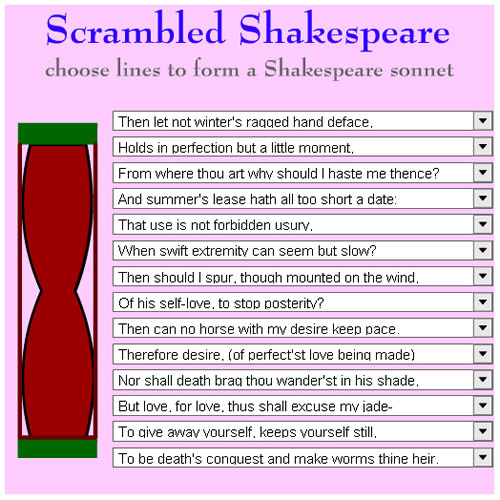
Click through to Flash animation
Millie Niss (Sporkworld) was a poet and new media artist who died at age 36 from complications of H1N1 in November 2009. She received a Classical education via Columbia University’s “Lit Hum” program and her earlier studies for the Baccalaureat section C (Math/Physics), Lycee Pierre D’Ailly, Compiegne, France. Her poetry and new media work has been exhibited at Harvard’s Dudley House “Errors and Contradictions” exhibit as well as SCOPE 2006. Her work appears on or is reviewed in many print and online publications, including: Iowa Review on the Web (with Martha Deed), Museum of the Essential and Beyond, dvblog, Unlikelystories, Hyperliterature Exchange, and Vispo.com. Her haiku generator (2009) was published on Logolalia. Her video, “I am the very model of a Psychopharmacologist,” won the People’s Choice Award at the Digital Arts Festival, Buffalo, NY and is found online at the Perpetual Art Machine.
 qarrtsiluni