Archive
Trance
by O Thiam Chin
The old man arrived at the kampong much earlier than expected. He had walked for an hour to reach where we stayed, and by the time he stepped foot into the house, he was perspiring all over. My grandfather and uncles were told that he was the most revered medium in the district, one who could summon and talk to any spirit he wanted to, to ask a request or favour, or to seek blessings or placation; his services available for a small token amount of ‘coffee money.’ To me, he was just like any old man — severe, toughened, wrinkled.
My mother told me to serve him a cup of coffee, and when I brought it to him, he gave me a White-Rabbit sweet in return. Then he turned back to my grandfather, his countenance serious, and continued with their discussion. I only caught a few snatches of words, before running out of the house, to join my other cousins at play, the sweet already melting in the heat of my palm.
That night, the old man stayed for dinner and ate at the table with the men of the family. Their heads remained lowered in deep talk, and the old man closed his eyes while he listened.
The wooden sedan-chair was brought in from the storage hut and placed before the altar that was ladled with food offerings and urns burning with smoky, eye-burning incense. The painted faces of the warrior gods and benevolent goddesses flickered with numerous changes of expression as the flames from the candles shuddered with each rotation of the overhead fans. We, the children, were told not to go into the living room for the night, or linger outside the corridor. We had to keep away from the procession.
But we watched nonetheless, peeking from behind tiny slits in the paneled doors, taking turns to observe the goings-on in the room. The old man had put on loose silky red pants, bare-torso, and was sitting in the sedan chair, his face turned down. Then his arms began to move, as if pulled by invisible strings, and he let out a terrible scream that silenced all residual noises from us, who were watching him with a curious intensity. He shook his head violently from side to side, and a voice, deep and alien and angry, fell out of his mouth. It was not a voice I recognized, but I noticed the wide-eyed surprise and subsequent relief evident in my grandfather’s and uncles’ faces. They were fully aware who was speaking to them through this medium-man, a voice they knew, way before my time.
My grandfather started asking questions of the medium, and before we could hear his replies, my mother and aunties came up from behind and swatted us away. As we ran off, our laughter charting down the dark corridor, we imagined a new exciting world where the dead are never actually dead, and the living are always reaching out to them.
*
O Thiam Chin’s short stories have appeared in several literary journals and anthologies, including Asia Literary Review, Quarterly Literary Review Singapore, Cha: An Asian Literary Journal, Best of Singapore Erotica, Silverfish New Writing 6 and Body2Body. His debut collection of short stories, Free-Falling Man, was published in 2006 and his new collection of stories, Never Been Better, was released last month.
Self-Portrait as Dryad, No. 7
The golden haze around these whips of limbs
Is glistening, awakening to light
Within retreating clouds — embattled fire
That melts the snow and pellmell sends the sky
To run in ditches near the highway’s edge.
My God, I am no witch to suffer so —
Who tied me to this stake that frosts my skin?
Who makes me tremble with his solar heat?
Who takes my voice and shakes the syllables
Until I speak in otherworldly tongues?
Dear Christ, the world is aching in its grave,
And can I bear another spring-time thaw?
O Willow, Willow, I uncurl to let
The bite and simmer of this raking gold
Explode in leaves — green eyes that weep for me,
My harrowed hell, my star-enkindled tree.
Marly Youmans (website, blog) recently saw the publication of her seventh book, Val/Orson. Set among the tree sitters of California’s redwoods, the story takes its inspiration from the legendary tale of Valentine and Orson and the forest romances of Shakespeare. Her previous books include Ingledove; Claire; The Curse of the Raven Mocker; The Wolf Pit; Catherwood; and Little Jordan. She co-edited qarrtsiluni’s Insecta issue with Ivy Alvarez.
The Seven Healing Saints
by Lucy Kempton
These photos were taken at the Chapel of Notre Dame du Hault, in Trédaniel, Côtes d’Armor, Brittany. It is the home of “Les Sept Saints Guéurisseurs,” the Seven Healing Saints, polychrome wood sculptures of uncertain age and provenance, each invested with the power to relieve certain afflictions. (Click on the photos to see larger versions.)

The Saints are St Houarniaule (or Hervé), St Mamert, St Méen, Ste Eugenie, St Lubin, St Livertin, and St Hubert. They were called on to cure a range of common maladies, such as migraines, eye troubles, rheumatism, but also mental and psychological problems; blind St Houarniaule who traditionally kept a dog or perhaps a wolf who ate the dog and was commanded by the saint to take its place, on a leash, was invoked to help with fear and ‘angoisse,’ anxiety, to master the wolf in a more figurative sense. St Hubert helped with dog-bites and rabies, ‘la rage,’ so by extension with rage and fear, the connection between fear and anger preempting modern psychological understanding. Ste Eugenie is the only woman, but wasn’t always; she was a feminised and Catholicised development of St Tujan, or Ujan, a much older, more indigenous saint, who was possibly in turn a Christianised version of a pre-Roman Celtic sun-deity.

St Mamert looked after intestinal troubles, including colicky babies. His intestines are exposed, open, and he holds them tenderly, a rather pretty pink coil of gut, between his two hands.
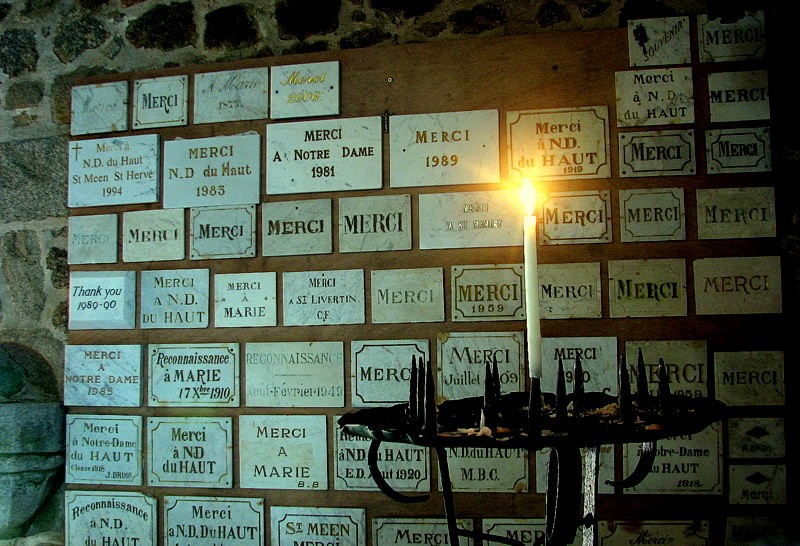
For a long time people brought gifts and offerings, oblations, for the Saints’ favours, either to propitiate or to thank them. They gave money, but also things like linen, hemp, butter, honey and beeswax, even piglets. The revenues from the chapel were enormous for such a small, out-of-the-way place. But by the end of the 19th century people began to offer other kinds of votives, these little plaques, mostly marble with engraved gilded lettering. They are in thanks for services rendered, and mostly simply say ‘Merci,’ Thank you, one or two are in English, some quite recent. (Many are also to Notre Dame to whom the Chapel is dedicated) The effect of the same word in different variations over and over in the gloom and candlelight is rather hypnotic.
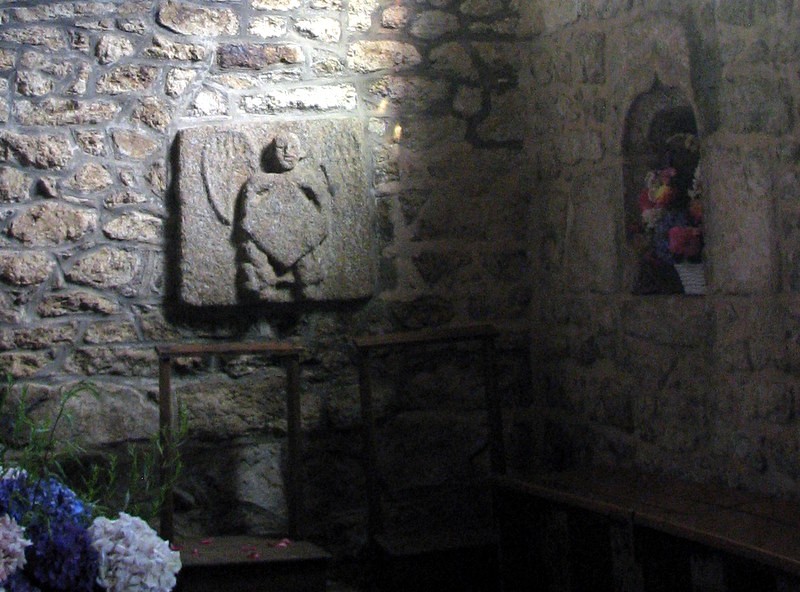
Things have always made their way to the chapel, been sheltered by or given to it; the Saints’ statues were not all always there, some were probably brought from another religious foundation, a leper hospital, at about the time of the Revolution. This relief carving is an enigma, was perhaps brought here in the mid-20th century during one of the chapel’s periods of restoration from another demolished church or chapel. I always think of it as the angel with the book, but elsewhere the object is described as a blank escutcheon, a heraldic support for words or symbols. Book or shield, there is a feeling that the angel is bringing something of importance that should tell us something, but it can’t be read.
Unfortunately, what drew wealth of course drew thieves, and the chapel was not infrequently robbed throughout its history. Then in the 1980s the Saints themselves were stolen. They were replaced by plaster copies, which were stolen again in the last few years. The statues in these photos are very new replicas of the originals, that have recently been installed.
They are faithful and sympathetic copies, the scale and forms and colours are all as they should be. But the idea of replacing the Saints is problematical; its difficult to grasp how practical and concrete the kind of faith they were part of was. They weren’t just representations of spiritual power, the power was the object. We see them as curious works of art, which might or might not house a spiritual reality, but that’s not quite the point. The spiritual and material reality used to be one and the same. So making new ones to replace the old shouldn’t work.
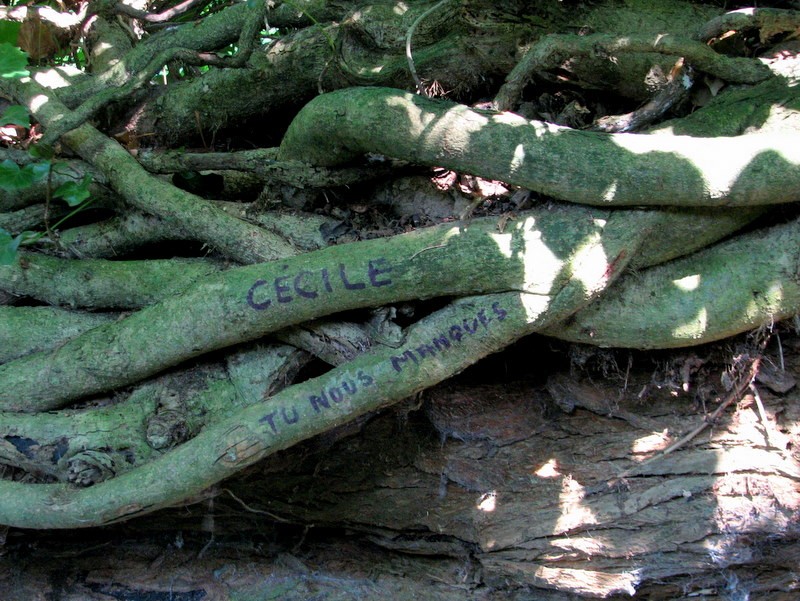
Unless the power is within the place, rather than its furniture and artifacts. This has always been a sacred place, a place of healing; the chapel and the Saints are quite recent emanations of this. If you walk west from the chapel, past some prehistoric standing stones, into a wooded ravine, you’ll come to the holy well. In mediaeval times it was dedicated to St Tujan, and has been a sacred place probably since the bronze age; Gallo-Roman remains have certainly been found there. People throw the age-old votive offerings of coins into the well. There is a stone cross and other stone artefacts from who know where set up here. A fallen tree covered in ivy forms an arch in front of it. On the ivy stems someone has inscribed the words ‘Cécile tu nous manques’ — ‘Cécile we miss you.’
Who knows who Cecile is or was and why she is missed, but someone brought their sadness, their angoisse to this particular place of power and left it as an offering in these words, a poignant counterpoint to the marble plaques of gratitude.
With thanks to Bertrand L’Hôtellier for help with the research on the chapel of Notre Dame du Hault.
Lucy Kempton is British, living in Brittany with husband and dog, and sometimes teaching English. She blogs at box elder — subtitled “meanderings of a displaced dilettante” — and the microblog Out with Mol. She is currently engaged in a call-and-response-style, online collaboration with British blogger (and qarrtsiluni author) Joe Hyam called Questions. She co-edited qarrtsiluni’s Water issue with Katherine Durham Oldmixon.
Emptiness
There you are, absence, there you are, soothing, black, and gone, there you are, more quiet than the thin dark mushrooms rising in a circle on the lawn at night. I call you and I draw you down, draw you close.
Emptiness, emptiness, I lift your black host in my hands, in honor, arms tense. Fingers long and shaking, I stroke your lack of outline and smell your faintest odor of cold and rain and the divine. I enfold you in my hands — look there between the crevasses created by my thumbs — I see you, your dark honor and your dignity. I have you, emptiness, I take you every night to my room where you assist me. You snuff out the candles and croon no lullaby, blacken my eyes and take me silently to dreamless sleep.
Catherine Ednie (louder) works as a systems analyst in the New York metropolitan area. Her work appears in In Pieces: An Anthology of Fragmentary Literature (Impassio Press), and in various locations online.
Credere
by Dick Jones
If God did not already exist, it would be necessary to invent him.
—Voltaire
“He’s God, cried all the creatures…”
—James Thurber, “The Owl Who Was God”
If there has to be a God —
no option on the broken
road, the bridge of sighs —
then let it be a dancing god,
like Shiva but a voiceless one,
indifferent, treading out
the double loop, the bee’s infinity
of weaving round and round until
the measure’s known by all.
Or if not the dancer,
how about a singer?
One who cants in tongues,
a lingua franca from the
furnace heat (ex corde vita),
singing the blues, sean nos,
la duende, passionate, engaged,
yet powerless to lift the curse
of Sisyphus, or block the juggernaut,
or move the stone. These gods omnipotent,
who claim our praise and swallow
our prayers like hungry birds,
are dreams that draw
on the oxygen of our need.
We might as well worship
water falling, shape-shifting
clouds, the janus faces watching
from the cliffs that tell us
what we want to know.
Dick Jones writes, “Initially wooed by the First World War poets and then seduced by the Beats, I have been exploring the vast territories in between since the age of 15. Fitfully published in a variety of magazines throughout the years of rambling: Orbis, The Interpreter’s House, Poetry Ireland Review, Qarrtsiluni, Westwords, Mipoesias, Three Candles, Other Poetry and others. Grand plans for the meisterwerk have been undermined constantly either by a Much Better Idea or a sort of Chekhovian inertia.”
A Widow’s Curse
by Bev Wigney
Let vultures tug at
the eyes and wallets
of the local yokels
who circle my farm
thinking I lost my brains
along with my husband,
and will sell out for a song
as I’m too dumb to know
what my land is worth.
May whining cicadas
jam up the ears of every
customer service rep
who said they’d change
an account over to my name
but never bothered so that
the monthly statements
continue to arrive addressed to
a dead man instead of me.
Let the Demons of Cosmos
break off manicured nails
and smear lipstick
on the face of any silly twit
who tugs on the arm of her mate,
towing him to safety,
after she discovers “her man” has been
chatting with a woman who (yikes!)
is revealed to be “a widow.”
Send yellow-bellied sapsuckers
to peck and lick at the cowards
who called themselves
family and friends
but never visited my husband
during his illness
when he could have used
someone to talk with
other than me.
May I be showered with pennies
for every time a
well-meaning friend has blithely chirped:
“You’re still young!
You’ll find someone else!”
as though dead soulmates
could be replaced with as little regard
as a pair of worn out hiking boots
or a broken canoe paddle.
Bev Wigney is a photographer, writer, artist and naturalist, who recently left her home of 31 years on a farm in eastern Ontario after the death of her husband, Don, and is now traveling around North America in a van with her two collies. “We move with the weather and my moods, camping wherever we find a good place to while away some time. This seems like the right way to live for at least the next few months, or perhaps even beyond,” she writes. Follow her progress in her blog, Journey to the Center, and check out her photographic work at her online gallery.
Common Needs
for Jim Martyn
My friend with ALS has moved to hospice.
Rick Steve’s tours of Europe streaming
on the Mac, a mouse he can click with a toe.
cough machine at the ready, biPap mask
for extra breath, for sleep, a meal pureed
to soup consistency. Time, still,
for visits, paying taxes, but I’m looking
up communication boards for the time
when speech goes too — this one,
pared to thirty-three commands —
may there be thirty-three angels for Jim,
wings color-coded, jerseys numbered,
to be called in for specialty plays —
moisten mouth, tighten mask,
move my thumbs, bring bed bath,
I’m hot, I’m cold; angels of breathing,
angels of cough, angels of settling the pillow
under his head, his shoulders, his knees;
angels bearing the bedpan, diapers,
the urinal; and send the angel of attention
to watch his eyes, fixed on number 33,
summoning the angel of the call switch
to watch over sleep.
Robin Chapman studied the acquisition of speech acts by children for forty years, and now writes poetry. Abundance, winner of the Cider Press Review Editors’ Award, is her newest book.
Dream

Prize-winning photographer Anne Morrison Smyth (website) grew up in Ripton, Vermont and in Cambridge, Massachusetts. She moved to Belchertown in 1999 after living in Amherst for 30 years, where she raised her four children. Anne’s love for wildernesses of all kinds informs her work with an intimate, unflinching celebration of the diverse small realities that create a larger truth.
Bittersweet
Snow drifts on the Rocky Mountains
Buffalo herds
race across the ice
The wind blows
so strongly
as the sun fights its way
to a fresh new day
—Alton Fred Brown
April 17, 1984 – April 10, 2001
Bitter-root
bitter cress
bitter-bloom
bitter weed
Bitter Gourd
Awash in bitterness
like moonlight
at forty below
midden heaps
beneath old city snow
Berries of Kansas hawthorn
smashed on sidewalks
or shat by birds
hungry in this drought
Bittersweet orange
Decades of mourning
a member of the family
Celastraceae
called Wahoo in the Audubon guide
An American tree
its powdered bark
a purgative
Purple berries
winter fare
for cardinals and chickadees
Death’s inexorable plow
laying open furrow after furrow
of virgin prairie
Osage orange
eastern cedar
honey locust
The sad butchery
that buried him
on his seventeenth birthday
and before that his father
murdered
in front of his two-year-old eyes
Then dust and grit
March gusts pelt
the windshield with
almost two centuries later
Bitter-root
bitter cress
bitter weed
Bitter-bloom
bitter fruit
Bitter Gourd
Buffalo-ooooo-ooo
O OOO O oo o
Christina Pacosz (webpage) has been writing and publishing prose and poetry for almost half a century. Her collection Notes from the Red Zone, originally published in 1983 by Seal Press in their anti-nuclear series, was selected by Ron Mohring as the inaugural collection in the ReBound Series from Seven Kitchens Press. Her work has appeared recently in Jane’s Stories III: Women Writing Across Boundaries, Pemmican, and Umbrella. She has been teaching urban youth for the past decade on both sides of the Missouri/Kansas state line where she lives with her husband.
 qarrtsiluni