Archive
egg
tiny cupped hands are no nest for a pair of speckled eggs.
but smooth your knitted brow and take comfort
in the illusion of a nest, the protectiveness of soft skin.
suck in your breath and make a barter for your heart
as you exhale on the eggs, rapt, bent on incubation.
this is innocence unmasked, exposed to the elements.
of all the particles of life, child, remember this one:
shredded newspaper in an old shoe box,
anxious, undulating gait of expectant birdmom.
lovingly you stir in the makings of a tonic,
a feather-stimulating elixir of chopped worms
and the unadulterated faith only youth can provide.
I say a little prayer to put some kismet in your mix—
that you not stray too far from your roost,
that I’ve made your own nest a halcyon.
move your body closer, child, so you may trigger
the cracks, the breaking of eggs, birth, the depth of
emotions these sweet feckless wings can conjure.
this is a love that cannot be misconstrued,
this is a bird that takes flight into the sun.
by Leslie F. Miller and Sarah R. Bloom
Download the MP3 (reading by Leslie)
Sarah’s shot (click on image for a larger version):

Leslie’s shot (click on image for a larger version):

For process notes, see “faith on the rocks.”
Dear Seven: A Circle of Epistles (7)
Part 7 in a series of 7
Dear Chris,
It’s been two years since the letter went ’round and I’ve been two years waiting for the break in the day. Not the daybreak, for like any new mother/father I’ve seen plenty of those, what Sylvia Plath called Nicholas’ “bald cry” which took “its place among the elements.” You’ve had it times two with your twin girls, and what a flickering whirlwind of a carousel ride it is, it is. Baby girls all around.
I hope our girls get together someday and levitate. I did it too, just like cin. You were only supposed to lift with two fingers, but somebody always cheated. Did you know that before the levitation happened, there was a séance? One girl would sit with the floatee’s head in her lap. She’d rub the floatee’s temples and tell everyone gathered around the story of how she died. “One night, Marguerite was walking along the road beside the graveyard. Dot dot dot.” Closing your eyes and listening to the story of your death felt holy and silly; you were spooked and yet delighted to still be alive! The final verse was light as a feather stiff as a board, let’s raise Marguerite up to the Lord.
When my cousins came over we played “Mary Widoworth.” Holding a candle, we faced the bathroom mirror in the dark, chanting, “I believe in Mary Widoworth, I believe in Mary Widoworth. Mary Widoworth, if you’re there, give us a sign!” Then one of my older siblings would pound on the wall (the other bathroom lined up behind it), and we’d all go screaming into the hall. Mary Widoworth was much hokier than levitation, but standing in the dark looking into a mirror with a flickering candle and then screaming your head off and bursting into the light was so magnificent, we easily suspended our disbelief.
I wonder if you believe in psychics, Chris. I have no psychic abilities, myself, but I’m convinced that others do. Would you think that silly?
And there it is, the ring of the phone, then the waking cry of Lulu, which drags me away from this epistle. Her cry is no longer a bald fright, but a whiny demand. She loves words, as we all do; she’ll repeat whatever you say—not always clearly, and not always correctly, but she rejoices in language and that makes me glad.
In honor of all sleepovers and cousins, I sign this with the grade school salutation:
sorry so short stupid and sloppy
Ciao,
Eileen
For process notes on the series, see the first letter.
Poems in response to Anne Sexton
The Eskimo Word for Woman is Abnaq
Too many people think they know
what is and what is not a woman.
Lonely thing
walking with a blanket round her head.
My grandmother fixed the suppers
—no one helped her clean.
Jesus fixed the suppers while the women
washed the dishes.
Pummeled by flakes, she is not a woman
but another word for snow.
At night, dreaming, she is a cat
with no kittens, teats full and glossy.
If you still bite after all these years,
consider yourself happily married.
I sweat sometimes at night, dreaming of a new body
to wrap my skin around.
Do you still bite your lip
when you think about me ?
***
rearranging the disaligned
homage to Anne Sexton’s “her kind”
i dream of a new body as i wash
the dishes. they squeak, “consider yourself
happily married” (another word
for snow). pummeled by flakes, this
lonely thing we call a house is a cat
with no kittens, teats full and glossy.
she still bites after all these years.
my grandmothers fixed supper with jesus
at their sides, and no one helped them
clean up, either. people think they know
what i wrap my skin around,
why i sweat. sometimes at night,
i walk with a blanket over my head
pretending i am not a woman, thinking
about myself making messes of what is
and what is not, wondering,
will i ever stop?
Process notes
In response to first listening to a recording of, then reading Anne Sexton’s “Her Kind” [link includes recording], Jill chose five words/phrases to play with: at night; dreaming; lonely thing; not a woman; fixed the suppers; still bite. Next, we each wrote five lines on our own using the phrases. Then we each set out on the task of weaving the lines into a single poem.
Here are the raw lines that became the two poems above.
Jill’s:
- At night, dreaming, she is a cat with no kittens, teats full and glossy.
- Lonely thing, that woman, walking with a blanket round her head.
- Pummeled by flakes, she is not a woman but another word for snow.
- Jesus fixed the suppers while the women washed the dishes.
- If you still bite after all these years, consider yourself happily married.
Carolee’s:
- I sweat sometimes at night, dreaming of a new body to wrap my skin around.
- will we ever stop making messes in this lonely thing we call a house?
- too many people think they know what is and what is not a woman.
- my grandmothers fixed the suppers and no one helped them clean up.
- do you still bite your lip when you think about me?
Closer
I am not blaming you for Rick’s absurd behavior
and I am certainly not taking his side. Hiding
in the shower, claiming to be the messiah,
gibbering of men with scarves and knives.
And still, you encourage him with the hummingbirds
of your chest, the deep sigh of your inner thigh.
Is it the snakeskin boots, how his Stetson tilts and droops,
that makes your navel trill sweet drops of suicide?
Wait. Stop this now. I know you want to! See how
we do this every time? That first tomato of the season
is not the biggest nor the sweetest; there’s no need
to be so greedy. Consider, too, its nightshade,
not deadly, but poison — an itch left on your lips. Lick it.
You will taste him. Hold out your hand. It will graze
his spurs, before he digs them, harder than necessary,
into your groin. Close your eyes. Picture white,
white eggshells. Barefoot, step lightly. He will return
smelling of marinara and belching her perfume.
Is that blood on his shirt or a complex Barbarossa?
What a year for things acidic and dry: the sun
ripening your summer hair, the bite behind his thirst!
From what desert has he risen to find you naked, mussels
spilling from your hands, lisping peyote pardons
through impacted wisdom teeth?
Go on, limp towards him. There will always be honey
in your pink eye, feathered clothes, and new toys
for your return. You might clutch a Nerf ball to your belly
lean over the tippy-top of the stairs, and take flight.
Then again, he might drunk dial you from Paper Cut City,
make it home in time to catch the tail end of the news:
a man on the loose, wanted for stealing sap from the heart-
wood of half-grown maple trees. And here it is,
wrapped up in your grandmother’s afghan that you come
back to me. What is it that I am, still to you? Aging
professor in shiny elbow patches, tantric guru, shrink
with boundary issues, guardian angel? I could swing
your flesh around me like a robe. I could read the deep
creases in your wrist. I could take you back again.
Lock you in the crawl space of my heart. Play
your bones like bamboo flutes.
Hang your wings—
like heirlooms on the vine.
by Lissa Kiernan and Susan Yount
The Literary Revolution can’t be stopped
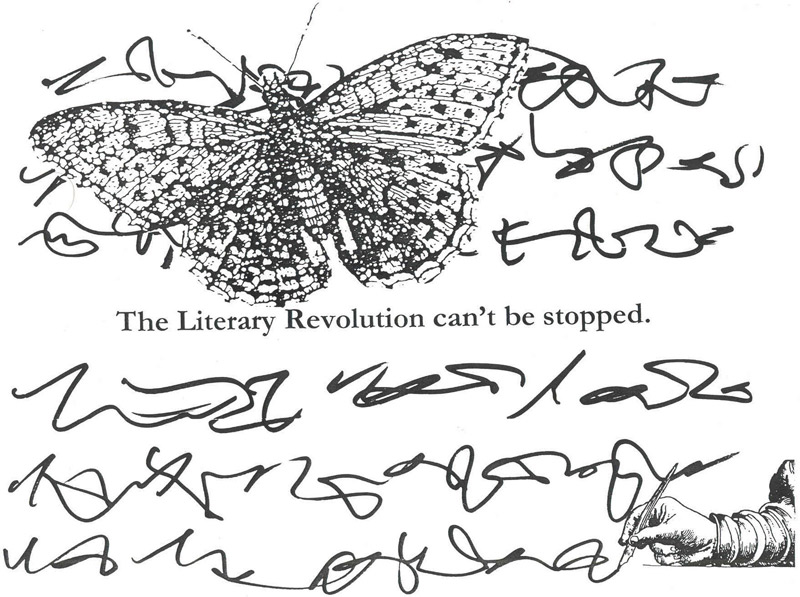
(Click on image to view at larger size.)
by Andrew Topel and Reed Altemus
Excerpt #4
Phlegmatic is a compliment when it comes to the disclosure
of profit margins, when it’s aromatic as the perfect wallet
in fine Italian calfskin, supple and slim, with flip out
ID window and divided bill compartment, the perfect gift
for the discerning men on your list. Remember the sailor
and the jitney driver? The sea and the mirror?
The anvil and the hammer? How all binaries are either
true or not true? Quadratic vatic, irresponsible constable,
blurbs for an epic never to be written, My Lady of Sorrows
wet under her burqua, constellations adrift in the wide
sky without warning, narrowly approved amendments
banning amphora’s marriage to camphor ointments,
a horror to the secular bearing speculums
and their harrowing intentions from comatose frenzy
quotas. To lose one precious iota numbs the mix.
Those who reel at its stilted bearing, fix their antic
pantaloons in chimerical granaries, where discretion
feeds the hindmost who plot cold wars to replenish
the Gatorade decathlon, dashing garam masala
across the finish line. Anything to spice the mix
of jitney and sailor raging across the diamond needle’s
vinyl page! The mirrored sea reflects their tonal sequence,
an automatic enclosure deflecting the resulting clamor
and the burning cars, trees, bars and markets overrun
with looters. To implement a disaster requires
an exit plan: militia and other trained shooters
to deny the informal reparation process taking place.
Who meant what went where when the chain
of commandeering lost face. The last desperate grasp
escaped the urban fizzle of their watch. But
the corporation continued as normal, raking dividends
from fear and its deflection. The grifters parlayed
their egg nest where they sat, never lifting a butt
to let escape their fetal heat nor their fetid airs,
the only music diamonds scratched on glass replay,
misusing their numbing synesthesia. The plumbers
they hired bumbled though the crumbling infrastructure,
scattering wet melodies wherever their monkey wrenches
twitched like a dowsing rod, plop and fizz don’t begin
to tell the pinched symphony, each filched fissure
sounds impermanence but lovely ovals vouched for
a jumpsuit’s slimming features when under ran
the moist rat, the dark water not salted like sea
but infused with coppery flecks nonetheless, waste
not wanted, but toiled in by plum plumbers lumbering
plump and wet home to the very point stereotype
breaks down and stereophonic cow bells replace
the better half, however she might clamber or malinger
to welcome her rank tool-flanked man home.
by Ravi Shankar and Vernon Frazer
Process notes
Vernon writes:
When Ravi and I agreed to collaborate on a poem, he sent me a list of about twenty possible opening lines to choose from. We had no discussions about our working method. As I recall, I responded with a one-line continuation and Ravi wrote about a half-dozen lines. Since he liked to dig in, so to speak, I did the same, writing six or eight lines that used the sound, rhythm and subject matter of the lines that preceded mine, but working within the context of my more language-centered style. Although we improvised our way through the work, we made use of recurring motifs to establish a sense of continuity. Once the poem was completed, Ravi and I agreed that the lines seemed a bit long and shortening them might improve the pace and pulse of the poem. I shortened the lines. With Ravi’s consent, I made an effort to apply projective techniques to the poem, but stopped when I realized the change would only produce superfluous visual effects, not substantive improvements to the work.
Ravi writes:
Vernon Frazer and I began our sonic wandering because of a New England rust-belt city, full of Poles and Puerto Ricans, New Britain, CT, home of the Central Connecticut Blue Devils and the Stanley Toolworks, which has laid off over half its workers since I’ve been here. Vernon had lived here and I taught here and fortuitously, we connected and spun a poem of proportion the way a scaffold worker might lay lanyard, else a jazz pianist respond to a trumpet solo. We challenged each other, always keeping sound foremost in our mind and the language accordingly deflected and transformed into its own analysand. Verb and reverb, buzz and hiss, the movement took on its momentum until the poem swelled, taking in the language we put into it, drumming it out with its own percussive logic, revealing revelations that could only arise between the two of us. Writing the piece was intense and encompassing, and we moved it further nearly daily for over a month. Then the wave crashed. But it left behind a spiracle of shell that when held to ear plumbs ocean. Resounds sound.
Cling
Discovered a concrete way to buy clothes?
A way to wear an abstraction—
A way to paint beneath the skin—
But cotton inoculates us
against this attempt,
100%, crisscrossed, & mercerized
horizon to prophylactic horizon.
Across each tight stitch, each
carbonated step
presses its sheet & fancies
a speck of latent illustration.
Bowing to the appeal of pleats,
the frayed & loose pattern
soft petals off of its graph,
an occasional pocket
holding a spring
sets its self off.
by Jenna Cardinale and Bruce Covey
Process notes
We decided to write a series of poems in which collaborative shifts occurred in cross-current from the poem’s couplet structure. One of us began with a single line; the other completed the couplet then began a new couplet. In each case the titles came last.
326 Miles North
Poetry Conversations, Part 4 of 4
He washes dishes downtown
and I can see him drown
the forks and spoons
spraying dinner plates
spinning steam like cocoons.
His 17 year old frame
tight knit sinew speaks to muscle
bears the weight of the world’s hustle
built for highs school hallways
literal lightning of broad shoulders
force summer sun comparisons always
shirtless shinings as he subtlety flexes his
brotherly bravado
testing, chest to chest.
I love him.
I love him.
I love him.
Esau demanding that Jacob
put to rest the grudges of youth
snapping the fraternal yards stick
hands soft but quick
refusing to notch my claim against the wall
of family history.
9 years.
9 years between birth and new birth.
He watched as I two stepped first
waiting like shovel
poised over new earth
mitigated mirth
so he too
could shirk the lazy burden of youth
tucked deep into rural reckonings of
blueberry farms, convenience stores
and suburban family dysfunction.
I took flight
for academic ease at seventeen leaving
the day to day of sibling laughter
my eyes already tired from
the weight and heat of home
but he waited
like a crepe paper balloon
hollowed out as elastic dreams
popped and shriveled
spun and swiveled
boyishly battled with unraveled seams.
He waited.
Waited.
Waited.
Anticipated
until adolescent hurt
simmered to righteous anger
at the people, places and things
that had made fraudulent claims
about how sons should be raised.
And now
I wait as he waits
watching as taciturn toes
tap and turn towards the tide
the inevitable gravitational pull
towards the feather strong feel of
light and orbiting inertia
standing on the edge of precipices
so ordinary and so dangerous they
shimmer like electrified copper pennies.
I wait as he waits
for some dark night
when adult agility will knock at his window
calling to war
swift strings of real romance and
hands that are ready to heal.
But now
he leans against a full sink
waits without knowing he’s waiting
co-creating, washing dishes downtown
I can see him drown
the forks and spoons
spraying fate in the face
and spinning steam like cocoons.
by Ryan Hoke
Music by Ryan and Andy Anderson, Wild Goose Creative
Process notes
Andy was especially involved on “326 Miles North” in creating the entire guitar line underneath. (For additional process notes, see Part 1.)
rounding up the seasons
I want one of those figs stewed in heavy sweet syrup
my mother used to make for winter. you quickly learn
one is enough. served with a glass of water to wash it down.
who still wants “progress”?
uterine wasp’s nest, Fall harvest feels foreign in the city,
obsessed with large,
growth: it’s metastatic. not cyclic.
such weak mutagens UV rainbow, espresso
summer is a small pithy room we have plastered
with (blank) images.
heterotrophic memory, lined with new walnuts
my father used to crack between rocks and feed to me
forest floor velvet convert lichen:
their advanced agriculture. I need a language
to be able to digest this singularity.
when DNA can’t spell it becomes GMO, grows
Roundup Ready™ into the small vertebrae of Spring.
by Christina Shah and Daniela Elza
Process notes
Daniela:
Christina and I used to get together to write regularly before she left Vancouver. We wanted to call ourself Burning the Cheese writing group, partly because the coffee shops we wrote in seemed to be burning the cheese all the time. Still we got together. When I saw this call for submissions I thought it would be a great opportunity to really write together.
Christina:
A good analogy for this process would be that of Cordyceps sinensis, a medicinal mushroom that grows out of a caterpillar. Hence the name, “winter worm, summer grass.” I felt like my part was that of the worm, and Daniela’s was that of the mycelium. I provided the initial concept, running with the actual Mutating the Signature idea, and Daniela provided the framework. But this was most definitely a symbiotic (not a parasitic!) relationship.
Daniela:
Most of our collaborating happened over the phone and intermittent emails. We did not seem to haggle much over things, but we kept mishearing words.
Christina:
Daniela misheard ‘lost’ for ‘wasp’ (3rd stanza) and we kind of liked how that sounded — and played with and laughed with it. So it would be ‘uterine lost nest’s’ which Daniela thought sounded quite cozy.
Daniela:
When I read Christina’s work, there is always something I have to look up, so at one point I told her I feel I need to take a language course to work with her. She tries to pack so much. So I spend some time unpacking.
Christina:
Yes, Daniela compared working with me and my tendencies toward density to stewed figs in heavy syrup.
Daniela:
And the figs, and the language and the lost nest made it into the poem one way or another, on the lexical or idea level.
 qarrtsiluni